Busy Season, Easy Targets
Protecting Customers and Employees Through Fraud’s Busiest Season
📅 November 24, 2026

Thanksgiving marks the start of one of the busiest shopping periods of the year. Over the coming weeks, millions of people will shop online, book travel, send money, and make charitable donations. Businesses will also see an increase in transactions as customers prepare for the holidays.
For fraudsters, this activity presents plenty of opportunities. Fake shopping websites, fraudulent delivery messages, charity scams, and impersonation attempts are among the schemes that tend to surface during this period.
Customers aren’t the only targets. Employees face fake vendor invoices, fraudulent payment requests and emails posing as senior executives, often while workloads are high and colleagues are on leave. Whether the target is a shopper or a finance team, the playbook is the same: create urgency, exploit trust and push people to act before they verify.
Most scams need the target to skip a check. During the holidays, people skip checks because they are handling more payments, orders and emails than usual, and a detail that would stand out in a quiet week slips past.
Requests that would normally seem strange stop seeming strange. A senior manager asking for gift cards for clients, a supplier sending an unexpected invoice before the books close, a colleague sharing a charity link: in December, each has an easy explanation, and fraudsters write their scripts accordingly.
Then there is the staffing gap. With people on leave, approvals often fall to deputies who don’t know a vendor’s usual bank details or how a particular executive writes. Suppliers are short-staffed too. Any control that depends on someone sensing that something is wrong gets weaker when the experienced people are out.
Scam messages are also harder to spot than they used to be. Generative AI has largely removed the typos and clumsy phrasing that people were trained to look for. The FBI’s 2025 report counted AI-related crime as its own category for the first time: over 22,000 complaints and nearly $900 million in losses.
The executive gift card request is still the most common holiday scam inside organizations. An employee gets a message that seems to come from a senior leader, asking them to buy gift cards for clients or staff, keep it quiet and send over the codes. The sums are small and the request fits the season, so it keeps succeeding.
Year-end close brings a bigger version of the same trick. Fraudsters pose as suppliers or executives to change payment details or rush a transfer while finance teams work against deadlines. Business email compromise caused $3.05 billion in reported losses in 2025, second only to investment fraud, from fewer than 25,000 complaints. A single convincing email can cost more than thousands of consumer scams combined.
Some risks come in through employees’ own habits. Malware hides in attachments labeled as party invitations or holiday rotas. Staff who shop on work laptops, or use corporate email for deliveries, expose the company network to the same fake parcel alerts aimed at consumers.
For banks and other financial institutions, the biggest customer risk is fraud carried out in their name. Scammers call or text posing as the bank’s fraud team and mention a suspicious holiday purchase. They then persuade the customer to read out a one-time passcode or move money into a new account to keep it safe. Impersonation scams topped the FTC’s fraud reports in 2024, and customers who lose money this way often blame the bank as well as the criminal.
Shopping fraud peaks too, from fake online stores using stolen branding to social media deals on goods that never arrive. The FBI’s holiday alert last year put losses from non-delivery, non-payment and credit card fraud at close to $1 billion. Fake delivery texts, account takeovers and bogus charity appeals add to the load.
Compliance teams should also watch seasonal job offers. Some work-from-home jobs that involve processing payments are recruitment fronts for money mule networks. A customer who takes one may end up moving the proceeds of the scams above through their own account, which makes this an AML problem as much as a consumer protection one.
Almost none of these schemes beat a technical control. They use authority, urgency and distraction to get a competent person to skip a step. Holiday fraud is social engineering scheduled for the weeks when people are least likely to stop and check.
For compliance teams, the most useful work this season is making sure existing procedures are actually followed when people are busy. Staff and customers also need to feel free to question a request, even one that appears to come from someone senior.
Financial institutions have an important role in helping customers recognize scams, particularly when fraudulent messages are designed to look like legitimate bank communications.
Customer awareness campaigns can reinforce a few simple practices:
The speed at which customers report suspected fraud can make a difference. Financial institutions should make their reporting channels easy to find and ensure customers know what steps to take if they believe they have been targeted.2
Seasonal fraud warnings are useful, but they need to be supported by the right controls and procedures. Financial institutions should consider whether their existing arrangements are sufficient to manage the increase in transaction activity and the types of scams customers are likely to encounter.
A few areas deserve particular attention.
These measures are most effective when employees understand not just what the procedures require, but why they matter.
Fraud prevention is not solely the responsibility of compliance teams or fraud investigators. Employees across an organization can encounter suspicious activity, whether they are processing payments, responding to customers, reviewing invoices, or managing business relationships.
A policy may require employees to verify payment instructions, for example, but that requirement is only useful if they understand how payment fraud works and recognize when a request warrants additional scrutiny.
The same applies to social engineering. Employees need to understand how fraudsters use urgency, authority, familiarity, and emotional pressure to influence decisions. Recognizing these tactics can help them pause, ask questions, and follow the appropriate reporting procedures.
Fraud awareness training should therefore go beyond a list of common scams. It should cover how different schemes operate, the warning signs employees are likely to encounter, and the steps they should take when something does not look right.
Scenario-based exercises can also help employees apply what they learn. Working through examples of fraudulent payment requests, phishing emails, vendor impersonation, and suspicious customer transactions gives employees a better sense of how these schemes might appear in their day-to-day roles.
Most importantly, training should be ongoing. Fraud tactics change, and employees need regular opportunities to revisit what they know and learn about new schemes.
Employees cannot prevent what they do not recognize. Understanding how fraud schemes work, identifying suspicious behavior, and knowing when to escalate concerns are essential parts of an effective fraud prevention program.
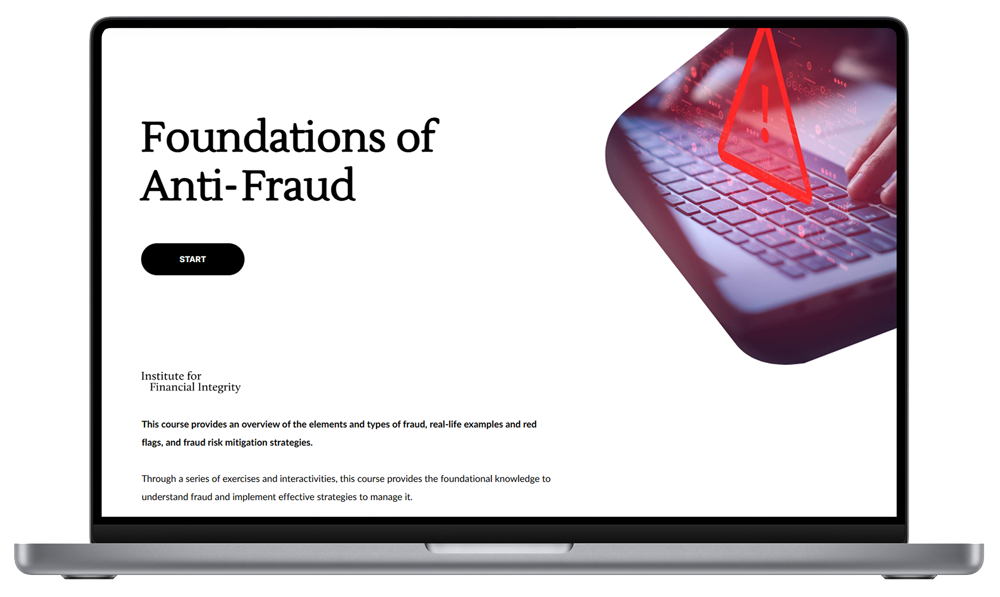
IFI’s Foundation of Anti-Fraud course introduces learners to common fraud schemes, the indicators that may signal fraudulent activity, and approaches to fraud detection and prevention. It provides organizations with an opportunity to build employee awareness and reinforce the role individuals play in identifying and addressing fraud risks.
 https://finintegrity.org/wp-content/uploads/2026/10/loney-hearts-bg.jpg
1350
1800
IFI
https://live-black-pebble.pantheonsite.io/wp-content/uploads/2023/12/GIFI-Placeholder2.png
IFI2026-11-11 07:00:472026-11-09 15:06:13Lonely Hearts, Open Wallets
 https://finintegrity.org/wp-content/uploads/2026/10/Screenshot-2026-10-20-115053.png
1301
2320
IFI
https://live-black-pebble.pantheonsite.io/wp-content/uploads/2023/12/GIFI-Placeholder2.png
IFI2026-11-10 07:00:372026-11-09 13:40:11The Job Offer That Cost Binance $6.3 Billion
 https://finintegrity.org/wp-content/uploads/2026/10/october-2026-sanctions-ser.jpg
680
1200
IFI
https://live-black-pebble.pantheonsite.io/wp-content/uploads/2023/12/GIFI-Placeholder2.png
IFI2026-11-03 07:00:462026-11-03 09:30:08October 2026 Monthly Sanctions and Export Controls Report
 https://finintegrity.org/wp-content/uploads/2026/10/wake-up-call-bg.jpg
1350
1800
IFI
https://live-black-pebble.pantheonsite.io/wp-content/uploads/2023/12/GIFI-Placeholder2.png
IFI2026-10-28 07:00:472026-10-22 14:07:22The $1.2 Billion AML Wake-Up Call
https://finintegrity.org/wp-content/uploads/2026/10/Screenshot-2026-10-20-115053.png
1301
2320
IFI
https://live-black-pebble.pantheonsite.io/wp-content/uploads/2023/12/GIFI-Placeholder2.png
IFI2026-10-21 07:00:052026-10-21 11:26:02Across Borders, Beyond Sight
 https://finintegrity.org/wp-content/uploads/2026/10/bg-expanding-crime.jpg
1357
1800
IFI
https://live-black-pebble.pantheonsite.io/wp-content/uploads/2023/12/GIFI-Placeholder2.png
IFI2026-10-14 07:00:092026-10-05 16:11:03The Expanding Scope of Financial Crime Compliance Training
 https://finintegrity.org/wp-content/uploads/2026/10/bg-september-2026-se-report.jpg
1199
1600
IFI
https://live-black-pebble.pantheonsite.io/wp-content/uploads/2023/12/GIFI-Placeholder2.png
IFI2026-10-06 07:00:462026-10-05 13:03:02September 2026 Monthly Sanctions and Export Controls Report
 https://finintegrity.org/wp-content/uploads/2026/09/bg-the-data-behind-the-payment.jpg
1140
1800
IFI
https://live-black-pebble.pantheonsite.io/wp-content/uploads/2023/12/GIFI-Placeholder2.png
IFI2026-09-30 07:00:312026-09-29 10:35:23The Data Behind the Payment
 https://finintegrity.org/wp-content/uploads/2026/08/judgement-gap-in-market-abuse-compliance-bg.jpg
841
1500
IFI
https://live-black-pebble.pantheonsite.io/wp-content/uploads/2023/12/GIFI-Placeholder2.png
IFI2026-08-25 07:00:462026-08-24 11:34:59The Judgment Gap in Market Abuse Compliance
