Who We Serve: Financial Institutions

Strengthening compliance programs and culture

In recent years, illicit financing risks have expanded in scope, complexity, and significance including across money laundering, terrorist financing, proliferation financing, corruption, and the evasion of sanctions and strategic trade controls.

These risks are increasingly threatening the integrity and security of the international financial system. It is more important than ever for financial institutions to implement training programs to meet elevated compliance and risk management expectations, protect their reputations, and safeguard our collective security.
A Trusted Partner

We partner with global financial centers and institutions to help meet expanding and heightened international standards that govern cross-border financial relationships.

Through a robust suite of solutions, we empower financial institutions to:

  • Equip staff with the expertise, skills, and judgment they need to identify, assess, and manage financial crime and sanctions risks as well as related reputational risks
  • Tailor training programs to the firm’s policies, procedures, and risk appetite to create more effective workflows for addressing financial crime and sanctions risks
  • Adapt training materials to meet the ever-evolving and complex regulatory and policy environment
  • Strengthen enterprise-wide confidence in the management of financial crime and sanctions risk in alignment with the firm’s risk appetite

Since 2015, our training faculty and advisors have brought unparalleled experience and know-how to a range of financial institution training audiences, including compliance officers, boards of directors, senior executives, and first-line and operations employees.

Compliance Courses

Flagship courses offer a seamless solution to meet regulatory requirements

Compliance Courses

Flagship courses offer a seamless solution to meet regulatory requirements

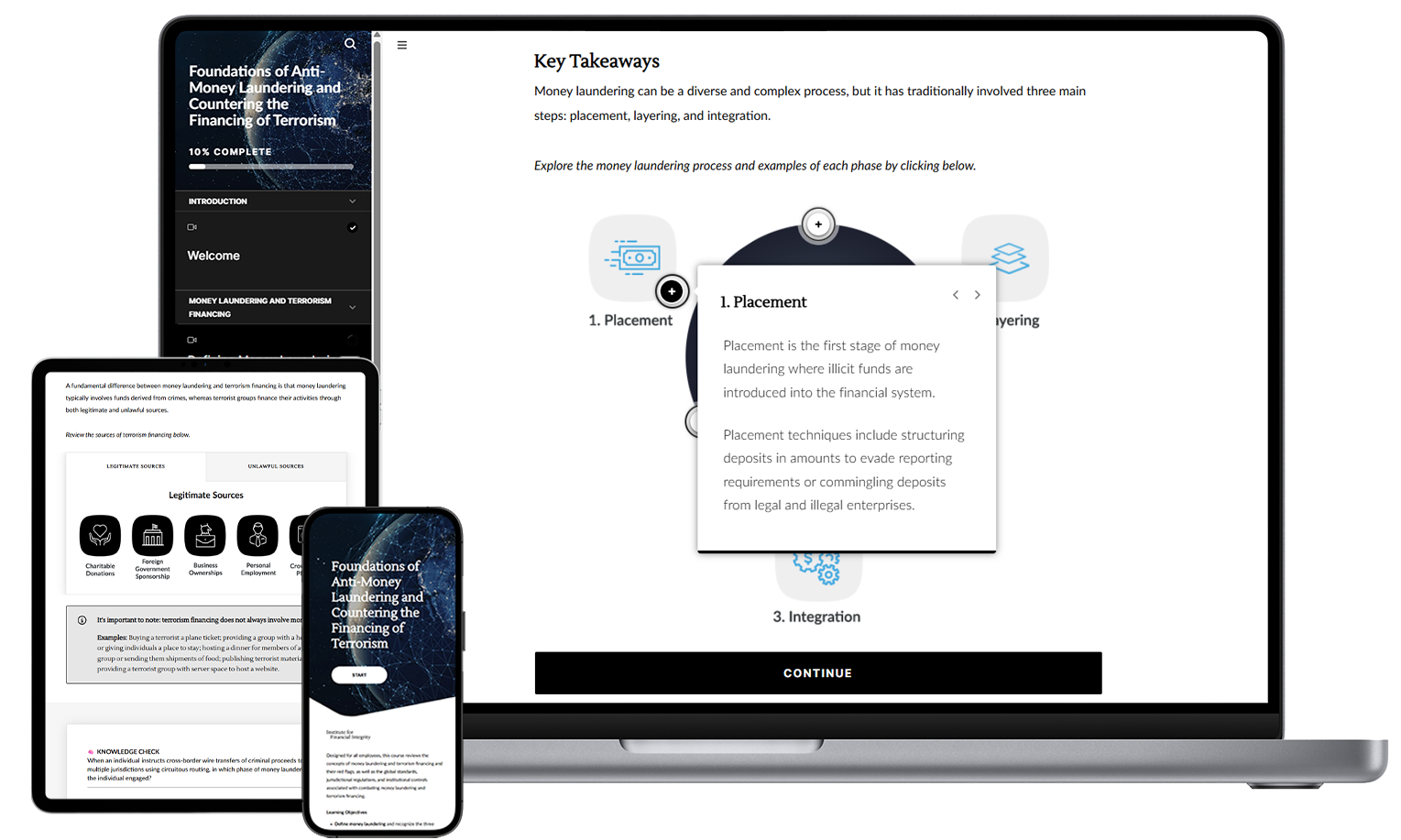
Designed for all employees, this course reviews the concepts of money laundering and terrorism financing and their red flags, as well as the global standards, jurisdictional regulations, and institutional controls associated with combating money laundering and terrorism financing

Through a series of videos and interactivities, learners will gain the foundational knowledge necessary to identify and mitigate financial crime risks, empowering you to contribute to your organization’s compliance efforts and protect the financial system.


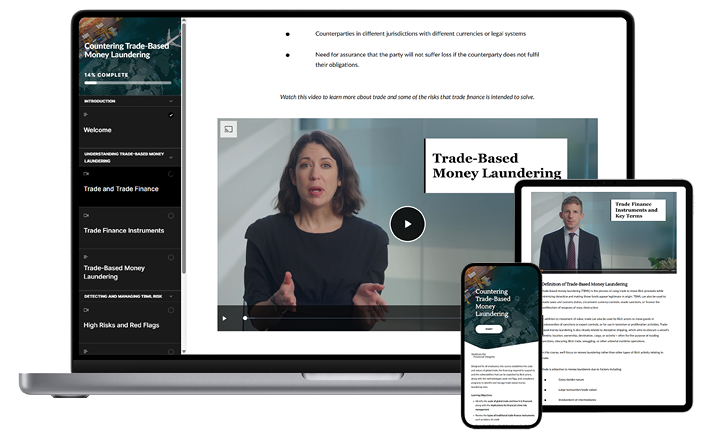
Designed for all employees, this course establishes the scale and nature of global trade, the financing required to support it, and the vulnerabilities that can be exploited by illicit actors, along with the methodologies used, red flags, and compliance programs to identify and manage trade-based money laundering risks.

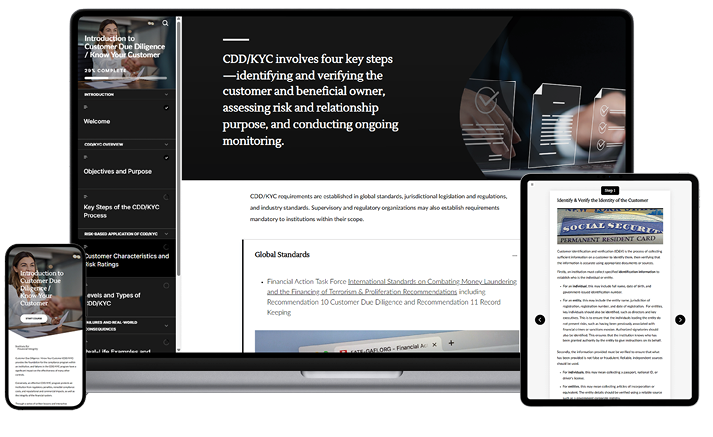
Customer Due Diligence / Know Your Customer (CDD/KYC) provides the foundation for the compliance program within an institution, and failures in the CDD/KYC program have a significant impact on the effectiveness of many other controls.

Conversely, an effective CDD/KYC program protects an institution from regulatory penalties, remedial compliance costs, and reputational and commercial impacts, as well as the integrity of the financial system.

Through a series of written lessons and interactive exercises, this course will equip learners to know your customer and apply due diligence throughout the client lifecycle.


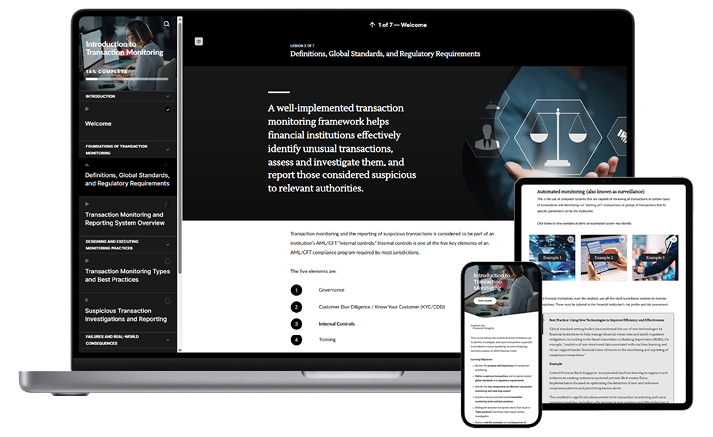
This course reviews the controls financial institutions use to identify, investigate, and report transactions suspected to be linked to money laundering, terrorism financing, sanctions evasion, or other financial crimes.

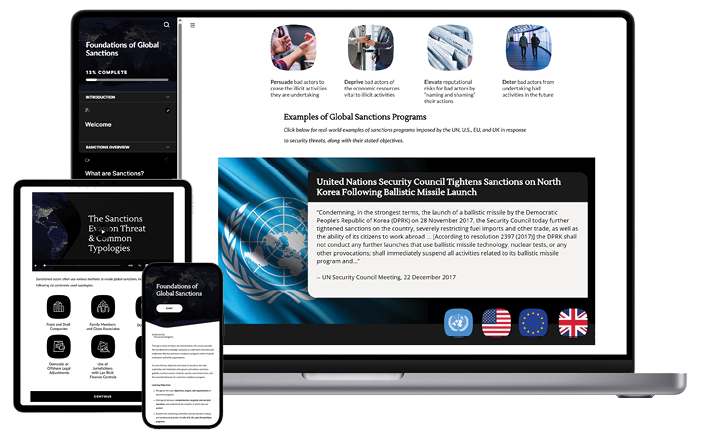
This course is designed to equip compliance professionals with an understanding of global sanctions regimes, their purposes, and impact. Through a series of videos and interactivities, learners will gain the foundational knowledge necessary to navigate global sanctions regimes and implement effective sanctions compliance programs.

This course covers the key objectives and types of sanctions, the main authorities and institutions that govern and enforce sanctions globally, common evasion methods used by sanctioned actors, and the essential elements of a sanctions compliance program.

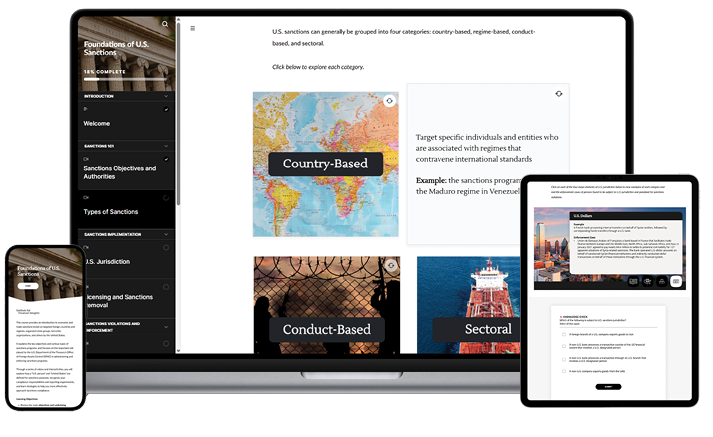
This course is designed to equip compliance professionals with an understanding of global sanctions regimes, their purposes, and impact. Through a series of videos and interactivities, learners will gain the foundational knowledge necessary to navigate global sanctions regimes and implement effective sanctions compliance programs.

This course covers the key objectives and types of sanctions, the main authorities and institutions that govern and enforce sanctions globally, common evasion methods used by sanctioned actors, and the essential elements of a sanctions compliance program.

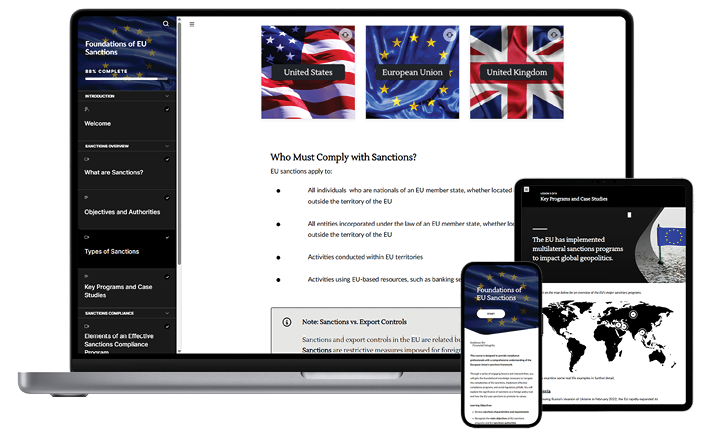
This course is designed to equip compliance professionals with a comprehensive understanding of the European Union’s sanctions framework.

Through engaging lessons, real-world case studies, and interactivities, learners will gain the foundational knowledge necessary to navigate the complexity of EU sanctions, implement effective compliance programs, and avoid regulatory pitfalls. Learners will explore the significance of sanctions as a foreign policy tool and how the EU uses sanctions to promote its values.


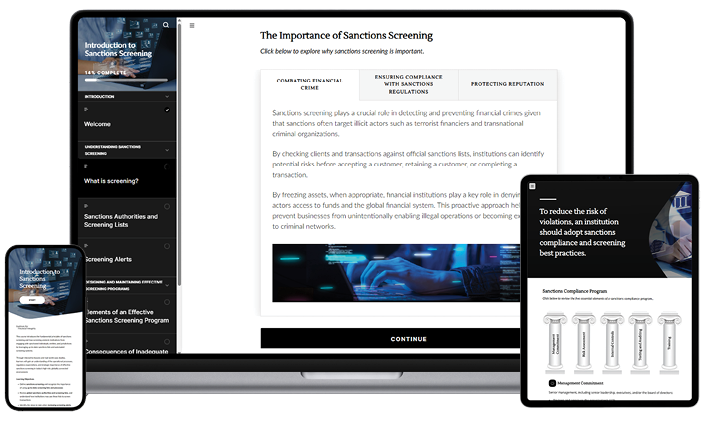
This course introduces the fundamental principles of sanctions screening and how screening protects institutions from engaging with sanctioned individuals, entities, and jurisdictions by leveraging up-to-date sanctions lists and automated screening systems.

Through interactive lessons and real-world case studies, learners will gain an understanding of the operational processes, regulatory expectations, and strategic importance of effective sanctions screening in today’s high-risk, globally connected environment.

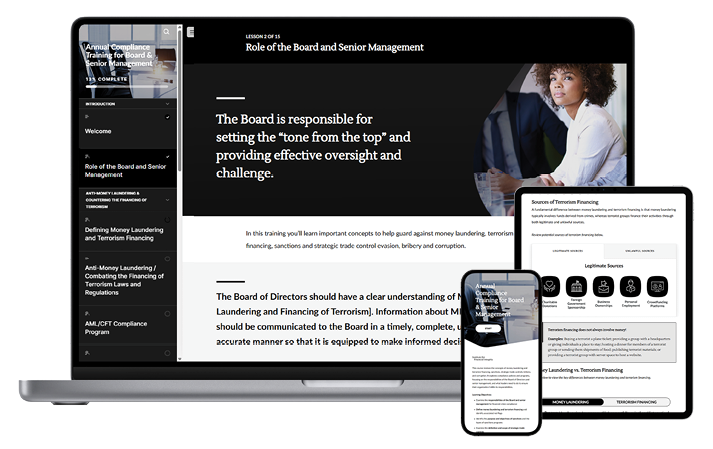
This course reviews the concepts of money laundering and terrorism financing, sanctions, strategic trade controls, bribery, and corruption. It explores compliance policies and programs, focusing on the responsibilities of the Board of Directors and senior management, and what leaders need to do to ensure their organization fulfills its responsibilities.

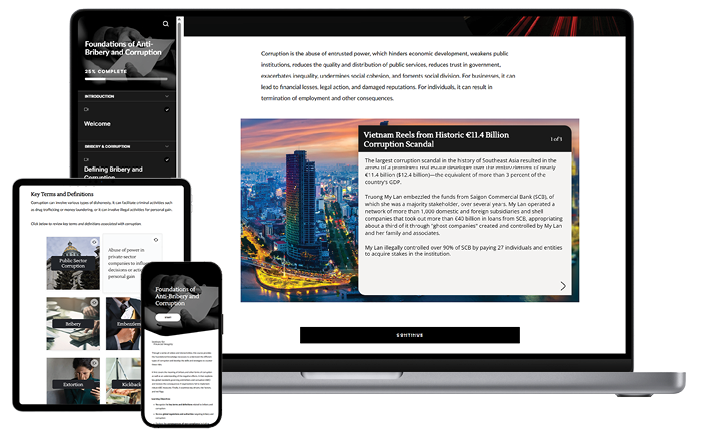
Through a series of videos and interactivities, this course provides the foundational knowledge necessary to understand the different types of corruption and develop the skills and strategies to counter these risks.

It first covers the meaning of bribery and other forms of corruption as well as an understanding of the negative effects. It then explores key global standards governing anti-bribery and corruption (ABC) and reviews the consequences if organizations fail to implement robust ABC measures. Finally, it examines key drivers, risk factors, and red flags.

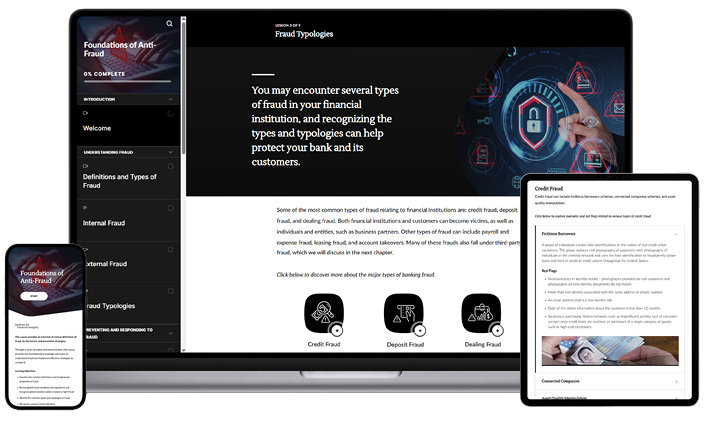
This course provides an overview of the elements and types of fraud, real-life examples and red flags, and fraud risk mitigation strategies.

Through a series of exercises and interactivities, this course provides the foundational knowledge to understand fraud and implement effective strategies to manage it.

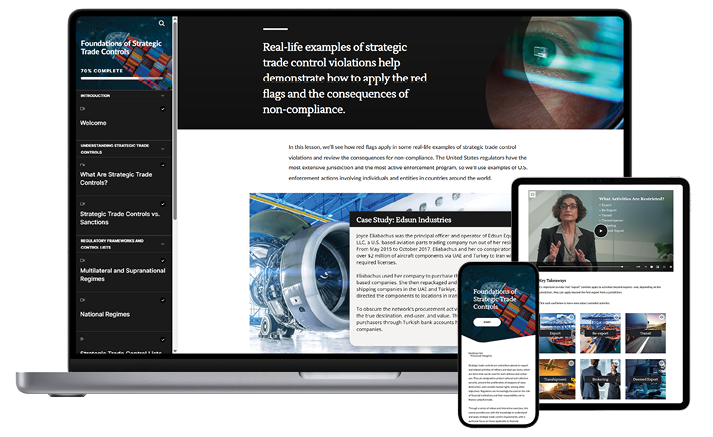
Strategic trade controls are restrictions placed on export and related activities of military and dual-use items, which are items that can be used for both defense and civilian use. They are designed to protect national and collective security, prevent the proliferation of weapons of mass destruction, and consider human rights, among other objectives. Regulators are increasingly focused on the role of financial institutions and their responsibility not to finance unlawful trade.

Through a series of videos and interactive exercises, this course provides learners with the knowledge to understand and apply strategic trade control requirements, with a particular focus on those applicable to financial institutions.


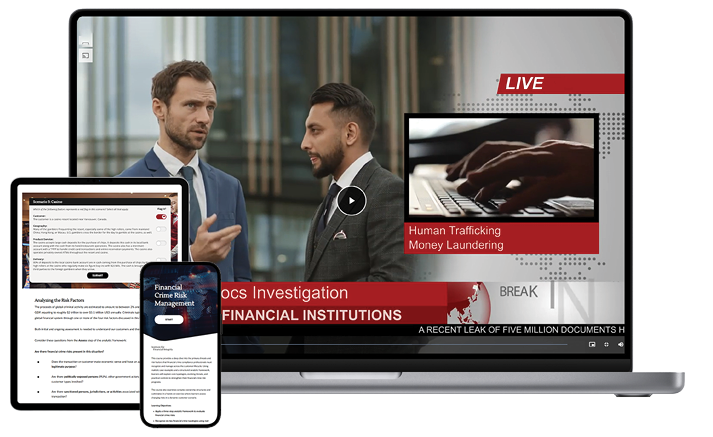
This course explores the primary financial crime threats and risks financial institutions face. Through a series of interactive exercises, you will learn to identify, assess and manage such risks. This course includes lessons on how to recognize red flags, investigate threats, manage risk as a customer’s needs change over time, and map ownership structures.


This course reviews the financial crime risk management challenges associated with current and prospective customers that engage in payments processing.

Through a series of interactive exercises, you will learn the features and risks associated with different types of payment providers and how to identify and assess the payment parties involved in different transactions. You will then apply an analytic framework to effectively identify, assess, and manage the financial crime risks posed by various payment products, systems, and providers.

Certification Programs

Train and certify your audience with rigorous programs designed and delivered by global experts using proprietary analytic frameworks

Acquire and certify your knowledge of foundational, intermediate, and advanced AML/CFT and sanctions issues, and other related financial integrity topics to help protect and advance business operations as well as collective security interests

  • Develop more knowledgeable and flexible teams to better address modern-day financial crimes and sanctions-related risks
  • Increase professional satisfaction among certified employees, thereby contributing to employee retention
  • Better manage real and regulatory risks to protect and enhance the integrity the enterprise and the global financial system

A transformative approach to certification that equips candidates with the expertise, skills, and judgment they need to address global sanctions risks. The online self-study program is designed to help participants:

  • Identify risks related to global sanctions programs and those of jurisdictions with global reach (e.g., UN, U.S., EU, UK)
  • Understand the exposure of jurisdictions, regulated entities, and institutions to sanctions-related risks from global, foreign, and domestic sources
  • Manage sanctions-related risks and exposure from programmatic and case-specific perspectives

Platform

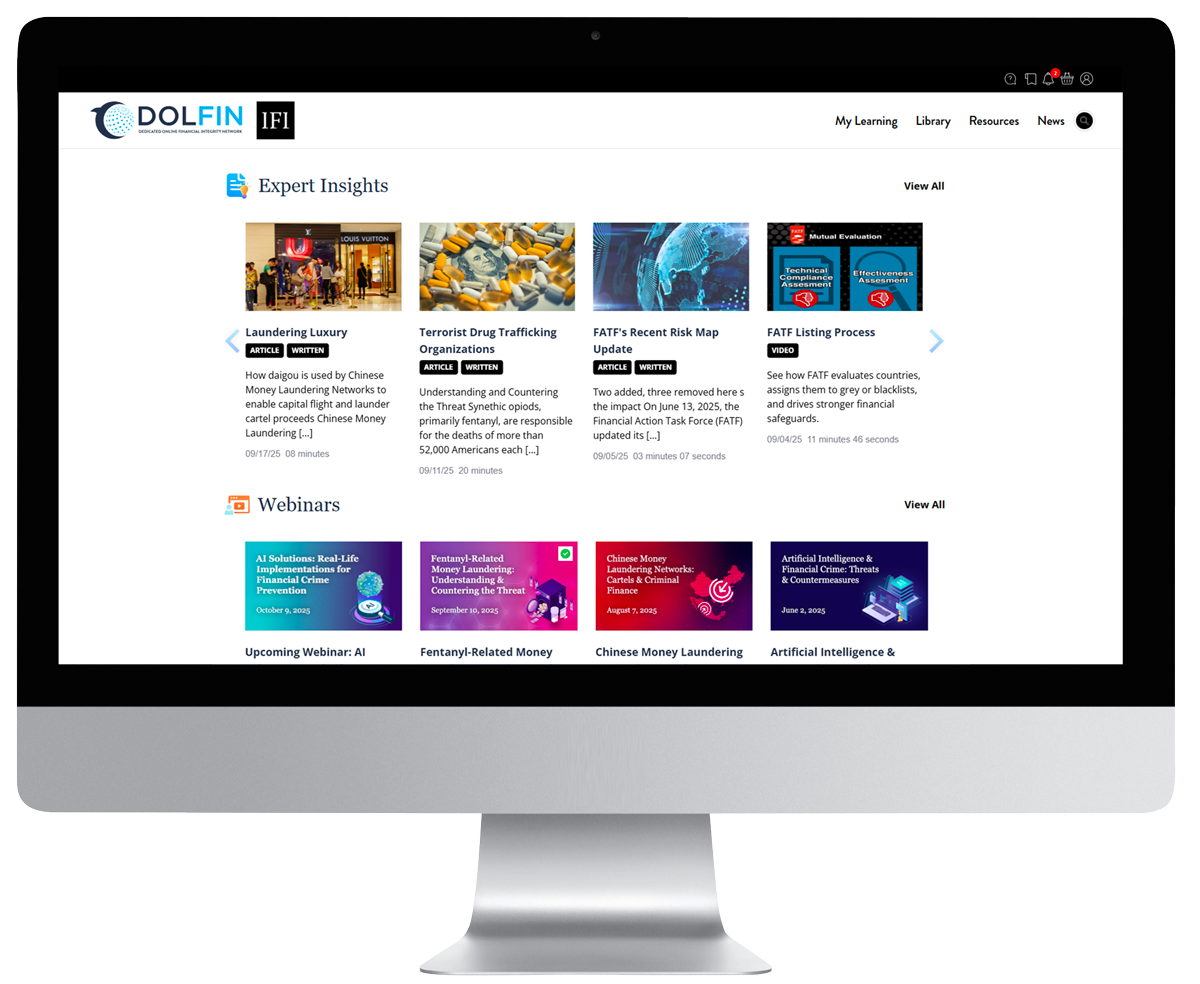
Designed by the framers of the modern global counter-illicit finance regime, the Dedicated Online Financial Integrity Network (DOLFIN) offers a powerful resource for public sector authorities including supervisors, intelligence analysts, investigators, and prosecutors.

Membership grants unlimited access to our extensive resource library, including:

DOLFIN Daily Digest

A daily compilation of international news and regulatory developments of interest to the financial integrity community

Expert Insights

Explore reports on key industry events including comprehensive analysis and assessments

Library

Access user-friendly reference materials across a comprehensive scope of financial integrity subject matter

Toolkit

Track and implement ever-changing regulatory requirements with specially designed applications, like our Red Flags Database and Sanctions Heat Maps

DOLFIN Monthly Newsletter

A monthly publication that highlights new financial integrity trends and regulatory developments, notable enforcement actions, and upcoming events

Webinars

Watch the latest curated lectures and panel discussions led by industry experts

Podcasts

Hear global industry experts address emerging risks and regulatory and policy changes

AskFIN

Generative AI-powered capability provides financial integrity professionals with information, guidance and actionable intelligence

Tailored Training

We provide training, certification, and continuing education services tailored to your organization’s unique requirements.

Our offering of professional education products and services helps financial institutions understand the particular financial crime, sanctions and illicit financing risks they confront and identify comprehensive training requirements that will enable them to address these risks across an ever-evolving landscape.

Partner with our experts to design enterprise-wide training strategies and programs that address risk topics for employees at all levels, helping to build a stronger culture of compliance and sustainable workforce. Please reach out to discuss your needs further.