Report

The Convergence of Sanctions and AML/CFT Regimes

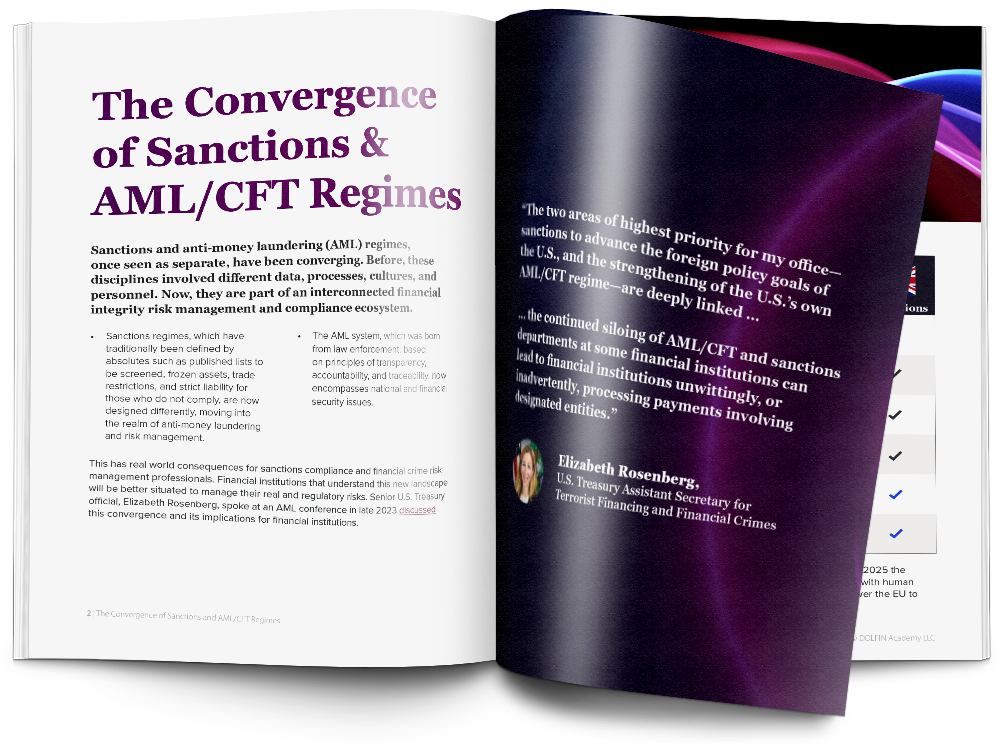
Sanctions and anti-money laundering (AML)/countering the financing of terrorism (CFT) regimes, once seen as separate, have been converging. Before, these disciplines involved different data, processes, cultures, and personnel. Now, they are part of an interconnected financial integrity risk management and compliance ecosystem.

Continue reading in our Expert Insight Report: The Convergence of Sanctions & AML/CFT Regimes in which we discuss the following four main areas of convergence.

  1. Targeting of common conduct
  2. Reliance on common preconditions
  3. Evolution of common compliance program pillars
  4. Emergence of common red flags

Please complete the following form to view the report.

By submitting this form the Institute for Financial Integrity will use the information you have provided here in accordance with our Privacy Policy. By providing your personal information, you agree that Institute for Financial Integrity may use it to contact you by email. If you do not agree to Institute for Financial Integrity using your personal information for this purpose, do not complete this form.

.

Recommended Articles

The Data Behind the Payment

Two changes have raised the bar on what banks can expect to see in a payment. Explore how corporate banks can put ISO 20022 and FATF's revised Recommendation 16 to work in transaction monitoring.

Real Estate, Real Risks

The FATF has identified the global real estate sector as an area requiring heightened attention due to its vulnerabilities to money laundering, terrorism financing, sanctions evasion and other illicit activity. This article explores why property transactions attract financial crime.

Iran and the Sanctions Landscape

Iran has spent nearly five decades under some form of U.S. economic sanctions, and the network built to evade those sanctions is correspondingly mature. Since February 2025, that architecture has come under the most intensive and sustained pressure it has faced since the 2015 nuclear deal.

August Monthly Sanctions and Export Controls Report

Explore this month’s Sanctions and Export Controls Update, highlighting IFI’s take on key developments from August 2026.

The Judgment Gap in Market Abuse Compliance

While banks may know the set of rules outlined in the EU’s Market Abuse Regulation, exposure sits in the judgment calls related to delayed disclosure, information barriers, and market soundings. Dive into where the risk lies in each area.

The Illicit Oil Pipeline: How Criminal Networks Turn Crude into Clean Cash

Money laundering in the oil sector is a highly lucrative global pipeline where illicit networks exploit the massive volume, complex supply chains, and liquid nature of the market. Explore the lifecycle of oil laundering schemes as well as key red flags.

Beyond the Course Library

A comprehensive compliance course library doesn’t guarantee prepared staff. Here's how forward-looking teams are moving beyond static course libraries toward learning that keeps pace with risk.

July Monthly Sanctions and Export Controls Report

Explore this month’s Sanctions and Export Controls Update, highlighting IFI’s take on key developments from July 2026.

A Financial Institution’s Guide to Updated EU Market Abuse Regulation

MAR sounds straightforward until a real case tests it. This guide breaks down what the regulation covers, who it applies to, and the disclosure rules, court rulings, and regulatory guidance that shifted the ground under compliance teams in 2026.