• Link to LinkedIn
  • Link to Youtube
  • Sign In
  • Register
  • Subscribe
  • Contact
Institute for Financial Integrity
  • Training
    • eLearning Courses

      • Suite of interactive e-learning courses to educate and engage staff on core compliance topics

      • Learn More
    • Video Library

      • An online learning journey through the various domains of financial crime, explore our library of expert-led videos

      • Learn More
    • Training Services

      • Trusted compliance training design, development, and delivery tailored to your unique requirements

      • Learn More
    • Certifications
      • Certified Risk Management Specialist – Global Sanctions
      • Certified Financial Integrity Professional Program
  • Technology
    • DOLFIN

      • A platform that equips financial integrity professionals with the continuing education, expert insights, resources and tools needed to protect the integrity of the global financial system.

      • Learn More
    • AskFIN

      • A revolutionary, AI-powered tool seamlessly integrated with DOLFIN® — the world’s largest and most trusted library of curated resources on financial integrity topics.

      • Learn More
  • Insights
    • Insights
      • Articles
      • Reports & White Papers
      • Webinars
      • Subscribe
  • About Us
    • Who We Are
      • Our Story
      • Leadership
      • Press Releases
    • Who We Serve
      • Financial Institutions
      • Jurisdictions
      • Executives
      • Industry Professionals
  • Get a Demo
  • Menu Menu

Lonely Hearts, Open Wallets

What Singles’ Day Reveals About Manufactured Trust

📅 November 11, 2026

Singles’ Day started in China as a student joke holiday for people without partners and is now the biggest online shopping event in the world, with retailers in many other countries running their own 11.11 sales. On the same day, millions of people are reminded that they are single and pushed to act before a deal runs out.

Police in Macao and security firms like Kaspersky put out warnings every year around 11.11, mostly about fake shops and phishing links. Romance fraud gets far less attention, even though it works on the same impulse: someone who has spent weeks talking to a person they now trust is far more likely to act on a tip that comes with a deadline.

That blind spot shows up in the numbers too. The FBI’s Internet Crime Complaint Center recorded about $929 million in romance scam losses in 2025, spread across roughly 23,000 complaints. In the same report, investment fraud cost Americans $8.65 billion. The two figures sit in different rows of the table, but a large share of both comes from the same crime.

How The Scam Has Evolved

Ten years ago, a typical romance scam ended with a request for gift cards, a plane ticket or money for a hospital bill. The current version takes longer and pays far more. Organized groups, many run from scam compounds in Southeast Asia, work on a single target for weeks or months before moving the conversation to cryptocurrency, where the amounts are bigger and the money is much harder to get back.

Singles’ Day is mainly a shopping event, but the surge in online activity around it shows how many ways fraudsters now have to reach people. Dating apps, social media and messaging platforms all give scammers a way in and a way to stay in contact. AI has made the whole operation cheaper to run: the FBI’s 2025 report says scammers now use AI chat tools to write fake profiles and scripts, which lets one operator keep dozens of conversations going at once.

A few factors make these schemes particularly difficult to detect.

  • Convincing fake identities: Fraudsters can use stolen photographs, fabricated biographies, and AI-generated images to make their profiles appear genuine. Some may also use manipulated video or audio to make it harder for victims to question who they are communicating with.
  • Emotional manipulation: Romance scams rely on more than convincing stories. Scammers deliberately build trust and emotional dependence, making victims less likely to question their intentions. Some may even discourage victims from discussing the relationship or financial requests with friends and family.
  • Moving conversations between platforms: Initial contact may take place on a dating application or social media platform before the scammer encourages the victim to move to a private messaging service. This can make the interaction harder to monitor and remove it from platforms where suspicious profiles might otherwise be reported.
  • Different ways of extracting money: Requests may involve bank transfers, gift cards, cryptocurrency, or payments to third-party accounts. In some cases, victims are persuaded to receive and transfer money themselves, unknowingly becoming part of a wider fraud or money laundering operation.

The financial consequences can extend beyond the individual victim, particularly when fraud proceeds move through multiple accounts and payment channels.

The Financial Crime Risks for Financial Institutions

For banks and other financial institutions, romance scams can be difficult to identify because the customer may be making payments voluntarily. Unlike an unauthorized card transaction, the victim may personally initiate and approve each transfer.

However, the activity surrounding these payments can offer clues.

Unusual Payments to New Beneficiaries

A customer who suddenly begins making frequent or high-value transfers to unfamiliar individuals may warrant closer attention, particularly when the payments are inconsistent with their usual activity. Repeated transfers to newly added beneficiaries, unexpected international payments, or sudden changes in transaction patterns may indicate possible financial exploitation.

Rapid Movement of Funds

Some romance scams involve several accounts or payment channels. Money may be transferred from a victim’s account to an intermediary before being moved elsewhere. Where victims are instructed to receive and forward funds, their accounts may also be used to move proceeds of fraud.

Cryptocurrency-Related Transfers

Romance-investment scams often involve cryptocurrency. A victim may be persuaded to make repeated transfers to a virtual asset service provider to fund an investment on a fraudulent platform. Unusual transfers to cryptocurrency exchanges, particularly when accompanied by other indicators of social engineering, may warrant further investigation.

Potential Money Mule Activity

Not every person involved in moving fraudulent funds is aware of what they are doing. Some romance scam victims are persuaded to receive money from other individuals and transfer it onward, sometimes in exchange for a commission. They may believe they are helping a partner or assisting with a legitimate business transaction, when their account is actually being used to move illicit funds.

These indicators should be considered in context. An unusual transfer or payment to a cryptocurrency exchange does not automatically indicate fraud. The customer’s transaction history, circumstances, and other available information should inform any decision to investigate or intervene.

What Financial Institutions Can Do to Reduce the Risk

Identifying romance scams requires more than monitoring transactions. Employees also need to understand how these schemes work and why customers may not recognize that they are being deceived.

There are several practical steps institutions can take:

  • Train customer-facing staff. Frontline employees are often in a position to notice unusual payment behavior or hear explanations that raise concerns. They should understand common romance scam tactics and know how to approach customers who may be sending money under pressure or emotional manipulation.
  • Review transaction monitoring rules. Fraud and AML teams should consider whether existing monitoring scenarios capture patterns such as repeated transfers to new beneficiaries, rapid movement of funds, and unusual payments to virtual asset service providers.
  • Improve coordination between fraud and AML teams. Romance scams can generate both fraud and money laundering concerns. Sharing information between these functions can help institutions identify connections between individual transactions, beneficiary accounts, and wider networks involved in moving fraudulent proceeds.
  • Intervene when payments raise concerns. When a transaction appears unusual, employees should be equipped to ask appropriate questions and explain the risks without immediately assuming the customer is acting fraudulently. A well-timed conversation may prevent a customer from losing money they cannot recover.
  • Keep customer education relevant. General warnings about online fraud are useful, but customers also need to understand how romance scams actually work. Institutions can use targeted communications to explain common tactics, including requests for emergency payments, pressure to move conversations off-platform, and unsolicited investment advice from online contacts.

Institutions that train for this conversation catch cases earlier and usually keep the customer, even after delaying or blocking a payment. Those that rely on monitoring alone are up against a scheme designed so that every payment looks like something the customer chose to do.

Fraud Awareness for Staff and Customers

Singles’ Day lasts one day. The groups behind these scams work all year and change tactics faster than most policies get updated. The Institute for Financial Integrity’s Foundations of Anti-Fraud course trains frontline and oversight teams to spot fraud built on manipulation and to step in before the payment goes through.
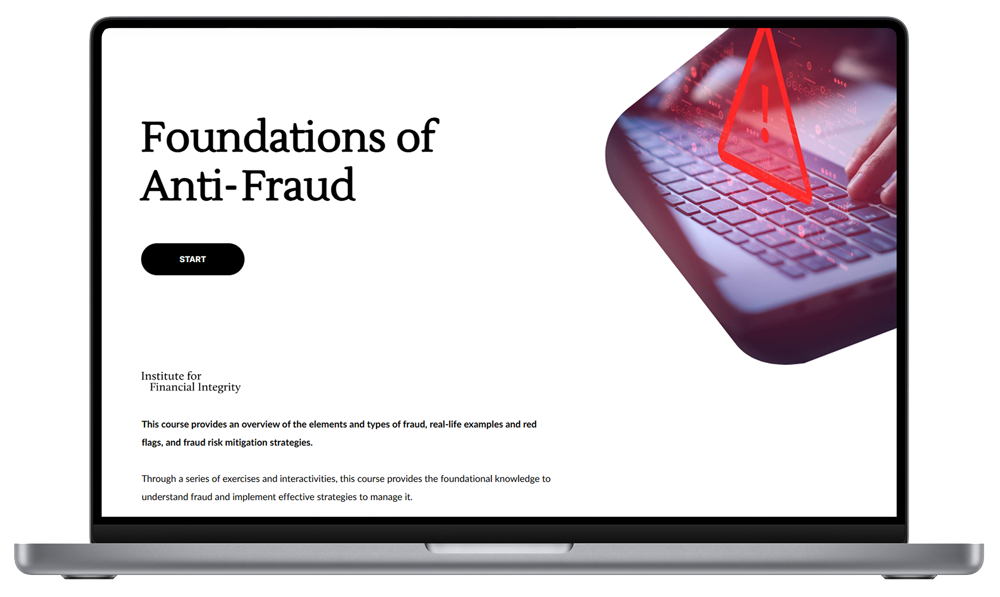

Learn more about Foundations of Anti-Fraud

Recommended Blogs

The Job Offer That Cost Binance $6.3 Billion

November 10, 2026
Examine the October 29, 2026 Binance hack including how attackers used a sophisticated social engineering scheme to compromise an employee and gain access to critical systems.
Read more
https://finintegrity.org/wp-content/uploads/2026/10/Screenshot-2026-10-20-115053.png 1301 2320 IFI https://live-black-pebble.pantheonsite.io/wp-content/uploads/2023/12/GIFI-Placeholder2.png IFI2026-11-10 07:00:372026-11-09 13:40:11The Job Offer That Cost Binance $6.3 Billion

October 2026 Monthly Sanctions and Export Controls Report

November 3, 2026
Explore this month’s Sanctions and Export Controls Update, highlighting IFI’s take on key developments from October 2026.
Read more
https://finintegrity.org/wp-content/uploads/2026/10/october-2026-sanctions-ser.jpg 680 1200 IFI https://live-black-pebble.pantheonsite.io/wp-content/uploads/2023/12/GIFI-Placeholder2.png IFI2026-11-03 07:00:462026-11-03 09:30:08October 2026 Monthly Sanctions and Export Controls Report
The $1.2 Billion AML Wake-Up Call

October 28, 2026
FinCEN’s $1.2 billion penalty against Bank of America highlights significant gaps in transaction monitoring, suspicious activity reporting, and customer due diligence. Explore key findings from the enforcement action and what they mean for strengthening compliance controls.
Read more
https://finintegrity.org/wp-content/uploads/2026/10/wake-up-call-bg.jpg 1350 1800 IFI https://live-black-pebble.pantheonsite.io/wp-content/uploads/2023/12/GIFI-Placeholder2.png IFI2026-10-28 07:00:472026-10-22 14:07:22The $1.2 Billion AML Wake-Up Call

Across Borders, Beyond Sight

October 21, 2026
Cross-border payments power the global economy, but they also create opportunities for financial crime. Explore key areas of exposure and how leading institutions are gaining greater visibility into the payment chain.
Read more
https://finintegrity.org/wp-content/uploads/2026/10/Screenshot-2026-10-20-115053.png 1301 2320 IFI https://live-black-pebble.pantheonsite.io/wp-content/uploads/2023/12/GIFI-Placeholder2.png IFI2026-10-21 07:00:052026-10-21 11:26:02Across Borders, Beyond Sight

The Expanding Scope of Financial Crime Compliance Training

October 14, 2026
There is a global shift toward integrating proliferation financing as a distinct threat alongside money laundering and terrorist financing. Discover what this means for enterprise-wide training at financial institutions.
Read more
https://finintegrity.org/wp-content/uploads/2026/10/bg-expanding-crime.jpg 1357 1800 IFI https://live-black-pebble.pantheonsite.io/wp-content/uploads/2023/12/GIFI-Placeholder2.png IFI2026-10-14 07:00:092026-10-05 16:11:03The Expanding Scope of Financial Crime Compliance Training

September 2026 Monthly Sanctions and Export Controls Report

October 6, 2026
Explore this month’s Sanctions and Export Controls Update, highlighting IFI’s take on key developments from September 2026.
Read more
https://finintegrity.org/wp-content/uploads/2026/10/bg-september-2026-se-report.jpg 1199 1600 IFI https://live-black-pebble.pantheonsite.io/wp-content/uploads/2023/12/GIFI-Placeholder2.png IFI2026-10-06 07:00:462026-10-05 13:03:02September 2026 Monthly Sanctions and Export Controls Report

The Data Behind the Payment

September 30, 2026
Two changes have raised the bar on what banks can expect to see in a payment. Explore how corporate banks can put ISO 20022 and FATF's revised Recommendation 16 to work in transaction monitoring.
Read more
https://finintegrity.org/wp-content/uploads/2026/09/bg-the-data-behind-the-payment.jpg 1140 1800 IFI https://live-black-pebble.pantheonsite.io/wp-content/uploads/2023/12/GIFI-Placeholder2.png IFI2026-09-30 07:00:312026-09-29 10:35:23The Data Behind the Payment
The Judgment Gap in Market Abuse Compliance

August 25, 2026
While banks may know the set of rules outlined in the EU’s Market Abuse Regulation, exposure sits in the judgment calls related to delayed disclosure, information barriers, and market soundings. Dive into where the risk lies in each area.
Read more
https://finintegrity.org/wp-content/uploads/2026/08/judgement-gap-in-market-abuse-compliance-bg.jpg 841 1500 IFI https://live-black-pebble.pantheonsite.io/wp-content/uploads/2023/12/GIFI-Placeholder2.png IFI2026-08-25 07:00:462026-08-24 11:34:59The Judgment Gap in Market Abuse Compliance

Beyond the Course Library

August 12, 2026
A comprehensive compliance course library doesn’t guarantee prepared staff. Here's how forward-looking teams are moving beyond static course libraries toward learning that keeps pace with risk.
Read more
https://finintegrity.org/wp-content/uploads/2026/08/beyond-the-course-library-bg.jpg 1060 1800 IFI https://live-black-pebble.pantheonsite.io/wp-content/uploads/2023/12/GIFI-Placeholder2.png IFI2026-08-12 07:00:232026-08-11 12:42:07Beyond the Course Library
Previous Previous Previous Next Next Next
Download IFI Compliance Checklist Report

Follow Us on LinkedIn

Share this article

  • Share on LinkedIn
  • Share by Mail

Recent Articles

  • Lonely Hearts, Open Wallets
  • The Job Offer That Cost Binance $6.3 Billion
  • Qi Card Expands Financial Crime Compliance Training with IFI as Regional Presence Grows
  • October 2026 Monthly Sanctions and Export Controls Report
  • The $1.2 Billion AML Wake-Up Call

Explore Other Topics

  • Artificial Intelligence
  • Compliance Best Practices
  • Corruption
  • Digital Assets
  • Drug Trafficking
  • European Union
  • Fraud
  • Human Trafficking
  • Money Laundering
  • Oil and Gas
  • Press Releases
  • Proliferation Finance
  • Regulation
  • Russia
  • Sanctions
  • Strategic Trade Controls / Export Controls
  • Terrorism

View Our Expert Insights

  • Compliance Training Readiness Checklist
  • Inside the Cartels and Chinese Money Laundering Networks Driving Criminal Economies
  • High Stakes – Casinos, Crime, and Cartels
  • From Cost Center to Risk Control
  • Leveraging Artificial Intelligence for Enhanced Financial Compliance
  • The Convergence of Sanctions and AML/CFT Regimes
  • Casinos and Cryptocurrency Driving Illicit Finance in East and Southeast Asia
  • Russia 2024: The Two-Year Anniversary of the Invasion
  • Human Trafficking Crisis after Russia’s Invasion of Ukraine
  • 2024 Trends Report
© DOLFIN Academy LLC 2026
  • Link to LinkedIn
  • Link to Youtube
  • Privacy Policy
Link to: The Job Offer That Cost Binance $6.3 Billion Link to: The Job Offer That Cost Binance $6.3 Billion The Job Offer That Cost Binance $6.3 Billion
Scroll to top Scroll to top Scroll to top

This site uses cookies. By continuing to browse the site, you are agreeing to our use of cookies.

Accept settingsHide notification onlySettings

Cookie and Privacy Settings


How we use cookies

We may request cookies to be set on your device. We use cookies to let us know when you visit our websites, how you interact with us, to enrich your user experience, and to customize your relationship with our website.

Click on the different category headings to find out more. You can also change some of your preferences. Note that blocking some types of cookies may impact your experience on our websites and the services we are able to offer.

Essential Website Cookies

These cookies are strictly necessary to provide you with services available through our website and to use some of its features.

Because these cookies are strictly necessary to deliver the website, refusing them will have impact how our site functions. You always can block or delete cookies by changing your browser settings and force blocking all cookies on this website. But this will always prompt you to accept/refuse cookies when revisiting our site.

We fully respect if you want to refuse cookies but to avoid asking you again and again kindly allow us to store a cookie for that. You are free to opt out any time or opt in for other cookies to get a better experience. If you refuse cookies we will remove all set cookies in our domain.

We provide you with a list of stored cookies on your computer in our domain so you can check what we stored. Due to security reasons we are not able to show or modify cookies from other domains. You can check these in your browser security settings.

Google Analytics Cookies

These cookies collect information that is used either in aggregate form to help us understand how our website is being used or how effective our marketing campaigns are, or to help us customize our website and application for you in order to enhance your experience.

If you do not want that we track your visit to our site you can disable tracking in your browser here:

Other external services

We also use different external services like Google Webfonts, Google Maps, and external Video providers. Since these providers may collect personal data like your IP address we allow you to block them here. Please be aware that this might heavily reduce the functionality and appearance of our site. Changes will take effect once you reload the page.

Google Webfont Settings:

Google Map Settings:

Google reCaptcha Settings:

Vimeo and Youtube video embeds:

Privacy Policy

You can read about our cookies and privacy settings in detail on our Privacy Policy Page.

Privacy Policy
Accept settingsHide notification only