Beneath the Shine
Financial Crime Risks in the Precious Metals and Stones Trade
📅 November 18, 2026

Precious metals and stones have long played an important role in global commerce, valued for their rarity, durability, industrial applications, cultural significance, and enduring appeal as stores of wealth. Gold, silver, platinum, diamonds, and other precious commodities are traded worldwide, serving everything from manufacturing and jewelry production to wealth preservation and investment diversification.
Their high value relative to their physical size, combined with their ability to be bought, sold, transported, and held across borders, makes them attractive assets for legitimate investors and businesses alike. Yet these same characteristics can also create vulnerabilities that criminals seek to exploit.
The same characteristics that make precious metals and stones attractive to legitimate markets can also make them attractive to those seeking to move, store, or conceal illicit wealth.
These vulnerabilities can manifest in several forms of financial crime, from laundering illicit proceeds and concealing beneficial ownership to facilitating corruption, smuggling, terrorism financing, and sanctions evasion.
Money Laundering and Concealed Ownership
Criminals may use proceeds from fraud, corruption, drug trafficking, or other illicit activity to purchase precious metals and stones, then sell or transfer them through legitimate markets. The resulting proceeds may appear to originate from ordinary commercial activity rather than the underlying crime. Multiple dealers, brokers, companies, and jurisdictions can further obscure the transaction trail.
Companies and other legal structures can also conceal the individuals who ultimately own or control a business. Suppliers or customers may operate through holding companies, trusts, nominees, agents, or networks of intermediaries. Understanding beneficial ownership, the source of funds, and the commercial rationale for transactions is therefore essential to assessing risk.
Corruption and Bribery
The extraction, transportation, licensing, import, export, and sale of valuable commodities can involve significant government interaction. Licenses, mining rights, customs processes, tax assessments, inspections, permits, and other regulatory decisions may create opportunities for bribery and corruption. These practices may also facilitate the concealment of a commodity’s true origin or ownership, allowing illicit materials to enter legitimate supply chains.
Smuggling and Trade-Based Financial Crime
The physical nature of precious metals and stones creates opportunities for smuggling and other forms of trade-based financial crime. Commodities may be misrepresented, undervalued, overvalued, falsely documented, or moved through jurisdictions that make their origin or ownership difficult to establish.
Terrorism and Conflict Financing
Supply chains can intersect with terrorism financing, conflict financing, and organized crime. In areas with weak governance or limited state control, criminal organizations, armed groups, or other illicit actors may participate in mining, transportation, or trade. Revenue can help finance continued criminal or armed activity. For businesses sourcing from high-risk regions, understanding the broader context surrounding a supply chain can therefore be as important as understanding the immediate customer or supplier.
Sanctions Evasion
Sanctioned individuals, companies, and networks may use intermediaries, front companies, alternative trading routes, or third-country jurisdictions to maintain access to markets and move value. Where commodities are sourced, processed, sold, or financed across multiple jurisdictions, businesses may need to consider not only the immediate counterparty, but also beneficial owners, intermediaries, source countries, destination countries, and other parties involved in the transaction.
The complexity of the precious metals and stones trade makes a risk-based approach particularly important. Businesses should consider risk across multiple dimensions, including the customer, supplier, product, transaction, geography, delivery route, payment method, and source of the commodity.
Customer and supplier due diligence should go beyond simply confirming that a business exists. Depending on the risk, organizations may need to understand beneficial ownership and control, the nature of the counterparty’s business, source of funds, source of wealth, expected transaction activity, and the provenance of the commodities involved.
Supply-chain due diligence is equally important. Where appropriate, businesses should seek to understand where commodities originated, who handled them along the way, how they were transported, where they were processed, and whether documentation supports the stated chain of custody.
This does not mean that every transaction requires the same level of investigation. A risk-based approach allows organizations to focus enhanced scrutiny and resources where the potential exposure is greatest.
Understanding how precious metals and stones can be exploited is an important first step in protecting the integrity of the sector.
Effective compliance depends not only on policies and systems, but also on the people responsible for applying them. Employees need to understand the financial crime risks relevant to their roles, recognize meaningful red flags, understand when additional due diligence may be appropriate, and know how to escalate concerns.
For dealers, refiners, manufacturers, wholesalers, retailers, financial institutions, and other businesses connected to the precious metals and stones trade, practical training can help translate complex global risks into decisions employees can recognize and act upon.v
At IFI, we specialize in developing practical, risk-based compliance training programs that help organizations understand the evolving threats they face and the measures needed to counter them.
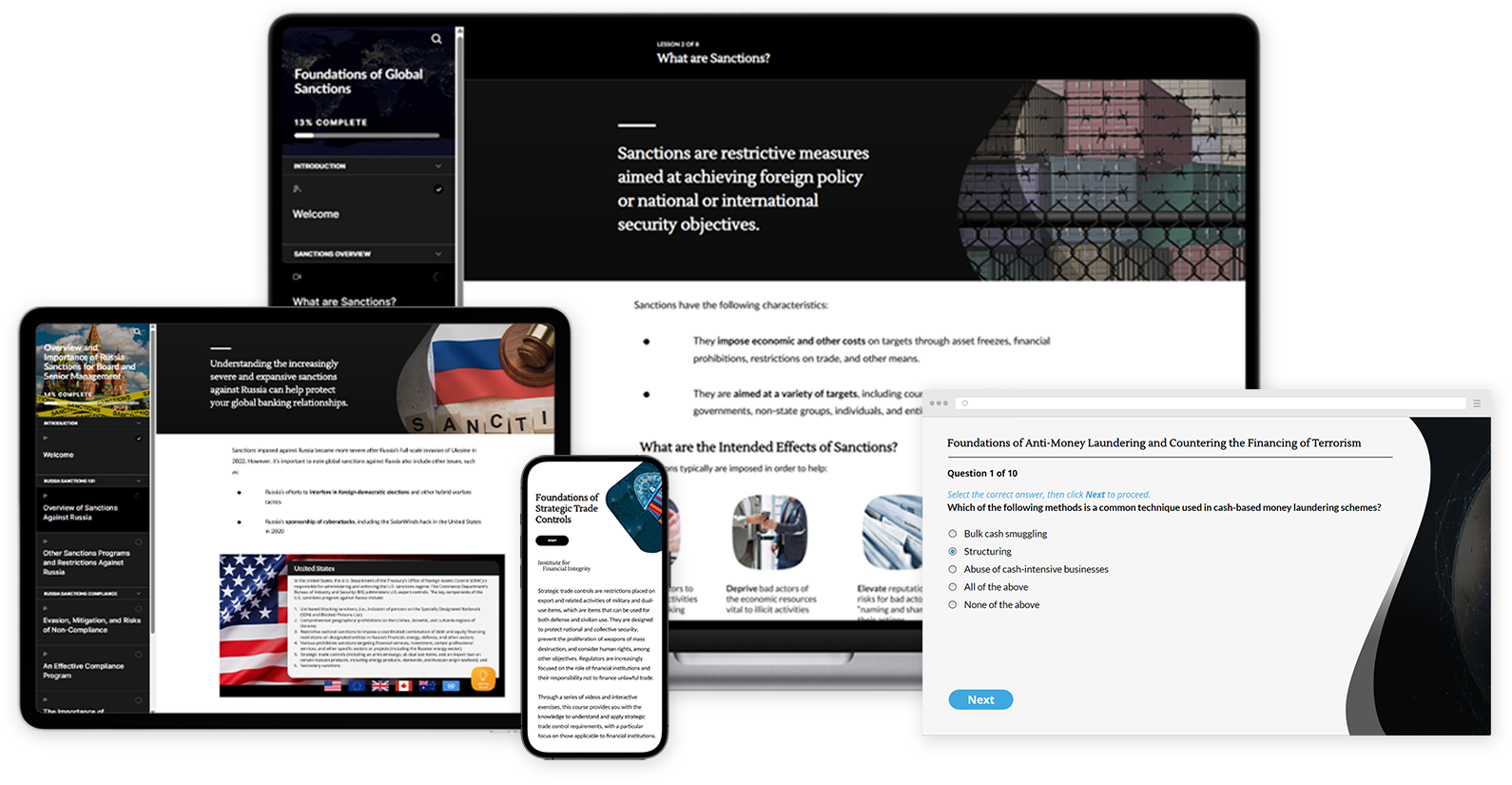
Our expert-led training equips professionals with the knowledge and practical skills to recognize financial crime risks, strengthen due diligence, and apply effective controls. Through tailored content, engaging instruction, and a focus on real-world application, we help organizations translate regulatory expectations into meaningful, effective compliance practices.
 https://finintegrity.org/wp-content/uploads/2026/11/navigating-iran-sanctions-bg.png
800
1200
IFI
https://live-black-pebble.pantheonsite.io/wp-content/uploads/2023/12/GIFI-Placeholder2.png
IFI2026-11-16 07:00:502026-11-16 10:46:21Navigating Iran Sanctions Risk Across the Gulf
 https://finintegrity.org/wp-content/uploads/2026/10/october-2026-sanctions-ser.jpg
680
1200
IFI
https://live-black-pebble.pantheonsite.io/wp-content/uploads/2023/12/GIFI-Placeholder2.png
IFI2026-11-03 07:00:462026-11-03 09:30:08October 2026 Monthly Sanctions and Export Controls Report
 https://finintegrity.org/wp-content/uploads/2026/10/wake-up-call-bg.jpg
1350
1800
IFI
https://live-black-pebble.pantheonsite.io/wp-content/uploads/2023/12/GIFI-Placeholder2.png
IFI2026-10-28 07:00:472026-10-22 14:07:22The $1.2 Billion AML Wake-Up Call
 https://finintegrity.org/wp-content/uploads/2026/10/Screenshot-2026-10-20-115053.png
1301
2320
IFI
https://live-black-pebble.pantheonsite.io/wp-content/uploads/2023/12/GIFI-Placeholder2.png
IFI2026-10-21 07:00:052026-10-21 11:26:02Across Borders, Beyond Sight
 https://finintegrity.org/wp-content/uploads/2026/10/bg-expanding-crime.jpg
1357
1800
IFI
https://live-black-pebble.pantheonsite.io/wp-content/uploads/2023/12/GIFI-Placeholder2.png
IFI2026-10-14 07:00:092026-10-05 16:11:03The Expanding Scope of Financial Crime Compliance Training
 https://finintegrity.org/wp-content/uploads/2026/10/bg-september-2026-se-report.jpg
1199
1600
IFI
https://live-black-pebble.pantheonsite.io/wp-content/uploads/2023/12/GIFI-Placeholder2.png
IFI2026-10-06 07:00:462026-10-05 13:03:02September 2026 Monthly Sanctions and Export Controls Report
 https://finintegrity.org/wp-content/uploads/2026/09/bg-the-data-behind-the-payment.jpg
1140
1800
IFI
https://live-black-pebble.pantheonsite.io/wp-content/uploads/2023/12/GIFI-Placeholder2.png
IFI2026-09-30 07:00:312026-09-29 10:35:23The Data Behind the Payment
 https://finintegrity.org/wp-content/uploads/2026/09/shutterstock_2645005987-scaled.jpg
1706
2560
IFI
https://live-black-pebble.pantheonsite.io/wp-content/uploads/2023/12/GIFI-Placeholder2.png
IFI2026-09-24 07:00:302026-09-24 11:44:27Dirty Barrels
 https://finintegrity.org/wp-content/uploads/2026/09/real-estate-risk.jpg
614
1000
IFI
https://live-black-pebble.pantheonsite.io/wp-content/uploads/2023/12/GIFI-Placeholder2.png
IFI2026-09-17 12:40:222026-09-17 20:35:41Real Estate, Real Risks
