Real Estate, Real Risks
Why Property Transactions Attract Financial Crime
📅 September 17, 2026

Real estate is a significant component of the global economy and a common vehicle for investment, wealth preservation, and economic development. It is also vulnerable to abuse by money launderers, terrorist financiers, sanctions evaders, and individuals and networks seeking to circumvent proliferation financing and trade control restrictions.
The Financial Action Task Force (FATF), the global standard-setting body for anti-money laundering and countering the financing of terrorism, has identified the real estate sector as an area requiring heightened attention. In its Risk-Based Approach Guidance for the Real Estate Sector, published in July 2022, the FATF notes that real estate is a popular investment choice but can also attract criminals seeking to use property in illicit activities or to launder the proceeds of crime.
Real estate can enable criminal networks to preserve and grow illicit wealth, generate apparently legitimate income, and establish a façade of financial legitimacy. In some jurisdictions, the misuse of real estate may also contribute to rising property prices, reduced housing accessibility, and increased incentives for criminal activity.
Real estate is attractive to criminals because it offers multiple ways to conceal, preserve, transfer, and potentially legitimize illicit wealth. Its high value, complex ownership structures, international reach, and potential to generate income can make property particularly useful in sophisticated financial crime schemes.
Store of Value
High-value properties can absorb substantial amounts of illicit funds and allow criminals to preserve wealth in tangible assets. Property may also generate rental income, appreciate over time, or be used as collateral for additional financing.
Ownership of real estate can further create an appearance of financial success, stability, and legitimacy, particularly when the property is held through an apparently reputable company or individual.
Integration Mechanism
Criminal proceeds that have already entered the financial system may be invested in real estate and subsequently reintroduced into the legitimate economy through transactions such as property sales, rentals, mortgage financing, or development projects.
For example, illicit funds may be used to purchase a property, finance renovations, or support a development project. Subsequent rental income, refinancing, or resale proceeds may then appear to represent legitimate investment returns, making it more difficult to identify the original criminal source of the funds.
Concealment of Ownership and Control
Real estate can be acquired or held through legal entities, nominees, family members, intermediaries, trusts, or layered ownership structures that obscure the identity of the individuals who ultimately own or control the property.
The involvement of multiple entities, jurisdictions, or representatives may make it difficult to establish who is providing the funds, who benefits from the transaction, and who ultimately exercises control over the asset.
Cross-Border Value Transfer
Real estate transactions can facilitate the movement of wealth across jurisdictions. Funds originating in one country may be used to acquire property in another, creating additional complexity around the source of funds, beneficial ownership, tax residency, and the purpose of the investment.
Foreign companies, offshore structures, international financing arrangements, and cross-border transfers may further complicate efforts to identify the individuals ultimately controlling the assets or assess the legitimacy of the transaction.
Legitimization of Illicit Wealth
Rental income, capital gains, refinancing proceeds, and property sale proceeds can create an appearance of lawful income or investment returns. Where the underlying acquisition or financing was funded with criminal proceeds, these subsequent transactions may help obscure the origin of the wealth and integrate it into the formal economy.
Real estate may therefore serve not only as a destination for illicit funds, but also as a mechanism through which criminal proceeds are transformed into apparently legitimate assets and income.
Understanding why real estate attracts illicit actors is an important first step. Effective training helps translate that understanding into the knowledge and practical skills needed to recognize risk and apply appropriate controls.
FATF assessments have identified persistent weaknesses in the sector’s understanding of money laundering and terrorist financing risks, as well as shortcomings in the measures implemented to mitigate them. Effective customer due diligence, beneficial ownership identification, ongoing monitoring, and risk-based controls are therefore essential to reducing the sector’s exposure.
For real estate agents and brokers, as well as financial institutions involved in property transactions, training can strengthen awareness of emerging threats, improve the recognition of suspicious activity, and support the consistent application of risk-based controls. In doing so, it contributes to protecting the integrity of the financial system and the legitimate real estate market.
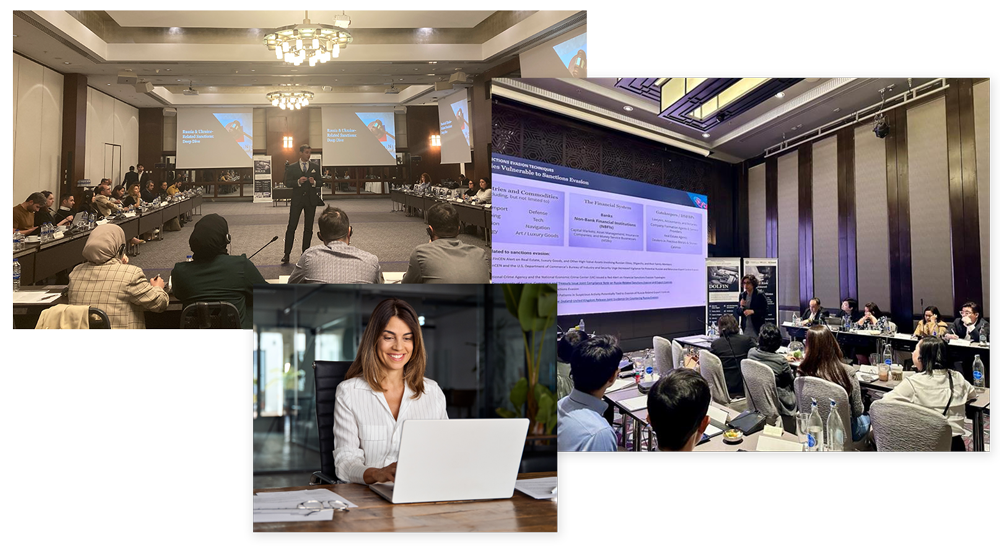
At IFI, we specialize in developing practical, risk-based compliance training programs that help organizations understand the evolving threats they face and the measures needed to counter them. Through tailored content and a focus on real-world application, we equip learners with the knowledge and practical skills to recognize financial crime risks, strengthen due diligence, and apply effective controls.
 https://finintegrity.org/wp-content/uploads/2026/10/bg-september-2026-se-report.jpg
1199
1600
IFI
https://live-black-pebble.pantheonsite.io/wp-content/uploads/2023/12/GIFI-Placeholder2.png
IFI2026-10-06 07:00:462026-10-05 13:03:02September 2026 Monthly Sanctions and Export Controls Report
https://finintegrity.org/wp-content/uploads/2026/10/bg-september-2026-se-report.jpg
1199
1600
IFI
https://live-black-pebble.pantheonsite.io/wp-content/uploads/2023/12/GIFI-Placeholder2.png
IFI2026-10-06 07:00:462026-10-05 13:03:02September 2026 Monthly Sanctions and Export Controls Report https://finintegrity.org/wp-content/uploads/2026/09/bg-the-data-behind-the-payment.jpg
1140
1800
IFI
https://live-black-pebble.pantheonsite.io/wp-content/uploads/2023/12/GIFI-Placeholder2.png
IFI2026-09-30 07:00:312026-09-29 10:35:23The Data Behind the Payment
https://finintegrity.org/wp-content/uploads/2026/09/bg-the-data-behind-the-payment.jpg
1140
1800
IFI
https://live-black-pebble.pantheonsite.io/wp-content/uploads/2023/12/GIFI-Placeholder2.png
IFI2026-09-30 07:00:312026-09-29 10:35:23The Data Behind the Payment https://finintegrity.org/wp-content/uploads/2026/09/iran-and-sanctions-landscape-bg.jpg
1013
1800
IFI
https://live-black-pebble.pantheonsite.io/wp-content/uploads/2023/12/GIFI-Placeholder2.png
IFI2026-09-10 07:00:352026-09-17 20:21:30Iran and the Sanctions Landscape
https://finintegrity.org/wp-content/uploads/2026/09/iran-and-sanctions-landscape-bg.jpg
1013
1800
IFI
https://live-black-pebble.pantheonsite.io/wp-content/uploads/2023/12/GIFI-Placeholder2.png
IFI2026-09-10 07:00:352026-09-17 20:21:30Iran and the Sanctions Landscape https://finintegrity.org/wp-content/uploads/2026/09/august-2026-se-report-bg.jpg
888
1184
IFI
https://live-black-pebble.pantheonsite.io/wp-content/uploads/2023/12/GIFI-Placeholder2.png
IFI2026-09-02 07:00:562026-09-01 13:19:24August Monthly Sanctions and Export Controls Report
https://finintegrity.org/wp-content/uploads/2026/09/august-2026-se-report-bg.jpg
888
1184
IFI
https://live-black-pebble.pantheonsite.io/wp-content/uploads/2023/12/GIFI-Placeholder2.png
IFI2026-09-02 07:00:562026-09-01 13:19:24August Monthly Sanctions and Export Controls Report https://finintegrity.org/wp-content/uploads/2026/08/oil-pipeline-bg.jpg
1000
1500
IFI
https://live-black-pebble.pantheonsite.io/wp-content/uploads/2023/12/GIFI-Placeholder2.png
IFI2026-08-19 07:00:062026-08-19 00:07:14The Illicit Oil Pipeline: How Criminal Networks Turn Crude into Clean Cash
https://finintegrity.org/wp-content/uploads/2026/08/oil-pipeline-bg.jpg
1000
1500
IFI
https://live-black-pebble.pantheonsite.io/wp-content/uploads/2023/12/GIFI-Placeholder2.png
IFI2026-08-19 07:00:062026-08-19 00:07:14The Illicit Oil Pipeline: How Criminal Networks Turn Crude into Clean Cash https://finintegrity.org/wp-content/uploads/2026/08/july2026-se-bg.jpg
1177
1800
IFI
https://live-black-pebble.pantheonsite.io/wp-content/uploads/2023/12/GIFI-Placeholder2.png
IFI2026-08-04 07:00:452026-08-04 09:42:02July Monthly Sanctions and Export Controls Report
https://finintegrity.org/wp-content/uploads/2026/08/july2026-se-bg.jpg
1177
1800
IFI
https://live-black-pebble.pantheonsite.io/wp-content/uploads/2023/12/GIFI-Placeholder2.png
IFI2026-08-04 07:00:452026-08-04 09:42:02July Monthly Sanctions and Export Controls Report https://finintegrity.org/wp-content/uploads/2026/06/june2026-se-report-bg.jpg
798
1200
IFI
https://live-black-pebble.pantheonsite.io/wp-content/uploads/2023/12/GIFI-Placeholder2.png
IFI2026-07-01 07:00:392026-07-02 10:28:58June 2026 Sanctions and Export Controls Report
https://finintegrity.org/wp-content/uploads/2026/06/june2026-se-report-bg.jpg
798
1200
IFI
https://live-black-pebble.pantheonsite.io/wp-content/uploads/2023/12/GIFI-Placeholder2.png
IFI2026-07-01 07:00:392026-07-02 10:28:58June 2026 Sanctions and Export Controls Report https://finintegrity.org/wp-content/uploads/2026/06/may-bg-2026-se.jpg
1200
1800
IFI
https://live-black-pebble.pantheonsite.io/wp-content/uploads/2023/12/GIFI-Placeholder2.png
IFI2026-06-03 07:00:142026-06-02 14:36:12May 2026 Sanctions and Export Controls Update
https://finintegrity.org/wp-content/uploads/2026/06/may-bg-2026-se.jpg
1200
1800
IFI
https://live-black-pebble.pantheonsite.io/wp-content/uploads/2023/12/GIFI-Placeholder2.png
IFI2026-06-03 07:00:142026-06-02 14:36:12May 2026 Sanctions and Export Controls Update https://finintegrity.org/wp-content/uploads/2026/05/april-bg-2026-se.jpg
1348
1800
IFI
https://live-black-pebble.pantheonsite.io/wp-content/uploads/2023/12/GIFI-Placeholder2.png
IFI2026-05-05 07:00:332026-05-06 13:57:33April 2026 Monthly Sanctions and Export Controls Report
https://finintegrity.org/wp-content/uploads/2026/05/april-bg-2026-se.jpg
1348
1800
IFI
https://live-black-pebble.pantheonsite.io/wp-content/uploads/2023/12/GIFI-Placeholder2.png
IFI2026-05-05 07:00:332026-05-06 13:57:33April 2026 Monthly Sanctions and Export Controls Report
 Dirty Barrels