Terrorist Drug Trafficking Organizations
Understanding and Countering the Threat
📅 September 11, 2025
This article was written by IFI for the September/October 2025 issue of the ABA Risk and Compliance Magazine. Reproduced with permission.

Synethic opiods, primarily fentanyl, are responsible for the deaths of more than 52,000 Americans each year,1 with drug overdoses being the leading cause of death for those aged 18-44 years old.2 In 2024, U.S. financial institutions (FIs) reported approximately $1.4 billion in suspicious transactions potentially linked to fentanyl-related activities, including precursor chemical procurement, fentanyl trafficking, and associated money laundering.3 Moreover, the trade in fentanyl and other illicit drugs drives violence, criminality, bribery, and corruption globally.
The Trump Administration has made combating the illegal production and trafficking of fentanyl a top priority. It has declared a national emergency with respect to the threat posed by drug cartels and implemented a policy of “total elimination” of their presence in the United States.4 In February 2025, the State Department designated six Mexican drug cartels as Foreign Terrorist Organizations (FTOs)5 and the Treasury Department, Drug Enforcement Administration (DEA), Homeland Security Investigations (HSI), Federal Bureau of Investigations (FBI), Customs and Border Protection (CBP), and Department of Justice have coordinated on a “whole-of-government” effort to use all available tools to relentlessly target the cartels and their support networks.6
FIs have a vital role to play in this effort. This article provides background on designated cartels — their geographic reach, how they raise and move money, the risks they pose to financial institutions, and common red flags that may help identify suspicious activity.
According to the DEA, the two most important FTOs are the Sinaloa and Jalisco Cartels: they are at the heart of the fentanyl crisis and have a presence in almost every state in America.7 In Mexico, they are based out of the states from which they derive their names (Sinaloa and Jalisco) but they exercise control and influence beyond those areas, including at multiple maritime ports, to help facilitate their shipments and raise revenue. In addition, the “big two” cartels operate extensive global supply chains, from precursor chemicals to production facilities, and direct complex networks that include international shippers, cross-border transporters, corrupt officials, tunnel builders, shell companies, and money launderers.
The Gulf Cartel and Northeast Cartel are both based in the Mexican state of Tamaulipas, which is in the northeastern corner of Mexico bordering Texas.
The New Family Michoacana and United Cartels are based in the Mexican state of Michoacán and have been locked in an ongoing battle with the Jalisco Cartel to control drug trafficking routes running through the state and their share in local illicit economies, including drug production and the extortion of avocado producers.
To view detailed maps of fentanyl trafficking operations in Mexico by cartel, please see pages 8–16 of the 2025 National Drug Threat Assessment published by the Drug Enforcement Administration. The full PDF is available here.
For a visual overview, see Figure 1 for 2024 fentanyl seizures along major U.S. drug trafficking corridors. For details on cartel operations in both the U.S. and Mexico — including their areas of control, sources of funding, and money laundering methods — see Figure 2.
Figure 1. Fentanyl Seizures along the 10 Most-Traveled U.S. Interstates, by weight, 2024
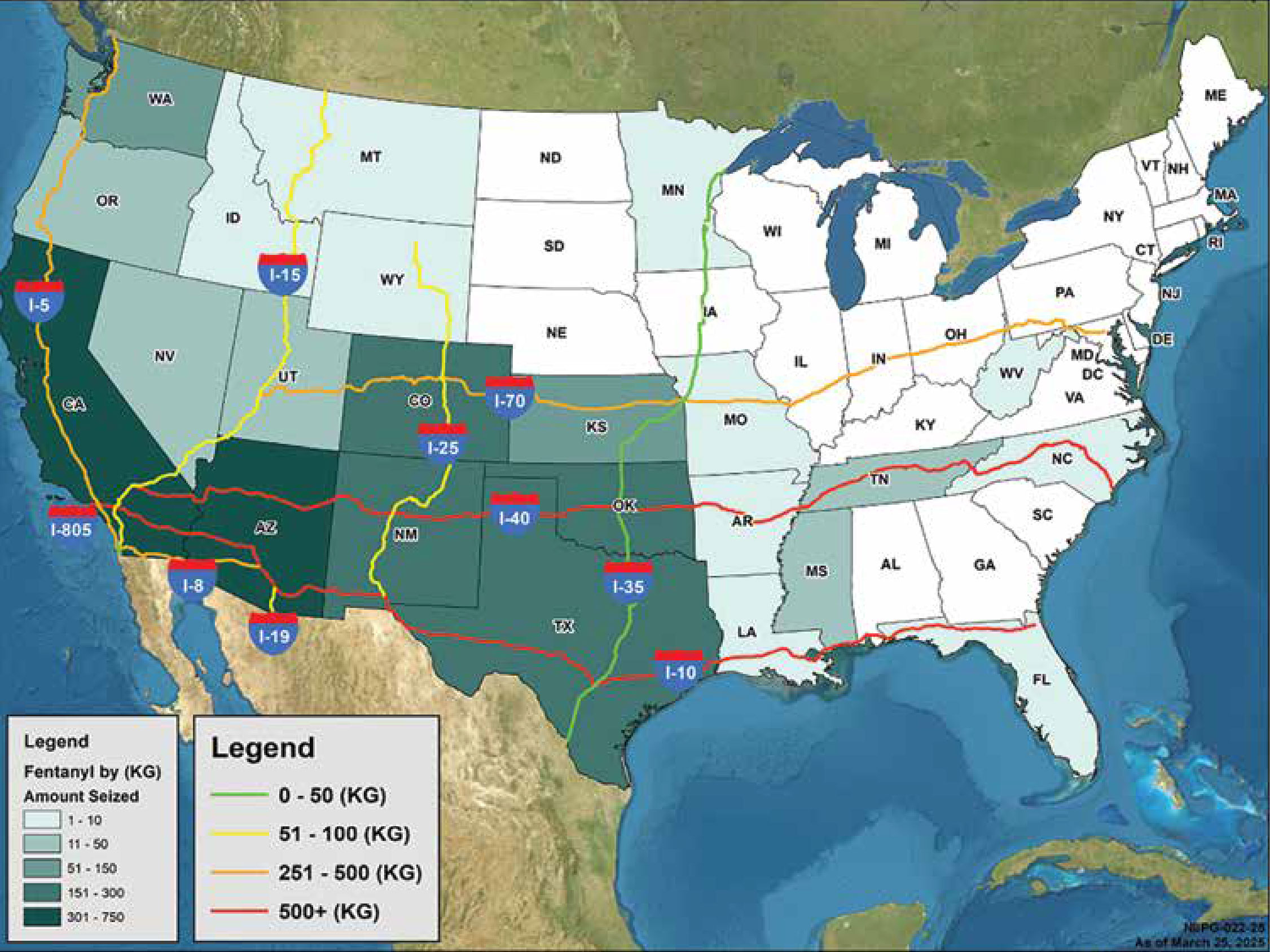
Source: El Paso Intelligence Center, National Seizure System
Distribution and sale of narcotics in the United States generates significant volumes of cash for cartels, which they seek to launder and repatriate to the cartel in countries such as Mexico. Recently, Chinese Money Laundering Networks (CMLNs) have emerged as the leading “service provider” to launder these illicit funds. CMLNs service a growing demand from Chinese nationals to access U.S. dollars in the United States, which are otherwise restricted by the $50,000 limitation imposed by the Chinese government to restrict capital flight. Capital flight from China was estimated at $516 billion in 2024.14 The high volumes of cash generated by narcotics trafficking and other cartel activities, provide a key supply of USD cash. Cartels need to dispose of U.S. dollars and Chinese nationals want to acquire them. (See Mirror Transfers: How Cartels and CMLNs Move Money Across borders below.)
Significantly, by using this method each currency stays within its own country: USD stay in the United States, RMB in China, and pesos in Mexico. The implication of using these “mirror transfers” is that they do not use cross-border payments — which are considered by many FIs as an indicator that can be used to identify “higher risk” activity. FIs must therefore ensure they consider other indicators to identify risks of cartel and CMLN activity.
Cartels and Chinese underground banking networks use “mirror transfers” — a form of informal value transfer — to move drug proceeds across borders quietly without using traditional wire transfers, minimizing the possibility of triggering financial reporting systems. Here’s how it works:
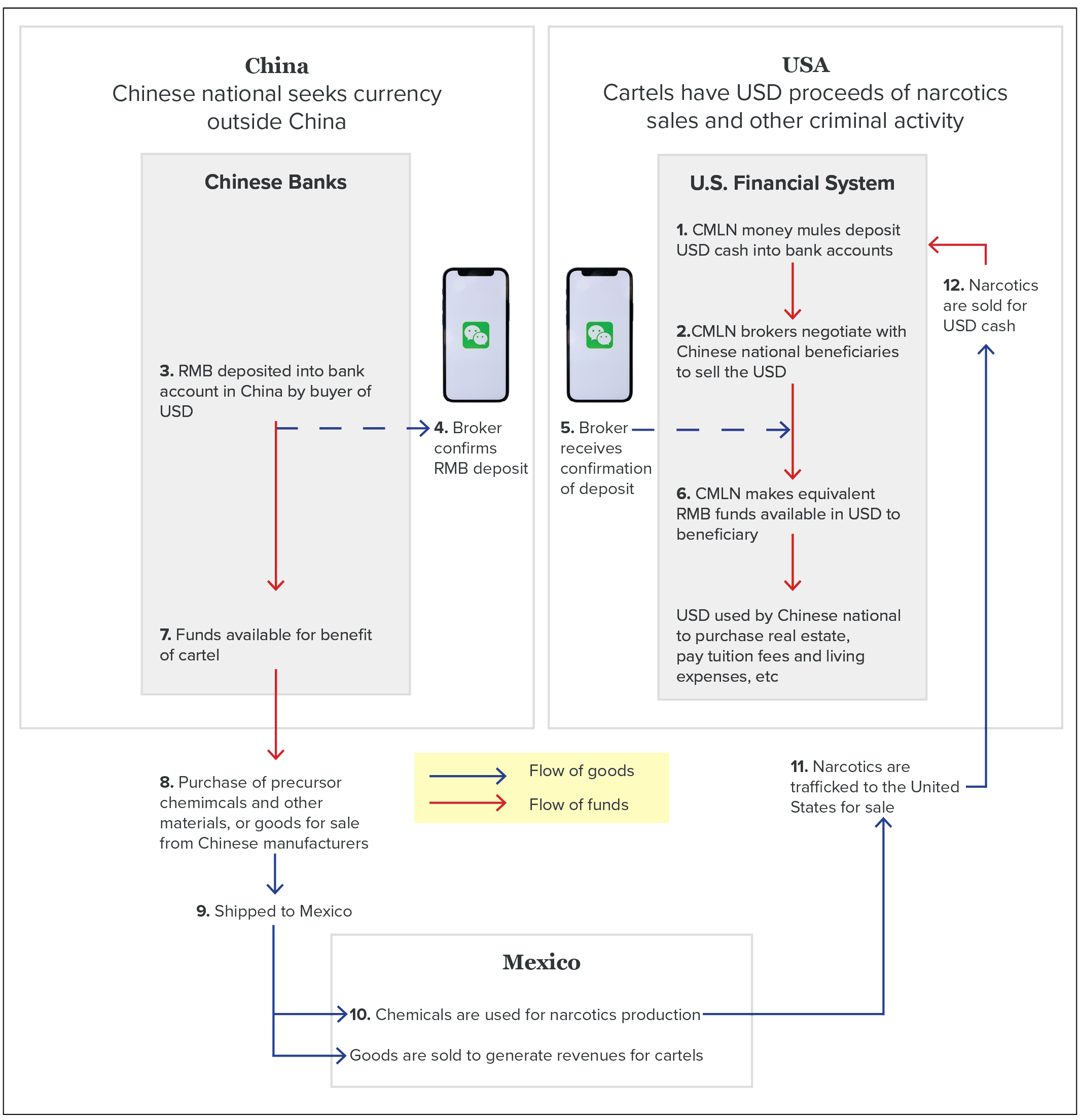
Drug cartels generate large amounts of U.S. dollar proceeds from narcotics sales and other criminal activity. Money mules working for Chinese money laundering networks (CMLNs) deposit this cash into U.S. bank accounts — often in small amounts to avoid detection.
CMLN brokers in the U.S. connect with Chinese nationals who want access to U.S. dollars (e.g., to pay tuition, buy real estate, or cover living expenses in the U.S.). The brokers offer to sell them these cartel-originated dollars.
The Chinese national (or their representative) deposits the equivalent amount in Chinese yuan (RMB) into a bank account in China — usually held by someone working with the broker.
Using apps like WeChat, the broker confirms the RMB deposit has been made. This communication happens outside the formal financial system and is difficult for regulators to trace.
Once the RMB deposit is confirmed, the broker provides the agreed amount in U.S. dollars to the beneficiary in the U.S. nominated by the Chinese national. The dollars are now “clean” from the perspective of the recipient and can be used for everyday expenses or investments.
Meanwhile, the cartel — through its relationships with the broker — now has access to funds in China. These funds were never officially transferred, but the value was moved.
The cartel uses these funds to purchase fentanyl precursors, lab equipment, or other goods from Chinese suppliers.
The materials are exported from China to Mexico as commercial goods, with no indication that they are part of a money laundering scheme.
The chemicals are used to produce fentanyl or other narcotics in Mexico. Imported goods unrelated to fentanyl production are also sold to generate revenue as part of traditional trade-based money laundering schemes.
The finished drugs are smuggled into the U.S. and sold, restarting the cycle. No cross-border wire transfers occurred — only goods and informal settlements — making detection extremely difficult.
This system enables cartels to repurpose U.S. drug proceeds, fund further production, and meet demand from wealthy Chinese nationals for offshore currency — all while minimizing reliance on formal banking channels, wire transfers, and paperwork that would alert regulators. It’s a highly efficient, low-visibility method of laundering money across borders.
There are also other laundering methods used, including use of digital assets, trade-based money laundering using electronics and luxury goods, cross-border cash smuggling, and laundering through money services businesses and banks.15
The red flags that can be identified by FIs in this case include:
The red flags that can be identified by FIs in this case include:
The red flags that can be identified by FIs in this case include:
Figure 2. Cartel Operations
| Foreign Terrorist Organization | Operational Areas in Mexico | Operational Areas in USA | Sources of Funding | Money Laundering Methods |
|---|---|---|---|---|
Sinaloa Cartel | • Sinaloa • Sonora • Chihuahua • Durango • Others • Port of Mazatlan | Almost all 50 states, most notably: • Arizona • California • Florida • Georgia • Illinois • Texas | • Drug trafficking • Fuel theft / Oil smuggling • Extortion • Human smuggling • Prostitution • Weapons trafficking • Wildlife trafficking • Prostitution | • Chinese money laundering networks • Shell companies and front businesses, such as restaurants, real estate, and agriculture • Bulk cash smuggling • Cryptocurrency exploitation • Trade-based money laundering • Structuring |
Jalisco Cartel | • Jalisco • Colima • Guerrero • Michoacán • Guanajuato • Others • Ports of Manzanillo, Lázaro Cárdenas, and Veracruz | Almost all 50 states, most notably: • California • Colorado • Florida • Georgia • Illinois • Missouri • Texas | • Drug trafficking • Fuel theft / Oil smuggling • Services fees at ports • Extortion of farmers • Human smuggling • Weapons trafficking • Real estate schemes | • Chinese money laundering networks • Shell companies and front businesses • Real estate investments • Trade-based money laundering • Cryptocurrency exploitation • Money service businesses • Structuring • Bulk cash smuggling |
Gulf Cartel | • Tamaulipas • Nuevo Leon • Coahuila • Veracruz • Mexico City • Others • Port of Altamira | ~16 states, including: • California • Nebraska • New York • Oklahoma • Pennsylvania • Texas • Virginia • Upper Midwest • Southeastern US | • Drug trafficking • Human smuggling • Fuel theft / Oil smuggling • Kidnapping • Extortion • Illegal fishing • Arms trafficking • Counterfeit products | • Bulk cash smuggling • Shell companies and front businesses • Money service businesses • Trade-based money laundering • Structuring • Properties and vehicles • Gas stations |
Northeast Cartel | • Tamaulipas • Nuevo Leon • Zacatecas • Mexico City • Others | • Texas • Georgia • Oklahoma • Upper Midwest | • Drug trafficking • Human smuggling • Kidnapping • Extortion • Fuel theft / Oil smuggling • Vehicle theft • Prostitution • Armed robbery | • Shell companies and front businesses • Trade-based money laundering • Cash-intensive businesses • Horse-racing business • Extortion |
New Michoacán Family | • Michoacán • Guerrero • Port of Lázaro Cárdenas (contested with Jalisco Cartel) | ~1/3 of US states, including: Texas • New Mexico • North Carolina • Georgia | • Drug trafficking • Kidnapping • Extortion • Human smuggling • Illegal mining • Weapons smuggling | • Shell companies and front businesses • Trade-based money laundering, including through used clothing stores • Bulk cash smuggling • Money services businesses • Extortion |
United Cartel | • Michoacán, especially Tepalcatepec | • ~1/3 of US states | • Drug trafficking • Illicit economies across Michoacán’s Tierra Caliente region • Extortion, primarily of lime and avocado farmers | • Unknown |
FIs play a crucial role in countering the threat posed by cartels and CMLNs by assisting law enforcement and other government authorities to identify and disrupt these networks, and preventing illicit actors from accessing and laundering illicit funds. To do so, FIs should take the following actions:
Figure 3. AML Tools for Cartel and Fentanyl Threats
| Organization | Publication | Description |
|---|---|---|
| HSI | Cornerstone (Ongoing) | Monthly newsletter produced by DHS’s Homeland Security Investigations (HSI) to spread awareness about how criminals launder illicit proceeds. Often features case studies, trends, typologies, and red flags associated with cartel-related money laundering. |
| DEA | National Drug Threat Assessment (May 2025) | A comprehensive strategic assessment of illicit drug threats endangering the U.S., including detailed profiles of the terrorism-designated cartels and an overview on the methods by which their illicit proceeds are laundered. Note: The 2024 NDTA contains additional details on the Sinaloa and Jalisco cartels and their money laundering methods. |
| FinCEN | Alert on Bulk Cash Smuggling and Repatriation by Mexico-Based TCOs (March 2025) | Provides an overview of methodologies used by cartels to smuggle, launder, and repatriate bulk cash using Mexican business, usually with locations near the U.S. southwest border. Includes red flag indicators and SAR filing instructions. |
| FinCen | Supplemental Advisory on Procurement of Fentanyl Precursor Chemicals and Manufacturing Equipment (June 2024) | Highlights the primary typologies and red flags associated with how Mexico-based cartels purchase fentanyl precursor chemicals, pill presses, die molds, and other manufacturing equipment primarily from companies in China, and includes SAR filing instructions. |
| Treasury | National Money Laundering Risk Assessment (February 2024) | Includes sections with case studies on money laundering threats involving proceeds generated from trafficking fentanyl and other illicit drugs, the Sinaloa and Jalisco cartels, and CMLNs |
| US District Court for the Central District of California | First Superseding Indictment No. 2:23-cr-524(A)-DMG USA v. Edgar Martinez-Reyez et al. (October 2023) | Indictment with detailed narrative explaining how money laundering organizations fueling the drug trade in the U.S. — including through traditional TBML and Chinese underground banking — and description of how a network of 24 defendants conspired to assist the Sinaloa Cartel conceal and launder their drug proceeds. |
| FATF | Money Laundering from Fentanyl and Synthetic Opioids (November 2022) | Report based on input from multiple jurisdictions including common money laundering typologies as well as examples based on investigation and prosecution case studies |
| Congressional Research Service | Mexico: Organized Crime and Drug Trafficking Organizations (June 2022) | Detailed report on Mexico’s criminal and illicit drugs landscape and the evolution and profiles of the Mexican drug cartels |
| DEA | Emoji Drug Code: Decoded (December 2021) | Reference guide for how emojis are used in conjunction with illegal drugs (sometimes seen on financial transactions), based on common examples found in DEA investigations |
| FinCEN | Advisory on Illicit Methods Related to Fentanyl Trafficking (August 2019) | Highlights the primary typologies and red flags associated with the sale by foreign suppliers, the methods used by cartels to launder the proceeds, and financial methodologies associated with the sale and procurement over the Internet, as well as SAR filing instructions |
Cartels, CMLNs, and their destructive effects extend beyond any one country or region. Within the United States, they operate across almost all states. Beyond this, China is closely associated with precursor chemicals and CMLNs are key enablers through the laundering services they provide. Other countries are also involved as sellers of precursors, markets for narcotics, or as alternative sources of illicit funds to drive CMLN activity and profitability. Cartel and CMLNs’ extensive, complex, and adaptable networks present formidable challenges across the financial sector. All FIs are vulnerable and must prioritize actions to counter cartel activity, money laundering, the criminality and violence they drive in the United States and globally, and the threats they present to national and collective security.
1. https://www.dea.gov/documents/2025/2025-05/2025-05-13/national-drug-threat-assessment
2. https://www.cdc.gov/media/releases/2025/2025-cdc-reports-decline-in-us-drug-overdose-deaths.html
3. https://www.fincen.gov/sites/default/files/shared/FinCEN-FTA-Fentanyl.pdf
4. https://www.whitehouse.gov/presidential-actions/2025/01/designating-cartels-and-other-organizations-as-foreign-terrorist-organizations-and-specially-designated-global-terrorists/
5. https://www.state.gov/terrorist-designations-of-international-cartels/
6. https://home.treasury.gov/news/press-releases/sb0125
7. https://www.dea.gov/documents/2024/2024-05/2024-05-24/national-drug-threat-assessment-2024 and https://www.dea.gov/documents/2025/2025-05/2025-05-13/national-drug-threat-assessment
8. https://www.dea.gov/documents/2024/2024-05/2024-05-24/national-drug-threat-assessment-2024
9. Ibid
10. https://insightcrime.org/mexico-organized-crime-news/gulf-cartel-profile/
11. https://insightcrime.org/mexico-organized-crime-news/zetas-profile/
12. https://insightcrime.org/news/organized-crime-groups-thus-labeled-terrorist-organizations/
13. Ibid.
14. https://www.ft.com/content/acaf6a57-4c3b-4f1c-89c4-c70d683a6619
15. https://www.dea.gov/documents/2025/2025-05/2025-05-13/national-drug-threat-assessment
16. https://content.govdelivery.com/accounts/USDHSICE/bulletins/37fff16
17. ‘Federal Indictment Alleges Alliance Between Sinaloa Cartel and Money Launderers Linked to Chinese Underground Banking’ U.S. Attorney’s Office, June 18, 2024
18. Superseding Indictment, United States District Court for the Central District of California, October 2023, Case No. 2:23-cr-524(A)-DMG
19. https://www.justice.gov/usao-sdca/pr/leader-sophisticated-sinaloa-cartel-money-laundering-organization-sentenced-120-months
20. https://www.fincen.gov/sites/default/files/shared/FinCEN-FTA-Fentanyl.pdf
21. Ibid.
22. Ibid.
23. Ibid.
 https://finintegrity.org/wp-content/uploads/2026/09/bg-the-data-behind-the-payment.jpg
1140
1800
IFI
https://live-black-pebble.pantheonsite.io/wp-content/uploads/2023/12/GIFI-Placeholder2.png
IFI2026-09-30 07:00:312026-09-29 10:35:23The Data Behind the Payment
https://finintegrity.org/wp-content/uploads/2026/09/bg-the-data-behind-the-payment.jpg
1140
1800
IFI
https://live-black-pebble.pantheonsite.io/wp-content/uploads/2023/12/GIFI-Placeholder2.png
IFI2026-09-30 07:00:312026-09-29 10:35:23The Data Behind the Payment https://finintegrity.org/wp-content/uploads/2026/09/real-estate-risk.jpg
614
1000
IFI
https://live-black-pebble.pantheonsite.io/wp-content/uploads/2023/12/GIFI-Placeholder2.png
IFI2026-09-17 12:40:222026-09-17 20:35:41Real Estate, Real Risks
https://finintegrity.org/wp-content/uploads/2026/09/real-estate-risk.jpg
614
1000
IFI
https://live-black-pebble.pantheonsite.io/wp-content/uploads/2023/12/GIFI-Placeholder2.png
IFI2026-09-17 12:40:222026-09-17 20:35:41Real Estate, Real Risks https://finintegrity.org/wp-content/uploads/2026/08/oil-pipeline-bg.jpg
1000
1500
IFI
https://live-black-pebble.pantheonsite.io/wp-content/uploads/2023/12/GIFI-Placeholder2.png
IFI2026-08-19 07:00:062026-08-19 00:07:14The Illicit Oil Pipeline: How Criminal Networks Turn Crude into Clean Cash
https://finintegrity.org/wp-content/uploads/2026/08/oil-pipeline-bg.jpg
1000
1500
IFI
https://live-black-pebble.pantheonsite.io/wp-content/uploads/2023/12/GIFI-Placeholder2.png
IFI2026-08-19 07:00:062026-08-19 00:07:14The Illicit Oil Pipeline: How Criminal Networks Turn Crude into Clean Cash https://finintegrity.org/wp-content/uploads/2025/12/travelrule.jpg
700
1600
IFI
https://live-black-pebble.pantheonsite.io/wp-content/uploads/2023/12/GIFI-Placeholder2.png
IFI2026-03-25 07:00:132026-03-24 15:51:20The Travel Rule Playbook
https://finintegrity.org/wp-content/uploads/2025/12/travelrule.jpg
700
1600
IFI
https://live-black-pebble.pantheonsite.io/wp-content/uploads/2023/12/GIFI-Placeholder2.png
IFI2026-03-25 07:00:132026-03-24 15:51:20The Travel Rule Playbook https://finintegrity.org/wp-content/uploads/2026/03/jorge.jpg
1003
1500
IFI
https://live-black-pebble.pantheonsite.io/wp-content/uploads/2023/12/GIFI-Placeholder2.png
IFI2026-03-18 07:00:442026-05-14 13:55:38Professional Crypto Laundering
https://finintegrity.org/wp-content/uploads/2026/03/jorge.jpg
1003
1500
IFI
https://live-black-pebble.pantheonsite.io/wp-content/uploads/2023/12/GIFI-Placeholder2.png
IFI2026-03-18 07:00:442026-05-14 13:55:38Professional Crypto Laundering https://finintegrity.org/wp-content/uploads/2026/01/bg-wynn-or-lose.jpg
1000
1500
IFI
https://live-black-pebble.pantheonsite.io/wp-content/uploads/2023/12/GIFI-Placeholder2.png
IFI2026-02-11 07:00:322026-03-25 15:35:28Wynn or Lose
https://finintegrity.org/wp-content/uploads/2026/01/bg-wynn-or-lose.jpg
1000
1500
IFI
https://live-black-pebble.pantheonsite.io/wp-content/uploads/2023/12/GIFI-Placeholder2.png
IFI2026-02-11 07:00:322026-03-25 15:35:28Wynn or Lose https://finintegrity.org/wp-content/uploads/2026/01/following-ilicit-funds-bg.jpg
808
1500
IFI
https://live-black-pebble.pantheonsite.io/wp-content/uploads/2023/12/GIFI-Placeholder2.png
IFI2026-01-28 07:00:532026-03-27 12:35:12Following the Illicit Funds
https://finintegrity.org/wp-content/uploads/2026/01/following-ilicit-funds-bg.jpg
808
1500
IFI
https://live-black-pebble.pantheonsite.io/wp-content/uploads/2023/12/GIFI-Placeholder2.png
IFI2026-01-28 07:00:532026-03-27 12:35:12Following the Illicit Funds https://finintegrity.org/wp-content/uploads/2025/12/blind-spots-in-the-system-bg.jpg
1066
1600
IFI
https://live-black-pebble.pantheonsite.io/wp-content/uploads/2023/12/GIFI-Placeholder2.png
IFI2026-01-21 07:00:252026-05-14 13:57:40Blind Spots in the System
https://finintegrity.org/wp-content/uploads/2025/12/blind-spots-in-the-system-bg.jpg
1066
1600
IFI
https://live-black-pebble.pantheonsite.io/wp-content/uploads/2023/12/GIFI-Placeholder2.png
IFI2026-01-21 07:00:252026-05-14 13:57:40Blind Spots in the System https://finintegrity.org/wp-content/uploads/2026/01/bg-top-ten-cartel-finance.jpg
500
1200
IFI
https://live-black-pebble.pantheonsite.io/wp-content/uploads/2023/12/GIFI-Placeholder2.png
IFI2026-01-15 07:00:232026-05-14 13:58:54Top 10: Cartel Finance & Chinese Money Laundering Networks
https://finintegrity.org/wp-content/uploads/2026/01/bg-top-ten-cartel-finance.jpg
500
1200
IFI
https://live-black-pebble.pantheonsite.io/wp-content/uploads/2023/12/GIFI-Placeholder2.png
IFI2026-01-15 07:00:232026-05-14 13:58:54Top 10: Cartel Finance & Chinese Money Laundering Networks
 Laundering Luxury