Understanding the FATF: A Guide for Private Sector Stakeholders
Part 2: The Mutual Evaluation Process and Follow-up Monitoring and Listings
📅 April 28, 2026

As members of the FATF or an FATF-style regional body (FSRB), jurisdictions agree to subject themselves to periodic, peer driven mutual evaluations that assess how well they’re meeting their commitments to combat illicit finance. The results of the mutual evaluation process feed directly into the FATF’s black-listing and grey-listing decisions.
So it’s important to understand how the mutual evaluations work. The entire process is designed to be rigorous, technical, and apolitical, with all participating jurisdictions subjected to the set of standards and evaluation criteria.
An FATF mutual evaluation is an intensive process that unfolds over the course of more than a year culminating in a public report that details the positive and negative elements of a jurisdiction’s performance. The review is performed by either the FATF, an FSRB, or a dedicated office within the World Bank or International Monetary Fund (IMF). The review is called a Mutual Evaluation Report (MER) if performed by the FATF or an FSRB, or a Detailed Assessment Report if performed by the World Bank or IMF.
Broadly, the mutual evaluation comprises two main components.
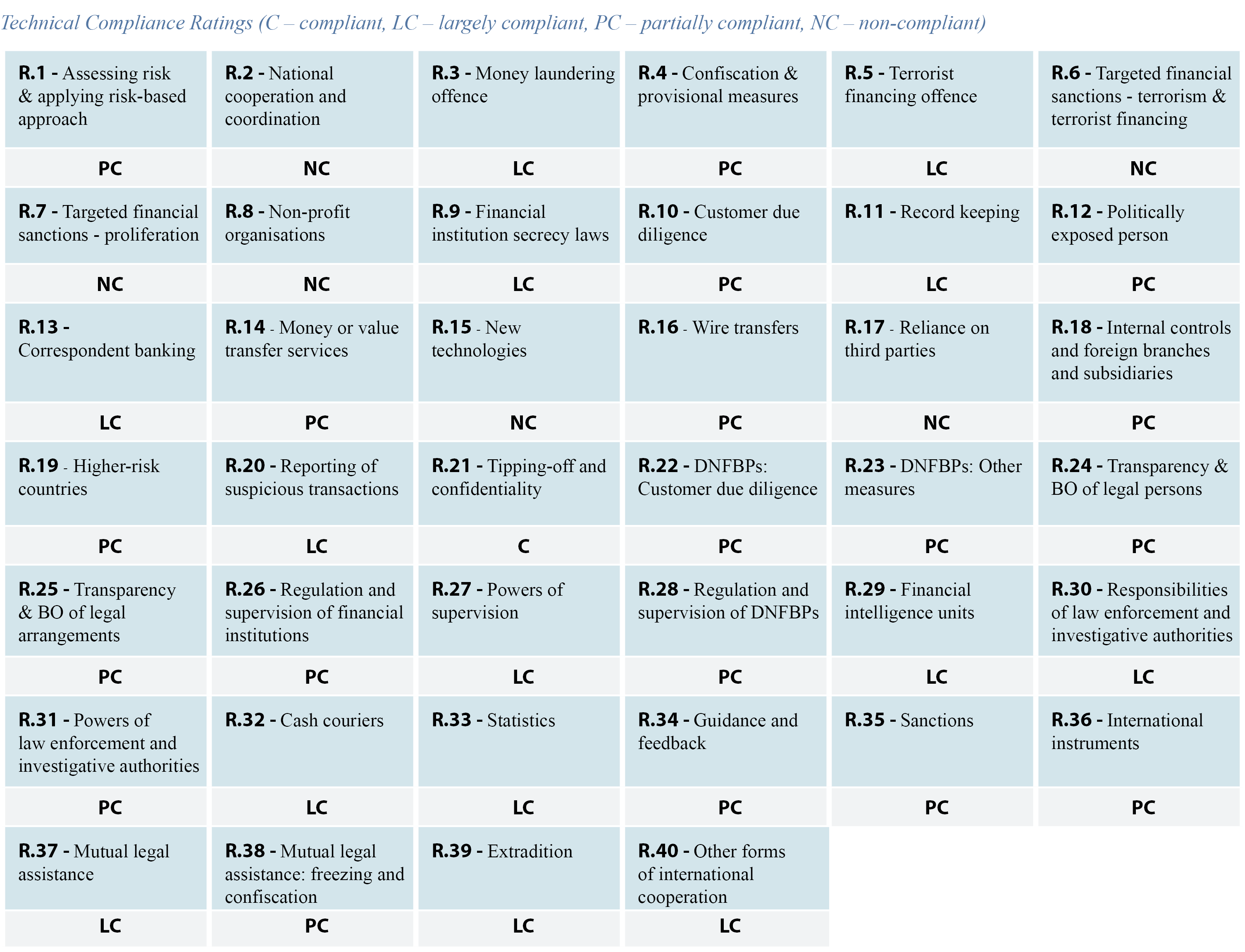
The technical compliance component assesses whether the country being evaluated has implemented the specific requirements of the FATF 40 Recommendations, including the necessary AML/CFT/CFP-related laws, regulations, and institutions.
For each Recommendation, FATF assessors reach a conclusion about the extent to which a country complies or doesn’t comply with the standard.
There are four ratings based on level of compliance:
Included below is an example of Technical Compliance Ratings for the Maldives from its October 2025 Mutual Evaluation Report.
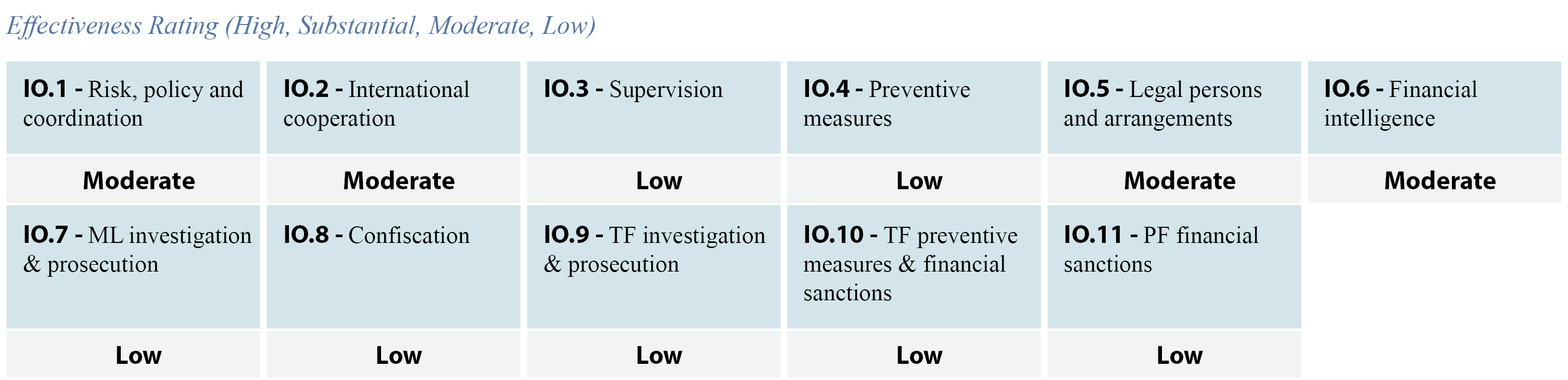
The effectiveness component assesses whether a country’s AML/CFT/CPF system is working, and the extent to which the country is achieving a defined set of outcomes. It doesn’t involve checking whether specific requirements are met, or that all elements of a given Recommendation are in place. Instead, it requires a judgement as to whether, or to what extent, defined outcomes are being achieved.
To do this, FATF assessors work in consultation with the assessed country to evaluate “Immediate Outcomes” in the following areas:
For each of the Immediate Outcomes, the FATF assessors try to answer two overarching questions: to what extent is the outcome being achieved, and what can be done to improve effectiveness? There are four possible ratings for effectiveness:
Included below is an example of Effectiveness Ratings for the Maldives from its October 2025 Mutual Evaluation Report.
Financial institutions and an increasing number of DNFBPs, and VASPs now make a jurisdiction’s performance on its MER an important factor in their AML/CFT/CPF risk-rating systems. Correspondents and other clients located in jurisdictions that perform poorly may be subject to enhanced due diligence or rejected altogether. This differentiated treatment in turn creates incentives for the private sector within jurisdictions receiving poor FATF assessments and ratings to lobby its government to improve its AML/CFT/CPF performance—or at least to improve its standing with the FATF.
If reviewers give high marks to the country or jurisdiction, the publication of the Mutual Evaluation Report generally brings the process to an end. However, a significant majority of those reviewed have deficiencies significant enough to warrant a follow-up report.
Within this group, a minority are deemed to have substantial and strategic deficiencies in their AML/CFT/CPF regimes that necessitate their placement under special review by the FATF’s International Co-operation Review Group (ICRG) to begin an enhanced follow-up process in which the jurisdiction will face additional scrutiny.
There are four ways that a jurisdiction can earn a referral to the ICRG:
Once placed under review by the ICRG, a country has a year to work with the FATF or its FSRB to address deficiencies using an action plan formulated by the FATF and the country of concern. At the end of the year, the ICRG assesses the progress achieved in implementing the remedies. If sufficient progress has not been made, the country is publicly placed under increased monitoring, which is often referred to as being on the FATF “Grey List.”
The purpose of this list is to protect the international financial system from money laundering, terrorist financing, and proliferation financing risks and to encourage greater compliance with FATF standards by identifying jurisdictions whose strategic AML/CFT/CPF deficiencies present substantial risks to the international financial system.
The list is included in the statement published after each FATF Plenary Meeting, which take place three times a year. Specific deficiencies for each listed jurisdiction are described in the FATF public statement, together with a summary of current progress in addressing such deficiencies. Listed countries maintain their status until they implement all or nearly all elements of their agreed remedial action plan.
High-Risk Jurisdictions Subject to a Call for Action (FATF Black List)
Countries with strategic deficiencies that have repeatedly failed to make progress toward remediating those deficiencies are listed in a separate FATF public statement following each Plenary Meeting called “High-Risk Jurisdictions Subject to a Call for Action.” This list is colloquially known as the FATF “Black List.” For all countries identified as high risk, the FATF calls on all members and urges all jurisdictions to apply enhanced due diligence, and in the most serious cases, countries are called upon to apply countermeasures to protect the international financial system from the ML/TF/PF risks emanating from the country. The listings are maintained as long as listed jurisdictions continue to present ongoing and serious risks to the international financial system.
Stay tuned for our next article in this series, which will describe the consequences of FATF listings for listed and non-listed countries and for the international financial system, as well as lessons learned from countries that have exited the Grey List.
 https://finintegrity.org/wp-content/uploads/2026/09/august-2026-se-report-bg.jpg
888
1184
IFI
https://live-black-pebble.pantheonsite.io/wp-content/uploads/2023/12/GIFI-Placeholder2.png
IFI2026-09-02 07:00:562026-09-01 13:19:24August Monthly Sanctions and Export Controls Report
https://finintegrity.org/wp-content/uploads/2026/09/august-2026-se-report-bg.jpg
888
1184
IFI
https://live-black-pebble.pantheonsite.io/wp-content/uploads/2023/12/GIFI-Placeholder2.png
IFI2026-09-02 07:00:562026-09-01 13:19:24August Monthly Sanctions and Export Controls Report https://finintegrity.org/wp-content/uploads/2026/08/judgement-gap-in-market-abuse-compliance-bg.jpg
841
1500
IFI
https://live-black-pebble.pantheonsite.io/wp-content/uploads/2023/12/GIFI-Placeholder2.png
IFI2026-08-25 07:00:462026-08-24 11:34:59The Judgment Gap in Market Abuse Compliance
https://finintegrity.org/wp-content/uploads/2026/08/judgement-gap-in-market-abuse-compliance-bg.jpg
841
1500
IFI
https://live-black-pebble.pantheonsite.io/wp-content/uploads/2023/12/GIFI-Placeholder2.png
IFI2026-08-25 07:00:462026-08-24 11:34:59The Judgment Gap in Market Abuse Compliance https://finintegrity.org/wp-content/uploads/2026/07/guide-to-market-abuse-bg.jpg
1067
1600
IFI
https://live-black-pebble.pantheonsite.io/wp-content/uploads/2023/12/GIFI-Placeholder2.png
IFI2026-07-29 07:00:472026-07-28 12:45:11A Financial Institution’s Guide to Updated EU Market Abuse Regulation
https://finintegrity.org/wp-content/uploads/2026/07/guide-to-market-abuse-bg.jpg
1067
1600
IFI
https://live-black-pebble.pantheonsite.io/wp-content/uploads/2023/12/GIFI-Placeholder2.png
IFI2026-07-29 07:00:472026-07-28 12:45:11A Financial Institution’s Guide to Updated EU Market Abuse Regulation https://finintegrity.org/wp-content/uploads/2026/03/understandingfatf-bg.jpg
1000
1500
IFI
https://live-black-pebble.pantheonsite.io/wp-content/uploads/2023/12/GIFI-Placeholder2.png
IFI2026-05-13 07:00:082026-05-22 13:26:47Understanding the FATF: A Guide for Private Sector Stakeholders Part 3
https://finintegrity.org/wp-content/uploads/2026/03/understandingfatf-bg.jpg
1000
1500
IFI
https://live-black-pebble.pantheonsite.io/wp-content/uploads/2023/12/GIFI-Placeholder2.png
IFI2026-05-13 07:00:082026-05-22 13:26:47Understanding the FATF: A Guide for Private Sector Stakeholders Part 3 https://finintegrity.org/wp-content/uploads/2026/04/consumerprotection-bg.jpg
1000
1500
IFI
https://live-black-pebble.pantheonsite.io/wp-content/uploads/2023/12/GIFI-Placeholder2.png
IFI2026-04-15 07:00:202026-04-08 09:36:08Data as a Critical Business and Compliance Asset
https://finintegrity.org/wp-content/uploads/2026/03/understandingfatf-bg.jpg
1000
1500
IFI
https://live-black-pebble.pantheonsite.io/wp-content/uploads/2023/12/GIFI-Placeholder2.png
IFI2026-04-08 07:00:352026-05-22 13:30:04Understanding the FATF: A Guide for Private Sector Stakeholders
https://finintegrity.org/wp-content/uploads/2026/04/consumerprotection-bg.jpg
1000
1500
IFI
https://live-black-pebble.pantheonsite.io/wp-content/uploads/2023/12/GIFI-Placeholder2.png
IFI2026-04-15 07:00:202026-04-08 09:36:08Data as a Critical Business and Compliance Asset
https://finintegrity.org/wp-content/uploads/2026/03/understandingfatf-bg.jpg
1000
1500
IFI
https://live-black-pebble.pantheonsite.io/wp-content/uploads/2023/12/GIFI-Placeholder2.png
IFI2026-04-08 07:00:352026-05-22 13:30:04Understanding the FATF: A Guide for Private Sector Stakeholders https://finintegrity.org/wp-content/uploads/2026/03/feb2026-bg.jpg
879
1500
IFI
https://live-black-pebble.pantheonsite.io/wp-content/uploads/2023/12/GIFI-Placeholder2.png
IFI2026-03-03 07:00:312026-04-01 11:30:03February 2026 Monthly Sanctions and Export Controls Report
https://finintegrity.org/wp-content/uploads/2026/03/feb2026-bg.jpg
879
1500
IFI
https://live-black-pebble.pantheonsite.io/wp-content/uploads/2023/12/GIFI-Placeholder2.png
IFI2026-03-03 07:00:312026-04-01 11:30:03February 2026 Monthly Sanctions and Export Controls Report https://finintegrity.org/wp-content/uploads/2026/01/article-eftfs-bg.jpg
800
1200
IFI
https://live-black-pebble.pantheonsite.io/wp-content/uploads/2023/12/GIFI-Placeholder2.png
IFI2026-02-05 07:00:282026-03-27 12:32:49Electronic Fund Transfer Consumer Protection
https://finintegrity.org/wp-content/uploads/2026/01/article-eftfs-bg.jpg
800
1200
IFI
https://live-black-pebble.pantheonsite.io/wp-content/uploads/2023/12/GIFI-Placeholder2.png
IFI2026-02-05 07:00:282026-03-27 12:32:49Electronic Fund Transfer Consumer Protection https://finintegrity.org/wp-content/uploads/2026/02/bg-jan2026.jpg
690
1200
IFI
https://live-black-pebble.pantheonsite.io/wp-content/uploads/2023/12/GIFI-Placeholder2.png
IFI2026-02-03 07:00:332026-03-27 12:34:22January 2026 Monthly Sanctions and Export Controls Report
https://finintegrity.org/wp-content/uploads/2026/02/bg-jan2026.jpg
690
1200
IFI
https://live-black-pebble.pantheonsite.io/wp-content/uploads/2023/12/GIFI-Placeholder2.png
IFI2026-02-03 07:00:332026-03-27 12:34:22January 2026 Monthly Sanctions and Export Controls Report
 April 2026 Monthly Sanctions and Export Controls Report