• Link to LinkedIn
  • Link to Youtube
  • Sign In
  • Register
  • Subscribe
  • Contact
Institute for Financial Integrity
  • Training
    • eLearning Courses

      • Suite of interactive e-learning courses to educate and engage staff on core compliance topics

      • Learn More
    • Video Library

      • An online learning journey through the various domains of financial crime, explore our library of expert-led videos

      • Learn More
    • Training Services

      • Trusted compliance training design, development, and delivery tailored to your unique requirements

      • Learn More
    • Certifications
      • Certified Risk Management Specialist – Global Sanctions
      • Certified Financial Integrity Professional Program
  • Technology
    • DOLFIN

      • A platform that equips financial integrity professionals with the continuing education, expert insights, resources and tools needed to protect the integrity of the global financial system.

      • Learn More
    • AskFIN

      • A revolutionary, AI-powered tool seamlessly integrated with DOLFIN® — the world’s largest and most trusted library of curated resources on financial integrity topics.

      • Learn More
  • Insights
    • Insights
      • Articles
      • Reports & White Papers
      • Webinars
      • Subscribe
  • About Us
    • Who We Are
      • Our Story
      • Leadership
      • Press Releases
    • Who We Serve
      • Financial Institutions
      • Jurisdictions
      • Executives
      • Industry Professionals
  • Get a Demo
  • Menu Menu

Understanding the FATF: A Guide for Private Sector Stakeholders

Part 1: The FATF Standards

📅 April 8, 2026

What do the United States, Mexico, China, Iceland, the United Arab Emirates, Australia, Bahrain, and Saudi Arabia have in common?

They are all expected to host “on-site” visits in 2026 by the Financial Action Task Force (FATF) or a FATF-style regional body (FSRB) to evaluate the effectiveness of their Anti-Money Laundering, Countering the Financing of Terrorism, and Countering Proliferation Financing (AML/CFT/CPF) systems.

This will be followed by visits in 2027 to the United Kingdom and 14 other jurisdictions, and over time nearly all nations will be evaluated under the FATF’s recently updated methodology.

These visits and the broader FATF assessment process—and in some cases the grey- or black-listings that result—have major implications for private sector financial integrity stakeholders:

  • Participation in On-Site Assessments: A representative sample of managers and compliance officers of financial institutions (FIs), designated non-financial businesses and professions (DNFBPs, which include casinos, real estate agencies, precious metals/stones businesses, lawyers, notaries, accountants, and trust and company service providers), and virtual assets service providers (VASPs) are typically involved in the on-site visit.
  • Increased Scrutiny from Supervisors: Jurisdictions undergoing a “Mutual Evaluation” by the FATF or an FSRB, or implementing a follow-up action plan, are usually under significant pressure to demonstrate effectiveness, which is generally reflected in increased scrutiny and enforcement actions by AML and sanctions regulators.
  • Legal Requirements Associated with FATF Listings: FIs, DNFBPs, VASPs, and their employees need to understand the legal requirements and supervisory expectations associated with FATF listings in the jurisdictions where they operate. These requirements and expectations may differ across jurisdictions. They may demand certain conditions or restrictions with respect to financial relationships, operations, and transactions implicating jurisdictions identified on the FATF lists.
  • Country-Risk Rating Methodologies: Compliance and risk management professionals should incorporate the FATF listings into their country risk-rating methodologies—and should do so in a nuanced way. Not every listed country presents an equal risk. The use of FATF status in risk-rating methodologies should consider the underlying bases for each jurisdictional listing by the FATF. FIs, DNFBPs, and VASPs should understand the FATF lists’ limitations for determining jurisdictional risk and should consider referring to the underlying Mutual Evaluation Reports (MERs), rather than listed status alone, across listed and non-listed jurisdictions.
  • Risk Mitigation Measures: FIs, DNFBPs, and VASPs should also consider the bases of FATF listings in determining the institution’s risk appetite and the risk mitigation measures appropriate for developing or maintaining relationships or operations in or with FATF-listed jurisdictions. In addition, they should monitor MERs and FATF listing processes and regulatory expectations.

It’s critical for private sector financial integrity professionals—particularly those responsible for financial crime and sanctions compliance and risk management within FIs, DNFBPs, and VASPs—to have a sophisticated understand the FATF standards, mutual evaluations, and listings. Therefore, IFI is publishing a three-part FATF guide breaking down (1) the 40 Recommendations, (2) the mutual evaluation process and follow-up monitoring and listings, and (3) consequences of FATF listings and associated lessons learned.

FATF Standards: The 40 Recommendations

The FATF—an inter-governmental body with 38 member jurisdictions and two regional organizations—sets international standards for the counter-illicit finance (CIF) regimes of countries, including AML/CTF/CPF preventive measures that countries apply to their FIs, DNFBPs, and VASPs. Since its founding in 1989, the FATF’s remit has grown from money laundering alone to combating the financing of terrorism and proliferation of weapons of mass destruction. Similarly, with each revision, its standards have become more expansive, detailed, and stringent, requiring more of both jurisdictions and private sector institutions. The FATF standards, known as “The 40 Recommendations,” were last revised comprehensively in 2012 and have been regularly updated since.

Some FATF standards require a “whole-of-government” approach to implement, while others apply to supervisors or private sector entities.

  • An example of a “whole-of-government” standard is Recommendation 1, which indicates that countries should identify, assess, and understanding their ML/TF/PF risks, apply a risk-based approach to preventing ML/TF/PF, and require FIs and DNFBPs identify, assess, and take effective and risk-based actin to mitigate their ML/TF/PF risks.
  • An example of a supervisory standard is Recommendation 27, which states in part that “supervisors should have adequate powers to supervise or monitor, and ensure compliance by, FIs with requirements to combat ML and TF, including authority to conduct inspections.”

FIs, DNFBPs, and VASPs should be familiar with the FATF standards that apply directly to private sector entities, as they almost certainly have been implemented by regulatory requirements in the jurisdictions in which they operate. The most prominent of these recommendations include:

  1. R10-CDD: FIs, DNFBPs, and VASPs should perform customer due diligence (CDD) measures when establishing business relations and in other specified circumstances and should not hold anonymous accounts or accounts in obviously fictitious names.
  2. R11-Recordkeeping: FIs, DNFBPs, and VASPs should maintain, for at least five years, all necessary records on transactions to enable them to comply swiftly with information requests from competent authorities.
  3. R12-PEPs: FIs, DNFBPs, and VASPs should perform enhanced due diligence (EDD) and take other precautions if a customer is a politically exposed person (PEP).
  4. R13-Correspondent Banking: FIs should perform EDD and take special precautions when providing correspondent banking services.
  5. R15-New Technologies: FIs, DNFBPs, and VASPs should understand and prepare for the AML/CFT/CFP impact of new technologies before introducing them.
  6. R16-Travel Rule: FIs sending or receiving wire transfers and VASPs sending or receiving virtual asset transfers should ensure that the identity of the sender and receiver is known at all points during the transfer.
  7. R17-Reliance on 3Ps: FIs, DNFBPs, and VASPs that rely on third parties to carry out AML/CFT/CFP programs must ensure they meet at least the same standards.
  8. R18-Foreign Branches: FIs, DNFBPs, and VASPs should have internal controls and AML/CFT/CFP programs that apply to all their foreign branches and majority-owned subsidiaries and that are designed to effectively manage the risk of ML/TF/PF.
  9. R19-Higher-Risk Countries: FIs, DNFBPs, and VASPs should perform EDD and take special precautions when working with clients from, and engaging in transactions with, higher-risk countries.
  10. R20-STRs: FIs, DNFBPs, and VASPs should file Suspicious Transaction Reports (STRs) when they suspect that transactions are related to ML/TF/PF.

The FATF is only a policy-setting body; it has no power to enforce its Recommendations. Nevertheless, the endorsement of the FATF’s Recommendations by governments in almost all countries around the world has given them significant weight, and in many cases, they are seen practically as binding rules. A jurisdiction’s adherence to the FATF standards, as periodically assessed in peer review reports called “mutual evaluations,” is one of the most widely accepted markers of its seriousness in combating money laundering and the financing of terrorism and the proliferation of weapons of mass destruction (WMD).

Stay tuned for our next article in this series, which will describe the mutual evaluation process, including the technical compliance and effectiveness components, and what happens when jurisdictions are found to have strategic AML/CFT/CPF deficiencies that present risks to the international financial system.

Recorded Webinar

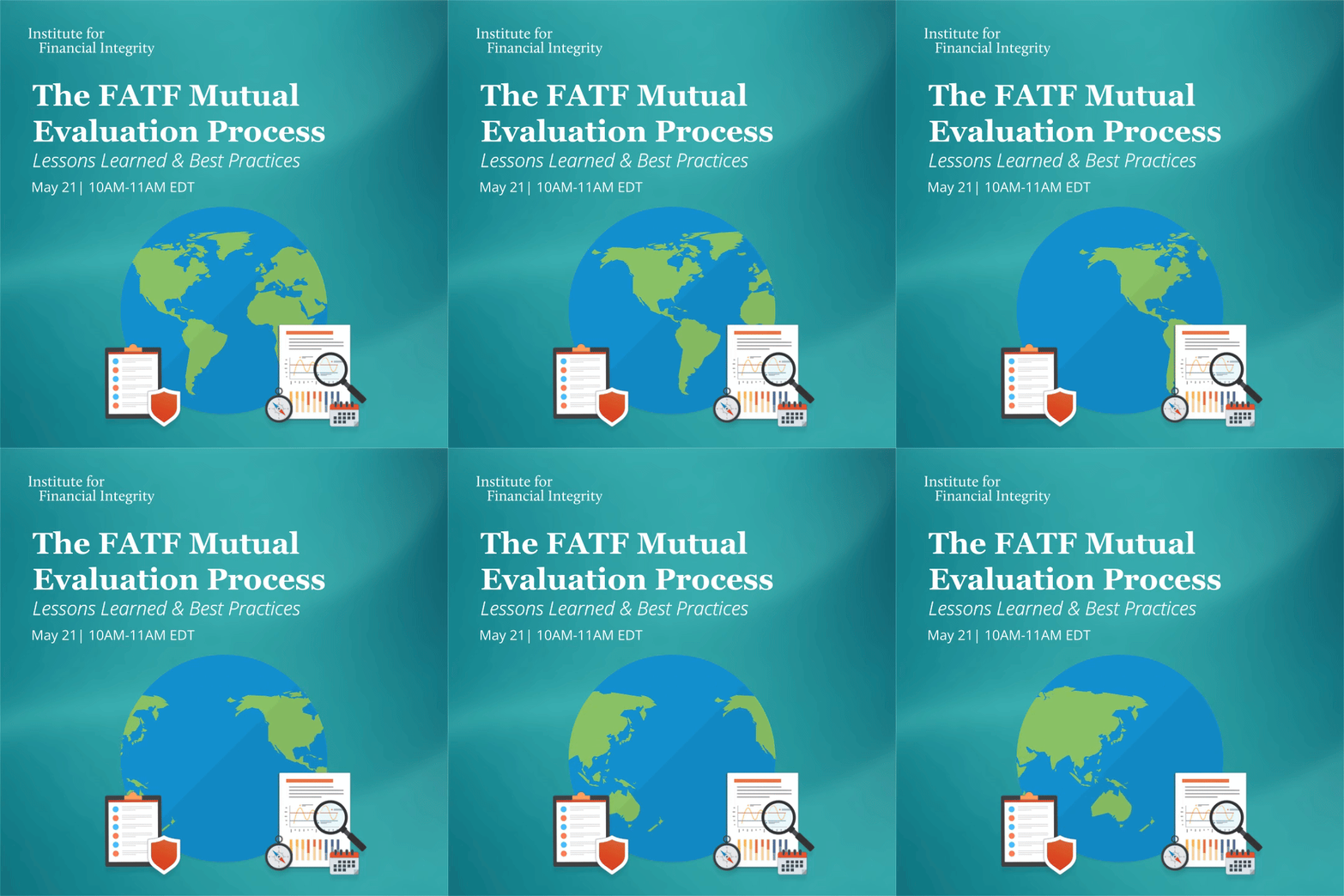
Watch our recorded webinar on the FATF mutual evaluation process—the driving force behind global AML/CFT progress. As nearly 200 jurisdictions are assessed on compliance and effectiveness, this process shapes regulatory expectations, increases supervisory scrutiny, and impacts risk frameworks across financial institutions, DNFBPs, and VASPs.

Our expert panel breaks down how evaluations work, why jurisdictions are grey-listed or black-listed and how they are removed, what to take from Mutual Evaluation Reports, and what to expect from the FATF’s evolving Fifth-Round methodology and future priorities.

View Recording

Recommended Blogs

August Monthly Sanctions and Export Controls Report

September 2, 2026
Explore this month’s Sanctions and Export Controls Update, highlighting IFI’s take on key developments from August 2026.
Read more
https://finintegrity.org/wp-content/uploads/2026/09/august-2026-se-report-bg.jpg 888 1184 IFI https://live-black-pebble.pantheonsite.io/wp-content/uploads/2023/12/GIFI-Placeholder2.png IFI2026-09-02 07:00:562026-09-01 13:19:24August Monthly Sanctions and Export Controls Report

The Judgment Gap in Market Abuse Compliance

August 25, 2026
While banks may know the set of rules outlined in the EU’s Market Abuse Regulation, exposure sits in the judgment calls related to delayed disclosure, information barriers, and market soundings. Dive into where the risk lies in each area.
Read more
https://finintegrity.org/wp-content/uploads/2026/08/judgement-gap-in-market-abuse-compliance-bg.jpg 841 1500 IFI https://live-black-pebble.pantheonsite.io/wp-content/uploads/2023/12/GIFI-Placeholder2.png IFI2026-08-25 07:00:462026-08-24 11:34:59The Judgment Gap in Market Abuse Compliance

A Financial Institution’s Guide to Updated EU Market Abuse Regulation

July 29, 2026
MAR sounds straightforward until a real case tests it. This guide breaks down what the regulation covers, who it applies to, and the disclosure rules, court rulings, and regulatory guidance that shifted the ground under compliance teams in 2026.
Read more
https://finintegrity.org/wp-content/uploads/2026/07/guide-to-market-abuse-bg.jpg 1067 1600 IFI https://live-black-pebble.pantheonsite.io/wp-content/uploads/2023/12/GIFI-Placeholder2.png IFI2026-07-29 07:00:472026-07-28 12:45:11A Financial Institution’s Guide to Updated EU Market Abuse Regulation
Understanding the FATF: A Guide for Private Sector Stakeholders Part 3

May 13, 2026
This article examines what FATF listings mean in practice and draws out the lessons learned from jurisdictions that have successfully exited the Grey List, using the United Arab Emirates (UAE) as a case study.
Read more
https://finintegrity.org/wp-content/uploads/2026/03/understandingfatf-bg.jpg 1000 1500 IFI https://live-black-pebble.pantheonsite.io/wp-content/uploads/2023/12/GIFI-Placeholder2.png IFI2026-05-13 07:00:082026-05-22 13:26:47Understanding the FATF: A Guide for Private Sector Stakeholders Part 3

Understanding the FATF: A Guide for Private Sector Stakeholders Part 2

April 28, 2026
The FATF’s mutual evaluation process has been the single greatest catalyst for improvements to the global AML/CFT regime in recent years. It’s critical for financial crime compliance and risk management professionals to understand this process and related standards and listings.
Read more
https://finintegrity.org/wp-content/uploads/2026/03/understandingfatf-bg.jpg 1000 1500 IFI https://live-black-pebble.pantheonsite.io/wp-content/uploads/2023/12/GIFI-Placeholder2.png IFI2026-04-28 07:00:032026-05-22 13:28:23Understanding the FATF: A Guide for Private Sector Stakeholders Part 2

Data as a Critical Business and Compliance Asset

April 15, 2026
Data is an increasingly critical asset. It plays a key role in due diligence, identifying and responding against illicit finance, and identifying fraud, as well as for commercial decisions and business success. Explore global data protection and retention requirements in this article.
Read more
https://finintegrity.org/wp-content/uploads/2026/04/consumerprotection-bg.jpg 1000 1500 IFI https://live-black-pebble.pantheonsite.io/wp-content/uploads/2023/12/GIFI-Placeholder2.png IFI2026-04-15 07:00:202026-04-08 09:36:08Data as a Critical Business and Compliance Asset

February 2026 Monthly Sanctions and Export Controls Report

March 3, 2026
Explore this month’s Sanctions and Export Controls Update, highlighting IFI’s take on key developments from February 2026.
Read more
https://finintegrity.org/wp-content/uploads/2026/03/feb2026-bg.jpg 879 1500 IFI https://live-black-pebble.pantheonsite.io/wp-content/uploads/2023/12/GIFI-Placeholder2.png IFI2026-03-03 07:00:312026-04-01 11:30:03February 2026 Monthly Sanctions and Export Controls Report

Electronic Fund Transfer Consumer Protection

February 5, 2026
The Electronic Fund Transfer Act (EFTA) was established to protect consumers using electronic fund transfers. Explore what is considered in scope and the changes proposed to include crypto.
Read more
https://finintegrity.org/wp-content/uploads/2026/01/article-eftfs-bg.jpg 800 1200 IFI https://live-black-pebble.pantheonsite.io/wp-content/uploads/2023/12/GIFI-Placeholder2.png IFI2026-02-05 07:00:282026-03-27 12:32:49Electronic Fund Transfer Consumer Protection

January 2026 Monthly Sanctions and Export Controls Report

February 3, 2026
There were several major sanctions-related developments in January, most notably the U.S.’s easing of sanctions to facilitate Venezuelan oil sales and the ratcheting up of western sanctions in response to Tehran’s violent crackdown on protestors, among others.
Read more
https://finintegrity.org/wp-content/uploads/2026/02/bg-jan2026.jpg 690 1200 IFI https://live-black-pebble.pantheonsite.io/wp-content/uploads/2023/12/GIFI-Placeholder2.png IFI2026-02-03 07:00:332026-03-27 12:34:22January 2026 Monthly Sanctions and Export Controls Report
Previous Previous Previous Next Next Next
Download IFI Compliance Checklist Report

Follow Us on LinkedIn

Share this article

  • Share on LinkedIn
  • Share by Mail

Recent Articles

  • September 2026 Monthly Sanctions and Export Controls Report
  • The Data Behind the Payment
  • Dirty Barrels
  • Real Estate, Real Risks
  • Iran and the Sanctions Landscape

Explore Other Topics

  • Artificial Intelligence
  • Compliance Best Practices
  • Corruption
  • Digital Assets
  • Drug Trafficking
  • European Union
  • Fraud
  • Human Trafficking
  • Money Laundering
  • Oil and Gas
  • Press Releases
  • Proliferation Finance
  • Regulation
  • Russia
  • Sanctions
  • Strategic Trade Controls / Export Controls
  • Terrorism

View Our Expert Insights

  • Compliance Training Readiness Checklist
  • Inside the Cartels and Chinese Money Laundering Networks Driving Criminal Economies
  • High Stakes – Casinos, Crime, and Cartels
  • From Cost Center to Risk Control
  • Leveraging Artificial Intelligence for Enhanced Financial Compliance
  • The Convergence of Sanctions and AML/CFT Regimes
  • Casinos and Cryptocurrency Driving Illicit Finance in East and Southeast Asia
  • Russia 2024: The Two-Year Anniversary of the Invasion
  • Human Trafficking Crisis after Russia’s Invasion of Ukraine
  • 2024 Trends Report
© DOLFIN Academy LLC 2026
  • Link to LinkedIn
  • Link to Youtube
  • Privacy Policy
Link to: Al-Kuraimi Islamic Bank and Al-Kuraimi Islamic Microfinance Bank Choose IFI to Strengthen Compliance Training Link to: Al-Kuraimi Islamic Bank and Al-Kuraimi Islamic Microfinance Bank Choose IFI to Strengthen Compliance Training Al-Kuraimi Islamic Bank and Al-Kuraimi Islamic Microfinance Bank Choose IFI... Link to: Data as a Critical Business and Compliance Asset Link to: Data as a Critical Business and Compliance Asset Data as a Critical Business and Compliance Asset
Scroll to top Scroll to top Scroll to top

This site uses cookies. By continuing to browse the site, you are agreeing to our use of cookies.

Accept settingsHide notification onlySettings

Cookie and Privacy Settings


How we use cookies

We may request cookies to be set on your device. We use cookies to let us know when you visit our websites, how you interact with us, to enrich your user experience, and to customize your relationship with our website.

Click on the different category headings to find out more. You can also change some of your preferences. Note that blocking some types of cookies may impact your experience on our websites and the services we are able to offer.

Essential Website Cookies

These cookies are strictly necessary to provide you with services available through our website and to use some of its features.

Because these cookies are strictly necessary to deliver the website, refusing them will have impact how our site functions. You always can block or delete cookies by changing your browser settings and force blocking all cookies on this website. But this will always prompt you to accept/refuse cookies when revisiting our site.

We fully respect if you want to refuse cookies but to avoid asking you again and again kindly allow us to store a cookie for that. You are free to opt out any time or opt in for other cookies to get a better experience. If you refuse cookies we will remove all set cookies in our domain.

We provide you with a list of stored cookies on your computer in our domain so you can check what we stored. Due to security reasons we are not able to show or modify cookies from other domains. You can check these in your browser security settings.

Google Analytics Cookies

These cookies collect information that is used either in aggregate form to help us understand how our website is being used or how effective our marketing campaigns are, or to help us customize our website and application for you in order to enhance your experience.

If you do not want that we track your visit to our site you can disable tracking in your browser here:

Other external services

We also use different external services like Google Webfonts, Google Maps, and external Video providers. Since these providers may collect personal data like your IP address we allow you to block them here. Please be aware that this might heavily reduce the functionality and appearance of our site. Changes will take effect once you reload the page.

Google Webfont Settings:

Google Map Settings:

Google reCaptcha Settings:

Vimeo and Youtube video embeds:

Privacy Policy

You can read about our cookies and privacy settings in detail on our Privacy Policy Page.

Privacy Policy
Accept settingsHide notification only