Laundering Luxury
How ‘daigou’ is used by Chinese Money Laundering Networks to enable capital flight and launder cartel proceeds
📅 September 17, 2025

Chinese Money Laundering Networks (CMLNs) are a key enabler of laundering cartel and other criminal proceeds in the United States and globally. Driven by capital flight from China, meaning the demand from Chinese nationals to move fundsoutside China in excess of amounts permitted by the Chinese government, CMLNs use multiple laundering methods to achieve their objectives. These include use of “mirror transfers”, casinos, crypto, cash smuggling, real estate, and ‘daigou’.
Daigou, which approximately translates as ‘buying on behalf of’, uses straw buyers to acquire goods in western countries, which are exported to China and sold at a profit. While daigou itself is not illegal, daigou operations are often financed by CMLNs, which receive and launder proceeds from cartels and other criminal activities. Daigou may also involve tax and tariff evasion, and can obscure the identity of the client and source of funds.
Financial institutions, credit card companies, payment processers, and retailers should be aware of the risk indicators for daigou and should take action accordingly.
Only a small proportion of suspicious activity reports from U.S. financial institutions specifically reference ‘daigou’ – approximately $9.6 million from a total of $312 billion in suspicious activity associated with CMLNs overall, according to a 2025 FinCEN Financial Trend Analysis. However, a significantly higher proportion of reports involve unusual credit card activity ($19 billion), some of which may also represent daigou activity.
Daigou operations have been identified by law enforcement and financial intelligence units in other countries too. In an advisory on daigou published by the United Kingdom Financial Intelligence Unit, the National Crime Agency, identified one CMLN as controlling approximately 600 accounts at a single financial institution, and the same CMLN was known to control accounts at multiple other financial institutions too. Daigou networks have also been identified operating in Canada.
“A primary goal of CMLNs is to obtain large quantities of USD and other currencies to meet the demand for these currencies by Chinese citizens seeking to evade the People’s Republic of China’s (PRC’s) currency controls. This demand for USD has led CMLNs to partner with illicit actors, such as the Cartels, who have access to large sums of USD that they need to launder. CMLNs assume much of the risk of transporting and laundering large volumes of cash inside the United States, while providing near-instant transfers of value back to their clients by engaging in informal value transfer systems (IVTS) or trade-based money laundering (TBML) schemes. In the United States, CMLNs functionally operate as unregistered money services businesses (MSBs) and serve as money brokers in the global Chinese underground banking system (CUBS), which provides Chinese citizens the ability to move funds out of China despite the PRC’s currency control laws.” – FinCEN Advisory FIN-2025-A003
In China, luxury goods are often subject to significant tariffs and can be expensive compared with the same item purchased overseas. Counterfeiting is also prevalent and may result in health risks or even death. In 2004, fake infant formula originated in Anhui province in China caused the deaths of 13 babies, followed in subsequent years by further infant deaths caused by contamination. The result is demand for authentic western products and/or luxury items at lower prices than official outlets (where taxes and duties have been paid) – with discounts of around 40% for some products.
With movement of capital out of China restricted to approximately $50,000 per person per year, daigou buyers in western countries face liquidity issues with financing their purchases, as well as moving the proceeds of sales outside China. They may therefore engage with CMLNs as financial service providers, or alternatively CMLNs may directly manage and operate diagou networks.
One methodology for daigou operations is:
Daigou may also use CMLNs to move value using mirror transfers, circumventing Chinese capital restrictions, for example:
Through these mirror transfers, the daigou moves their profits from China to the United Kingdom.
There are many variations on the daigou operations, with the above representing just some ways they can operate.
CMLNs often target Chinese diaspora to operate as money mules, buyers, or brokers. Chinese students are particularly vulnerable due to visa conditions which may limit lawful employment. Some students may be recruited by being told they are providing money transmission services for other students or unbanked Chinese workers, whereas other mules are aware their account will be used for illicit activity.
Red flags that may indicate an account is associated with daigou activity are:
🚩 The customer shows indications of irregularities in documents which may indicate they are fraudulent, for example a Chinese passport and visa contain the same photograph despite purportedly being issued years apart.
🚩 Activity that is not commensurate with the customer profile. For example, a student receives wire transfers described as “tuition” or “living expenses” that do not correspond with the timing of these costs during the academic year, or where the amounts do not correspondent with the expenses described.
🚩 Discrepancies between declared income/earnings and account activity.
🚩 A customer, especially a Chinese national, regularly uses a credit card to purchase large volumes of electronics or other luxury goods.
Assessments indicate that some students may hand control of their accounts to CMLNs when they return to China on completion of their studies. This means that ongoing monitoring of accounts is necessary to identify changes that may indicate daigou or illicit activity.
Business bank accounts may also be used to facilitate daigou activity. Red flags include:
🚩 Individuals associated with a business account, such as directors or authorized signatories, show indications of irregularities (see above).
🚩 A business operating in the electronics or luxury goods sector shows revenues that are not proportionate to the business’ size or scale.
🚩 A business operating in the electronic or luxury goods sector makes payments for multiple credit cards for individuals unrelated to the business.
🚩 Companies registered in Hong Kong send funds to Chinese nationals residing in the United States, where the company has characteristics of a shell company.
Financial institutions identifying unusual activity which may indicate daigou or related CMLN activity should undertake an investigation in accordance with their internal process. This may include collecting and validating further information about the source of wealth or source of funds for the customer, and enhanced due diligence on the account holder, related individuals, and counterparties.
Where the investigation indicates that the activity is suspicious, institutions should file a Suspicious Activity Report (SAR) in accordance with regulatory requirements. For example, for reports to FinCEN the report should include the key reference “CMLN-2025-A003”.
Additional reports, such as Currency Transaction Reports, should also be filed where requirements are met.
Information sharing between financial institutions provides valuable opportunities to better identify, assess, and respond to potentially illicit activity. Sharing should be undertaken in accordance with applicable regulatory requirements.
Finally, staff should be provided with training to ensure they remain informed on emerging typologies and risk indicators, enabling them to respond effectively. In addition to regular (often annual) training, specialized and targeted training throughout the year may also be valuable.
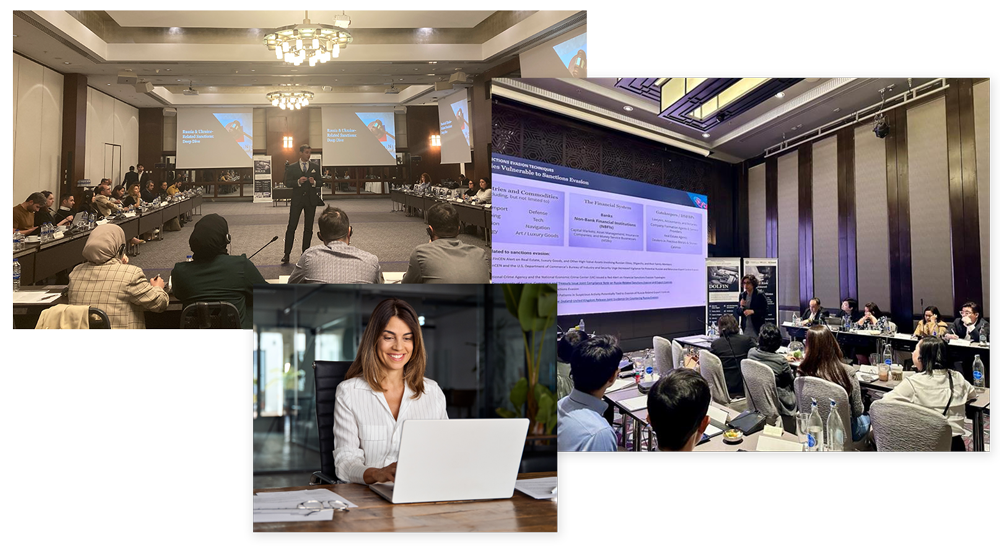
Contact us for more details on our online courses and instructor-led training on cartels and Chinese Money Laundering Networks.
 https://finintegrity.org/wp-content/uploads/2026/10/bg-expanding-crime.jpg
1357
1800
IFI
https://live-black-pebble.pantheonsite.io/wp-content/uploads/2023/12/GIFI-Placeholder2.png
IFI2026-10-14 07:00:092026-10-05 16:11:03The Expanding Scope of Financial Crime Compliance Training
https://finintegrity.org/wp-content/uploads/2026/10/bg-expanding-crime.jpg
1357
1800
IFI
https://live-black-pebble.pantheonsite.io/wp-content/uploads/2023/12/GIFI-Placeholder2.png
IFI2026-10-14 07:00:092026-10-05 16:11:03The Expanding Scope of Financial Crime Compliance Training https://finintegrity.org/wp-content/uploads/2026/10/bg-september-2026-se-report.jpg
1199
1600
IFI
https://live-black-pebble.pantheonsite.io/wp-content/uploads/2023/12/GIFI-Placeholder2.png
IFI2026-10-06 07:00:462026-10-05 13:03:02September 2026 Monthly Sanctions and Export Controls Report
https://finintegrity.org/wp-content/uploads/2026/10/bg-september-2026-se-report.jpg
1199
1600
IFI
https://live-black-pebble.pantheonsite.io/wp-content/uploads/2023/12/GIFI-Placeholder2.png
IFI2026-10-06 07:00:462026-10-05 13:03:02September 2026 Monthly Sanctions and Export Controls Report https://finintegrity.org/wp-content/uploads/2026/09/bg-the-data-behind-the-payment.jpg
1140
1800
IFI
https://live-black-pebble.pantheonsite.io/wp-content/uploads/2023/12/GIFI-Placeholder2.png
IFI2026-09-30 07:00:312026-09-29 10:35:23The Data Behind the Payment
https://finintegrity.org/wp-content/uploads/2026/09/bg-the-data-behind-the-payment.jpg
1140
1800
IFI
https://live-black-pebble.pantheonsite.io/wp-content/uploads/2023/12/GIFI-Placeholder2.png
IFI2026-09-30 07:00:312026-09-29 10:35:23The Data Behind the Payment https://finintegrity.org/wp-content/uploads/2026/09/real-estate-risk.jpg
614
1000
IFI
https://live-black-pebble.pantheonsite.io/wp-content/uploads/2023/12/GIFI-Placeholder2.png
IFI2026-09-17 12:40:222026-09-17 20:35:41Real Estate, Real Risks
https://finintegrity.org/wp-content/uploads/2026/09/real-estate-risk.jpg
614
1000
IFI
https://live-black-pebble.pantheonsite.io/wp-content/uploads/2023/12/GIFI-Placeholder2.png
IFI2026-09-17 12:40:222026-09-17 20:35:41Real Estate, Real Risks https://finintegrity.org/wp-content/uploads/2026/08/judgement-gap-in-market-abuse-compliance-bg.jpg
841
1500
IFI
https://live-black-pebble.pantheonsite.io/wp-content/uploads/2023/12/GIFI-Placeholder2.png
IFI2026-08-25 07:00:462026-08-24 11:34:59The Judgment Gap in Market Abuse Compliance
https://finintegrity.org/wp-content/uploads/2026/08/judgement-gap-in-market-abuse-compliance-bg.jpg
841
1500
IFI
https://live-black-pebble.pantheonsite.io/wp-content/uploads/2023/12/GIFI-Placeholder2.png
IFI2026-08-25 07:00:462026-08-24 11:34:59The Judgment Gap in Market Abuse Compliance https://finintegrity.org/wp-content/uploads/2026/08/oil-pipeline-bg.jpg
1000
1500
IFI
https://live-black-pebble.pantheonsite.io/wp-content/uploads/2023/12/GIFI-Placeholder2.png
IFI2026-08-19 07:00:062026-08-19 00:07:14The Illicit Oil Pipeline: How Criminal Networks Turn Crude into Clean Cash
https://finintegrity.org/wp-content/uploads/2026/08/oil-pipeline-bg.jpg
1000
1500
IFI
https://live-black-pebble.pantheonsite.io/wp-content/uploads/2023/12/GIFI-Placeholder2.png
IFI2026-08-19 07:00:062026-08-19 00:07:14The Illicit Oil Pipeline: How Criminal Networks Turn Crude into Clean Cash https://finintegrity.org/wp-content/uploads/2026/08/beyond-the-course-library-bg.jpg
1060
1800
IFI
https://live-black-pebble.pantheonsite.io/wp-content/uploads/2023/12/GIFI-Placeholder2.png
IFI2026-08-12 07:00:232026-08-11 12:42:07Beyond the Course Library
https://finintegrity.org/wp-content/uploads/2026/08/beyond-the-course-library-bg.jpg
1060
1800
IFI
https://live-black-pebble.pantheonsite.io/wp-content/uploads/2023/12/GIFI-Placeholder2.png
IFI2026-08-12 07:00:232026-08-11 12:42:07Beyond the Course Library https://finintegrity.org/wp-content/uploads/2026/08/july2026-se-bg.jpg
1177
1800
IFI
https://live-black-pebble.pantheonsite.io/wp-content/uploads/2023/12/GIFI-Placeholder2.png
IFI2026-08-04 07:00:452026-08-04 09:42:02July Monthly Sanctions and Export Controls Report
https://finintegrity.org/wp-content/uploads/2026/08/july2026-se-bg.jpg
1177
1800
IFI
https://live-black-pebble.pantheonsite.io/wp-content/uploads/2023/12/GIFI-Placeholder2.png
IFI2026-08-04 07:00:452026-08-04 09:42:02July Monthly Sanctions and Export Controls Report https://finintegrity.org/wp-content/uploads/2026/07/guide-to-market-abuse-bg.jpg
1067
1600
IFI
https://live-black-pebble.pantheonsite.io/wp-content/uploads/2023/12/GIFI-Placeholder2.png
IFI2026-07-29 07:00:472026-07-28 12:45:11A Financial Institution’s Guide to Updated EU Market Abuse Regulation
https://finintegrity.org/wp-content/uploads/2026/07/guide-to-market-abuse-bg.jpg
1067
1600
IFI
https://live-black-pebble.pantheonsite.io/wp-content/uploads/2023/12/GIFI-Placeholder2.png
IFI2026-07-29 07:00:472026-07-28 12:45:11A Financial Institution’s Guide to Updated EU Market Abuse Regulation
 The Rising Standard