• Link to LinkedIn
  • Link to Youtube
  • Sign In
  • Register
  • Subscribe
  • Contact
Institute for Financial Integrity
  • Training
    • eLearning Courses

      • Suite of interactive e-learning courses to educate and engage staff on core compliance topics

      • Learn More
    • Video Library

      • An online learning journey through the various domains of financial crime, explore our library of expert-led videos

      • Learn More
    • Training Services

      • Trusted compliance training design, development, and delivery tailored to your unique requirements

      • Learn More
    • Certifications
      • Certified Risk Management Specialist – Global Sanctions
      • Certified Financial Integrity Professional Program
  • Technology
    • DOLFIN

      • A platform that equips financial integrity professionals with the continuing education, expert insights, resources and tools needed to protect the integrity of the global financial system.

      • Learn More
    • AskFIN

      • A revolutionary, AI-powered tool seamlessly integrated with DOLFIN® — the world’s largest and most trusted library of curated resources on financial integrity topics.

      • Learn More
  • Insights
    • Insights
      • Articles
      • Reports & White Papers
      • Webinars
      • Subscribe
  • About Us
    • Who We Are
      • Our Story
      • Leadership
      • Press Releases
    • Who We Serve
      • Financial Institutions
      • Jurisdictions
      • Executives
      • Industry Professionals
  • Get a Demo
  • Menu Menu

Busy Season, Easy Targets

Protecting Customers and Employees Through Fraud’s Busiest Season

📅 November 24, 2026

Thanksgiving marks the start of one of the busiest shopping periods of the year. Over the coming weeks, millions of people will shop online, book travel, send money, and make charitable donations. Businesses will also see an increase in transactions as customers prepare for the holidays.

For fraudsters, this activity presents plenty of opportunities. Fake shopping websites, fraudulent delivery messages, charity scams, and impersonation attempts are among the schemes that tend to surface during this period.

Customers aren’t the only targets. Employees face fake vendor invoices, fraudulent payment requests and emails posing as senior executives, often while workloads are high and colleagues are on leave. Whether the target is a shopper or a finance team, the playbook is the same: create urgency, exploit trust and push people to act before they verify.

Why the Holidays Work for Fraudsters

Most scams need the target to skip a check. During the holidays, people skip checks because they are handling more payments, orders and emails than usual, and a detail that would stand out in a quiet week slips past.

Requests that would normally seem strange stop seeming strange. A senior manager asking for gift cards for clients, a supplier sending an unexpected invoice before the books close, a colleague sharing a charity link: in December, each has an easy explanation, and fraudsters write their scripts accordingly.

Then there is the staffing gap. With people on leave, approvals often fall to deputies who don’t know a vendor’s usual bank details or how a particular executive writes. Suppliers are short-staffed too. Any control that depends on someone sensing that something is wrong gets weaker when the experienced people are out.

Scam messages are also harder to spot than they used to be. Generative AI has largely removed the typos and clumsy phrasing that people were trained to look for. The FBI’s 2025 report counted AI-related crime as its own category for the first time: over 22,000 complaints and nearly $900 million in losses.

Employees as Targets

The executive gift card request is still the most common holiday scam inside organizations. An employee gets a message that seems to come from a senior leader, asking them to buy gift cards for clients or staff, keep it quiet and send over the codes. The sums are small and the request fits the season, so it keeps succeeding.

Year-end close brings a bigger version of the same trick. Fraudsters pose as suppliers or executives to change payment details or rush a transfer while finance teams work against deadlines. Business email compromise caused $3.05 billion in reported losses in 2025, second only to investment fraud, from fewer than 25,000 complaints. A single convincing email can cost more than thousands of consumer scams combined.

Some risks come in through employees’ own habits. Malware hides in attachments labeled as party invitations or holiday rotas. Staff who shop on work laptops, or use corporate email for deliveries, expose the company network to the same fake parcel alerts aimed at consumers.

Customers as Targets

For banks and other financial institutions, the biggest customer risk is fraud carried out in their name. Scammers call or text posing as the bank’s fraud team and mention a suspicious holiday purchase. They then persuade the customer to read out a one-time passcode or move money into a new account to keep it safe. Impersonation scams topped the FTC’s fraud reports in 2024, and customers who lose money this way often blame the bank as well as the criminal.

Shopping fraud peaks too, from fake online stores using stolen branding to social media deals on goods that never arrive. The FBI’s holiday alert last year put losses from non-delivery, non-payment and credit card fraud at close to $1 billion. Fake delivery texts, account takeovers and bogus charity appeals add to the load.

Compliance teams should also watch seasonal job offers. Some work-from-home jobs that involve processing payments are recruitment fronts for money mule networks. A customer who takes one may end up moving the proceeds of the scams above through their own account, which makes this an AML problem as much as a consumer protection one.

The Common Thread

Almost none of these schemes beat a technical control. They use authority, urgency and distraction to get a competent person to skip a step. Holiday fraud is social engineering scheduled for the weeks when people are least likely to stop and check.

For compliance teams, the most useful work this season is making sure existing procedures are actually followed when people are busy. Staff and customers also need to feel free to question a request, even one that appears to come from someone senior.

Helping Customers Protect Themselves

Financial institutions have an important role in helping customers recognize scams, particularly when fraudulent messages are designed to look like legitimate bank communications.

Customer awareness campaigns can reinforce a few simple practices:

  • Check before paying: Use established retailers and verify website addresses before entering payment information.
  • Be careful with links: Avoid clicking links in unexpected emails or text messages. Access banking and retail services through official websites or applications.
  • Keep account details private: Never share passwords, PINs, or one-time passcodes with someone claiming to represent a financial institution.
  • Confirm unusual payment requests: If a family member or business contact asks for an urgent transfer, verify the request independently before sending money.
  • Check charities before donating: Confirm that fundraising campaigns are legitimate and use official donation channels.
  • Monitor account activity: Review transactions regularly and enable account alerts where available.
  • Report suspicious activity quickly: Contact the financial institution immediately if an account has been compromised or an unauthorized transaction is identified.

The speed at which customers report suspected fraud can make a difference. Financial institutions should make their reporting channels easy to find and ensure customers know what steps to take if they believe they have been targeted.2

What Financial Institutions Should Be Doing

Seasonal fraud warnings are useful, but they need to be supported by the right controls and procedures. Financial institutions should consider whether their existing arrangements are sufficient to manage the increase in transaction activity and the types of scams customers are likely to encounter.

A few areas deserve particular attention.

  • Transaction monitoring: Higher transaction volumes can make unusual activity harder to identify. Monitoring systems should be able to flag transactions that differ from a customer’s normal behavior, as well as suspicious patterns that may indicate account takeover or payment fraud.
  • Customer authentication: Account changes, new beneficiaries, and unusual payment requests should be subject to appropriate verification. Additional checks may be necessary where the request or transaction presents an elevated risk.
  • Employee awareness: Frontline staff should know how to recognize common scams and respond when customers report suspicious activity. Employees handling payments, customer accounts, and sensitive information should also understand the risks associated with impersonation and social engineering.
  • Internal controls: Payment approvals, vendor verification, and escalation procedures should remain in place even when teams are working with reduced staffing. Organizations should be particularly careful about requests to bypass normal processes because of holiday deadlines.
  • Customer communication: Banks and other financial institutions should use their websites, mobile applications, email, and other communication channels to share relevant fraud warnings. Messages should explain how scams work and what customers should do if they receive suspicious communications.

These measures are most effective when employees understand not just what the procedures require, but why they matter.

Why Fraud Awareness Training Matters

Fraud prevention is not solely the responsibility of compliance teams or fraud investigators. Employees across an organization can encounter suspicious activity, whether they are processing payments, responding to customers, reviewing invoices, or managing business relationships.

A policy may require employees to verify payment instructions, for example, but that requirement is only useful if they understand how payment fraud works and recognize when a request warrants additional scrutiny.

The same applies to social engineering. Employees need to understand how fraudsters use urgency, authority, familiarity, and emotional pressure to influence decisions. Recognizing these tactics can help them pause, ask questions, and follow the appropriate reporting procedures.

Fraud awareness training should therefore go beyond a list of common scams. It should cover how different schemes operate, the warning signs employees are likely to encounter, and the steps they should take when something does not look right.

Scenario-based exercises can also help employees apply what they learn. Working through examples of fraudulent payment requests, phishing emails, vendor impersonation, and suspicious customer transactions gives employees a better sense of how these schemes might appear in their day-to-day roles.

Most importantly, training should be ongoing. Fraud tactics change, and employees need regular opportunities to revisit what they know and learn about new schemes.

Build Your Organization’s Fraud Awareness

Employees cannot prevent what they do not recognize. Understanding how fraud schemes work, identifying suspicious behavior, and knowing when to escalate concerns are essential parts of an effective fraud prevention program.

IFI’s Foundation of Anti-Fraud course introduces learners to common fraud schemes, the indicators that may signal fraudulent activity, and approaches to fraud detection and prevention. It provides organizations with an opportunity to build employee awareness and reinforce the role individuals play in identifying and addressing fraud risks.
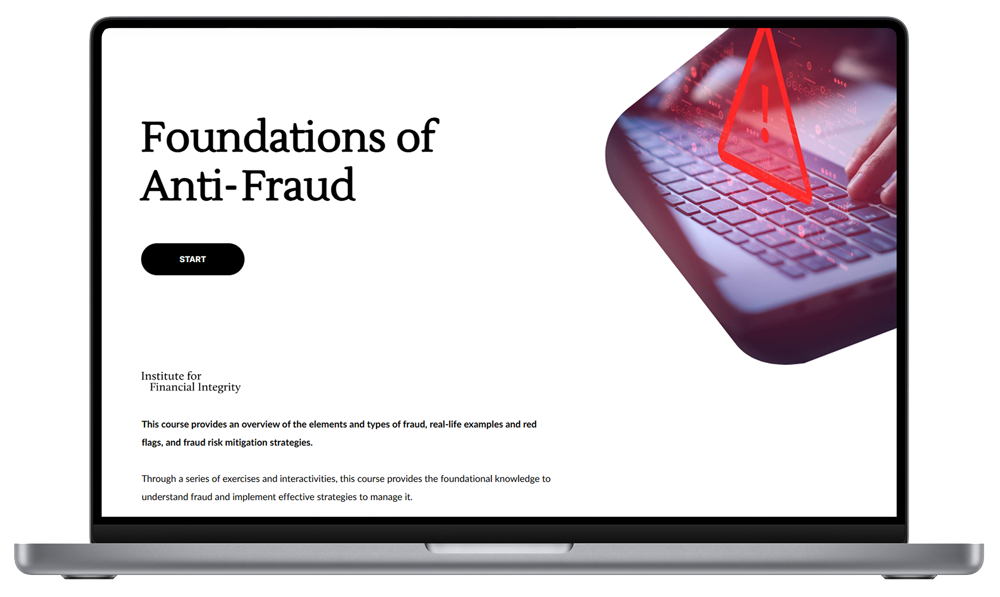

Learn more about Foundations of Anti-Fraud

Recommended Blogs

Lonely Hearts, Open Wallets

November 11, 2026
Fraudsters now use AI, emotional manipulation, and fraudulent cryptocurrency investments to deceive victims and move illicit funds. This Singles’ Day, explore how these schemes work, the financial crime risks they create, and how financial institutions can recognize the warning signs.
Read more
https://finintegrity.org/wp-content/uploads/2026/10/loney-hearts-bg.jpg 1350 1800 IFI https://live-black-pebble.pantheonsite.io/wp-content/uploads/2023/12/GIFI-Placeholder2.png IFI2026-11-11 07:00:472026-11-09 15:06:13Lonely Hearts, Open Wallets

The Job Offer That Cost Binance $6.3 Billion

November 10, 2026
Examine the October 29, 2026 Binance hack including how attackers used a sophisticated social engineering scheme to compromise an employee and gain access to critical systems.
Read more
https://finintegrity.org/wp-content/uploads/2026/10/Screenshot-2026-10-20-115053.png 1301 2320 IFI https://live-black-pebble.pantheonsite.io/wp-content/uploads/2023/12/GIFI-Placeholder2.png IFI2026-11-10 07:00:372026-11-09 13:40:11The Job Offer That Cost Binance $6.3 Billion

October 2026 Monthly Sanctions and Export Controls Report

November 3, 2026
Explore this month’s Sanctions and Export Controls Update, highlighting IFI’s take on key developments from October 2026.
Read more
https://finintegrity.org/wp-content/uploads/2026/10/october-2026-sanctions-ser.jpg 680 1200 IFI https://live-black-pebble.pantheonsite.io/wp-content/uploads/2023/12/GIFI-Placeholder2.png IFI2026-11-03 07:00:462026-11-03 09:30:08October 2026 Monthly Sanctions and Export Controls Report
The $1.2 Billion AML Wake-Up Call

October 28, 2026
FinCEN’s $1.2 billion penalty against Bank of America highlights significant gaps in transaction monitoring, suspicious activity reporting, and customer due diligence. Explore key findings from the enforcement action and what they mean for strengthening compliance controls.
Read more
https://finintegrity.org/wp-content/uploads/2026/10/wake-up-call-bg.jpg 1350 1800 IFI https://live-black-pebble.pantheonsite.io/wp-content/uploads/2023/12/GIFI-Placeholder2.png IFI2026-10-28 07:00:472026-10-22 14:07:22The $1.2 Billion AML Wake-Up Call

Across Borders, Beyond Sight

October 21, 2026
Cross-border payments power the global economy, but they also create opportunities for financial crime. Explore key areas of exposure and how leading institutions are gaining greater visibility into the payment chain.
Read more
https://finintegrity.org/wp-content/uploads/2026/10/Screenshot-2026-10-20-115053.png 1301 2320 IFI https://live-black-pebble.pantheonsite.io/wp-content/uploads/2023/12/GIFI-Placeholder2.png IFI2026-10-21 07:00:052026-10-21 11:26:02Across Borders, Beyond Sight

The Expanding Scope of Financial Crime Compliance Training

October 14, 2026
There is a global shift toward integrating proliferation financing as a distinct threat alongside money laundering and terrorist financing. Discover what this means for enterprise-wide training at financial institutions.
Read more
https://finintegrity.org/wp-content/uploads/2026/10/bg-expanding-crime.jpg 1357 1800 IFI https://live-black-pebble.pantheonsite.io/wp-content/uploads/2023/12/GIFI-Placeholder2.png IFI2026-10-14 07:00:092026-10-05 16:11:03The Expanding Scope of Financial Crime Compliance Training

September 2026 Monthly Sanctions and Export Controls Report

October 6, 2026
Explore this month’s Sanctions and Export Controls Update, highlighting IFI’s take on key developments from September 2026.
Read more
https://finintegrity.org/wp-content/uploads/2026/10/bg-september-2026-se-report.jpg 1199 1600 IFI https://live-black-pebble.pantheonsite.io/wp-content/uploads/2023/12/GIFI-Placeholder2.png IFI2026-10-06 07:00:462026-10-05 13:03:02September 2026 Monthly Sanctions and Export Controls Report

The Data Behind the Payment

September 30, 2026
Two changes have raised the bar on what banks can expect to see in a payment. Explore how corporate banks can put ISO 20022 and FATF's revised Recommendation 16 to work in transaction monitoring.
Read more
https://finintegrity.org/wp-content/uploads/2026/09/bg-the-data-behind-the-payment.jpg 1140 1800 IFI https://live-black-pebble.pantheonsite.io/wp-content/uploads/2023/12/GIFI-Placeholder2.png IFI2026-09-30 07:00:312026-09-29 10:35:23The Data Behind the Payment

The Judgment Gap in Market Abuse Compliance

August 25, 2026
While banks may know the set of rules outlined in the EU’s Market Abuse Regulation, exposure sits in the judgment calls related to delayed disclosure, information barriers, and market soundings. Dive into where the risk lies in each area.
Read more
https://finintegrity.org/wp-content/uploads/2026/08/judgement-gap-in-market-abuse-compliance-bg.jpg 841 1500 IFI https://live-black-pebble.pantheonsite.io/wp-content/uploads/2023/12/GIFI-Placeholder2.png IFI2026-08-25 07:00:462026-08-24 11:34:59The Judgment Gap in Market Abuse Compliance
Previous Previous Previous Next Next Next
Download IFI Compliance Checklist Report

Follow Us on LinkedIn

Share this article

  • Share on LinkedIn
  • Share by Mail

Recent Articles

  • Busy Season, Easy Targets
  • منظومة تحت الضغط
  • Beneath the Shine
  • Navigating Iran Sanctions Risk Across the Gulf
  • Lonely Hearts, Open Wallets

Explore Other Topics

  • Arabic
  • Artificial Intelligence
  • Compliance Best Practices
  • Corruption
  • Digital Assets
  • Drug Trafficking
  • European Union
  • Fraud
  • Human Trafficking
  • Money Laundering
  • Oil and Gas
  • Press Releases
  • Proliferation Finance
  • Regulation
  • Russia
  • Sanctions
  • Strategic Trade Controls / Export Controls
  • Terrorism

View Our Expert Insights

  • Compliance Training Readiness Checklist
  • Inside the Cartels and Chinese Money Laundering Networks Driving Criminal Economies
  • High Stakes – Casinos, Crime, and Cartels
  • From Cost Center to Risk Control
  • Leveraging Artificial Intelligence for Enhanced Financial Compliance
  • The Convergence of Sanctions and AML/CFT Regimes
  • Casinos and Cryptocurrency Driving Illicit Finance in East and Southeast Asia
  • Russia 2024: The Two-Year Anniversary of the Invasion
  • Human Trafficking Crisis after Russia’s Invasion of Ukraine
  • 2024 Trends Report
© DOLFIN Academy LLC 2026
  • Link to LinkedIn
  • Link to Youtube
  • Privacy Policy
Link to: منظومة تحت الضغط Link to: منظومة تحت الضغط منظومة تحت الضغط
Scroll to top Scroll to top Scroll to top

This site uses cookies. By continuing to browse the site, you are agreeing to our use of cookies.

Accept settingsHide notification onlySettings

Cookie and Privacy Settings


How we use cookies

We may request cookies to be set on your device. We use cookies to let us know when you visit our websites, how you interact with us, to enrich your user experience, and to customize your relationship with our website.

Click on the different category headings to find out more. You can also change some of your preferences. Note that blocking some types of cookies may impact your experience on our websites and the services we are able to offer.

Essential Website Cookies

These cookies are strictly necessary to provide you with services available through our website and to use some of its features.

Because these cookies are strictly necessary to deliver the website, refusing them will have impact how our site functions. You always can block or delete cookies by changing your browser settings and force blocking all cookies on this website. But this will always prompt you to accept/refuse cookies when revisiting our site.

We fully respect if you want to refuse cookies but to avoid asking you again and again kindly allow us to store a cookie for that. You are free to opt out any time or opt in for other cookies to get a better experience. If you refuse cookies we will remove all set cookies in our domain.

We provide you with a list of stored cookies on your computer in our domain so you can check what we stored. Due to security reasons we are not able to show or modify cookies from other domains. You can check these in your browser security settings.

Google Analytics Cookies

These cookies collect information that is used either in aggregate form to help us understand how our website is being used or how effective our marketing campaigns are, or to help us customize our website and application for you in order to enhance your experience.

If you do not want that we track your visit to our site you can disable tracking in your browser here:

Other external services

We also use different external services like Google Webfonts, Google Maps, and external Video providers. Since these providers may collect personal data like your IP address we allow you to block them here. Please be aware that this might heavily reduce the functionality and appearance of our site. Changes will take effect once you reload the page.

Google Webfont Settings:

Google Map Settings:

Google reCaptcha Settings:

Vimeo and Youtube video embeds:

Privacy Policy

You can read about our cookies and privacy settings in detail on our Privacy Policy Page.

Privacy Policy
Accept settingsHide notification only