The BIS 50% Rule
Closing a Gap in Our Export Control Defenses
📅 October 2, 2025

On Monday September 29, 2025, the U.S. Commerce Department’s Bureau of Industry and Security (BIS) published an interim final rule for “Non-listed Affiliates of listed entities.” The rule establishes that any entity that is at least 50% owned by an entity on the BIS Entity List, BIS Military End User (MEU) List, or a specified subset of parties on the OFAC Specially Designated Nationals and Blocked Persons list (SDN List), is automatically subject to same restrictions as the parent.
Until now, export control requirements applied only to entities specifically named on the BIS Entity List and MEU Lists. They did not apply to subsidiaries of listed entities, unless they were specifically named on a List.
The effect was to create a loophole which allowed listed entities to use their subsidiaries to acquire restricted goods, software, and technology. When an Entity was added to the BIS Lists – and therefore became subject to restrictions – it could set up a majority or wholly-owned subsidiary and continue to acquire restricted items. This unlawful diversion could continue during the time required for BIS to assess and add the subsidiaries to the BIS Lists.
What are the BIS Entity List and MEU Lists?
The Entity List is a list of parties (including individuals, businesses, and government organizations) identified by BIS as subject to export licensing restrictions, due to the risk of unlawful diversion.
The Military End User List identifies foreign parties who are military end users, meaning a license is required to export, re-export, or transfer items to them, even if a license would not usually be required for that item.
In February 2023, a Chinese high-altitude balloon flew over sensitive U.S. locations, before being intercepted and shot down. After assessment of the companies behind the program, the U.S. added Geovis Technology Co., Ltd to the BIS Entity List in May 2024. The diagram below shows some of the companies related to Geovis Technology.
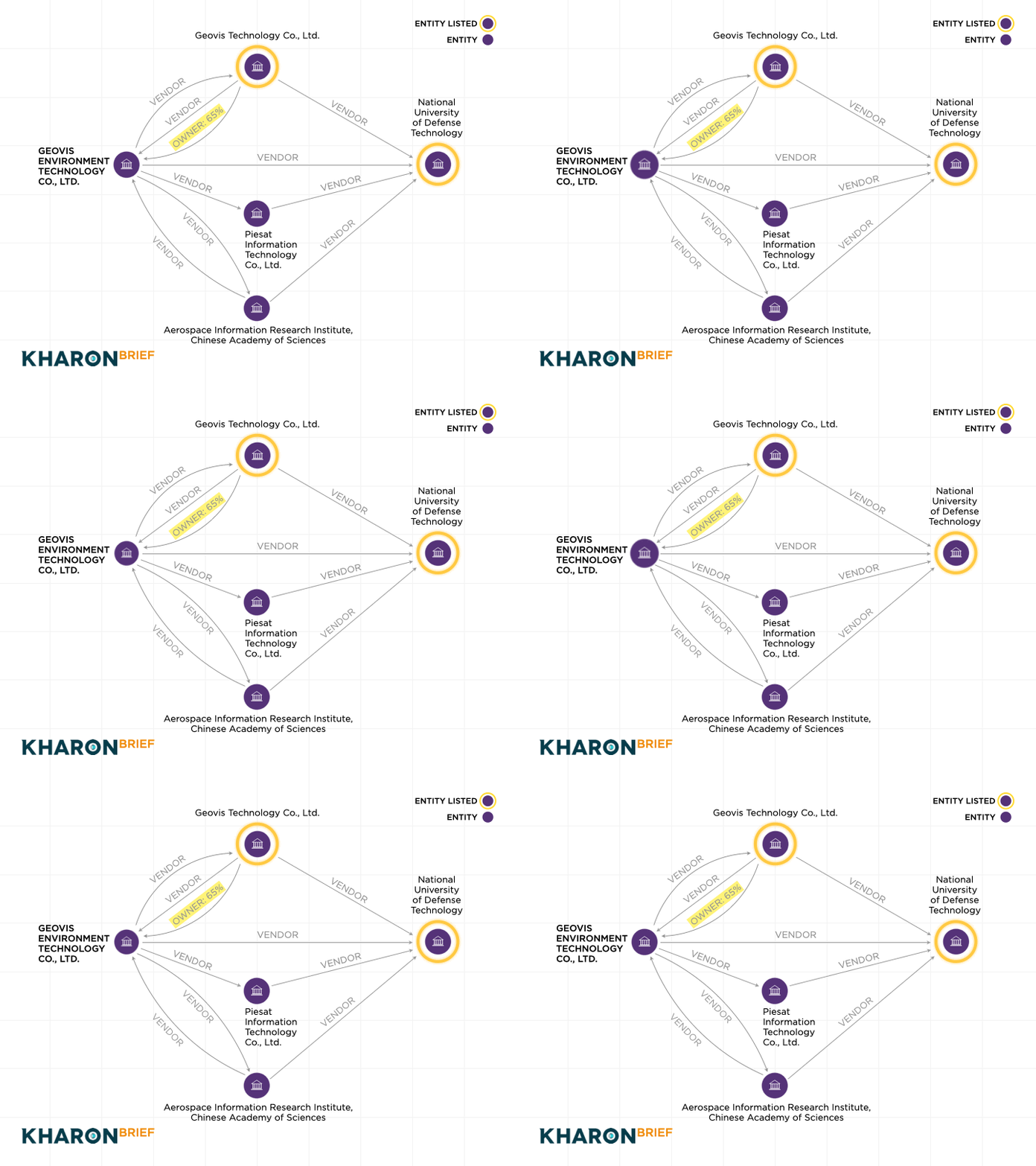
Source: Kharon (January 2025)
As shown in the diagram, one of Geovis Technology’s majority-owned subsidiaries (65% shareholding) is Geovis Environment Technology. According to analysis by a global risk analytics provider, Geovis Environment Technology has sold services including data analysis and processing systems to BIS-Listed entities including its parent (listed since 2024), and the National University of Defense Technology [of China] (listed since 2015). Geovis Environment Technology has also sold services to two additional suppliers to the National University of Defense Technology.
At the date of this article, Geovis Environment Technology has not been added to the BIS Entity List and would not previously have been subject to export restrictions, despite being a majority-owned subsidiary of a listed entity. Under the BIS Affiliates Rule, it will also be considered subject to the same restrictions as its listed parent entity.
If a foreign entity is a majority-owned or wholly-owned subsidiary of an entity on the BIS Entity List, BIS MEU List, or the specified subset of the OFAC SDN List, it is subject to the same restrictions as the parent entity.
The Affiliates rule is modeled on the OFAC 50% Rule: the BIS statement states that it is “designed to be consistent with longstanding Department of the Treasury practice.”
There are common elements between the BIS and OFAC Rules:
A “significant minority ownership” by listed entities (BIS or OFAC), or leadership links to listed entities, are also a “red flag of diversion risk” and require additional due diligence.
In contrast with many types of economic sanctions, being subject to export control licensing requirements does not bar all activity with the entity. Instead, a more nuanced analysis is required which includes the end use, end user, licenses required, and licenses held.
Following the New Guidance to Financial Institutions, published by BIS in October 2024, financial institutions should already have incorporated export controls into their counter illicit finance programs. The scope of the guidance and potential actions for banks are described here.
In response to the BIS Affiliates Rule, financial institutions would be well-advised to re-confirm and, where required, adapt their existing controls to ensure the requirements are met:
The BIS Affiliates Rule closes a loophole that facilitated unlawful diversion of sensitive and restricted components to western adversaries. By closing it, better protection is provided for these items, and export controls are moved into closer alignment with sanctions.
UPDATE: Please note, implementation of the BIS 50% Rule has been suspended for one year, starting on November 10, 2025.
Our course Foundations of Strategic Trade Controls offers a comprehensive overview of how to understand and apply strategic trade control requirements, with a particular focus on those applicable to financial institutions.
Learn more and strengthen your compliance skills today.
 https://finintegrity.org/wp-content/uploads/2026/10/bg-september-2026-se-report.jpg
1199
1600
IFI
https://live-black-pebble.pantheonsite.io/wp-content/uploads/2023/12/GIFI-Placeholder2.png
IFI2026-10-06 07:00:462026-10-05 13:03:02September 2026 Monthly Sanctions and Export Controls Report
https://finintegrity.org/wp-content/uploads/2026/10/bg-september-2026-se-report.jpg
1199
1600
IFI
https://live-black-pebble.pantheonsite.io/wp-content/uploads/2023/12/GIFI-Placeholder2.png
IFI2026-10-06 07:00:462026-10-05 13:03:02September 2026 Monthly Sanctions and Export Controls Report https://finintegrity.org/wp-content/uploads/2026/09/august-2026-se-report-bg.jpg
888
1184
IFI
https://live-black-pebble.pantheonsite.io/wp-content/uploads/2023/12/GIFI-Placeholder2.png
IFI2026-09-02 07:00:562026-09-01 13:19:24August Monthly Sanctions and Export Controls Report
https://finintegrity.org/wp-content/uploads/2026/09/august-2026-se-report-bg.jpg
888
1184
IFI
https://live-black-pebble.pantheonsite.io/wp-content/uploads/2023/12/GIFI-Placeholder2.png
IFI2026-09-02 07:00:562026-09-01 13:19:24August Monthly Sanctions and Export Controls Report https://finintegrity.org/wp-content/uploads/2026/08/july2026-se-bg.jpg
1177
1800
IFI
https://live-black-pebble.pantheonsite.io/wp-content/uploads/2023/12/GIFI-Placeholder2.png
IFI2026-08-04 07:00:452026-08-04 09:42:02July Monthly Sanctions and Export Controls Report
https://finintegrity.org/wp-content/uploads/2026/08/july2026-se-bg.jpg
1177
1800
IFI
https://live-black-pebble.pantheonsite.io/wp-content/uploads/2023/12/GIFI-Placeholder2.png
IFI2026-08-04 07:00:452026-08-04 09:42:02July Monthly Sanctions and Export Controls Report https://finintegrity.org/wp-content/uploads/2026/06/june2026-se-report-bg.jpg
798
1200
IFI
https://live-black-pebble.pantheonsite.io/wp-content/uploads/2023/12/GIFI-Placeholder2.png
IFI2026-07-01 07:00:392026-07-02 10:28:58June 2026 Sanctions and Export Controls Report
https://finintegrity.org/wp-content/uploads/2026/06/june2026-se-report-bg.jpg
798
1200
IFI
https://live-black-pebble.pantheonsite.io/wp-content/uploads/2023/12/GIFI-Placeholder2.png
IFI2026-07-01 07:00:392026-07-02 10:28:58June 2026 Sanctions and Export Controls Report https://finintegrity.org/wp-content/uploads/2026/06/may-bg-2026-se.jpg
1200
1800
IFI
https://live-black-pebble.pantheonsite.io/wp-content/uploads/2023/12/GIFI-Placeholder2.png
IFI2026-06-03 07:00:142026-06-02 14:36:12May 2026 Sanctions and Export Controls Update
https://finintegrity.org/wp-content/uploads/2026/06/may-bg-2026-se.jpg
1200
1800
IFI
https://live-black-pebble.pantheonsite.io/wp-content/uploads/2023/12/GIFI-Placeholder2.png
IFI2026-06-03 07:00:142026-06-02 14:36:12May 2026 Sanctions and Export Controls Update https://finintegrity.org/wp-content/uploads/2026/05/april-bg-2026-se.jpg
1348
1800
IFI
https://live-black-pebble.pantheonsite.io/wp-content/uploads/2023/12/GIFI-Placeholder2.png
IFI2026-05-05 07:00:332026-05-06 13:57:33April 2026 Monthly Sanctions and Export Controls Report
https://finintegrity.org/wp-content/uploads/2026/05/april-bg-2026-se.jpg
1348
1800
IFI
https://live-black-pebble.pantheonsite.io/wp-content/uploads/2023/12/GIFI-Placeholder2.png
IFI2026-05-05 07:00:332026-05-06 13:57:33April 2026 Monthly Sanctions and Export Controls Report https://finintegrity.org/wp-content/uploads/2026/04/march2026-header-bg.jpg
944
1500
IFI
https://live-black-pebble.pantheonsite.io/wp-content/uploads/2023/12/GIFI-Placeholder2.png
IFI2026-04-02 07:00:502026-04-08 19:51:19March 2026 Monthly Sanctions and Export Controls Report
https://finintegrity.org/wp-content/uploads/2026/04/march2026-header-bg.jpg
944
1500
IFI
https://live-black-pebble.pantheonsite.io/wp-content/uploads/2023/12/GIFI-Placeholder2.png
IFI2026-04-02 07:00:502026-04-08 19:51:19March 2026 Monthly Sanctions and Export Controls Report https://finintegrity.org/wp-content/uploads/2026/03/feb2026-bg.jpg
879
1500
IFI
https://live-black-pebble.pantheonsite.io/wp-content/uploads/2023/12/GIFI-Placeholder2.png
IFI2026-03-03 07:00:312026-04-01 11:30:03February 2026 Monthly Sanctions and Export Controls Report
https://finintegrity.org/wp-content/uploads/2026/03/feb2026-bg.jpg
879
1500
IFI
https://live-black-pebble.pantheonsite.io/wp-content/uploads/2023/12/GIFI-Placeholder2.png
IFI2026-03-03 07:00:312026-04-01 11:30:03February 2026 Monthly Sanctions and Export Controls Report https://finintegrity.org/wp-content/uploads/2026/02/bg-jan2026.jpg
690
1200
IFI
https://live-black-pebble.pantheonsite.io/wp-content/uploads/2023/12/GIFI-Placeholder2.png
IFI2026-02-03 07:00:332026-03-27 12:34:22January 2026 Monthly Sanctions and Export Controls Report
https://finintegrity.org/wp-content/uploads/2026/02/bg-jan2026.jpg
690
1200
IFI
https://live-black-pebble.pantheonsite.io/wp-content/uploads/2023/12/GIFI-Placeholder2.png
IFI2026-02-03 07:00:332026-03-27 12:34:22January 2026 Monthly Sanctions and Export Controls Report
 Operation Mouse