• Link to LinkedIn
  • Link to Youtube
  • Sign In
  • Register
  • Subscribe
  • Contact
Institute for Financial Integrity
  • Training
    • eLearning Courses

      • Suite of interactive e-learning courses to educate and engage staff on core compliance topics

      • Learn More
    • Video Library

      • An online learning journey through the various domains of financial crime, explore our library of expert-led videos

      • Learn More
    • Training Services

      • Trusted compliance training design, development, and delivery tailored to your unique requirements

      • Learn More
    • Certifications
      • Certified Risk Management Specialist – Global Sanctions
      • Certified Financial Integrity Professional Program
  • Technology
    • DOLFIN

      • A platform that equips financial integrity professionals with the continuing education, expert insights, resources and tools needed to protect the integrity of the global financial system.

      • Learn More
    • AskFIN

      • A revolutionary, AI-powered tool seamlessly integrated with DOLFIN® — the world’s largest and most trusted library of curated resources on financial integrity topics.

      • Learn More
  • Insights
    • Insights
      • Articles
      • Reports & White Papers
      • Webinars
      • Subscribe
  • About Us
    • Who We Are
      • Our Story
      • Leadership
      • Press Releases
    • Who We Serve
      • Financial Institutions
      • Jurisdictions
      • Executives
      • Industry Professionals
  • Get a Demo
  • Menu Menu

Intensifying Focus on Export Control Compliance by Banks

Actions Financial Institutions Can Take to Achieve Compliance

📅 April 16, 2025

The U.S. Commerce Department’s Bureau of Industry and Security (BIS) has intensified its focus on the responsibility of financial institutions not to finance trade that violates the Export Administration Regulations. Most notably, in October of last year, BIS issued detailed New Guidance for financial institutions.

Export controls also continue to be a priority for the new administration: on January 20, 2025, the President issued the America First Trade Policy highlighting the need to “maintain, obtain, and enhance” the United States’ technological edge by making recommendations on the export controls policies, practices, and enforcement mechanisms.

What does this signal for banks and export controls in 2025?

2025: Enforcement Action Against a Bank?

With BIS’ intensifying focus on financial institutions, we may see the first enforcement action against a bank. If this occurs, what are the indicators of what BIS may target first?

  • U.S. financial institution: While BIS has jurisdiction beyond the United States, it may decide to avoid jurisdictional complexity by taking action against a U.S. financial institution, where jurisdiction is well-established and less likely to be challenged.
  • On the “Entity List”: Several recent enforcement actions for sectors other than banking have highlighted that trades were with or ultimately destined for entities on the BIS Entity List. Against this backdrop, and taking into consideration that screening against the Entity List was specifically mentioned in the New Guidance to Financial Institutions, the first enforcement actions may focus on financing trade involving entities on the Entity List. These provide the most clear evidence that due diligence and screening were insufficient to meet BIS’ expectations.
  • Institutions with weak counter illicit finance controls: Export controls represent only one type of illicit activity that financial institutions must guard against. An institution with weak AML/CFT or sanctions controls is less likely to have adequate controls in place to detect and prevent export control evasion. These institutions are more likely be non-compliant and are therefore more likely to be subject to enforcement action.

What is the BIS Entity List?

The BIS Entity List specifies foreign entities and individuals prohibited from receiving some or all items subject to the Export Administration Regulations. Entities and individuals are added to the list due to the increased risk of diversion of items to weapons of mass destruction (WMD) programs, sanctioned activities, or actions contrary to U.S. national security or foreign policy.

The Entity List is different from OFAC’s Specially Designated Nationals and Blocked Persons (SDN) list, which is used to administer economic sanctions. The individuals and entities on the BIS Entity List are subject to specific license requirements for the export, reexport, or transfer of specified items, whereas the persons on the SDN List are subject to asset freezes.

The Backstory: How did we get here?

Let’s step through some of the key points on the timeline of BIS’s directions for financial institutions and then consider the implications for financial institutions.

June 2022: FinCEN and BIS Joint Alert 003 on Increased Vigilance for Potential Russian and Belarusian Export Control Evasion Attempts

On June 28, 2022, a joint alert was issued by FinCEN and BIS. The alert was issued in response to Russia’s further invasion  of Ukraine and the export controls imposed to restrict its access to “specific technologies and other items it needs to sustain its military activity”.

The alert contained:

  • A list of commodities of concern
  • Detail on how financial institutions might have visibility of export-related financial activity
  • Red flags for export control evasion

March 2023 Tri-Seal on “Cracking Down on Third-Party Intermediaries Used to Evade  Russia-Related Sanctions and Export Controls”

On March 2, 2023, a Joint Compliance Note was issued by the Department of Commerce, Department of the Treasury, and Department of Justice. The note focused on the use of third-party intermediaries and transshipment points to obscure the involvement of Russian end users.

The note contained:

  • Red flags to detect sanctions and export control evasion
  • Examples of civil enforcement actions and designations
  • Examples of criminal enforcement actions

May 2023: FinCEN and BIS Joint Alert 004 Supplemental Alert

On May 19, 2023 a Supplemental Alert was issued to add to and extend the guidance from June 2022 and to “urge continued vigilance for potential Russian export control evasion attempts.”

The alert contained:

  • Examples of enforcement actions
  • Updates on export control restrictions imposed since the June 2022 alert
  • A reference to the March 2023 Tri-Seal Note and a summary of its content
  • A list of high priority items
  • Risk factors and red flags

November 2023: FinCEN and BIS Alert NTC2 on Red Flags Relating to Global Evasion of U.S. Export Controls

On November 6, 2023, another joint alert was issued by FinCEN and BIS, adding and updating their earlier alerts. This alert contained:

  • A reminder on how financial institutions might have visibility of export-related financial activity
  • Additional red flags
  • Announcement of the creation of the Disruptive Technology Strike Force, which was established to protect U.S. advanced technologies from illegal use and acquisition
  • A reminder of bank’s reporting obligations, such as filing Suspicious Activity Reports (SARs) or Suspicious Transaction Reports (STRs)

February 2024: Common High Priority List

On February 23, 2024, BIS issued the Common High Priority List. This was developed jointly with the European Union, Japan, and the United Kingdom. The list specifies items at heightened risk of diversion to Russia because of their importance to Russia’s war efforts. The list has been updated several times since.

October 2024: New Guidance to Financial Institutions on Best Practices for Compliance with the Export Administration Regulations

On October 9, 2024, BIS issued new guidance for financial institutions. This represents the most extensive and focused guidance yet for financial institutions. The guidance includes:

  • Detail on the Export Administration Regulations (EAR), BIS’ jurisdiction, and the regulatory responsibilities of financial institutions.
  • A list of four “critical red flags” which BIS considers could constitute “knowledge” of a violation sufficient to contravene the EAR
  • Prescriptive descriptions of the controls banks should have in place to identify export control evasions including due diligence, ongoing transaction reviews, and real-time screening including against the BIS Entity List

What action can Chief Compliance Officers take?

An export control compliance program should not require a financial institution to build a new framework from the start. However, it would be prudent to take a structured approach to the requirements articulated by BIS and FinCEN to minimize risks of non-compliance.

As part of an institution’s compliance program, a Chief Compliance Officer should:
  1. Evaluate the BIS New Guidance to Financial Institutions as well as other guidance and alerts already issued
  2. Identify the export control risks specific to their financial institution taking into consideration geographies, clients, products/services, and channels
  3. Identify the controls required to manage these export control financing risks. Not all the required controls will be new. Some may be adaptations of existing controls and processes since the typologies used by illicit procurement networks are also used for other financial crimes. For example, financial institutions should already have a process to evaluate and implement red flags and to identify shell companies, which may be used in AML/CFT and sanctions evasion, as well as export control violations.
  4. Provide training on export controls to equip staff to identify export control specific risks and red flags. For example, staff undertaking client due diligence may be familiar with AML/CFT, and proliferation financing red flags but may need training on indicators of export control violations.
  5. Establish and document a roadmap for control enhancement. Where controls are still work-in-progress, a roadmap should be documented and the required implementation actions should be tracked to completion.
  6. Ensure senior management has visibility and signs off on current controls, future controls, risk, and mitigations. Export-related risks should be documented in the organization’s risk register, in the same way as AML/CFT, sanctions evasion, and other illicit finance risks.
  7. Monitor for regulatory changes, guidance, enforcement actions, emerging typologies and red flags to identify where the export control compliance program may need further enhancement or adaptation.
  8. Perform ongoing evaluation of the effectiveness of the export control compliance program and remediate as necessary.

Want to learn more about strategic trade controls?

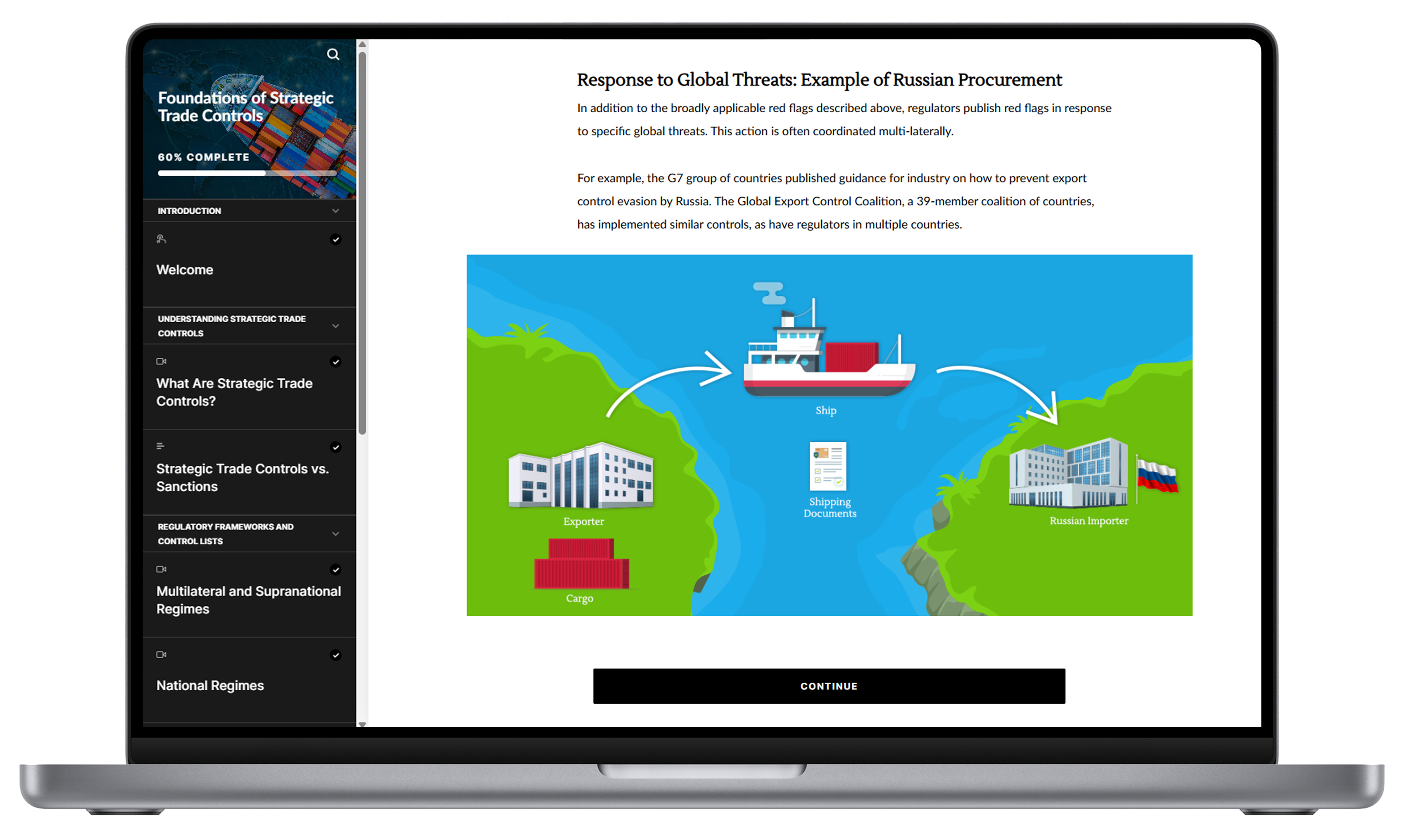
Our course Foundations of Strategic Trade Controls offers a comprehensive overview of how to understand and apply strategic trade control requirements, with a particular focus on those applicable to financial institutions.

Learn more and strengthen your compliance skills today.

Recommended Blogs

The Data Behind the Payment

September 30, 2026
Two changes have raised the bar on what banks can expect to see in a payment. Explore how corporate banks can put ISO 20022 and FATF's revised Recommendation 16 to work in transaction monitoring.
Read more
https://finintegrity.org/wp-content/uploads/2026/09/bg-the-data-behind-the-payment.jpg 1140 1800 IFI https://live-black-pebble.pantheonsite.io/wp-content/uploads/2023/12/GIFI-Placeholder2.png IFI2026-09-30 07:00:312026-09-29 10:35:23The Data Behind the Payment

August Monthly Sanctions and Export Controls Report

September 2, 2026
Explore this month’s Sanctions and Export Controls Update, highlighting IFI’s take on key developments from August 2026.
Read more
https://finintegrity.org/wp-content/uploads/2026/09/august-2026-se-report-bg.jpg 888 1184 IFI https://live-black-pebble.pantheonsite.io/wp-content/uploads/2023/12/GIFI-Placeholder2.png IFI2026-09-02 07:00:562026-09-01 13:19:24August Monthly Sanctions and Export Controls Report

The Judgment Gap in Market Abuse Compliance

August 25, 2026
While banks may know the set of rules outlined in the EU’s Market Abuse Regulation, exposure sits in the judgment calls related to delayed disclosure, information barriers, and market soundings. Dive into where the risk lies in each area.
Read more
https://finintegrity.org/wp-content/uploads/2026/08/judgement-gap-in-market-abuse-compliance-bg.jpg 841 1500 IFI https://live-black-pebble.pantheonsite.io/wp-content/uploads/2023/12/GIFI-Placeholder2.png IFI2026-08-25 07:00:462026-08-24 11:34:59The Judgment Gap in Market Abuse Compliance

Beyond the Course Library

August 12, 2026
A comprehensive compliance course library doesn’t guarantee prepared staff. Here's how forward-looking teams are moving beyond static course libraries toward learning that keeps pace with risk.
Read more
https://finintegrity.org/wp-content/uploads/2026/08/beyond-the-course-library-bg.jpg 1060 1800 IFI https://live-black-pebble.pantheonsite.io/wp-content/uploads/2023/12/GIFI-Placeholder2.png IFI2026-08-12 07:00:232026-08-11 12:42:07Beyond the Course Library

July Monthly Sanctions and Export Controls Report

August 4, 2026
Explore this month’s Sanctions and Export Controls Update, highlighting IFI’s take on key developments from July 2026.
Read more
https://finintegrity.org/wp-content/uploads/2026/08/july2026-se-bg.jpg 1177 1800 IFI https://live-black-pebble.pantheonsite.io/wp-content/uploads/2023/12/GIFI-Placeholder2.png IFI2026-08-04 07:00:452026-08-04 09:42:02July Monthly Sanctions and Export Controls Report

A Financial Institution’s Guide to Updated EU Market Abuse Regulation

July 29, 2026
MAR sounds straightforward until a real case tests it. This guide breaks down what the regulation covers, who it applies to, and the disclosure rules, court rulings, and regulatory guidance that shifted the ground under compliance teams in 2026.
Read more
https://finintegrity.org/wp-content/uploads/2026/07/guide-to-market-abuse-bg.jpg 1067 1600 IFI https://live-black-pebble.pantheonsite.io/wp-content/uploads/2023/12/GIFI-Placeholder2.png IFI2026-07-29 07:00:472026-07-28 12:45:11A Financial Institution’s Guide to Updated EU Market Abuse Regulation

The Hidden Factor Behind Effective Compliance Training

July 22, 2026
Discover why the success of a compliance training program depends on more than just quality content—it begins with how employees perceive its value. Learn how organizations can improve engagement, drive meaningful behavioral change, and demonstrate measurable training ROI by rethinking the learner experience.
Read more
https://finintegrity.org/wp-content/uploads/2026/07/hiddenfactor-compliance-bg.jpg 1200 1800 IFI https://live-black-pebble.pantheonsite.io/wp-content/uploads/2023/12/GIFI-Placeholder2.png IFI2026-07-22 07:00:132026-07-21 11:49:18The Hidden Factor Behind Effective Compliance Training

June 2026 Sanctions and Export Controls Report

July 1, 2026
Explore this month’s Sanctions and Export Controls Update, highlighting IFI’s take on key developments from June 2026.
Read more
https://finintegrity.org/wp-content/uploads/2026/06/june2026-se-report-bg.jpg 798 1200 IFI https://live-black-pebble.pantheonsite.io/wp-content/uploads/2023/12/GIFI-Placeholder2.png IFI2026-07-01 07:00:392026-07-02 10:28:58June 2026 Sanctions and Export Controls Report

Who Owns the Risk?

June 10, 2026
Organizations often take a one-size-fits-all approach to compliance training, despite each line of defense playing a different role in managing risk. Explore how training should be tailored to the responsibilities of the first line, second line, third line, and senior leadership.
Read more
https://finintegrity.org/wp-content/uploads/2026/06/who-owns-bg.png 667 1000 IFI https://live-black-pebble.pantheonsite.io/wp-content/uploads/2023/12/GIFI-Placeholder2.png IFI2026-06-10 07:00:162026-06-10 11:47:15Who Owns the Risk?
Previous Previous Previous Next Next Next
Download IFI Compliance Checklist Report

Follow Us on LinkedIn

Share this article

  • Share on LinkedIn
  • Share by Mail

Recent Articles

  • The Data Behind the Payment
  • Dirty Barrels
  • Real Estate, Real Risks
  • Iran and the Sanctions Landscape
  • August Monthly Sanctions and Export Controls Report

Explore Other Topics

  • Artificial Intelligence
  • Compliance Best Practices
  • Corruption
  • Digital Assets
  • Drug Trafficking
  • European Union
  • Fraud
  • Human Trafficking
  • Investigations
  • Money Laundering
  • Oil and Gas
  • Press Releases
  • Proliferation Finance
  • Regulation
  • Russia
  • Sanctions
  • Strategic Trade Controls / Export Controls
  • Terrorism

View Our Expert Insights

  • Compliance Training Readiness Checklist
  • Inside the Cartels and Chinese Money Laundering Networks Driving Criminal Economies
  • High Stakes – Casinos, Crime, and Cartels
  • From Cost Center to Risk Control
  • Leveraging Artificial Intelligence for Enhanced Financial Compliance
  • The Convergence of Sanctions and AML/CFT Regimes
  • Casinos and Cryptocurrency Driving Illicit Finance in East and Southeast Asia
  • Russia 2024: The Two-Year Anniversary of the Invasion
  • Human Trafficking Crisis after Russia’s Invasion of Ukraine
  • 2024 Trends Report
© DOLFIN Academy LLC 2026
  • Link to LinkedIn
  • Link to Youtube
  • Privacy Policy
Link to: AI vs. Human Judgment Link to: AI vs. Human Judgment AI vs. Human Judgment Link to: Cartels, Cash, and Capital Flows Link to: Cartels, Cash, and Capital Flows Cartels, Cash, and Capital Flows
Scroll to top Scroll to top Scroll to top

This site uses cookies. By continuing to browse the site, you are agreeing to our use of cookies.

Accept settingsHide notification onlySettings

Cookie and Privacy Settings


How we use cookies

We may request cookies to be set on your device. We use cookies to let us know when you visit our websites, how you interact with us, to enrich your user experience, and to customize your relationship with our website.

Click on the different category headings to find out more. You can also change some of your preferences. Note that blocking some types of cookies may impact your experience on our websites and the services we are able to offer.

Essential Website Cookies

These cookies are strictly necessary to provide you with services available through our website and to use some of its features.

Because these cookies are strictly necessary to deliver the website, refusing them will have impact how our site functions. You always can block or delete cookies by changing your browser settings and force blocking all cookies on this website. But this will always prompt you to accept/refuse cookies when revisiting our site.

We fully respect if you want to refuse cookies but to avoid asking you again and again kindly allow us to store a cookie for that. You are free to opt out any time or opt in for other cookies to get a better experience. If you refuse cookies we will remove all set cookies in our domain.

We provide you with a list of stored cookies on your computer in our domain so you can check what we stored. Due to security reasons we are not able to show or modify cookies from other domains. You can check these in your browser security settings.

Google Analytics Cookies

These cookies collect information that is used either in aggregate form to help us understand how our website is being used or how effective our marketing campaigns are, or to help us customize our website and application for you in order to enhance your experience.

If you do not want that we track your visit to our site you can disable tracking in your browser here:

Other external services

We also use different external services like Google Webfonts, Google Maps, and external Video providers. Since these providers may collect personal data like your IP address we allow you to block them here. Please be aware that this might heavily reduce the functionality and appearance of our site. Changes will take effect once you reload the page.

Google Webfont Settings:

Google Map Settings:

Google reCaptcha Settings:

Vimeo and Youtube video embeds:

Privacy Policy

You can read about our cookies and privacy settings in detail on our Privacy Policy Page.

Privacy Policy
Accept settingsHide notification only