• Link to LinkedIn
  • Link to Youtube
  • Sign In
  • Register
  • Subscribe
  • Contact
Institute for Financial Integrity
  • Training
    • eLearning Courses

      • Suite of interactive e-learning courses to educate and engage staff on core compliance topics

      • Learn More
    • Video Library

      • An online learning journey through the various domains of financial crime, explore our library of expert-led videos

      • Learn More
    • Training Services

      • Trusted compliance training design, development, and delivery tailored to your unique requirements

      • Learn More
    • Certifications
      • Certified Risk Management Specialist – Global Sanctions
      • Certified Financial Integrity Professional Program
  • Technology
    • DOLFIN

      • A platform that equips financial integrity professionals with the continuing education, expert insights, resources and tools needed to protect the integrity of the global financial system.

      • Learn More
    • AskFIN

      • A revolutionary, AI-powered tool seamlessly integrated with DOLFIN® — the world’s largest and most trusted library of curated resources on financial integrity topics.

      • Learn More
  • Insights
    • Insights
      • Articles
      • Reports & White Papers
      • Webinars
      • Subscribe
  • About Us
    • Who We Are
      • Our Story
      • Leadership
      • Press Releases
    • Who We Serve
      • Financial Institutions
      • Jurisdictions
      • Executives
      • Industry Professionals
  • Get a Demo
  • Menu Menu

AI vs. Human Judgment

Areas Where Financial Compliance Professionals Will Be Replaced or Empowered

📅 April 9, 2025

The AI Revolution in Financial Compliance

Artificial intelligence (AI) is making big waves in financial compliance, and it’s changing how things get done. As the rules around regulations become more complex and the amount of data to sift through grows, AI-driven tools are stepping in to handle much of the heavy lifting. But with all these advancements, one question keeps coming up: Will AI replace compliance professionals? Let’s explore where AI excels and where human judgment is crucial.

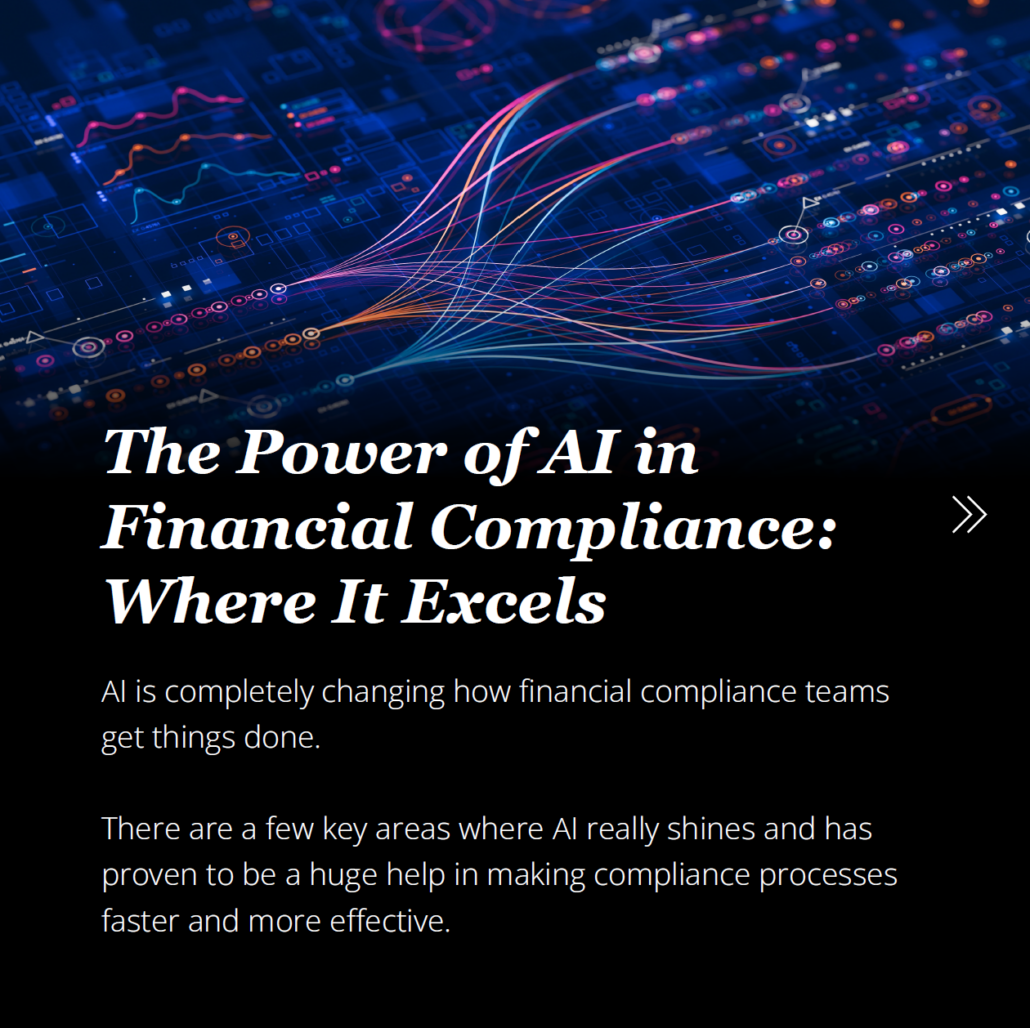
The Power of AI in Financial Compliance: Where It Excels

AI is completely changing how financial compliance teams get things done, and there are a few key areas where AI really shines and has proven to be a huge help in making compliance processes faster and more effective.

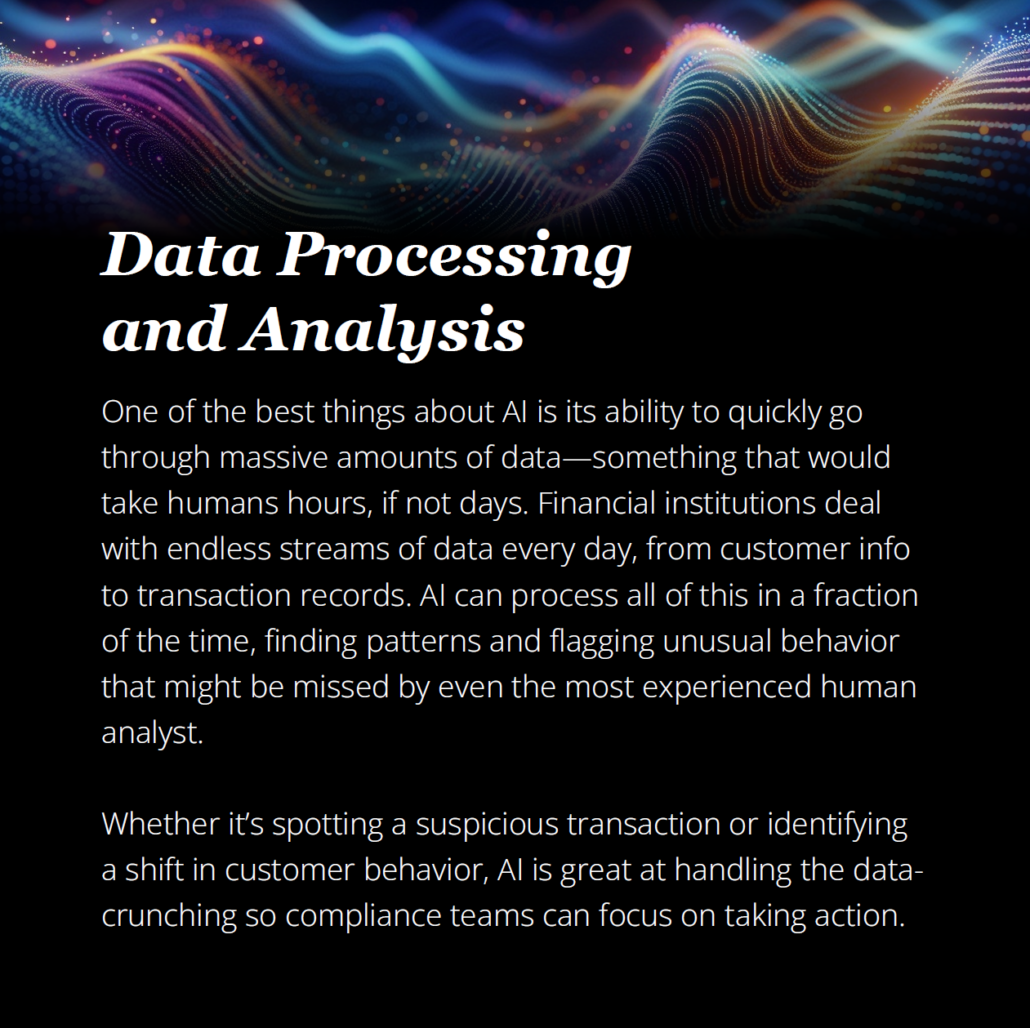
  • Data Processing and Analysis
    One of the best things about AI is its ability to quickly go through massive amounts of data—something that would take humans hours, if not days. Financial institutions deal with endless streams of data every day, from customer info to transaction records. AI can process all of this in a fraction of the time, finding patterns and flagging unusual behavior that might be missed by even the most experienced human analyst. Whether it’s spotting a suspicious transaction or identifying a shift in customer behavior, AI is great at handling the data-crunching so compliance teams can focus on taking action.
  • Transaction Monitoring
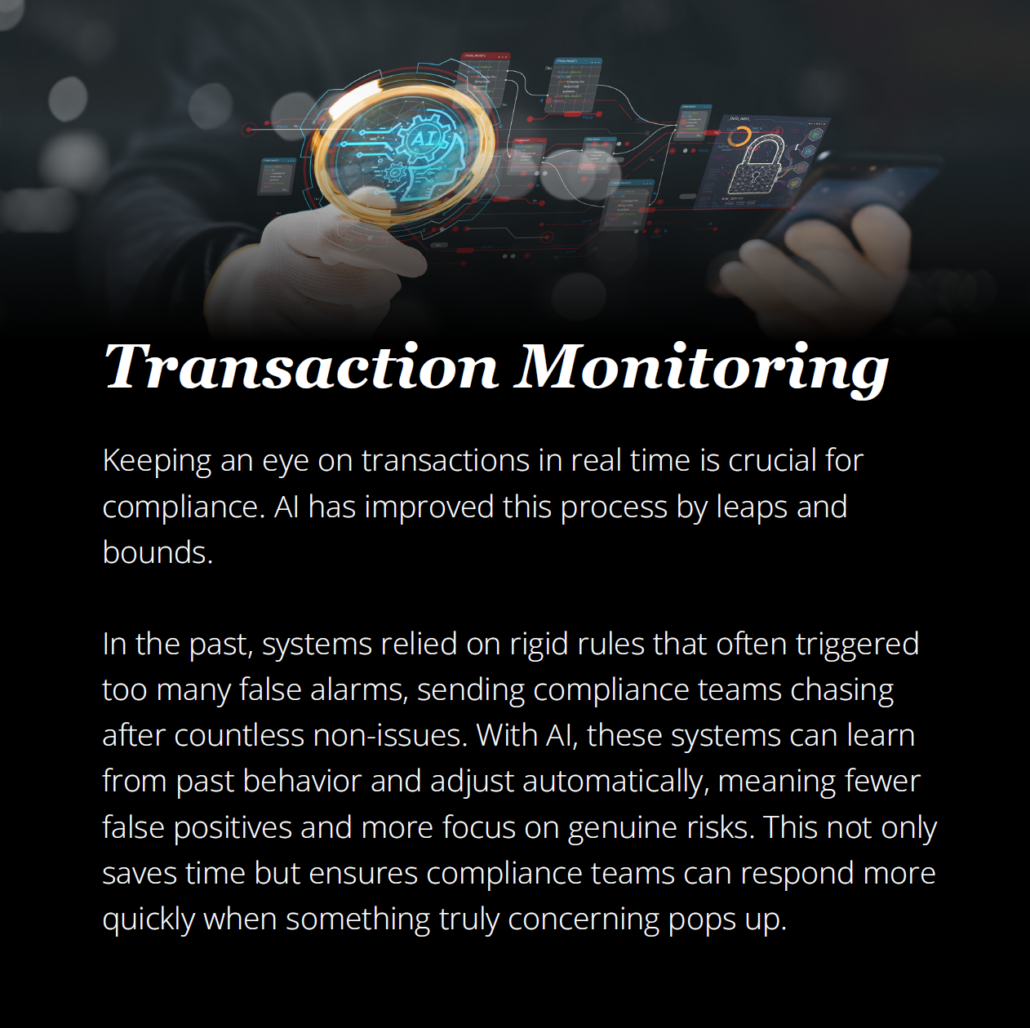
    Keeping an eye on transactions in real time is crucial for compliance. AI has improved this process by leaps and bounds. In the past, systems relied on rigid rules that often triggered too many false alarms, sending compliance teams chasing after countless non-issues. With AI, these systems can learn from past behavior and adjust automatically, meaning fewer false positives and more focus on genuine risks. This not only saves time but ensures compliance teams can respond more quickly when something truly concerning pops up.
  • Predictive Risk Assessment
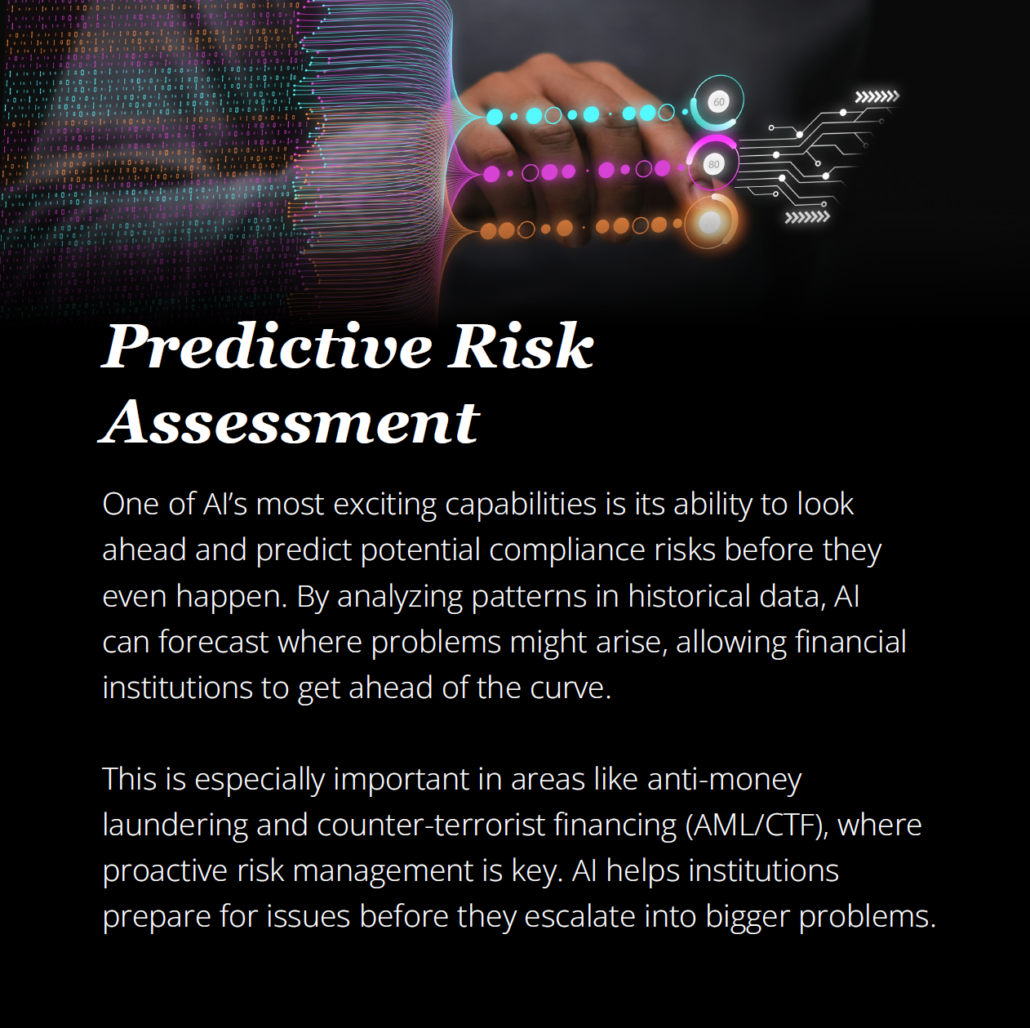
    One of AI’s most exciting capabilities is its ability to look ahead and predict potential compliance risks before they even happen. By analyzing patterns in historical data, AI can forecast where problems might arise, allowing financial institutions to get ahead of the curve. This is especially important in areas like anti-money laundering and counter-terrorist financing (AML/CTF), where proactive risk management is key. AI helps institutions prepare for issues before they escalate into bigger problems.
  • Regulatory Reporting Automation
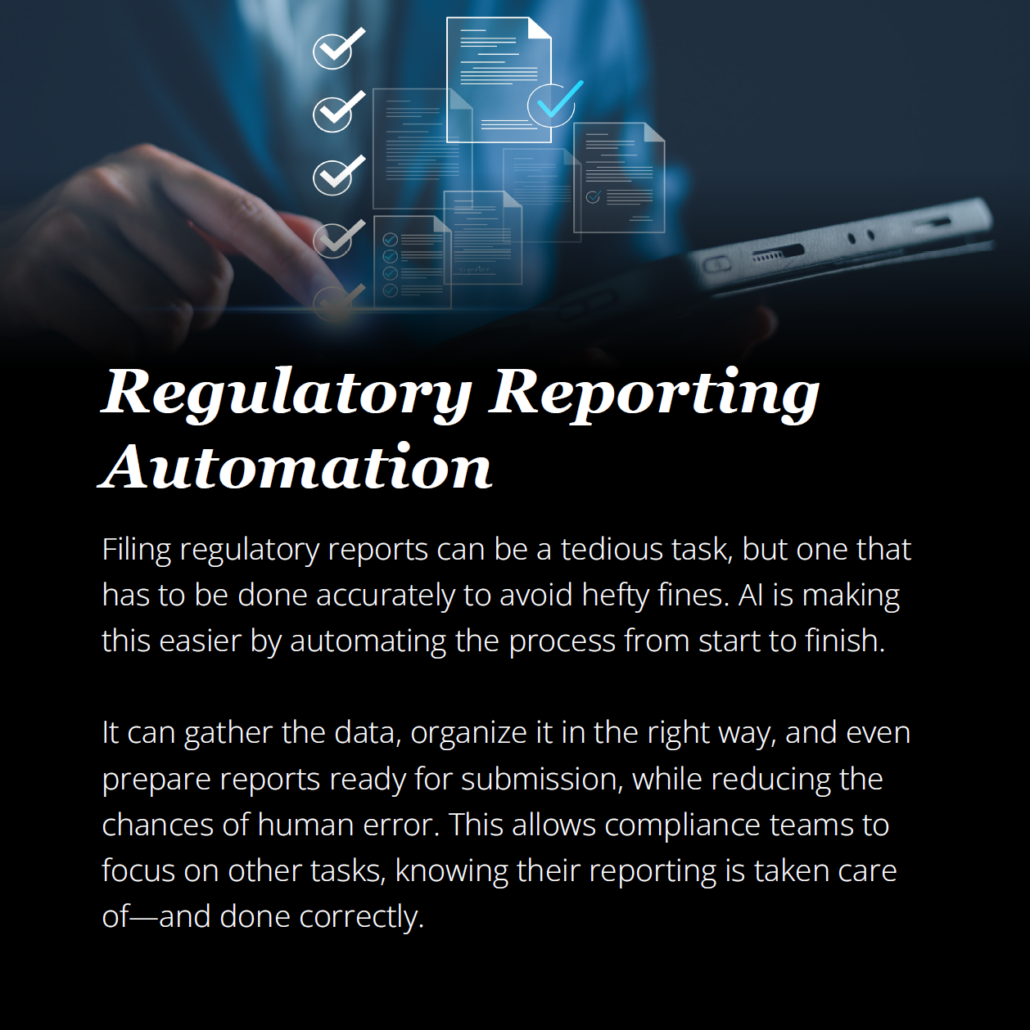
    Filing regulatory reports can be a tedious task, but one that has to be done accurately to avoid hefty fines. AI is making this easier by automating the process from start to finish. It can gather the data, organize it in the right way, and even prepare reports ready for submission, while reducing the chances of human error. This allows compliance teams to focus on other tasks, knowing their reporting is taken care of—and done correctly.

In all these areas, AI is a game-changer. It handles the heavy lifting, giving compliance teams more time and energy to focus on the things that really matter. But while AI excels in certain tasks, there are still areas where human judgment plays a critical role.

Previous Previous Previous Next Next Next
123456
Open image in lightbox: Screenshot 2025-07-17 133501 Open image in lightbox: Screenshot 2025-07-17 133501
Open image in lightbox: Screenshot 2025-07-17 133509 Open image in lightbox: Screenshot 2025-07-17 133509
Open image in lightbox: Screenshot 2025-07-17 133516 Open image in lightbox: Screenshot 2025-07-17 133516
Open image in lightbox: Screenshot 2025-07-17 133524 Open image in lightbox: Screenshot 2025-07-17 133524
Open image in lightbox: Screenshot 2025-07-17 133531 Open image in lightbox: Screenshot 2025-07-17 133531
Open image in lightbox: Screenshot 2025-07-17 133539 Open image in lightbox: Screenshot 2025-07-17 133539

The Human Element: Where Judgment Still Matters

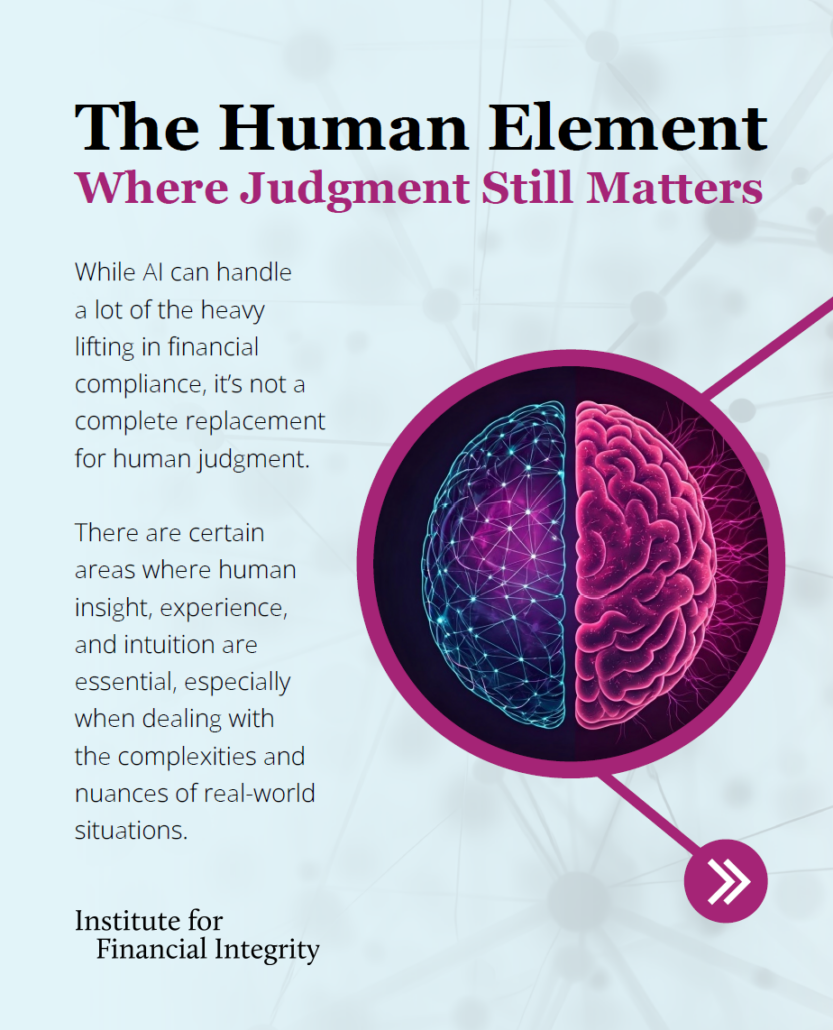
While AI can handle a lot of the heavy lifting in financial compliance, it’s not a complete replacement for human judgment. There are certain areas where human insight, experience, and intuition are essential, especially when dealing with the complexities and nuances of real-world situations.

  • Contextual Understanding
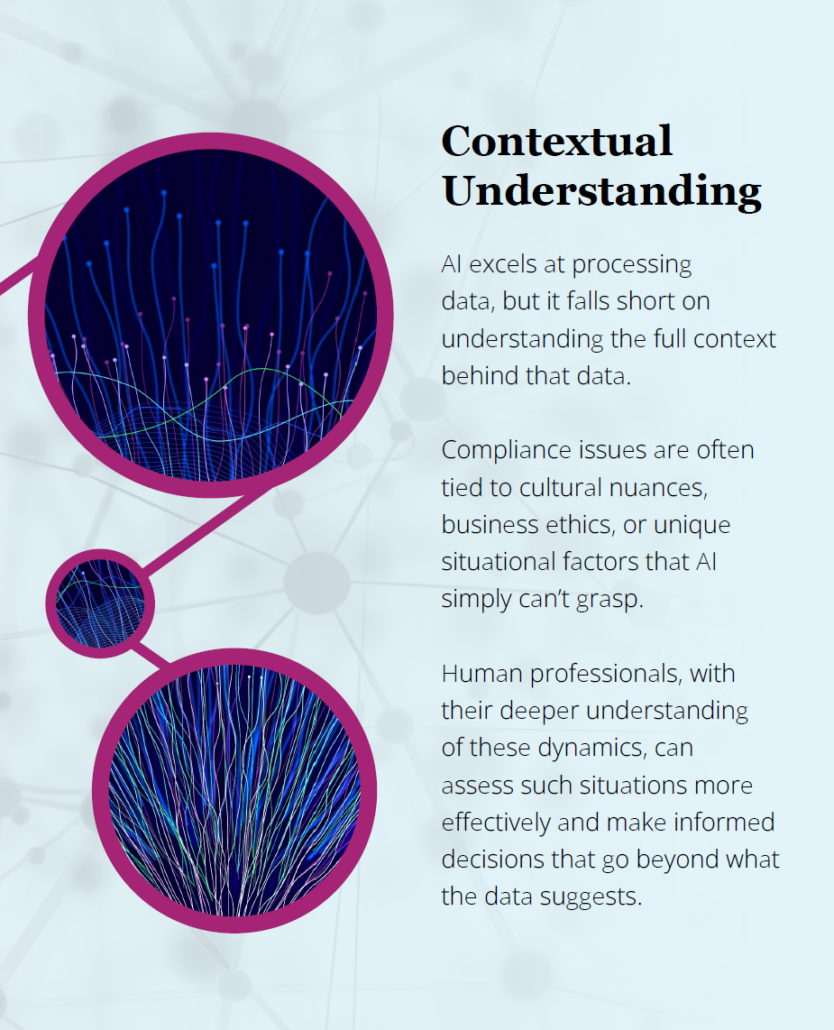
    AI excels at processing data, but it falls short when it comes to understanding the full context behind that data. Compliance issues are often tied to cultural nuances, business ethics, or unique situational factors that AI simply can’t grasp. For instance, what might be flagged as unusual by an algorithm could be completely normal in a specific cultural or business context. Human professionals, with their deeper understanding of these dynamics, are able to assess such situations more effectively and make informed decisions that go beyond what the data suggests.
  • Ethical Considerations
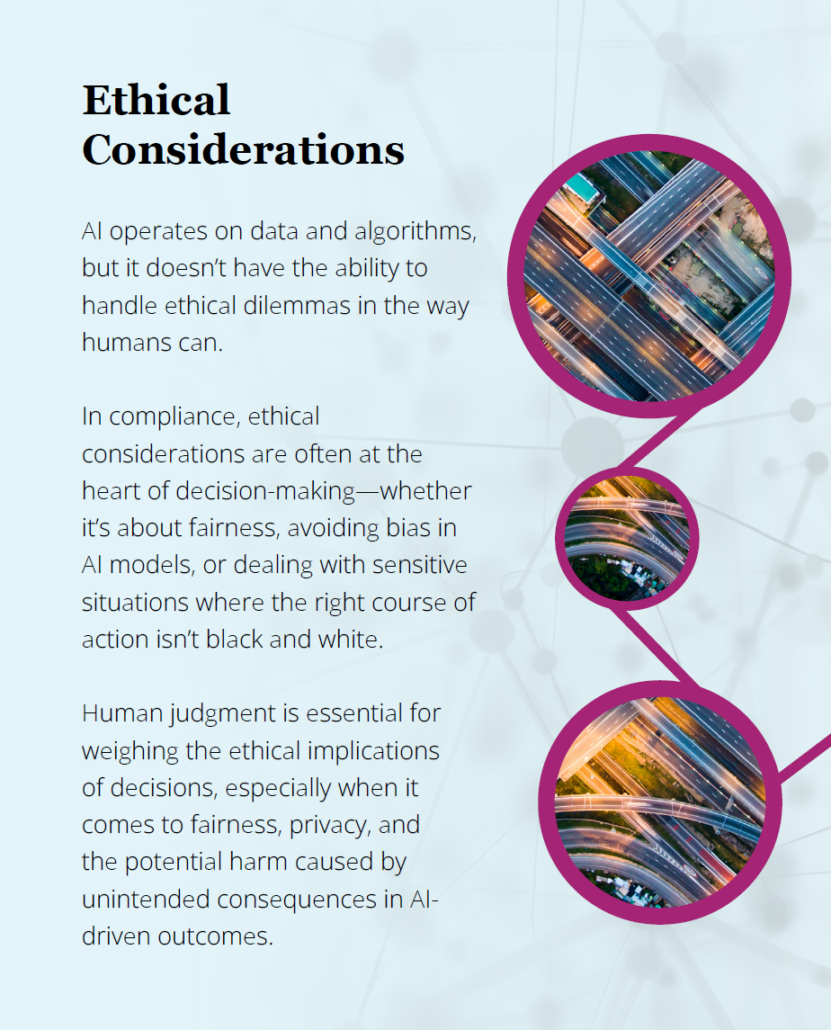
    AI operates on data and algorithms, but it doesn’t have the ability to handle ethical dilemmas in the way humans can. In compliance, ethical considerations are often at the heart of decision-making—whether it’s about fairness, avoiding bias in AI models, or dealing with sensitive situations where the right course of action isn’t black and white. Human judgment is essential for weighing the ethical implications of decisions, especially when it comes to fairness, privacy, and the potential harm caused by unintended consequences in AI-driven outcomes. Professionals can step in to ensure that these decisions are aligned with both regulatory standards and the organization’s moral compass.
  • Strategic Decision-Making
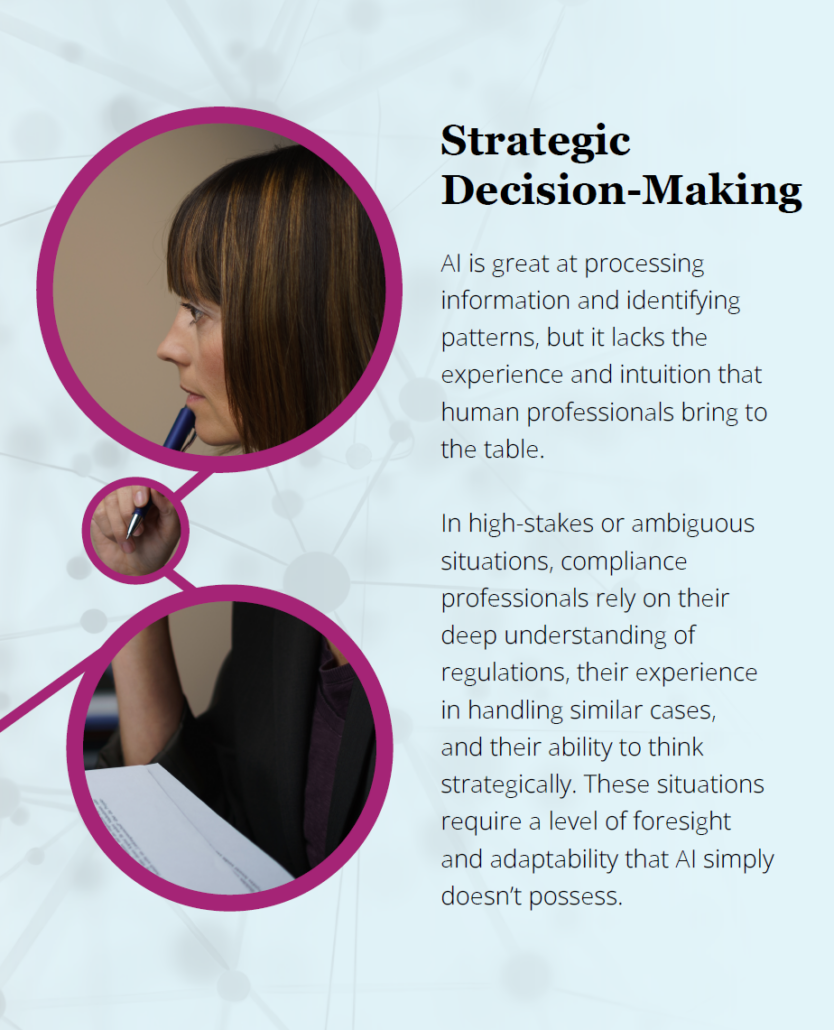
    AI is great at processing information and identifying patterns, but it lacks the experience and intuition that human professionals bring to the table. In high-stakes or ambiguous situations, compliance professionals rely on their deep understanding of regulations, their experience in handling similar cases, and their ability to think strategically. These situations require a level of foresight and adaptability that AI simply doesn’t possess. For example, when deciding whether to report a potential issue to regulators or how to handle a complex cross-border transaction, human insight is key to making the right call.
  • Handling Edge Cases
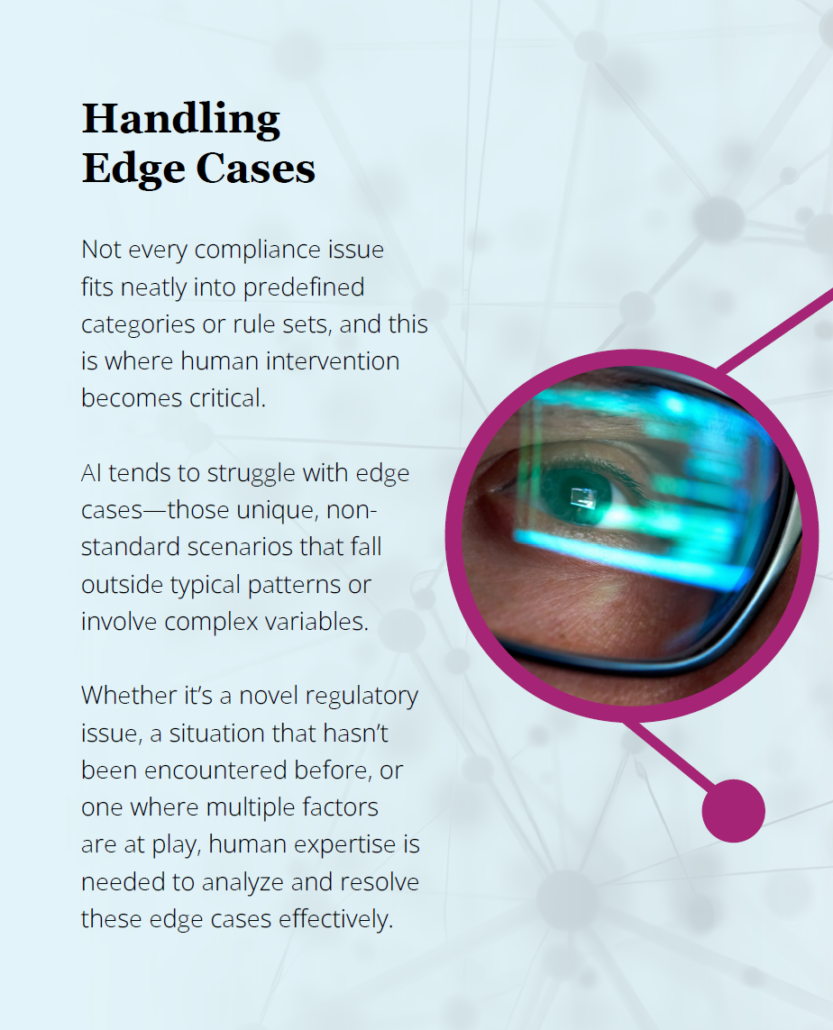
    Not every compliance issue fits neatly into predefined categories or rule sets, and this is where human intervention becomes critical. AI tends to struggle with edge cases—those unique, non-standard scenarios that fall outside of typical patterns or involve complex variables. These cases require professional judgment and the ability to interpret the finer details of a situation. Whether it’s a novel regulatory issue, a situation that hasn’t been encountered before, or one where multiple factors are at play, human expertise is needed to analyze and resolve these edge cases effectively.
Previous Previous Previous Next Next Next
12345
Open image in lightbox: Screenshot 2025-07-17 133650 Open image in lightbox: Screenshot 2025-07-17 133650
Open image in lightbox: Screenshot 2025-07-17 133700 Open image in lightbox: Screenshot 2025-07-17 133700
Open image in lightbox: Screenshot 2025-07-17 133711 Open image in lightbox: Screenshot 2025-07-17 133711
Open image in lightbox: Screenshot 2025-07-17 133722 Open image in lightbox: Screenshot 2025-07-17 133722
Open image in lightbox: Screenshot 2025-07-17 133730 Open image in lightbox: Screenshot 2025-07-17 133730

The Big Question: Will AI Replace Compliance Professionals?

As AI continues to transform the world of financial compliance, many professionals are asking the big question: Is AI going to take our jobs? While AI will certainly change how compliance professionals work, the answer isn’t a simple yes or no.

  • Yes, Some Jobs Will be Replaced
    The truth is just like in other industries, AI will inevitably take over certain manual tasks within compliance, especially those that are highly repetitive. Tasks such as data entry, basic transaction monitoring, and initial report drafting are prime examples of work that AI can handle more efficiently. By automating these routine jobs, AI frees up resources within organizations, allowing compliance professionals to focus on roles that demand human insight.
  • AI as a Tool for New Opportunities
    However, rather than simply reducing the need for compliance staff, AI will also open up new opportunities. As AI becomes integrated into compliance processes, there will be an increasing need for professionals skilled in AI oversight, risk assessment, ethical governance, and strategy. New roles will emerge that focus on interpreting AI-driven insights, managing compliance technology, and ensuring that AI systems align with regulatory standards and organizational values.
  • Upskilling for the Evolving Role
    As AI becomes a bigger part of compliance, professionals will need to adapt by learning how to work effectively with AI tools. This doesn’t mean becoming an AI expert, but it does mean understanding how to guide these tools, interpret AI-generated insights, and apply their judgment in areas where AI falls short. Upskilling will be key, as professionals who embrace these new skills will be better equipped to take on roles in AI oversight, strategic governance, and regulatory interpretation—areas that will only grow in importance as AI continues to advance.

Striking the Balance: A Collaborative Future

As mentioned, AI is reshaping compliance work, potentially replacing repetitive tasks and providing powerful insights. But the future of financial compliance isn’t about AI replacing people—it’s about combining the strengths of AI and human professionals, with each contributing their strengths in the following ways:

  • AI-Assisted Decision-Making
    AI can process data and flag issues quickly, but compliance professionals are essential for making the final decisions. AI handles the routine work, while humans apply context, judgment, and strategic thinking to evaluate complex situations.
  • Human-in-the-Loop Models
    “Human-in-the-loop” AI models keep professionals involved at critical decision points. AI automates initial tasks, but humans intervene for final reviews, ensuring compliance with ethical and regulatory standards. This partnership ensures both speed and fairness.
  • AI for Continuous Learning
    AI is a powerful tool for keeping compliance teams updated on new regulations and emerging risks. It delivers real-time insights, allowing professionals to focus on applying this knowledge in real-world contexts, enhancing their adaptability to changes in regulations.

Compliance professionals shouldn’t be too worried about losing their jobs to AI—instead, they should embrace it, not fear it. AI is a helpful tool that takes over the repetitive tasks, freeing up time for professionals to focus on the more complex, important work like understanding regulations, handling ethical issues, and building client relationships. These are areas where AI can’t compete with human skills. As AI evolves, compliance roles will shift more toward strategy and governance. By embracing AI while adapting and upskilling, professionals will stay at the heart of shaping the future of compliance.
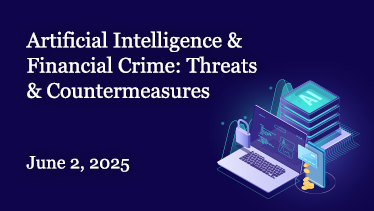
Webinar Recording

Artificial Intelligence & Financial Crime: Threats & Countermeasures

AI is increasingly used to enable fraud, and the methods used are rapidly increasing in sophistication, making them more difficult to prevent and detect. On the other side, AI provides the potential for significant enhancements to institutions’ counter illicit finance and compliance capabilities.

To respond effectively to AI-enabled threats while gaining the advantages of AI-enabled compliance tech, organizations in both the public and private sector must increase the AI knowledge and capacity of their staff, stakeholders, and clients.

Led by industry experts, this webinar explores the evolution of AI-enabled frauds using recent case studies, reviews the use of AI as a key countermeasure to respond to threats, and offers actions organizations can take.
Watch the Recording

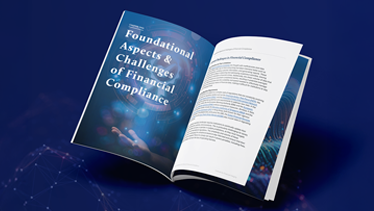
Expert Insight Report

Leveraging Artificial Intelligence for Enhanced Financial Compliance

AI is making big waves in financial compliance, and it’s changing how things get done. As regulations become increasingly complex and the amount of data to sift through grows, AI-driven tools are stepping in to handle much of the heavy lifting. Continue reading in our latest report in which we discuss strategies, applications, and future trends.

  • Foundational Aspects & Challenges of Financial Compliance
  • Key Strategies for Implementation
  • Applications & Real-World Examples
  • Navigating the Risks & Rewards of AI in Compliance
  • Regulatory Framework & Evolving Regulations
  • The Collaborative Future of AI & the Human Workforce
  • Future Trends
View the Report

Recommended Blogs

The Data Behind the Payment

September 30, 2026
Two changes have raised the bar on what banks can expect to see in a payment. Explore how corporate banks can put ISO 20022 and FATF's revised Recommendation 16 to work in transaction monitoring.
Read more
https://finintegrity.org/wp-content/uploads/2026/09/bg-the-data-behind-the-payment.jpg 1140 1800 IFI https://live-black-pebble.pantheonsite.io/wp-content/uploads/2023/12/GIFI-Placeholder2.png IFI2026-09-30 07:00:312026-09-29 10:35:23The Data Behind the Payment

The Judgment Gap in Market Abuse Compliance

August 25, 2026
While banks may know the set of rules outlined in the EU’s Market Abuse Regulation, exposure sits in the judgment calls related to delayed disclosure, information barriers, and market soundings. Dive into where the risk lies in each area.
Read more
https://finintegrity.org/wp-content/uploads/2026/08/judgement-gap-in-market-abuse-compliance-bg.jpg 841 1500 IFI https://live-black-pebble.pantheonsite.io/wp-content/uploads/2023/12/GIFI-Placeholder2.png IFI2026-08-25 07:00:462026-08-24 11:34:59The Judgment Gap in Market Abuse Compliance

Beyond the Course Library

August 12, 2026
A comprehensive compliance course library doesn’t guarantee prepared staff. Here's how forward-looking teams are moving beyond static course libraries toward learning that keeps pace with risk.
Read more
https://finintegrity.org/wp-content/uploads/2026/08/beyond-the-course-library-bg.jpg 1060 1800 IFI https://live-black-pebble.pantheonsite.io/wp-content/uploads/2023/12/GIFI-Placeholder2.png IFI2026-08-12 07:00:232026-08-11 12:42:07Beyond the Course Library

July Monthly Sanctions and Export Controls Report

August 4, 2026
Explore this month’s Sanctions and Export Controls Update, highlighting IFI’s take on key developments from July 2026.
Read more
https://finintegrity.org/wp-content/uploads/2026/08/july2026-se-bg.jpg 1177 1800 IFI https://live-black-pebble.pantheonsite.io/wp-content/uploads/2023/12/GIFI-Placeholder2.png IFI2026-08-04 07:00:452026-08-04 09:42:02July Monthly Sanctions and Export Controls Report

A Financial Institution’s Guide to Updated EU Market Abuse Regulation

July 29, 2026
MAR sounds straightforward until a real case tests it. This guide breaks down what the regulation covers, who it applies to, and the disclosure rules, court rulings, and regulatory guidance that shifted the ground under compliance teams in 2026.
Read more
https://finintegrity.org/wp-content/uploads/2026/07/guide-to-market-abuse-bg.jpg 1067 1600 IFI https://live-black-pebble.pantheonsite.io/wp-content/uploads/2023/12/GIFI-Placeholder2.png IFI2026-07-29 07:00:472026-07-28 12:45:11A Financial Institution’s Guide to Updated EU Market Abuse Regulation

The Hidden Factor Behind Effective Compliance Training

July 22, 2026
Discover why the success of a compliance training program depends on more than just quality content—it begins with how employees perceive its value. Learn how organizations can improve engagement, drive meaningful behavioral change, and demonstrate measurable training ROI by rethinking the learner experience.
Read more
https://finintegrity.org/wp-content/uploads/2026/07/hiddenfactor-compliance-bg.jpg 1200 1800 IFI https://live-black-pebble.pantheonsite.io/wp-content/uploads/2023/12/GIFI-Placeholder2.png IFI2026-07-22 07:00:132026-07-21 11:49:18The Hidden Factor Behind Effective Compliance Training

June 2026 Sanctions and Export Controls Report

July 1, 2026
Explore this month’s Sanctions and Export Controls Update, highlighting IFI’s take on key developments from June 2026.
Read more
https://finintegrity.org/wp-content/uploads/2026/06/june2026-se-report-bg.jpg 798 1200 IFI https://live-black-pebble.pantheonsite.io/wp-content/uploads/2023/12/GIFI-Placeholder2.png IFI2026-07-01 07:00:392026-07-02 10:28:58June 2026 Sanctions and Export Controls Report

Who Owns the Risk?

June 10, 2026
Organizations often take a one-size-fits-all approach to compliance training, despite each line of defense playing a different role in managing risk. Explore how training should be tailored to the responsibilities of the first line, second line, third line, and senior leadership.
Read more
https://finintegrity.org/wp-content/uploads/2026/06/who-owns-bg.png 667 1000 IFI https://live-black-pebble.pantheonsite.io/wp-content/uploads/2023/12/GIFI-Placeholder2.png IFI2026-06-10 07:00:162026-06-10 11:47:15Who Owns the Risk?

May 2026 Sanctions and Export Controls Update

June 3, 2026
Explore this month’s Sanctions and Export Controls Update, highlighting IFI’s take on key developments from May 2026.
Read more
https://finintegrity.org/wp-content/uploads/2026/06/may-bg-2026-se.jpg 1200 1800 IFI https://live-black-pebble.pantheonsite.io/wp-content/uploads/2023/12/GIFI-Placeholder2.png IFI2026-06-03 07:00:142026-06-02 14:36:12May 2026 Sanctions and Export Controls Update
Previous Previous Previous Next Next Next
Download IFI Compliance Checklist Report

Follow Us on LinkedIn

Share this article

  • Share on LinkedIn
  • Share by Mail

Recent Articles

  • The Data Behind the Payment
  • Dirty Barrels
  • Real Estate, Real Risks
  • Iran and the Sanctions Landscape
  • August Monthly Sanctions and Export Controls Report

Explore Other Topics

  • Artificial Intelligence
  • Compliance Best Practices
  • Corruption
  • Digital Assets
  • Drug Trafficking
  • European Union
  • Fraud
  • Human Trafficking
  • Investigations
  • Money Laundering
  • Oil and Gas
  • Press Releases
  • Proliferation Finance
  • Regulation
  • Russia
  • Sanctions
  • Strategic Trade Controls / Export Controls
  • Terrorism

View Our Expert Insights

  • Compliance Training Readiness Checklist
  • Inside the Cartels and Chinese Money Laundering Networks Driving Criminal Economies
  • High Stakes – Casinos, Crime, and Cartels
  • From Cost Center to Risk Control
  • Leveraging Artificial Intelligence for Enhanced Financial Compliance
  • The Convergence of Sanctions and AML/CFT Regimes
  • Casinos and Cryptocurrency Driving Illicit Finance in East and Southeast Asia
  • Russia 2024: The Two-Year Anniversary of the Invasion
  • Human Trafficking Crisis after Russia’s Invasion of Ukraine
  • 2024 Trends Report
© DOLFIN Academy LLC 2026
  • Link to LinkedIn
  • Link to Youtube
  • Privacy Policy
Link to: Syndicates of Terror Link to: Syndicates of Terror Syndicates of Terror Link to: Intensifying Focus on Export Control Compliance by Banks Link to: Intensifying Focus on Export Control Compliance by Banks Intensifying Focus on Export Control Compliance by Banks
Scroll to top Scroll to top Scroll to top

This site uses cookies. By continuing to browse the site, you are agreeing to our use of cookies.

Accept settingsHide notification onlySettings

Cookie and Privacy Settings


How we use cookies

We may request cookies to be set on your device. We use cookies to let us know when you visit our websites, how you interact with us, to enrich your user experience, and to customize your relationship with our website.

Click on the different category headings to find out more. You can also change some of your preferences. Note that blocking some types of cookies may impact your experience on our websites and the services we are able to offer.

Essential Website Cookies

These cookies are strictly necessary to provide you with services available through our website and to use some of its features.

Because these cookies are strictly necessary to deliver the website, refusing them will have impact how our site functions. You always can block or delete cookies by changing your browser settings and force blocking all cookies on this website. But this will always prompt you to accept/refuse cookies when revisiting our site.

We fully respect if you want to refuse cookies but to avoid asking you again and again kindly allow us to store a cookie for that. You are free to opt out any time or opt in for other cookies to get a better experience. If you refuse cookies we will remove all set cookies in our domain.

We provide you with a list of stored cookies on your computer in our domain so you can check what we stored. Due to security reasons we are not able to show or modify cookies from other domains. You can check these in your browser security settings.

Google Analytics Cookies

These cookies collect information that is used either in aggregate form to help us understand how our website is being used or how effective our marketing campaigns are, or to help us customize our website and application for you in order to enhance your experience.

If you do not want that we track your visit to our site you can disable tracking in your browser here:

Other external services

We also use different external services like Google Webfonts, Google Maps, and external Video providers. Since these providers may collect personal data like your IP address we allow you to block them here. Please be aware that this might heavily reduce the functionality and appearance of our site. Changes will take effect once you reload the page.

Google Webfont Settings:

Google Map Settings:

Google reCaptcha Settings:

Vimeo and Youtube video embeds:

Privacy Policy

You can read about our cookies and privacy settings in detail on our Privacy Policy Page.

Privacy Policy
Accept settingsHide notification only