• Link to LinkedIn
  • Link to Youtube
  • Sign In
  • Register
  • Subscribe
  • Contact
Institute for Financial Integrity
  • Training
    • eLearning Courses

      • Suite of interactive e-learning courses to educate and engage staff on core compliance topics

      • Learn More
    • Video Library

      • An online learning journey through the various domains of financial crime, explore our library of expert-led videos

      • Learn More
    • Training Services

      • Trusted compliance training design, development, and delivery tailored to your unique requirements

      • Learn More
    • Certifications
      • Certified Risk Management Specialist – Global Sanctions
      • Certified Financial Integrity Professional Program
  • Technology
    • DOLFIN

      • A platform that equips financial integrity professionals with the continuing education, expert insights, resources and tools needed to protect the integrity of the global financial system.

      • Learn More
    • AskFIN

      • A revolutionary, AI-powered tool seamlessly integrated with DOLFIN® — the world’s largest and most trusted library of curated resources on financial integrity topics.

      • Learn More
  • Insights
    • Insights
      • Articles
      • Reports & White Papers
      • Webinars
      • Subscribe
  • About Us
    • Who We Are
      • Our Story
      • Leadership
      • Press Releases
    • Who We Serve
      • Financial Institutions
      • Jurisdictions
      • Executives
      • Industry Professionals
  • Get a Demo
  • Menu Menu

OFAC’s Compliance Guidance in Action

Reviewing OFAC’s Five Compliance Pillars on the Five-Year Anniversary

📅 June 18, 2024

The Treasury Department’s Office of Foreign Assets Control (OFAC) five years ago published its Framework for OFAC Compliance Commitments (“OFAC Compliance Guidance”). This guidance remains the most comprehensive articulation of OFAC’s compliance expectations to date. Although it notably stopped short of mandating a sanctions compliance program (SCP), recent enforcement actions demonstrate the implications of not having an SCP in place.

  • U.S. regulators in November 2023 reached a record settlement with the world’s largest cryptocurrency exchange, Binance. The company agreed to pay more than $968 million to settle its potential civil liability for more than 1.5 million apparent violations of multiple sanctions programs. In its settlement agreement, OFAC noted that Binance failed to establish an SCP at the time it began operations in 2017, and when it created a sanctions compliance program in 2018, the efforts remained inadequate and ineffective.
  • OFAC in May 2023 settled with cosmetics company Murad LLC, which agreed to pay $3.3 million to settle its potential civil liability for an apparent violation of Treasury’s Iran sanctions. OFAC assessed that the company’s compliance deficiencies, including its lack of an SCP, contributed to the violations.

Aggravating and Mitigating Factors

Although OFAC recognizes that its regulations do not require a formal sanctions compliance program, it makes clear in its guidance and enforcement actions that lack of an effective compliance program is a root cause for sanctions violations and a factor in pursuing enforcement actions. At the same time, OFAC has considered the existence and implementation of an SCP as a mitigating factor when calculating financial penalties for violations.

  • An examination of OFAC’s settlements since publicizing the Guidelines shows that the complete lack of a SCP was one of the root causes of the sanctions violations identified during the course of the investigation in nine—or 11 percent—of the settlements. In addition, OFAC frequently identified this element as an aggravating factor in its analysis of the General Factors associated with such administrative actions, according to Treasury.
  • Microsoft in April 2023, agreed to pay a nearly $3 million settlement for potential violations of multiple OFAC sanctions programs. The penalty was a fraction of the more than $404 million statutory maximum civil monetary penalty applicable in the case, and OFAC noted the company’s self-initiated lookback of transactions upon discovering possible violations and significant remedial measures Microsoft undertook to improve its already robust SCP.
  • OFAC in a July 2020 settlement noted Amazon’s significant remedial measures to address its sanctions screening deficiencies, including investing “substantial resources” to improve the company’s overall compliance program as a mitigating factor. The Washington-based e-commerce giant agreed to pay $134,523 to settle its potential civil liability for apparent violations of multiple OFAC sanctions programs. The statutory maximum civil monetary penalty amount for Amazon’s apparent violations was more than $1billion.

Russia’s War Highlights Sanctions and AML Convergence

The OFAC Compliance Guidance is more relevant than ever as sanctions are being used more aggressively in the wake of Russia’s full-scale invasion of Ukraine, including by targeting central banks, companies with significant market shares in major industries, and sanctions evaders who use front and shell companies to hide their illicit activities.

Russia’s war against Ukraine has complicated compliance efforts with more than 18,000 individual designations imposed on Russian persons and companies by global powers since the invasion began in February 2022. In addition to blocking sanctions, compliance officers must also monitor strategic trade control developments, additions to the Bureau of Industry and Security’s (BIS) Entity List, sectoral sanctions, secondary sanctions, new embargoes, and violations of the $60 per barrel price cap on Russian-origin oil.

AML regimes, once seen as separate from sanctions compliance programs, can help U.S. firms and financial institutions enhance their compliance and financial risk management. U.S. financial institutions and other firms should consider their compliance programs holistically, linking their AML/CFT, trade finance, and sanctions compliance efforts to share information and analysis. Treasury during the past two years stressed the importance of implementing customer due diligence (CDD) procedures and other AML controls to mitigate sanctions risk.

  • In a speech at an anti-money laundering conference in October 2023, now-former Assistant Secretary for Terrorist Financing and Financial Crimes Elizabeth Rosenberg, stressed the importance of effective AML/CFT and sanctions programs to deprive Russia of its military-industrial resources. She highlighted that sanctions and AML/CFT regimes in the United States are linked and that continued siloing of AML/CFT and sanctions teams at some financial institutions can lead to witting or inadvertent violations.
  • In a sanctions advisory in December 2023, OFAC directed financial institutions to identify and minimize their exposure to activity involving Russia’s military-industrial base, including conducting customer due diligence, and using their AML controls to minimize the risk of secondary sanctions after President Biden signed EO 14114.
  • OFAC’s guidance for an effective SCP also stresses that an organization may conduct an assessment of customers, supply chains, intermediaries, and counterparties; the products and services it offers; and its geographic locations. These assessments are consistent with guidance FinCEN has been issuing that help identify indicators of money laundering, as well as identify sanctions evasion.

Both sanctions and AML compliance require heightened transparency, accountability, and information-sharing. AML and sanctions programs share essential elements or pillars and associated red flags. FinCEN in March 2022 issued an alert advising vigilance for potential Russian sanctions evasion attempts. The agency highlighted select indicators common to both money laundering and sanctions evasion.

🚩 The use of corporate vehicles and legal arrangements to obscure ownership, the source of funds, and countries involved.

🚩 The use of shell companies and third parties to shield the involvement of sanctioned persons in the transaction.

🚩 Jurisdictions previously associated with Russian financial flows that are identified as having a notable recent increase in new company formations.

🚩 Non-routine foreign exchange transactions that may indirectly involve sanctioned Russian financial institutions, including transactions that are inconsistent with activity over the prior 12 months.

The Five SCP Pillars

OFAC’s “five-pillar” framework for compliance programs, which is similar to the one required for AML programs in most jurisdictions, continues to be the foundational guide for implementing strong SCPs.

Senior management commitment. Like other regulatory agencies, OFAC expects senior management to review and approve its company’s program, maintain an autonomous and well-resourced compliance unit, and promote a culture of compliance within its organization. This means designating a specific OFAC compliance officer (who could also serve in other compliance functions, such as the Bank Secrecy Act officer) and ensuring that compliance staff sufficiently understand OFAC regulations and can identify OFAC-related issues, risks, and prohibited activities.

  • Senior Binance management knew about and permitted the presence of both U.S. and embargoed jurisdiction users on its platform, according to OFAC’s November settlement. Binance management also undermined its own compliance function, encouraging users to circumvent the company’s ostensible controls. In a Finding of Violation to Mashreq bank in 2021, OFAC also noted that some senior-level Mashreq branch employees had actual knowledge of the conduct giving rise to the violations.

Routine risk assessments. Organizations should conduct routine risk assessments to help identify potential sanctions risks.

  • OFAC’s settlement with Murad LLC highlights not just the importance of conducting sufficient pre- and post-acquisition due diligence, but also conducting risk assessments to identify and remediate compliance deficiencies. Unilever US, which acquired the company in 2015, did not know and was not informed about Murad’s unauthorized exports to or involvement with Iran and did not discover this conduct during its preacquisition due diligence. Murad’s website in Iran, including an Iranian domain, was active for more than three years following the acquisition, according to the settlement. OFAC also noted that the compliance reporting structures Murad had in place following its acquisition by Unilever US were inadequate in relation to the sanctions risks the company faced.

Internal controls. Compliance efforts that “identify, interdict, escalate, report (as appropriate), and keep records” of activity implicating OFAC regulations should go beyond basic screening requirements, depending on the organization’s risk assessment. Internal controls must be monitored for effectiveness and any weaknesses addressed through “immediate and effective action” targeting root causes.

  • OFAC’s settlement with Microsoft reflects the significant remedial measures the company undertook after it discovered apparent sanctions violations during the course of a self-initiated lookback. The company examined the root causes of the violations, improved its trade compliance program and increased its resources, and improved the methods by which it researches potential sanctions matches. Microsoft not only enhanced the procedures it used to respond to matches and expanded the scope and volume of data screened, but also deployed an internal investigative team with multiple linguistic expertise to aid its contractors and full-time employees in reviewing and researching potential restricted-party hits.

Testing and auditing. Organizations should have a comprehensive, independent, and objective testing or audit function to gauge the effectiveness of internal controls. Where there are negative findings, OFAC expects “immediate and effective” remedial action.

  • After Amazon was penalized for sanctions violations in July 2020, the company employed internal and third-party sources to conduct a thorough review of Amazon’s sanctions compliance program and its automated screening systems to address the screening failures that gave rise to the apparent violations. In addition, Amazon enhanced its sanctioned jurisdiction Internet Protocol (IP) blocking controls and implemented automated processes to update continually its mapping of IP ranges associated with sanctioned jurisdictions.

Training. An organization’s sanctions compliance program requires sanctions-specific training that is tailored for different employees and scoped to the organization’s particular products, services, clients, and geographic areas.

  • Both Microsoft and Amazon implemented additional training processes for their teams to help mitigate their compliance failures. Microsoft began providing detailed sanctions compliance training for certain employees and jurisdictions, which is designed to take account of specific vulnerabilities identified throughout this disclosure process. Amazon improved its training programs by providing training tailored to the roles of specific teams and specialized ad-hoc training to personnel responsible for sanctions and export control compliance.

SCPs Applicable to Non-US Firms

OFAC “strongly” encourages anyone subject to U.S. jurisdiction—as well as foreign entities that conduct business in or with the United States, U.S. persons, or entities using U.S.-origin goods or services—to implement a sanctions compliance program.  OFAC stated in the 2019 guidance what has long been seen in practice through high-profile civil and criminal cases against non-U.S. persons who rely on U.S. financial institutions to perform U.S. dollar-clearing activities or who use U.S.-origin products or services in contravention of U.S. sanctions prohibitions. In practice, this means that non-U.S. persons should have programs in place to determine if a U.S. jurisdictional nexus exists for any given transaction and, if so, to apply relevant U.S. sanctions requirements. These compliance programs are important for any person engaged in international trade, given the central role of the United States and the U.S. dollar in the global financial system and international supply chains.

Conclusion

Five years after OFAC released its framework for compliance, the guidance is even more critical because of Russia’s invasion of Ukraine. Compliance officers face an increasingly complex sanctions environment and must continue to understand and mitigate these risks by using the resources and tools common to AML and sanctions to target illicit conduct. Including sanctions compliance in an AML compliance program and sharing information between teams will help enhance both compliance efforts. The Institute for Financial Integrity’s proprietary Dedicated Online Financial Integrity Network (DOLFIN) platform features learning plans, policy alerts, expert insights, and other continuing education resources that focus on regulatory requirements, risk mitigation, and strategies to counter financial crime. DOLFIN also offers certification programs in Financial Crimes Risk Management, global sanctions, and other critical programs to help users remain compliant and enhance their expertise.
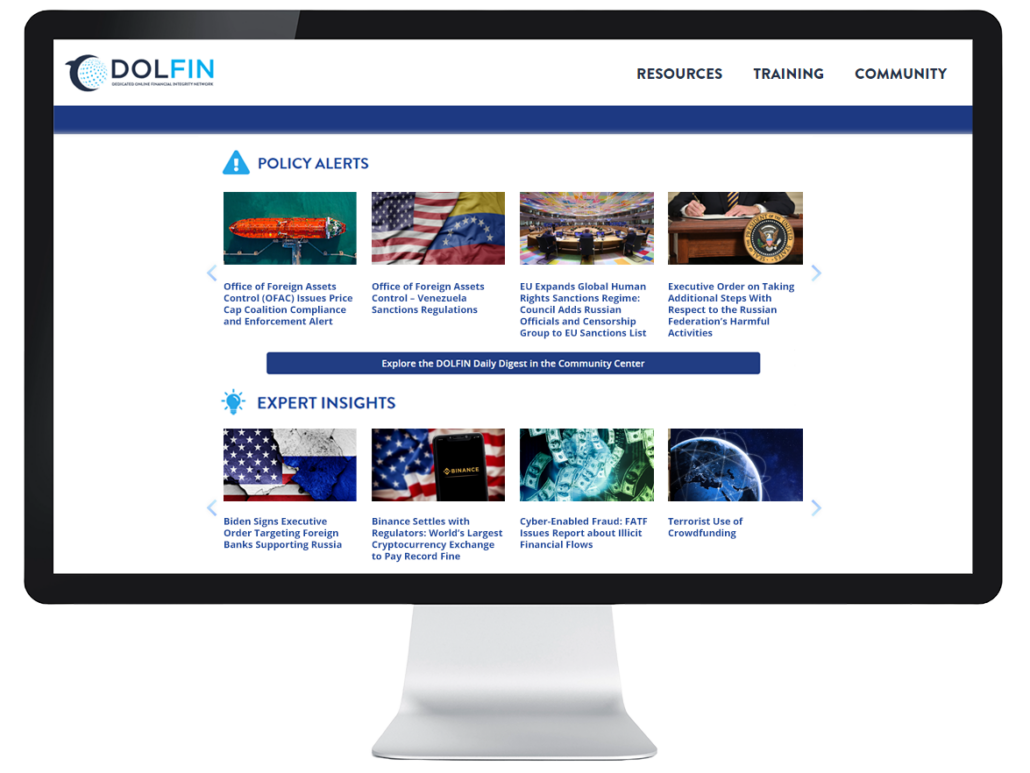
Interested in learning more about AML, sanctions and compliance?

Sign up for the Dedicated Online Financial Integrity Network (DOLFIN). A powerful resource for industry professionals, membership grants unlimited access to our extensive library spanning the core financial integrity topics.

Explore DOLFIN

Recommended Blogs

August Monthly Sanctions and Export Controls Report

September 2, 2026
Explore this month’s Sanctions and Export Controls Update, highlighting IFI’s take on key developments from August 2026.
Read more
https://finintegrity.org/wp-content/uploads/2026/09/august-2026-se-report-bg.jpg 888 1184 IFI https://live-black-pebble.pantheonsite.io/wp-content/uploads/2023/12/GIFI-Placeholder2.png IFI2026-09-02 07:00:562026-09-01 13:19:24August Monthly Sanctions and Export Controls Report

The Judgment Gap in Market Abuse Compliance

August 25, 2026
While banks may know the set of rules outlined in the EU’s Market Abuse Regulation, exposure sits in the judgment calls related to delayed disclosure, information barriers, and market soundings. Dive into where the risk lies in each area.
Read more
https://finintegrity.org/wp-content/uploads/2026/08/judgement-gap-in-market-abuse-compliance-bg.jpg 841 1500 IFI https://live-black-pebble.pantheonsite.io/wp-content/uploads/2023/12/GIFI-Placeholder2.png IFI2026-08-25 07:00:462026-08-24 11:34:59The Judgment Gap in Market Abuse Compliance

A Financial Institution’s Guide to Updated EU Market Abuse Regulation

July 29, 2026
MAR sounds straightforward until a real case tests it. This guide breaks down what the regulation covers, who it applies to, and the disclosure rules, court rulings, and regulatory guidance that shifted the ground under compliance teams in 2026.
Read more
https://finintegrity.org/wp-content/uploads/2026/07/guide-to-market-abuse-bg.jpg 1067 1600 IFI https://live-black-pebble.pantheonsite.io/wp-content/uploads/2023/12/GIFI-Placeholder2.png IFI2026-07-29 07:00:472026-07-28 12:45:11A Financial Institution’s Guide to Updated EU Market Abuse Regulation

Social Engineering Is Rewriting the Fraud Playbook

July 8, 2026
Fraudsters have shifted from breaching systems to manipulating people. This article examines how social engineering, from deepfake video calls to business email compromise, is outpacing traditional defenses, and what it takes to train employees to recognize and resist it.
Read more
https://finintegrity.org/wp-content/uploads/2026/06/social-engineering-bg-1.jpg 675 1200 IFI https://live-black-pebble.pantheonsite.io/wp-content/uploads/2023/12/GIFI-Placeholder2.png IFI2026-07-08 07:00:562026-07-08 07:57:51Social Engineering Is Rewriting the Fraud Playbook
Understanding the FATF: A Guide for Private Sector Stakeholders Part 3

May 13, 2026
This article examines what FATF listings mean in practice and draws out the lessons learned from jurisdictions that have successfully exited the Grey List, using the United Arab Emirates (UAE) as a case study.
Read more
https://finintegrity.org/wp-content/uploads/2026/03/understandingfatf-bg.jpg 1000 1500 IFI https://live-black-pebble.pantheonsite.io/wp-content/uploads/2023/12/GIFI-Placeholder2.png IFI2026-05-13 07:00:082026-05-22 13:26:47Understanding the FATF: A Guide for Private Sector Stakeholders Part 3

Understanding the FATF: A Guide for Private Sector Stakeholders Part 2

April 28, 2026
The FATF’s mutual evaluation process has been the single greatest catalyst for improvements to the global AML/CFT regime in recent years. It’s critical for financial crime compliance and risk management professionals to understand this process and related standards and listings.
Read more
https://finintegrity.org/wp-content/uploads/2026/03/understandingfatf-bg.jpg 1000 1500 IFI https://live-black-pebble.pantheonsite.io/wp-content/uploads/2023/12/GIFI-Placeholder2.png IFI2026-04-28 07:00:032026-05-22 13:28:23Understanding the FATF: A Guide for Private Sector Stakeholders Part 2

Data as a Critical Business and Compliance Asset

April 15, 2026
Data is an increasingly critical asset. It plays a key role in due diligence, identifying and responding against illicit finance, and identifying fraud, as well as for commercial decisions and business success. Explore global data protection and retention requirements in this article.
Read more
https://finintegrity.org/wp-content/uploads/2026/04/consumerprotection-bg.jpg 1000 1500 IFI https://live-black-pebble.pantheonsite.io/wp-content/uploads/2023/12/GIFI-Placeholder2.png IFI2026-04-15 07:00:202026-04-08 09:36:08Data as a Critical Business and Compliance Asset

Understanding the FATF: A Guide for Private Sector Stakeholders

April 8, 2026
The FATF standards, known as the 40 Recommendations, have become more expansive, detailed, and stringent over time, requiring more of both public and private sector institutions.
Read more
https://finintegrity.org/wp-content/uploads/2026/03/understandingfatf-bg.jpg 1000 1500 IFI https://live-black-pebble.pantheonsite.io/wp-content/uploads/2023/12/GIFI-Placeholder2.png IFI2026-04-08 07:00:352026-05-22 13:30:04Understanding the FATF: A Guide for Private Sector Stakeholders

February 2026 Monthly Sanctions and Export Controls Report

March 3, 2026
Explore this month’s Sanctions and Export Controls Update, highlighting IFI’s take on key developments from February 2026.
Read more
https://finintegrity.org/wp-content/uploads/2026/03/feb2026-bg.jpg 879 1500 IFI https://live-black-pebble.pantheonsite.io/wp-content/uploads/2023/12/GIFI-Placeholder2.png IFI2026-03-03 07:00:312026-04-01 11:30:03February 2026 Monthly Sanctions and Export Controls Report
Previous Previous Previous Next Next Next
Download IFI Compliance Checklist Report

Follow Us on LinkedIn

Share this article

  • Share on LinkedIn
  • Share by Mail

Recent Articles

  • The Data Behind the Payment
  • Dirty Barrels
  • Real Estate, Real Risks
  • Iran and the Sanctions Landscape
  • August Monthly Sanctions and Export Controls Report

Explore Other Topics

  • Artificial Intelligence
  • Compliance Best Practices
  • Corruption
  • Digital Assets
  • Drug Trafficking
  • European Union
  • Fraud
  • Human Trafficking
  • Investigations
  • Money Laundering
  • Oil and Gas
  • Press Releases
  • Proliferation Finance
  • Regulation
  • Russia
  • Sanctions
  • Strategic Trade Controls / Export Controls
  • Terrorism

View Our Expert Insights

  • Compliance Training Readiness Checklist
  • Inside the Cartels and Chinese Money Laundering Networks Driving Criminal Economies
  • High Stakes – Casinos, Crime, and Cartels
  • From Cost Center to Risk Control
  • Leveraging Artificial Intelligence for Enhanced Financial Compliance
  • The Convergence of Sanctions and AML/CFT Regimes
  • Casinos and Cryptocurrency Driving Illicit Finance in East and Southeast Asia
  • Russia 2024: The Two-Year Anniversary of the Invasion
  • Human Trafficking Crisis after Russia’s Invasion of Ukraine
  • 2024 Trends Report
© DOLFIN Academy LLC 2026
  • Link to LinkedIn
  • Link to Youtube
  • Privacy Policy
Link to: Corruption Kills Link to: Corruption Kills Corruption Kills Link to: Corruption in Construction Link to: Corruption in Construction Corruption in Construction
Scroll to top Scroll to top Scroll to top

This site uses cookies. By continuing to browse the site, you are agreeing to our use of cookies.

Accept settingsHide notification onlySettings

Cookie and Privacy Settings


How we use cookies

We may request cookies to be set on your device. We use cookies to let us know when you visit our websites, how you interact with us, to enrich your user experience, and to customize your relationship with our website.

Click on the different category headings to find out more. You can also change some of your preferences. Note that blocking some types of cookies may impact your experience on our websites and the services we are able to offer.

Essential Website Cookies

These cookies are strictly necessary to provide you with services available through our website and to use some of its features.

Because these cookies are strictly necessary to deliver the website, refusing them will have impact how our site functions. You always can block or delete cookies by changing your browser settings and force blocking all cookies on this website. But this will always prompt you to accept/refuse cookies when revisiting our site.

We fully respect if you want to refuse cookies but to avoid asking you again and again kindly allow us to store a cookie for that. You are free to opt out any time or opt in for other cookies to get a better experience. If you refuse cookies we will remove all set cookies in our domain.

We provide you with a list of stored cookies on your computer in our domain so you can check what we stored. Due to security reasons we are not able to show or modify cookies from other domains. You can check these in your browser security settings.

Google Analytics Cookies

These cookies collect information that is used either in aggregate form to help us understand how our website is being used or how effective our marketing campaigns are, or to help us customize our website and application for you in order to enhance your experience.

If you do not want that we track your visit to our site you can disable tracking in your browser here:

Other external services

We also use different external services like Google Webfonts, Google Maps, and external Video providers. Since these providers may collect personal data like your IP address we allow you to block them here. Please be aware that this might heavily reduce the functionality and appearance of our site. Changes will take effect once you reload the page.

Google Webfont Settings:

Google Map Settings:

Google reCaptcha Settings:

Vimeo and Youtube video embeds:

Privacy Policy

You can read about our cookies and privacy settings in detail on our Privacy Policy Page.

Privacy Policy
Accept settingsHide notification only