Collaboration Between Chinese Money Laundering Organizations & Drug Cartels
A Growing Threat to the Global Financial System
📅 August 28, 2024

Many wealthy Chinese nationals who live, work, or invest in China are barred by the Chinese government’s capital flight restrictions from transferring the equivalent of more than $50,000 per year out of the country. These individuals seek informal alternatives to the formal financial system to move funds.
Global regulators are drawing increasing attention to the frequency with which CMLOs have stepped in to help Chinese nationals avoid Beijing’s capital controls and the innovative methodologies they use to move funds.
Drug traffickers increasingly have partnered with Chinese underground money exchanges to take advantage of the large demand for U.S. dollars from Chinese nationals using currency brokers in the United States.
The sellers of U.S. currency in the United States accept illicit narcotics proceeds, which generate large amounts of bulk cash, according to the Justice Department, and charge a fee to conceal the nature and source of the funds. China-based investors contact these sellers of U.S. dollars, who provide identifying information for a bank account in China with instructions for the investor to deposit Chinese currency (renminbi) into that account. Once the deposit is completed, an equivalent amount of U.S. dollars is released to the buyer in the United States.
The funds that are transferred in China are then used to pay for goods purchased by businesses and organizations in Mexico or elsewhere such as consumer goods or items the DTO needs to manufacture illegal drugs. The Justice Department says that Chinese underground money exchanges helped the Sinaloa cartel launder more than $50 million in drug trafficking proceeds generated from the import of large amounts of fentanyl, cocaine, and methamphetamine between 2019 and 2023, exposing the global financial system to illicit drug proceeds and allowing criminals to move money.
CMLOs are a global problem, helping TCOs move illicit proceeds while at the same time helping wealthy Chinese nationals restricted by China’s capital flight laws from transferring more than $50,000 abroad per year, according to a U.S. Immigration and Customs Enforcement Bulletin issued in late 2023.
Ricardo Mayoral, Assistant Director for Countering Transnational Organized Crime at the Department of Homeland Security in an April 2024 U.S. Senate hearing noted that CMLOs recruit mules to purchase high-value electronics and luxury goods and export the merchandise from the United States to China, where it is sold for a profit. Funds generated from these goods are used to replenish overseas bank accounts used to facilitate Chinese underground banking activities.
Chinese money-laundering organizations (CMLOs) also often use the These money laundering groups also use the traditional financial system to move money.
A Chinese national and naturalized U.S. citizen in October 2021 was sentenced to 15 years in prison for conspiring to launder tens of millions of dollars in drug proceeds on behalf of foreign drug cartels. Cartel operatives would deliver suitcases full of cash to Chinese couriers directed by Xizhi Li, according to press reporting. The couriers had no criminal records and did not speak much English. They were employed as waiters or drivers, and others were students in the United States. They would use a photo of a serial number on a dollar bill as a prearranged signal, and the couriers would then alert their Chinese bosses in Mexico, who would send pesos to the bank accounts or safe houses of Mexican drug lords, once they received the cash in a mirror transaction.
Li would then launder money through the United States, China, and Latin America. He and his co-conspirators moved tens of millions of dollars among Chinese banks and companies. Co-defendant Tao Liu of Hong Kong helped execute the money laundering scheme by accepting bulk drug cash on behalf of Li, which he later deposited into bank accounts that Li provided.
Li’s money-laundering methodologies involved Chinese government officials and Communist Party elites. Drug cartels needed to get rid of U.S. dollars received from drug sales, and Chinese elite wanted to purchase them. Li and his co-conspirators served both sides.
FinCEN, in a recent advisory on procurement of precursor chemicals and manufacturing equipment used for synthesis of illicit fentanyl and other opioids, flagged specific indicators that can help financial institutions and other reporting entities identify transactions connected to Chinese underground money laundering networks.
In its advisory, FinCEN notes that since 2019, when China began controlling all fentanyl-related substances as a class of drugs, Mexico-based transnational criminal organizations (TCOs), such as the Sinaloa Cartel and the Jalisco New Generation Cartel, became the predominant traffickers of illicit fentanyl and other synthetic opioids into the United States. The Mexican DTOs can purchase precursor chemicals from China or through chemical brokers, who often serve as middlemen for the purchase of these chemicals. These brokers can be based in Mexico, China, or other jurisdictions, using their connections in mainland China and Mexico to connect suppliers and cartels.
FinCEN identified the following financial typologies associated with Mexico-based TCOs and their illicit procurement of fentanyl precursor chemicals and manufacturing equipment.
🚩 The use of shell and front companies – especially linked to China or Hong Kong
🚩 Money transfers through banks, money services businesses (MSBs), and online payment processors
🚩 The use of digital assets
U.S. financial institutions should be vigilant of any suspicious activity indicating illicit procurement of fentanyl precursor chemicals and manufacturing equipment from any jurisdiction.
Note: FinCEN in its recent guidance also flagged that financial institutions should use the key term “FENTANYL FIN-2024-A002” in Field 2 of their suspicious activity reports and in the narrative to alert regulators to possible links to money laundering of illicit fentanyl proceeds.
Red Flags for Customer Due Diligence
Customer-focused due diligence should include jurisdictional research and open-sourced research for links to the illicit narcotics trade if standard CDD indicates high-risk transactions related to CMLOs could occur.
🚩A customer or counterparty has previous drug-related convictions or open-source reporting indicates connections to clandestine lab operations.
🚩A customer or counterparty is a chemical or pharmaceutical company in the People’s Republic of China (PRC), Hong Kong, or another jurisdiction with a residential address or a business address shared with other similar businesses or that has no physical presence or shows other indicators of possible illicit shell company activity.
🚩A counterparty, with no supposed affiliation with the PRC, uses a PRC-based phone number or Internet Protocol (IP) address that is affiliated with the website of a Chinese chemical or pharmaceutical company.
🚩Multiple, seemingly unrelated Mexican importing companies share phone numbers, email addresses, or physical addresses and transact with the same PRC-based chemical manufacturing and pharmaceutical companies.
🚩A customer is a Mexican importing company that predominantly transacts only with chemical or pharmaceutical companies in the PRC or Hong Kong for no apparent legitimate reason as compared to similar importers that transact with foreign chemical manufacturing and pharmaceutical suppliers in multiple jurisdictions.
Red Flags for Transaction Monitoring
Suspicious transactions that specifically could be linked to Chinese underground money transfers of illicit drug proceeds, according to FinCEN, could include:
🚩 A customer sends low-dollar or virtual currency payments for no apparent legitimate purpose to beneficiaries involved in the chemical manufacturing and pharmaceutical industries in the PRC, Hong Kong, or another jurisdiction.
🚩 Multiple customers send funds for no apparent legitimate purpose to the same beneficiary involved in the chemical manufacturing and pharmaceutical industries in the PRC, Hong Kong, or other jurisdictions where the chemicals are not heavily regulated, such as Turkey and India.
🚩 A Mexico-based entity from an unrelated industry transacts with a PRC-based chemical or pharmaceutical company. Alternatively, a PRC-based entity from an unrelated industry transacts with a Mexico-based chemical or pharmaceutical company.
🚩 A customer sends virtual currency payments to an address that is linked through blockchain analytics to beneficiaries associated with the PRC-based chemical manufacturing and pharmaceutical industries or to individuals or entities listed in DOJ indictments and OFAC designations.
🚩 A customer is a Mexican company that does not appear to be involved in the chemical manufacturing and pharmaceutical industries, but its transactional activities indicate the procurement of fentanyl precursor chemicals and associated manufacturing equipment.
“Combatting the threat posed by Money Laundering Organizations in China is a key priority of the Treasury Department, and today we are taking action to cut off the financial flows of major money launderers who are powering the trafficking of fentanyl and other illicit drugs to the United States.” — Deputy Secretary of the Treasury Wally Adeyemo, after OFAC’s designation of Mexico- and China-based money launderers linked to the Sinaloa cartel in July, 2024.
Detecting and deterring Chinese money-laundering organizations’ (CMLO) activities is critical to ensuring the integrity of operations at financial institutions and the global financial system. The Biden Administration has made combatting the threat posed by CMLOs a priority as these organizations have become key actors in laundering illicit funds, partnering with Mexican drug cartels and other illicit actors in numerous countries to threaten the U.S. and global financial system.
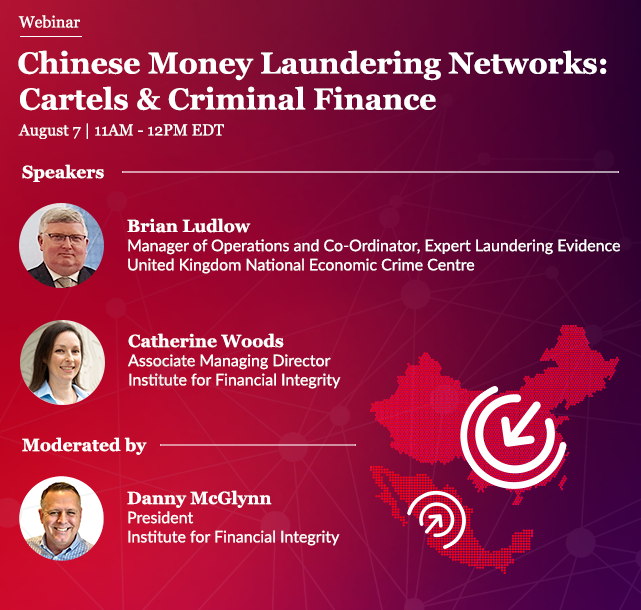
The Institute for Financial Integrity hosted an educational webinar on the emergence of Chinese money launderings networks as a key enabler for laundering cartel proceeds and other criminal finances.
 https://finintegrity.org/wp-content/uploads/2026/10/Screenshot-2026-10-20-115053.png
1301
2320
IFI
https://live-black-pebble.pantheonsite.io/wp-content/uploads/2023/12/GIFI-Placeholder2.png
IFI2026-10-21 07:00:052026-10-21 11:26:02Across Borders, Beyond Sight
https://finintegrity.org/wp-content/uploads/2026/10/Screenshot-2026-10-20-115053.png
1301
2320
IFI
https://live-black-pebble.pantheonsite.io/wp-content/uploads/2023/12/GIFI-Placeholder2.png
IFI2026-10-21 07:00:052026-10-21 11:26:02Across Borders, Beyond Sight https://finintegrity.org/wp-content/uploads/2026/09/bg-the-data-behind-the-payment.jpg
1140
1800
IFI
https://live-black-pebble.pantheonsite.io/wp-content/uploads/2023/12/GIFI-Placeholder2.png
IFI2026-09-30 07:00:312026-09-29 10:35:23The Data Behind the Payment
https://finintegrity.org/wp-content/uploads/2026/09/bg-the-data-behind-the-payment.jpg
1140
1800
IFI
https://live-black-pebble.pantheonsite.io/wp-content/uploads/2023/12/GIFI-Placeholder2.png
IFI2026-09-30 07:00:312026-09-29 10:35:23The Data Behind the Payment https://finintegrity.org/wp-content/uploads/2026/09/real-estate-risk.jpg
614
1000
IFI
https://live-black-pebble.pantheonsite.io/wp-content/uploads/2023/12/GIFI-Placeholder2.png
IFI2026-09-17 12:40:222026-09-17 20:35:41Real Estate, Real Risks
https://finintegrity.org/wp-content/uploads/2026/09/real-estate-risk.jpg
614
1000
IFI
https://live-black-pebble.pantheonsite.io/wp-content/uploads/2023/12/GIFI-Placeholder2.png
IFI2026-09-17 12:40:222026-09-17 20:35:41Real Estate, Real Risks https://finintegrity.org/wp-content/uploads/2026/08/oil-pipeline-bg.jpg
1000
1500
IFI
https://live-black-pebble.pantheonsite.io/wp-content/uploads/2023/12/GIFI-Placeholder2.png
IFI2026-08-19 07:00:062026-08-19 00:07:14The Illicit Oil Pipeline: How Criminal Networks Turn Crude into Clean Cash
https://finintegrity.org/wp-content/uploads/2026/08/oil-pipeline-bg.jpg
1000
1500
IFI
https://live-black-pebble.pantheonsite.io/wp-content/uploads/2023/12/GIFI-Placeholder2.png
IFI2026-08-19 07:00:062026-08-19 00:07:14The Illicit Oil Pipeline: How Criminal Networks Turn Crude into Clean Cash https://finintegrity.org/wp-content/uploads/2025/12/travelrule.jpg
700
1600
IFI
https://live-black-pebble.pantheonsite.io/wp-content/uploads/2023/12/GIFI-Placeholder2.png
IFI2026-03-25 07:00:132026-03-24 15:51:20The Travel Rule Playbook
https://finintegrity.org/wp-content/uploads/2025/12/travelrule.jpg
700
1600
IFI
https://live-black-pebble.pantheonsite.io/wp-content/uploads/2023/12/GIFI-Placeholder2.png
IFI2026-03-25 07:00:132026-03-24 15:51:20The Travel Rule Playbook https://finintegrity.org/wp-content/uploads/2026/03/jorge.jpg
1003
1500
IFI
https://live-black-pebble.pantheonsite.io/wp-content/uploads/2023/12/GIFI-Placeholder2.png
IFI2026-03-18 07:00:442026-05-14 13:55:38Professional Crypto Laundering
https://finintegrity.org/wp-content/uploads/2026/03/jorge.jpg
1003
1500
IFI
https://live-black-pebble.pantheonsite.io/wp-content/uploads/2023/12/GIFI-Placeholder2.png
IFI2026-03-18 07:00:442026-05-14 13:55:38Professional Crypto Laundering https://finintegrity.org/wp-content/uploads/2026/01/bg-wynn-or-lose.jpg
1000
1500
IFI
https://live-black-pebble.pantheonsite.io/wp-content/uploads/2023/12/GIFI-Placeholder2.png
IFI2026-02-11 07:00:322026-03-25 15:35:28Wynn or Lose
https://finintegrity.org/wp-content/uploads/2026/01/bg-wynn-or-lose.jpg
1000
1500
IFI
https://live-black-pebble.pantheonsite.io/wp-content/uploads/2023/12/GIFI-Placeholder2.png
IFI2026-02-11 07:00:322026-03-25 15:35:28Wynn or Lose https://finintegrity.org/wp-content/uploads/2026/01/following-ilicit-funds-bg.jpg
808
1500
IFI
https://live-black-pebble.pantheonsite.io/wp-content/uploads/2023/12/GIFI-Placeholder2.png
IFI2026-01-28 07:00:532026-03-27 12:35:12Following the Illicit Funds
https://finintegrity.org/wp-content/uploads/2026/01/following-ilicit-funds-bg.jpg
808
1500
IFI
https://live-black-pebble.pantheonsite.io/wp-content/uploads/2023/12/GIFI-Placeholder2.png
IFI2026-01-28 07:00:532026-03-27 12:35:12Following the Illicit Funds https://finintegrity.org/wp-content/uploads/2025/12/blind-spots-in-the-system-bg.jpg
1066
1600
IFI
https://live-black-pebble.pantheonsite.io/wp-content/uploads/2023/12/GIFI-Placeholder2.png
IFI2026-01-21 07:00:252026-05-14 13:57:40Blind Spots in the System
https://finintegrity.org/wp-content/uploads/2025/12/blind-spots-in-the-system-bg.jpg
1066
1600
IFI
https://live-black-pebble.pantheonsite.io/wp-content/uploads/2023/12/GIFI-Placeholder2.png
IFI2026-01-21 07:00:252026-05-14 13:57:40Blind Spots in the System
 The Ghost in the Shell