• Link to LinkedIn
  • Link to Youtube
  • Sign In
  • Register
  • Subscribe
  • Contact
Institute for Financial Integrity
  • Training
    • eLearning Courses

      • Suite of interactive e-learning courses to educate and engage staff on core compliance topics

      • Learn More
    • Video Library

      • An online learning journey through the various domains of financial crime, explore our library of expert-led videos

      • Learn More
    • Training Services

      • Trusted compliance training design, development, and delivery tailored to your unique requirements

      • Learn More
    • Certifications
      • Certified Risk Management Specialist – Global Sanctions
      • Certified Financial Integrity Professional Program
  • Technology
    • DOLFIN

      • A platform that equips financial integrity professionals with the continuing education, expert insights, resources and tools needed to protect the integrity of the global financial system.

      • Learn More
    • AskFIN

      • A revolutionary, AI-powered tool seamlessly integrated with DOLFIN® — the world’s largest and most trusted library of curated resources on financial integrity topics.

      • Learn More
  • Insights
    • Insights
      • Articles
      • Reports & White Papers
      • Webinars
      • Subscribe
  • About Us
    • Who We Are
      • Our Story
      • Leadership
      • Press Releases
    • Who We Serve
      • Financial Institutions
      • Jurisdictions
      • Executives
      • Industry Professionals
  • Get a Demo
  • Menu Menu

Beneath the Shine

Financial Crime Risks in the Precious Metals and Stones Trade

📅 November 18, 2026

Precious metals and stones have long played an important role in global commerce, valued for their rarity, durability, industrial applications, cultural significance, and enduring appeal as stores of wealth. Gold, silver, platinum, diamonds, and other precious commodities are traded worldwide, serving everything from manufacturing and jewelry production to wealth preservation and investment diversification.

Their high value relative to their physical size, combined with their ability to be bought, sold, transported, and held across borders, makes them attractive assets for legitimate investors and businesses alike. Yet these same characteristics can also create vulnerabilities that criminals seek to exploit.

The same characteristics that make precious metals and stones attractive to legitimate markets can also make them attractive to those seeking to move, store, or conceal illicit wealth.

  • High value and portability: Significant wealth can be stored in small quantities and transported across borders, potentially exploiting weaknesses in customs controls.
  • Liquidity and convertibility: Gold and other commodities can be sold, exchanged, melted, or recast, potentially obscuring their origin and creating new forms of value.
  • Cash-intensive transactions: Cash purchases and informal payment arrangements can reduce transparency and complicate efforts to establish the source of funds.
  • Complex supply chains: Multiple intermediaries, jurisdictions, and transactions can make it difficult to verify a commodity’s origin and the parties involved.

These vulnerabilities can manifest in several forms of financial crime, from laundering illicit proceeds and concealing beneficial ownership to facilitating corruption, smuggling, terrorism financing, and sanctions evasion.

Money Laundering and Concealed Ownership

Criminals may use proceeds from fraud, corruption, drug trafficking, or other illicit activity to purchase precious metals and stones, then sell or transfer them through legitimate markets. The resulting proceeds may appear to originate from ordinary commercial activity rather than the underlying crime. Multiple dealers, brokers, companies, and jurisdictions can further obscure the transaction trail.

Companies and other legal structures can also conceal the individuals who ultimately own or control a business. Suppliers or customers may operate through holding companies, trusts, nominees, agents, or networks of intermediaries. Understanding beneficial ownership, the source of funds, and the commercial rationale for transactions is therefore essential to assessing risk.

Corruption and Bribery

The extraction, transportation, licensing, import, export, and sale of valuable commodities can involve significant government interaction. Licenses, mining rights, customs processes, tax assessments, inspections, permits, and other regulatory decisions may create opportunities for bribery and corruption. These practices may also facilitate the concealment of a commodity’s true origin or ownership, allowing illicit materials to enter legitimate supply chains.

Smuggling and Trade-Based Financial Crime

The physical nature of precious metals and stones creates opportunities for smuggling and other forms of trade-based financial crime. Commodities may be misrepresented, undervalued, overvalued, falsely documented, or moved through jurisdictions that make their origin or ownership difficult to establish.

Terrorism and Conflict Financing

Supply chains can intersect with terrorism financing, conflict financing, and organized crime. In areas with weak governance or limited state control, criminal organizations, armed groups, or other illicit actors may participate in mining, transportation, or trade. Revenue can help finance continued criminal or armed activity. For businesses sourcing from high-risk regions, understanding the broader context surrounding a supply chain can therefore be as important as understanding the immediate customer or supplier.

Sanctions Evasion

Sanctioned individuals, companies, and networks may use intermediaries, front companies, alternative trading routes, or third-country jurisdictions to maintain access to markets and move value. Where commodities are sourced, processed, sold, or financed across multiple jurisdictions, businesses may need to consider not only the immediate counterparty, but also beneficial owners, intermediaries, source countries, destination countries, and other parties involved in the transaction.

Building a Risk-Based Approach

The complexity of the precious metals and stones trade makes a risk-based approach particularly important. Businesses should consider risk across multiple dimensions, including the customer, supplier, product, transaction, geography, delivery route, payment method, and source of the commodity.

Customer and supplier due diligence should go beyond simply confirming that a business exists. Depending on the risk, organizations may need to understand beneficial ownership and control, the nature of the counterparty’s business, source of funds, source of wealth, expected transaction activity, and the provenance of the commodities involved.

Supply-chain due diligence is equally important. Where appropriate, businesses should seek to understand where commodities originated, who handled them along the way, how they were transported, where they were processed, and whether documentation supports the stated chain of custody.

This does not mean that every transaction requires the same level of investigation. A risk-based approach allows organizations to focus enhanced scrutiny and resources where the potential exposure is greatest.

Building Awareness, Strengthening Defenses

Understanding how precious metals and stones can be exploited is an important first step in protecting the integrity of the sector.

Effective compliance depends not only on policies and systems, but also on the people responsible for applying them. Employees need to understand the financial crime risks relevant to their roles, recognize meaningful red flags, understand when additional due diligence may be appropriate, and know how to escalate concerns.

For dealers, refiners, manufacturers, wholesalers, retailers, financial institutions, and other businesses connected to the precious metals and stones trade, practical training can help translate complex global risks into decisions employees can recognize and act upon.v

Strengthening Compliance Through Tailored Training

At IFI, we specialize in developing practical, risk-based compliance training programs that help organizations understand the evolving threats they face and the measures needed to counter them.
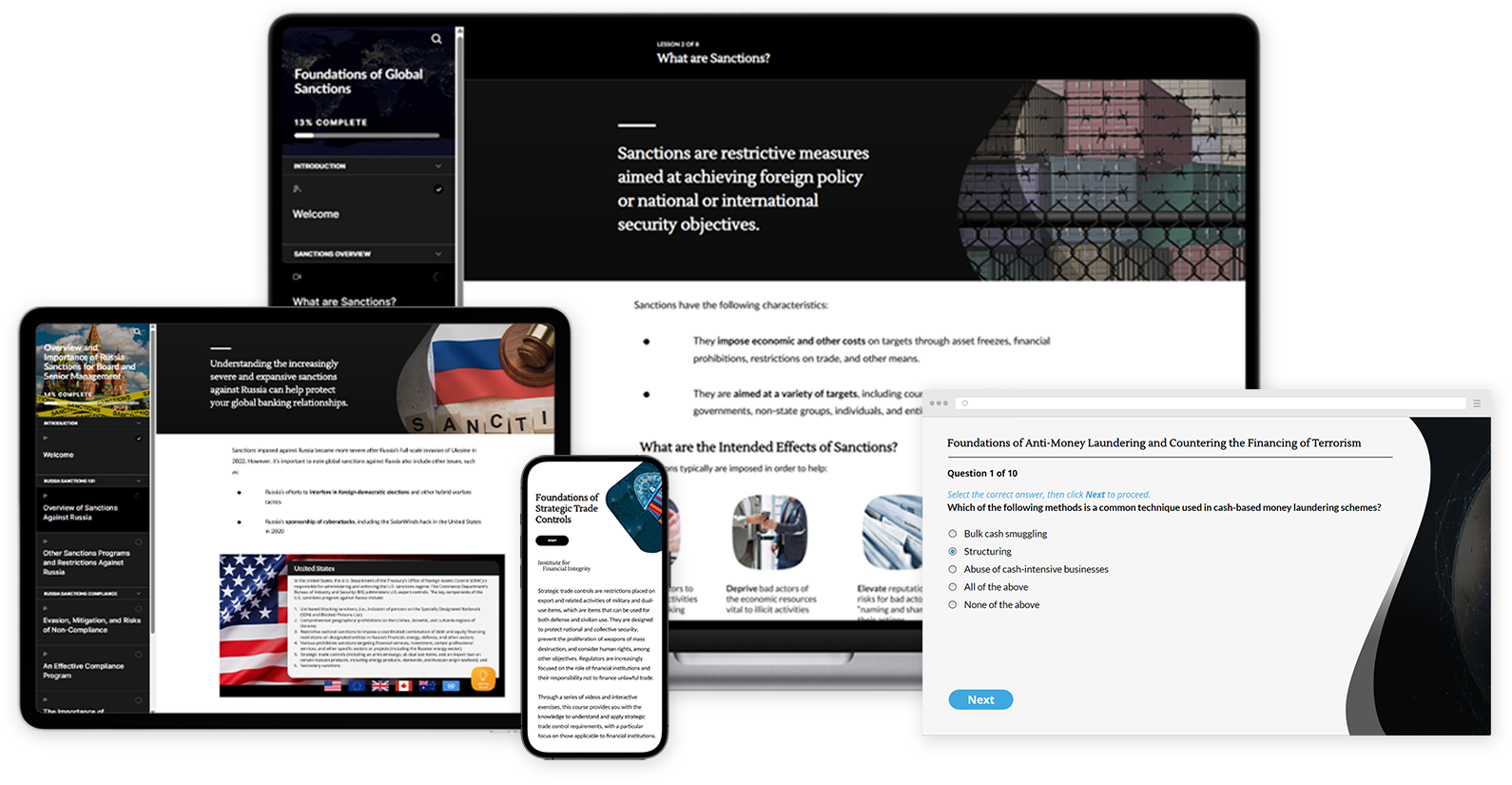
Our expert-led training equips professionals with the knowledge and practical skills to recognize financial crime risks, strengthen due diligence, and apply effective controls. Through tailored content, engaging instruction, and a focus on real-world application, we help organizations translate regulatory expectations into meaningful, effective compliance practices.
Explore Training Services

Recommended Blogs

Navigating Iran Sanctions Risk Across the Gulf

November 16, 2026
One threat, six Gulf national responses: from the UAE’s trade halt to Qatar’s mediation, each government has decided for itself how far to cut Iran off. Learn what drives the differences, which signals show a regulator is about to act, and how multi-state banks can run one method with local overlays.
Read more
https://finintegrity.org/wp-content/uploads/2026/11/navigating-iran-sanctions-bg.png 800 1200 IFI https://live-black-pebble.pantheonsite.io/wp-content/uploads/2023/12/GIFI-Placeholder2.png IFI2026-11-16 07:00:502026-11-16 10:46:21Navigating Iran Sanctions Risk Across the Gulf

October 2026 Monthly Sanctions and Export Controls Report

November 3, 2026
Explore this month’s Sanctions and Export Controls Update, highlighting IFI’s take on key developments from October 2026.
Read more
https://finintegrity.org/wp-content/uploads/2026/10/october-2026-sanctions-ser.jpg 680 1200 IFI https://live-black-pebble.pantheonsite.io/wp-content/uploads/2023/12/GIFI-Placeholder2.png IFI2026-11-03 07:00:462026-11-03 09:30:08October 2026 Monthly Sanctions and Export Controls Report
The $1.2 Billion AML Wake-Up Call

October 28, 2026
FinCEN’s $1.2 billion penalty against Bank of America highlights significant gaps in transaction monitoring, suspicious activity reporting, and customer due diligence. Explore key findings from the enforcement action and what they mean for strengthening compliance controls.
Read more
https://finintegrity.org/wp-content/uploads/2026/10/wake-up-call-bg.jpg 1350 1800 IFI https://live-black-pebble.pantheonsite.io/wp-content/uploads/2023/12/GIFI-Placeholder2.png IFI2026-10-28 07:00:472026-10-22 14:07:22The $1.2 Billion AML Wake-Up Call

Across Borders, Beyond Sight

October 21, 2026
Cross-border payments power the global economy, but they also create opportunities for financial crime. Explore key areas of exposure and how leading institutions are gaining greater visibility into the payment chain.
Read more
https://finintegrity.org/wp-content/uploads/2026/10/Screenshot-2026-10-20-115053.png 1301 2320 IFI https://live-black-pebble.pantheonsite.io/wp-content/uploads/2023/12/GIFI-Placeholder2.png IFI2026-10-21 07:00:052026-10-21 11:26:02Across Borders, Beyond Sight

The Expanding Scope of Financial Crime Compliance Training

October 14, 2026
There is a global shift toward integrating proliferation financing as a distinct threat alongside money laundering and terrorist financing. Discover what this means for enterprise-wide training at financial institutions.
Read more
https://finintegrity.org/wp-content/uploads/2026/10/bg-expanding-crime.jpg 1357 1800 IFI https://live-black-pebble.pantheonsite.io/wp-content/uploads/2023/12/GIFI-Placeholder2.png IFI2026-10-14 07:00:092026-10-05 16:11:03The Expanding Scope of Financial Crime Compliance Training

September 2026 Monthly Sanctions and Export Controls Report

October 6, 2026
Explore this month’s Sanctions and Export Controls Update, highlighting IFI’s take on key developments from September 2026.
Read more
https://finintegrity.org/wp-content/uploads/2026/10/bg-september-2026-se-report.jpg 1199 1600 IFI https://live-black-pebble.pantheonsite.io/wp-content/uploads/2023/12/GIFI-Placeholder2.png IFI2026-10-06 07:00:462026-10-05 13:03:02September 2026 Monthly Sanctions and Export Controls Report

The Data Behind the Payment

September 30, 2026
Two changes have raised the bar on what banks can expect to see in a payment. Explore how corporate banks can put ISO 20022 and FATF's revised Recommendation 16 to work in transaction monitoring.
Read more
https://finintegrity.org/wp-content/uploads/2026/09/bg-the-data-behind-the-payment.jpg 1140 1800 IFI https://live-black-pebble.pantheonsite.io/wp-content/uploads/2023/12/GIFI-Placeholder2.png IFI2026-09-30 07:00:312026-09-29 10:35:23The Data Behind the Payment

Dirty Barrels

September 24, 2026
While oil and gas is one of the world's most valuable and strategically important industries, it is vulnerable to corruption. Explore how corruption risks can arise throughout the lifecycle of an oil and gas transaction.
Read more
https://finintegrity.org/wp-content/uploads/2026/09/shutterstock_2645005987-scaled.jpg 1706 2560 IFI https://live-black-pebble.pantheonsite.io/wp-content/uploads/2023/12/GIFI-Placeholder2.png IFI2026-09-24 07:00:302026-09-24 11:44:27Dirty Barrels

Real Estate, Real Risks

September 17, 2026
The FATF has identified the global real estate sector as an area requiring heightened attention due to its vulnerabilities to money laundering, terrorism financing, sanctions evasion and other illicit activity. This article explores why property transactions attract financial crime.
Read more
https://finintegrity.org/wp-content/uploads/2026/09/real-estate-risk.jpg 614 1000 IFI https://live-black-pebble.pantheonsite.io/wp-content/uploads/2023/12/GIFI-Placeholder2.png IFI2026-09-17 12:40:222026-09-17 20:35:41Real Estate, Real Risks
Previous Previous Previous Next Next Next
Download IFI Compliance Checklist Report

Follow Us on LinkedIn

Share this article

  • Share on LinkedIn
  • Share by Mail

Recent Articles

  • Beneath the Shine
  • Navigating Iran Sanctions Risk Across the Gulf
  • Lonely Hearts, Open Wallets
  • The Job Offer That Cost Binance $6.3 Billion
  • Qi Card Expands Financial Crime Compliance Training with IFI as Regional Presence Grows

Explore Other Topics

  • Artificial Intelligence
  • Compliance Best Practices
  • Corruption
  • Digital Assets
  • Drug Trafficking
  • European Union
  • Fraud
  • Human Trafficking
  • Money Laundering
  • Oil and Gas
  • Press Releases
  • Proliferation Finance
  • Regulation
  • Russia
  • Sanctions
  • Strategic Trade Controls / Export Controls
  • Terrorism

View Our Expert Insights

  • Compliance Training Readiness Checklist
  • Inside the Cartels and Chinese Money Laundering Networks Driving Criminal Economies
  • High Stakes – Casinos, Crime, and Cartels
  • From Cost Center to Risk Control
  • Leveraging Artificial Intelligence for Enhanced Financial Compliance
  • The Convergence of Sanctions and AML/CFT Regimes
  • Casinos and Cryptocurrency Driving Illicit Finance in East and Southeast Asia
  • Russia 2024: The Two-Year Anniversary of the Invasion
  • Human Trafficking Crisis after Russia’s Invasion of Ukraine
  • 2024 Trends Report
© DOLFIN Academy LLC 2026
  • Link to LinkedIn
  • Link to Youtube
  • Privacy Policy
Link to: Navigating Iran Sanctions Risk Across the Gulf Link to: Navigating Iran Sanctions Risk Across the Gulf Navigating Iran Sanctions Risk Across the Gulf
Scroll to top Scroll to top Scroll to top

This site uses cookies. By continuing to browse the site, you are agreeing to our use of cookies.

Accept settingsHide notification onlySettings

Cookie and Privacy Settings


How we use cookies

We may request cookies to be set on your device. We use cookies to let us know when you visit our websites, how you interact with us, to enrich your user experience, and to customize your relationship with our website.

Click on the different category headings to find out more. You can also change some of your preferences. Note that blocking some types of cookies may impact your experience on our websites and the services we are able to offer.

Essential Website Cookies

These cookies are strictly necessary to provide you with services available through our website and to use some of its features.

Because these cookies are strictly necessary to deliver the website, refusing them will have impact how our site functions. You always can block or delete cookies by changing your browser settings and force blocking all cookies on this website. But this will always prompt you to accept/refuse cookies when revisiting our site.

We fully respect if you want to refuse cookies but to avoid asking you again and again kindly allow us to store a cookie for that. You are free to opt out any time or opt in for other cookies to get a better experience. If you refuse cookies we will remove all set cookies in our domain.

We provide you with a list of stored cookies on your computer in our domain so you can check what we stored. Due to security reasons we are not able to show or modify cookies from other domains. You can check these in your browser security settings.

Google Analytics Cookies

These cookies collect information that is used either in aggregate form to help us understand how our website is being used or how effective our marketing campaigns are, or to help us customize our website and application for you in order to enhance your experience.

If you do not want that we track your visit to our site you can disable tracking in your browser here:

Other external services

We also use different external services like Google Webfonts, Google Maps, and external Video providers. Since these providers may collect personal data like your IP address we allow you to block them here. Please be aware that this might heavily reduce the functionality and appearance of our site. Changes will take effect once you reload the page.

Google Webfont Settings:

Google Map Settings:

Google reCaptcha Settings:

Vimeo and Youtube video embeds:

Privacy Policy

You can read about our cookies and privacy settings in detail on our Privacy Policy Page.

Privacy Policy
Accept settingsHide notification only