• Link to LinkedIn
  • Link to Youtube
  • Sign In
  • Register
  • Subscribe
  • Contact
Institute for Financial Integrity
  • Training
    • eLearning Courses

      • Suite of interactive e-learning courses to educate and engage staff on core compliance topics

      • Learn More
    • Video Library

      • An online learning journey through the various domains of financial crime, explore our library of expert-led videos

      • Learn More
    • Training Services

      • Trusted compliance training design, development, and delivery tailored to your unique requirements

      • Learn More
    • Certifications
      • Certified Risk Management Specialist – Global Sanctions
      • Certified Financial Integrity Professional Program
  • Technology
    • DOLFIN

      • A platform that equips financial integrity professionals with the continuing education, expert insights, resources and tools needed to protect the integrity of the global financial system.

      • Learn More
    • AskFIN

      • A revolutionary, AI-powered tool seamlessly integrated with DOLFIN® — the world’s largest and most trusted library of curated resources on financial integrity topics.

      • Learn More
  • Insights
    • Insights
      • Articles
      • Reports & White Papers
      • Webinars
      • Subscribe
  • About Us
    • Who We Are
      • Our Story
      • Leadership
      • Press Releases
    • Who We Serve
      • Financial Institutions
      • Jurisdictions
      • Executives
      • Industry Professionals
  • Get a Demo
  • Menu Menu

2024 National Proliferation Financing Risk Assessment

A discussion of the threats, vulnerabilities, and regulatory factors of proliferation financing

📅 April 19, 2024

The U.S. Department of the Treasury published the 2024 National Proliferation Financing Risk Assessment in February 2024 providing an in-depth analysis of the threats and vulnerabilities related to proliferation financing (PF) and highlighting key countries and non-state actors working to gain access to weapons of mass destruction (WMDs) and their components and to conventional restricted weapons and technologies. The report assesses that the U.S. financial system’s size, the dominance of the U.S. dollar, and the role of U.S. manufacturers in producing military-related technology make it a target for exploitation by proliferation financing networks. While there is a strong culture of compliance with U.S. law among financial institutions and other private-sector actors, gaps remain, necessitating ongoing efforts to improve counterproliferation financing programs. 

PF networks, often operating at the direction of state actors like Russia, the Democratic People’s Republic of Korea (DPRK), and Iran continue to exploit the U.S. financial system and private sector to finance WMD proliferation. The Treasury assessment highlights both Russia and the DPRK as an increased risk owing to the scope and sophistication of their illicit procurement and revenue-generation efforts for WMD capabilities. 

State and Non-State Actors’ Response to Threats 

Based on a review of the relevant data since 2022, Russia and the DPRK are the highest-risk threat actors, according to the Treasury. Iran, China, Syria, Pakistan, and non-state actors also pose significant risks in terms of proliferation financing, either through direct involvement in WMD programs or by supporting illicit procurement activities. The report emphasizes the persistent dangers posed by state actors and their networks in financing WMD proliferation, highlighting the ongoing need for vigilance, compliance efforts, and international collaboration to effectively tackle these threats. 

  • Russia: Despite possessing a substantial nuclear and conventional military capability that it has been working to modernize, Russia’s invasion of Ukraine has heightened concerns about its proliferation financing activities. This includes seeking weapons replenishment through international partnerships and using front companies for procurement, potentially from the DPRK and Iran, which could undermine global nonproliferation efforts. 
  • DPRK: The DPRK continues to enhance its WMD capabilities, as the regime views nuclear weapons as crucial for its survival and deterrence. Its use of cyber theft and illicit trade to fund its WMD program has raised alarms, with estimates indicating significant revenue acquired through these illicit means. Recent OFAC designations targeting entities linked to DPRK’s weapons exports and financial institutions further highlight these concerns. 
  • Iran: The United States is closely monitoring Iran’s nuclear activities, and Iran has not yet pursued key nuclear weapons development. However, ongoing concerns exist regarding Iran’s nuclear program, leading to joint actions with partners to counter Tehran’s procurement efforts, especially concerning missiles, unmanned aerial systems (UAS), and other weapons. Iran’s provision of UAS to groups in the Middle East also raises proliferation concerns. 
  • China, Syria, and Pakistan: China is actively pursuing military modernization to protect its interests, enhance regional influence, and counter U.S. military dominance, focusing on nuclear, cyber, space, and counterspace capabilities. The report assesses that China engages in economic espionage and cyber theft to acquire technology. In other regions, efforts to hold Syria accountable for chemical weapon use continue, while Pakistan prioritizes nuclear weapons development amid regional security concerns, leading to U.S. sanctions on China-based suppliers involved in Pakistan’s missile program. 
  • Non-state Actors: Preventing terrorist groups and non-state actors from acquiring WMDs remains a priority for the United States and its allies, which is evident in actions like renewing UNSCR 1540’s mandate obliging UN member states to develop and enforce appropriate legal and regulatory measures against the proliferation of WMD, and releasing a National Security Memorandum on WMD terrorism prevention. The Memorandum discusses systematic methods to prevent non-state actors from using chemical, biological, radiological, and nuclear weapons. Treasury has not assessed whether non-state actors exploit the U.S. financial system to acquire WMDs. 

Economic Factors 

The economic factors related to the U.S. financial system’s structure and accessibility make it a prime target for proliferators seeking to fund their WMD programs through illicit means, according to the Treasury assessment. The size, sophistication, stability, and openness of the U.S. financial system make it vulnerable to misuse by illicit proliferation networks. 

  1. The U.S. financial sector provides access to a wide range of financial services, which can be exploited by proliferators to raise, store, move, and use funds for illicit activities. 
  2. Proliferators may seek access to the international and U.S. financial system to disguise their payments for goods and services or to raise funds to evade sanctions and support WMD programs. They often falsify business ownership information, obfuscate the end-users/end-use of sensitive goods and technologies and ultimate destination of shipments, and use shell and front companies to illegally acquire goods or transship them to third countries for diversion.  
  3. The financial sector’s role in providing financial services to private sector actors, including banks in foreign countries through correspondent banking and other relationships, creates opportunities for proliferators to exploit these connections for their illicit financing activities. 

Legal and Regulatory Factors  

Legal and regulatory factors play a crucial role in shaping the risk landscape of proliferation financing by setting standards, requirements, and mechanisms for monitoring and preventing illicit financial activities related to WMD proliferation. 

  1. The United States maintains a robust legal regime for AML/CFT/CPF, sanctions, and export controls. All natural and legal U.S. persons must comply with OFAC and State Department sanctions, as well as Department of Commerce export control regulations. 
  2. U.S. financial institutions and entities with AML program requirements must mitigate proliferation financing risk through the appropriate implementation of compliance requirements, including customer due diligence, transaction monitoring, and the filing of suspicious activity reports (SARs). 
  3. Gaps in the U.S. AML/CFT/CPF framework have been identified in previous assessments, which have contributed to the ability of proliferation networks to conduct their activities. Efforts have been made to address these gaps through new legislation, regulations, and guidance to enhance the effectiveness of compliance with sanctions and controls.  
  4. Beneficial ownership is a key concern, as proliferation networks often create murky legal entities with unclear ownership and control structures to obscure financial activities linked to states of proliferation concern. The Corporate Transparency Act (CTA) was enacted to establish a legal framework for reporting beneficial ownership information to the U.S. Treasury’s Financial Crimes Enforcement Network (FinCEN), aiming to enhance transparency and combat illicit financial activities. 

Emerging Trends 

The United States has a robust legislative and regulatory framework to combat proliferation financing, given the ongoing threats posed by WMD proliferators and their networks. These threats include the acquisition of dual-use technology, revenue-raising efforts targeting U.S. entities, and new trends such as the use of cryptocurrencies as alternatives to the U.S. dollar in global trade. The United States will continue targeting PF procurement networks, while also addressing challenges such as sanctions evasion, state complicity, new payment infrastructure, and emerging technologies that could be misused for proliferation activities. 

Structural vulnerabilities in the U.S. financial system and the centrality of the U.S. dollar in global trade continue to make the country a target for PF exploitation, although compliance efforts by financial institutions have been mitigating these risks. Strengthening the U.S. counter-proliferation finance regime is key to preventing WMD-related threats.

Recorded Webinar

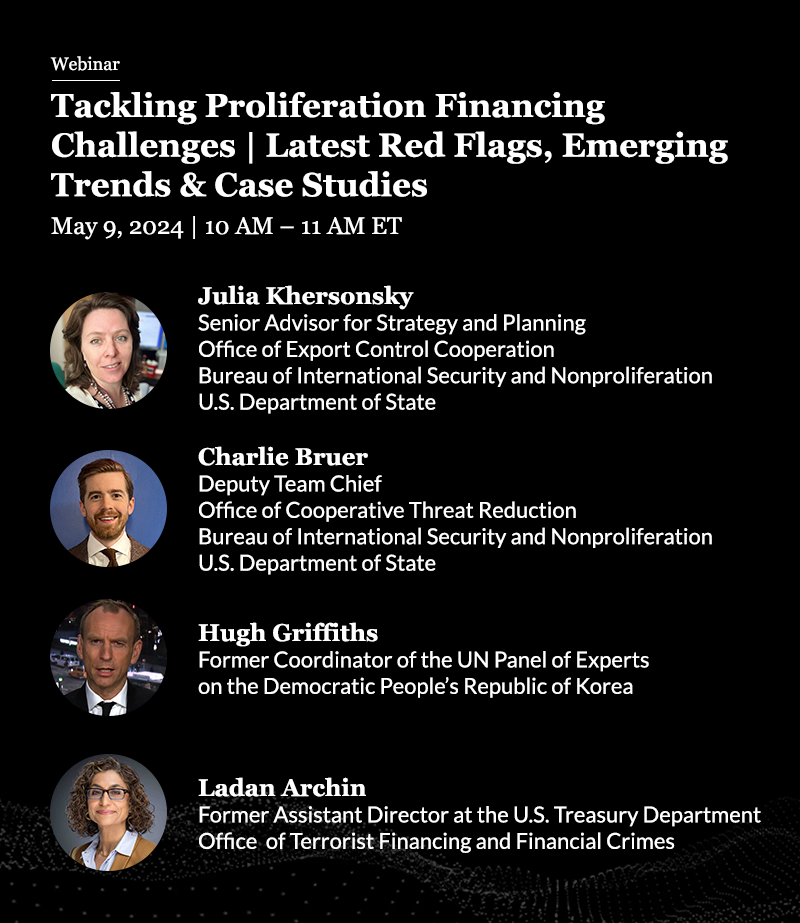
Over the past six months, the Russian Federation has vetoed a renewal of UN sanctions against Iran’s ballistic missile and UAV program, as well as a resolution extending the mandate of the UN Panel of Experts monitoring the sanctions on North Korea, while at the same time importing Iranian and North Korean UAVs and ballistic missiles for use in its war against Ukraine.

Russia’s vetoes have effectively dismantled the multilateral sanctions framework on Iran and abolished multilateral sanctions monitoring capabilities for North Korea. Russia’s procurement of North Korean ballistic missiles and Iranian UAVs in Ukraine further heighten proliferation finance and sanctions risk for the private sector.

View Recording

Recommended Blogs

Real Estate, Real Risks

September 17, 2026
The FATF has identified the global real estate sector as an area requiring heightened attention due to its vulnerabilities to money laundering, terrorism financing, sanctions evasion and other illicit activity. This article explores why property transactions attract financial crime.
Read more
https://finintegrity.org/wp-content/uploads/2026/09/real-estate-risk.jpg 614 1000 IFI https://live-black-pebble.pantheonsite.io/wp-content/uploads/2023/12/GIFI-Placeholder2.png IFI2026-09-17 12:40:222026-09-17 20:35:41Real Estate, Real Risks

Iran and the Sanctions Landscape

September 10, 2026
Iran has spent nearly five decades under some form of U.S. economic sanctions, and the network built to evade those sanctions is correspondingly mature. Since February 2025, that architecture has come under the most intensive and sustained pressure it has faced since the 2015 nuclear deal.
Read more
https://finintegrity.org/wp-content/uploads/2026/09/iran-and-sanctions-landscape-bg.jpg 1013 1800 IFI https://live-black-pebble.pantheonsite.io/wp-content/uploads/2023/12/GIFI-Placeholder2.png IFI2026-09-10 07:00:352026-09-17 20:21:30Iran and the Sanctions Landscape

August Monthly Sanctions and Export Controls Report

September 2, 2026
Explore this month’s Sanctions and Export Controls Update, highlighting IFI’s take on key developments from August 2026.
Read more
https://finintegrity.org/wp-content/uploads/2026/09/august-2026-se-report-bg.jpg 888 1184 IFI https://live-black-pebble.pantheonsite.io/wp-content/uploads/2023/12/GIFI-Placeholder2.png IFI2026-09-02 07:00:562026-09-01 13:19:24August Monthly Sanctions and Export Controls Report
The Illicit Oil Pipeline: How Criminal Networks Turn Crude into Clean Cash

August 19, 2026
Money laundering in the oil sector is a highly lucrative global pipeline where illicit networks exploit the massive volume, complex supply chains, and liquid nature of the market. Explore the lifecycle of oil laundering schemes as well as key red flags.
Read more
https://finintegrity.org/wp-content/uploads/2026/08/oil-pipeline-bg.jpg 1000 1500 IFI https://live-black-pebble.pantheonsite.io/wp-content/uploads/2023/12/GIFI-Placeholder2.png IFI2026-08-19 07:00:062026-08-19 00:07:14The Illicit Oil Pipeline: How Criminal Networks Turn Crude into Clean Cash

July Monthly Sanctions and Export Controls Report

August 4, 2026
Explore this month’s Sanctions and Export Controls Update, highlighting IFI’s take on key developments from July 2026.
Read more
https://finintegrity.org/wp-content/uploads/2026/08/july2026-se-bg.jpg 1177 1800 IFI https://live-black-pebble.pantheonsite.io/wp-content/uploads/2023/12/GIFI-Placeholder2.png IFI2026-08-04 07:00:452026-08-04 09:42:02July Monthly Sanctions and Export Controls Report

Social Engineering Is Rewriting the Fraud Playbook

July 8, 2026
Fraudsters have shifted from breaching systems to manipulating people. This article examines how social engineering, from deepfake video calls to business email compromise, is outpacing traditional defenses, and what it takes to train employees to recognize and resist it.
Read more
https://finintegrity.org/wp-content/uploads/2026/06/social-engineering-bg-1.jpg 675 1200 IFI https://live-black-pebble.pantheonsite.io/wp-content/uploads/2023/12/GIFI-Placeholder2.png IFI2026-07-08 07:00:562026-07-08 07:57:51Social Engineering Is Rewriting the Fraud Playbook

June 2026 Sanctions and Export Controls Report

July 1, 2026
Explore this month’s Sanctions and Export Controls Update, highlighting IFI’s take on key developments from June 2026.
Read more
https://finintegrity.org/wp-content/uploads/2026/06/june2026-se-report-bg.jpg 798 1200 IFI https://live-black-pebble.pantheonsite.io/wp-content/uploads/2023/12/GIFI-Placeholder2.png IFI2026-07-01 07:00:392026-07-02 10:28:58June 2026 Sanctions and Export Controls Report

May 2026 Sanctions and Export Controls Update

June 3, 2026
Explore this month’s Sanctions and Export Controls Update, highlighting IFI’s take on key developments from May 2026.
Read more
https://finintegrity.org/wp-content/uploads/2026/06/may-bg-2026-se.jpg 1200 1800 IFI https://live-black-pebble.pantheonsite.io/wp-content/uploads/2023/12/GIFI-Placeholder2.png IFI2026-06-03 07:00:142026-06-02 14:36:12May 2026 Sanctions and Export Controls Update

April 2026 Monthly Sanctions and Export Controls Report

May 5, 2026
Explore this month’s Sanctions and Export Controls Update, highlighting IFI’s take on key developments from April 2026.
Read more
https://finintegrity.org/wp-content/uploads/2026/05/april-bg-2026-se.jpg 1348 1800 IFI https://live-black-pebble.pantheonsite.io/wp-content/uploads/2023/12/GIFI-Placeholder2.png IFI2026-05-05 07:00:332026-05-06 13:57:33April 2026 Monthly Sanctions and Export Controls Report
Previous Previous Previous Next Next Next
Download IFI Compliance Checklist Report

Follow Us on LinkedIn

Share this article

  • Share on LinkedIn
  • Share by Mail

Recent Articles

  • Dirty Barrels
  • Real Estate, Real Risks
  • Iran and the Sanctions Landscape
  • August Monthly Sanctions and Export Controls Report
  • National Bank of Yemen Launches Enterprise-Wide Compliance Training with IFI

Explore Other Topics

  • Artificial Intelligence
  • Compliance Best Practices
  • Corruption
  • Digital Assets
  • Drug Trafficking
  • European Union
  • Fraud
  • Human Trafficking
  • Investigations
  • Money Laundering
  • Oil and Gas
  • Press Releases
  • Proliferation Finance
  • Regulation
  • Russia
  • Sanctions
  • Strategic Trade Controls / Export Controls
  • Terrorism

View Our Expert Insights

  • Compliance Training Readiness Checklist
  • Inside the Cartels and Chinese Money Laundering Networks Driving Criminal Economies
  • High Stakes – Casinos, Crime, and Cartels
  • From Cost Center to Risk Control
  • Leveraging Artificial Intelligence for Enhanced Financial Compliance
  • The Convergence of Sanctions and AML/CFT Regimes
  • Casinos and Cryptocurrency Driving Illicit Finance in East and Southeast Asia
  • Russia 2024: The Two-Year Anniversary of the Invasion
  • Human Trafficking Crisis after Russia’s Invasion of Ukraine
  • 2024 Trends Report
© DOLFIN Academy LLC 2026
  • Link to LinkedIn
  • Link to Youtube
  • Privacy Policy
Link to: Liberating Limits: OFAC Licenses Link to: Liberating Limits: OFAC Licenses Liberating Limits: OFAC Licenses Link to: Counterproliferation Finance Detection and Deterrence – What Can Financial Institutions Do? Link to: Counterproliferation Finance Detection and Deterrence – What Can Financial Institutions Do? Counterproliferation Finance Detection and Deterrence – What Can Financial...
Scroll to top Scroll to top Scroll to top

This site uses cookies. By continuing to browse the site, you are agreeing to our use of cookies.

Accept settingsHide notification onlySettings

Cookie and Privacy Settings


How we use cookies

We may request cookies to be set on your device. We use cookies to let us know when you visit our websites, how you interact with us, to enrich your user experience, and to customize your relationship with our website.

Click on the different category headings to find out more. You can also change some of your preferences. Note that blocking some types of cookies may impact your experience on our websites and the services we are able to offer.

Essential Website Cookies

These cookies are strictly necessary to provide you with services available through our website and to use some of its features.

Because these cookies are strictly necessary to deliver the website, refusing them will have impact how our site functions. You always can block or delete cookies by changing your browser settings and force blocking all cookies on this website. But this will always prompt you to accept/refuse cookies when revisiting our site.

We fully respect if you want to refuse cookies but to avoid asking you again and again kindly allow us to store a cookie for that. You are free to opt out any time or opt in for other cookies to get a better experience. If you refuse cookies we will remove all set cookies in our domain.

We provide you with a list of stored cookies on your computer in our domain so you can check what we stored. Due to security reasons we are not able to show or modify cookies from other domains. You can check these in your browser security settings.

Google Analytics Cookies

These cookies collect information that is used either in aggregate form to help us understand how our website is being used or how effective our marketing campaigns are, or to help us customize our website and application for you in order to enhance your experience.

If you do not want that we track your visit to our site you can disable tracking in your browser here:

Other external services

We also use different external services like Google Webfonts, Google Maps, and external Video providers. Since these providers may collect personal data like your IP address we allow you to block them here. Please be aware that this might heavily reduce the functionality and appearance of our site. Changes will take effect once you reload the page.

Google Webfont Settings:

Google Map Settings:

Google reCaptcha Settings:

Vimeo and Youtube video embeds:

Privacy Policy

You can read about our cookies and privacy settings in detail on our Privacy Policy Page.

Privacy Policy
Accept settingsHide notification only