• Link to LinkedIn
  • Link to Youtube
  • Sign In
  • Register
  • Subscribe
  • Contact
Institute for Financial Integrity
  • Training
    • eLearning Courses

      • Suite of interactive e-learning courses to educate and engage staff on core compliance topics

      • Learn More
    • Video Library

      • An online learning journey through the various domains of financial crime, explore our library of expert-led videos

      • Learn More
    • Training Services

      • Trusted compliance training design, development, and delivery tailored to your unique requirements

      • Learn More
    • Certifications
      • Certified Risk Management Specialist – Global Sanctions
      • Certified Financial Integrity Professional Program
  • Technology
    • DOLFIN

      • A platform that equips financial integrity professionals with the continuing education, expert insights, resources and tools needed to protect the integrity of the global financial system.

      • Learn More
    • AskFIN

      • A revolutionary, AI-powered tool seamlessly integrated with DOLFIN® — the world’s largest and most trusted library of curated resources on financial integrity topics.

      • Learn More
  • Insights
    • Insights
      • Articles
      • Reports & White Papers
      • Webinars
      • Subscribe
  • About Us
    • Who We Are
      • Our Story
      • Leadership
      • Press Releases
    • Who We Serve
      • Financial Institutions
      • Jurisdictions
      • Executives
      • Industry Professionals
  • Get a Demo
  • Menu Menu

Counterproliferation Finance Detection and Deterrence

 What Can Financial Institutions Do?

📅 April 23, 2024

Proliferation Financing a National Security Threat

The Justice Department in late 2022 charged two companies and six individuals for allegedly selling and exporting powerful dual-use technologies to Russia, including a high-precision export-controlled item that can be used for Russia’s nuclear proliferation. Some of the electronic components purchased by the network and sold to sanctioned Russian end-users were discovered in Russian weapons platforms on the Ukrainian battlefield. The case highlights how illicit actors use deceptive practices to mislead financial institutions into participating in schemes to send critical military equipment and dual-use technologies to military end-users in Russia.

  • According to court documents, Germany-based Russian national Yury Orekhov was part-owner, CEO, and Managing Director of Nord-Deutsche Industrieanlagenbau GmbH (NDA GmbH), a privately held industrial equipment and commodity trading company located in Hamburg, Germany. Artem Uss, the other owner of NDA GmbH, is the son of the governor of Russia’s Krasnoyarsk Krai region. Svetlana Kuzurgasheva served as the CEO of one of the scheme’s shell companies and worked for NDA GmbH under Orekhov.
  • Using NDA GmbH as a front company, Orekhov and Kuzurgasheva sourced and purchased sensitive military and dual-use technologies from U.S. manufacturers, including advanced semiconductors and microprocessors used in fighter aircraft, missile systems, smart munitions, radar, satellites, and other space-based military applications. 
  • The defendants routed funds for NDA GmbH’s illicit activities through U.S. financial institutions and correspondent bank accounts. To facilitate these transactions, Orekhov and his co-conspirators used fictitious companies, falsified “know your customer” documentation, and exploited bank accounts in high-risk jurisdictions, according to the Justice Department press release. 

In its 2024 National Proliferation Financing Risk Assessment, the U.S. Treasury identified proliferation networks operating on behalf of Russia, North Korea, China, Iran, Syria, and Pakistan as threats to U.S. national security. These networks exploited the U.S. financial system to finance the proliferation of weapons of mass destruction (WMD), including financing to procure WMD components and raising revenues to support efforts by these state actors to advance their WMD activities. Treasury identified Russia and North Korea as the highest-risk threat actors because of the scope and sophistication of their efforts. 

Because of heavy battlefield losses Russia has experienced since it began its full-scale invasion of Ukraine in early 2022, Moscow has engaged with close partners to replenish its stocks of conventional weapons. Those losses have also increased Russia’s reliance on its nuclear, cyber, and space capabilities to maintain deterrence and project power globally, according to the Treasury assessment. 

North Korea since 2022 has continued to augment its WMD capability, including testing of multiple types of intercontinental ballistic missiles (ICBMs), according to the Director of National Intelligence (DNI) 2024 Threat Assessment. North Korea remains dedicated to expanding its nuclear capability, as well as enhancing its conventional missile capabilities, and will use both its offensive cyber capabilities and conventional trade control and sanctions evasion methodologies to steal and launder billions of dollars in cryptocurrencies to fund its WMD programs.  

  • The U.S. Treasury’s Office of Foreign Assets Control (OFAC) in concert with the Republic of Korea in late March 2024 designated six individuals and two entities based in Russia, China, and the UAE that generate revenue and facilitate financial transactions for North Korea. The DPRK uses overseas representatives of state-owned entities and banks to access the global financial system, according to the OFAC press release. 

Non-state actors, such as terrorist groups are also working to acquire WMD capabilities, according to the Treasury risk assessment. The United States in March 2023 released a National Security Memorandum (NSM) on WMD Terrorism and Advance Nuclear and Radioactive Material Security. The NSM seeks to provide a framework to prevent non-state actors from acquiring WMD and related materials. However, Treasury has not assessed that the efforts of non-state actors to acquire WMDs have involved exploitation of the U.S. financial system. 

Taking Action

Given the complex nature of the activities to hide proliferation financing, what can financial institutions do? The Financial Action Task Force (FATF) has provided indicators that could denote illicit activity and help financial institutions and other stakeholders identify high-risk customers and transactions. Some of these red flags are common methodologies used in sanctions and trade control evasion, fraud, and other financial crimes.

  • Transaction involves a person or entity in a foreign country of proliferation concern or that is known for diversion activities. 
  • The customer or counterparty or its address is similar to a party found on publicly available lists of “denied persons” or has a history of export control evasion. 
  • Customer activity does not match business profile, or end-user information does not match end-user’s business profile. 
  • A freight forwarding firm is listed as the product’s final destination.  
  • Order for goods is placed by firms or persons from foreign countries other than the country of the stated end-user. 
  • Transaction involves shipment of goods incompatible with the technical level of the country to which it is being shipped, (e.g. semiconductor manufacturing equipment being shipped to a country that has no electronics industry). 
  • Transaction involves possible shell companies or complex webs of ownership and control structures. 
  • Misleading shipping documentation is provided for the transaction. 

Although many of the indicators provided by FATF are also red flags that may denote trade-based money laundering, sanctions evasion, and other financial crimes, when coupled with the involvement of entities in jurisdictions at high risk of diversion or WMD proliferation, these red flags should be closely examined for possible proliferation concerns. The more indicators are present, the riskier the transaction. Financial institutions should monitor these transactions to detect and deter possible proliferation financing. 

Conclusion 

The size and sophistication of the U.S. financial system makes it particularly vulnerable for exploitation by illicit proliferation networks, and new technologies continue to enable illicit money transfers by malign actors. These actors use a combination of tried-and-true techniques and innovative strategies and technologies to transfer sensitive goods to restricted actors.

  • To disguise their activity as legitimate commerce, proliferation networks, such as Orekhov’s and Uss’s, use corporate entities to gain access to financial services, including correspondent banking. They also often create multiple front or shell companies in the United States and third-country jurisdictions and falsify documents to move goods and money. 
  • An Iranian and a Chinese national in late 2023 were indicted and charged with a scheme to procure U.S.-manufactured dual-use microelectronics for the Islamic Revolutionary Guard Corps (IRGC) Aerospace Force Self Sufficiency Jihad Organization’s (ASF SSJO) one-way attack unmanned aerial vehicle (UAV) program. According to the DOJ press release, the defendants allegedly used a web of foreign front companies to illegally purchase and export from the United States to Iran dual-use microelectronics that are commonly used in UAV production. The defendants allegedly used entities based in Iran, Malaysia, Hong Kong, and Indonesia to obfuscate the end-destination for the goods. An unwitting French company purchased components from a U.S. company and shipped the components to Hong Kong, where they were reexported to Iran. 
  • Treasury’s assessment also notes DPRK cyber actors target a variety of organizations in the blockchain technology and virtual asset industry, including virtual asset exchanges, decentralized finance (DeFi) protocols, blockchain bridge developers, virtual asset trading companies, venture capital funds investing in virtual assets, and individual holders of large amounts of virtual assets or non-fungible tokens (NFTs). They also seek to exploit CVC mixing activities. 

Financial institutions and virtual currency service providers must be aware of the emerging trends used by illicit actors—especially Russia and North Korea—to access restricted technologies and raise revenues for their WMD programs. Closely monitoring risky transactions, researching new proliferation financing methodologies, and putting together pieces of the counterproliferation puzzle will help avoid enforcement actions and secondary sanctions. 

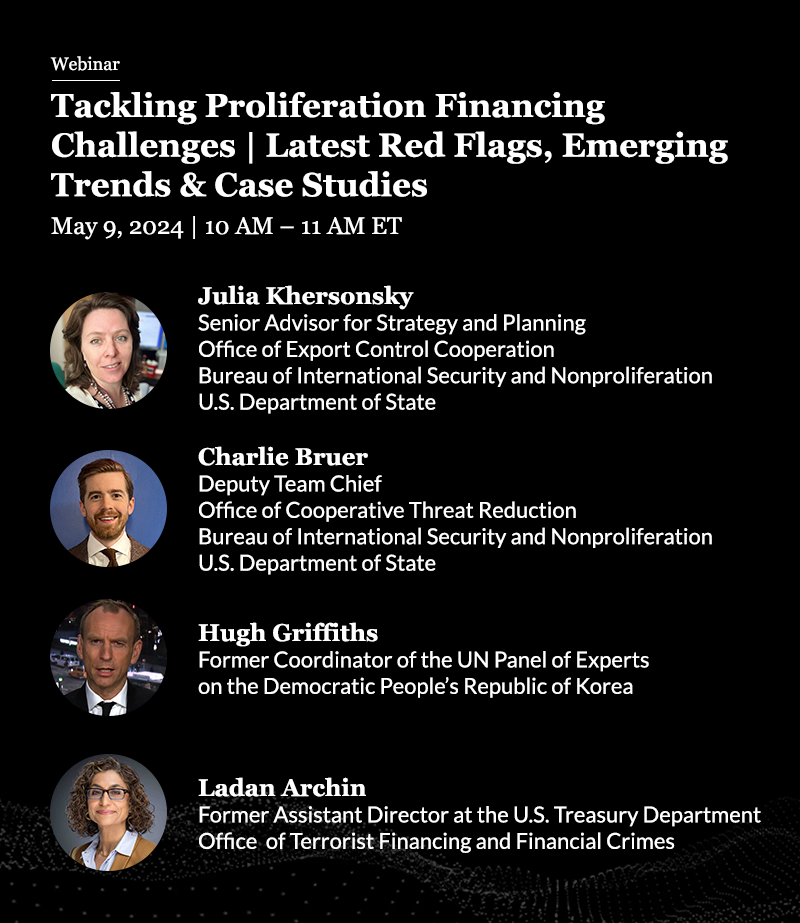
Recorded Webinar

Over the past six months, the Russian Federation has vetoed a renewal of UN sanctions against Iran’s ballistic missile and UAV program, as well as a resolution extending the mandate of the UN Panel of Experts monitoring the sanctions on North Korea, while at the same time importing Iranian and North Korean UAVs and ballistic missiles for use in its war against Ukraine.

Russia’s vetoes have effectively dismantled the multilateral sanctions framework on Iran and abolished multilateral sanctions monitoring capabilities for North Korea. Russia’s procurement of North Korean ballistic missiles and Iranian UAVs in Ukraine further heighten proliferation finance and sanctions risk for the private sector.

View Recording

Recommended Blogs

Real Estate, Real Risks

September 17, 2026
The FATF has identified the global real estate sector as an area requiring heightened attention due to its vulnerabilities to money laundering, terrorism financing, sanctions evasion and other illicit activity. This article explores why property transactions attract financial crime.
Read more
https://finintegrity.org/wp-content/uploads/2026/09/real-estate-risk.jpg 614 1000 IFI https://live-black-pebble.pantheonsite.io/wp-content/uploads/2023/12/GIFI-Placeholder2.png IFI2026-09-17 12:40:222026-09-17 20:35:41Real Estate, Real Risks

Iran and the Sanctions Landscape

September 10, 2026
Iran has spent nearly five decades under some form of U.S. economic sanctions, and the network built to evade those sanctions is correspondingly mature. Since February 2025, that architecture has come under the most intensive and sustained pressure it has faced since the 2015 nuclear deal.
Read more
https://finintegrity.org/wp-content/uploads/2026/09/iran-and-sanctions-landscape-bg.jpg 1013 1800 IFI https://live-black-pebble.pantheonsite.io/wp-content/uploads/2023/12/GIFI-Placeholder2.png IFI2026-09-10 07:00:352026-09-17 20:21:30Iran and the Sanctions Landscape

August Monthly Sanctions and Export Controls Report

September 2, 2026
Explore this month’s Sanctions and Export Controls Update, highlighting IFI’s take on key developments from August 2026.
Read more
https://finintegrity.org/wp-content/uploads/2026/09/august-2026-se-report-bg.jpg 888 1184 IFI https://live-black-pebble.pantheonsite.io/wp-content/uploads/2023/12/GIFI-Placeholder2.png IFI2026-09-02 07:00:562026-09-01 13:19:24August Monthly Sanctions and Export Controls Report
The Illicit Oil Pipeline: How Criminal Networks Turn Crude into Clean Cash

August 19, 2026
Money laundering in the oil sector is a highly lucrative global pipeline where illicit networks exploit the massive volume, complex supply chains, and liquid nature of the market. Explore the lifecycle of oil laundering schemes as well as key red flags.
Read more
https://finintegrity.org/wp-content/uploads/2026/08/oil-pipeline-bg.jpg 1000 1500 IFI https://live-black-pebble.pantheonsite.io/wp-content/uploads/2023/12/GIFI-Placeholder2.png IFI2026-08-19 07:00:062026-08-19 00:07:14The Illicit Oil Pipeline: How Criminal Networks Turn Crude into Clean Cash

July Monthly Sanctions and Export Controls Report

August 4, 2026
Explore this month’s Sanctions and Export Controls Update, highlighting IFI’s take on key developments from July 2026.
Read more
https://finintegrity.org/wp-content/uploads/2026/08/july2026-se-bg.jpg 1177 1800 IFI https://live-black-pebble.pantheonsite.io/wp-content/uploads/2023/12/GIFI-Placeholder2.png IFI2026-08-04 07:00:452026-08-04 09:42:02July Monthly Sanctions and Export Controls Report

Social Engineering Is Rewriting the Fraud Playbook

July 8, 2026
Fraudsters have shifted from breaching systems to manipulating people. This article examines how social engineering, from deepfake video calls to business email compromise, is outpacing traditional defenses, and what it takes to train employees to recognize and resist it.
Read more
https://finintegrity.org/wp-content/uploads/2026/06/social-engineering-bg-1.jpg 675 1200 IFI https://live-black-pebble.pantheonsite.io/wp-content/uploads/2023/12/GIFI-Placeholder2.png IFI2026-07-08 07:00:562026-07-08 07:57:51Social Engineering Is Rewriting the Fraud Playbook

June 2026 Sanctions and Export Controls Report

July 1, 2026
Explore this month’s Sanctions and Export Controls Update, highlighting IFI’s take on key developments from June 2026.
Read more
https://finintegrity.org/wp-content/uploads/2026/06/june2026-se-report-bg.jpg 798 1200 IFI https://live-black-pebble.pantheonsite.io/wp-content/uploads/2023/12/GIFI-Placeholder2.png IFI2026-07-01 07:00:392026-07-02 10:28:58June 2026 Sanctions and Export Controls Report

May 2026 Sanctions and Export Controls Update

June 3, 2026
Explore this month’s Sanctions and Export Controls Update, highlighting IFI’s take on key developments from May 2026.
Read more
https://finintegrity.org/wp-content/uploads/2026/06/may-bg-2026-se.jpg 1200 1800 IFI https://live-black-pebble.pantheonsite.io/wp-content/uploads/2023/12/GIFI-Placeholder2.png IFI2026-06-03 07:00:142026-06-02 14:36:12May 2026 Sanctions and Export Controls Update

April 2026 Monthly Sanctions and Export Controls Report

May 5, 2026
Explore this month’s Sanctions and Export Controls Update, highlighting IFI’s take on key developments from April 2026.
Read more
https://finintegrity.org/wp-content/uploads/2026/05/april-bg-2026-se.jpg 1348 1800 IFI https://live-black-pebble.pantheonsite.io/wp-content/uploads/2023/12/GIFI-Placeholder2.png IFI2026-05-05 07:00:332026-05-06 13:57:33April 2026 Monthly Sanctions and Export Controls Report
Previous Previous Previous Next Next Next
Download IFI Compliance Checklist Report

Follow Us on LinkedIn

Share this article

  • Share on LinkedIn
  • Share by Mail

Recent Articles

  • The Data Behind the Payment
  • Dirty Barrels
  • Real Estate, Real Risks
  • Iran and the Sanctions Landscape
  • August Monthly Sanctions and Export Controls Report

Explore Other Topics

  • Artificial Intelligence
  • Compliance Best Practices
  • Corruption
  • Digital Assets
  • Drug Trafficking
  • European Union
  • Fraud
  • Human Trafficking
  • Investigations
  • Money Laundering
  • Oil and Gas
  • Press Releases
  • Proliferation Finance
  • Regulation
  • Russia
  • Sanctions
  • Strategic Trade Controls / Export Controls
  • Terrorism

View Our Expert Insights

  • Compliance Training Readiness Checklist
  • Inside the Cartels and Chinese Money Laundering Networks Driving Criminal Economies
  • High Stakes – Casinos, Crime, and Cartels
  • From Cost Center to Risk Control
  • Leveraging Artificial Intelligence for Enhanced Financial Compliance
  • The Convergence of Sanctions and AML/CFT Regimes
  • Casinos and Cryptocurrency Driving Illicit Finance in East and Southeast Asia
  • Russia 2024: The Two-Year Anniversary of the Invasion
  • Human Trafficking Crisis after Russia’s Invasion of Ukraine
  • 2024 Trends Report
© DOLFIN Academy LLC 2026
  • Link to LinkedIn
  • Link to Youtube
  • Privacy Policy
Link to: 2024 National Proliferation Financing Risk Assessment Link to: 2024 National Proliferation Financing Risk Assessment 2024 National Proliferation Financing Risk Assessment Link to: Digital Assets in the Crosshairs Link to: Digital Assets in the Crosshairs Digital Assets in the Crosshairs
Scroll to top Scroll to top Scroll to top

This site uses cookies. By continuing to browse the site, you are agreeing to our use of cookies.

Accept settingsHide notification onlySettings

Cookie and Privacy Settings


How we use cookies

We may request cookies to be set on your device. We use cookies to let us know when you visit our websites, how you interact with us, to enrich your user experience, and to customize your relationship with our website.

Click on the different category headings to find out more. You can also change some of your preferences. Note that blocking some types of cookies may impact your experience on our websites and the services we are able to offer.

Essential Website Cookies

These cookies are strictly necessary to provide you with services available through our website and to use some of its features.

Because these cookies are strictly necessary to deliver the website, refusing them will have impact how our site functions. You always can block or delete cookies by changing your browser settings and force blocking all cookies on this website. But this will always prompt you to accept/refuse cookies when revisiting our site.

We fully respect if you want to refuse cookies but to avoid asking you again and again kindly allow us to store a cookie for that. You are free to opt out any time or opt in for other cookies to get a better experience. If you refuse cookies we will remove all set cookies in our domain.

We provide you with a list of stored cookies on your computer in our domain so you can check what we stored. Due to security reasons we are not able to show or modify cookies from other domains. You can check these in your browser security settings.

Google Analytics Cookies

These cookies collect information that is used either in aggregate form to help us understand how our website is being used or how effective our marketing campaigns are, or to help us customize our website and application for you in order to enhance your experience.

If you do not want that we track your visit to our site you can disable tracking in your browser here:

Other external services

We also use different external services like Google Webfonts, Google Maps, and external Video providers. Since these providers may collect personal data like your IP address we allow you to block them here. Please be aware that this might heavily reduce the functionality and appearance of our site. Changes will take effect once you reload the page.

Google Webfont Settings:

Google Map Settings:

Google reCaptcha Settings:

Vimeo and Youtube video embeds:

Privacy Policy

You can read about our cookies and privacy settings in detail on our Privacy Policy Page.

Privacy Policy
Accept settingsHide notification only