Why Compliance Training Still Fails
The Cost of a Check-the-Box Culture
📅 May 15, 2025

In late 2024, headlines lit up with news of a $3 billion fine slapped on one of North America’s largest banks. The cause? Years of anti-money laundering failures that let illicit funds slip through the cracks. What made it even more alarming was this: employees had technically done everything right—on paper, as they must have completed the mandatory compliance training. The boxes were checked, the certificates filed. But clearly, something critical was missing.
Unfortunately, this story is all too familiar. Many institutions have robust training programs in place—at least in theory. Staff watch the videos, take the quizzes, and click “complete.” But when compliance becomes just another task to get through, the real goal—changing behavior and actually reducing risk—gets lost in the shuffle.
The truth is, traditional compliance training often focuses more on proving that training happened than on making sure it works. And that “check-the-box” mentality leaves organizations vulnerable—to costly mistakes, regulatory enforcement actions, and reputational damage.
U.S. Department of Justice Press Release (October 11, 2024)
“For nearly a decade, TD Bank failed to update its anti-money laundering compliance program to address known risks. As bank employees acknowledged in internal communications, these failures made the bank an ‘easy target’ for the bad guys.”
⚠️ Regulators aren’t satisfied with training that exists on paper. They want to see programs that shape behavior, reduce risk, and evolve with emerging threats.
In this article, we’re digging into why compliance training still fails, even in well-intentioned institutions. We’ll look at what’s broken, what it’s costing us, and how a smarter, more strategic approach can turn training into a true line of defense—rather than a missed opportunity.
So what exactly is a “check-the-box” approach to compliance training?
At its core, it’s when the primary goal of training shifts from learning to simply proving that training occurred. It’s the kind of training program where success is measured by completion rates and attendance logs—not by how well employees understand the material, let alone how they apply it in their day-to-day roles.
You’ve probably seen the signs:
So why does this happen?
In many cases, it comes down to pressure—pressure to show auditors and regulators that training has been completed; pressure to roll out training at scale with limited resources; and pressure to do it quickly. Without strong internal champions pushing for strategic learning, the easiest route becomes the default: launch the same cookie-cutter content to everyone, check the completion box, and call it a day.
But that approach misses the point. In today’s dynamic risk environment—where threats evolve quickly and regulators are increasingly scrutinizing the quality of compliance programs—a box-ticking culture won’t cut it. If training doesn’t resonate, risks don’t get flagged. And when risks go unnoticed, institutions pay the price.
Let’s be honest—most people don’t walk away from a compliance training session feeling inspired or better equipped to manage risk. And it’s not because they don’t care. It’s because the training isn’t always built to help them succeed in the real world.
Here’s why so many traditional training programs fall flat:
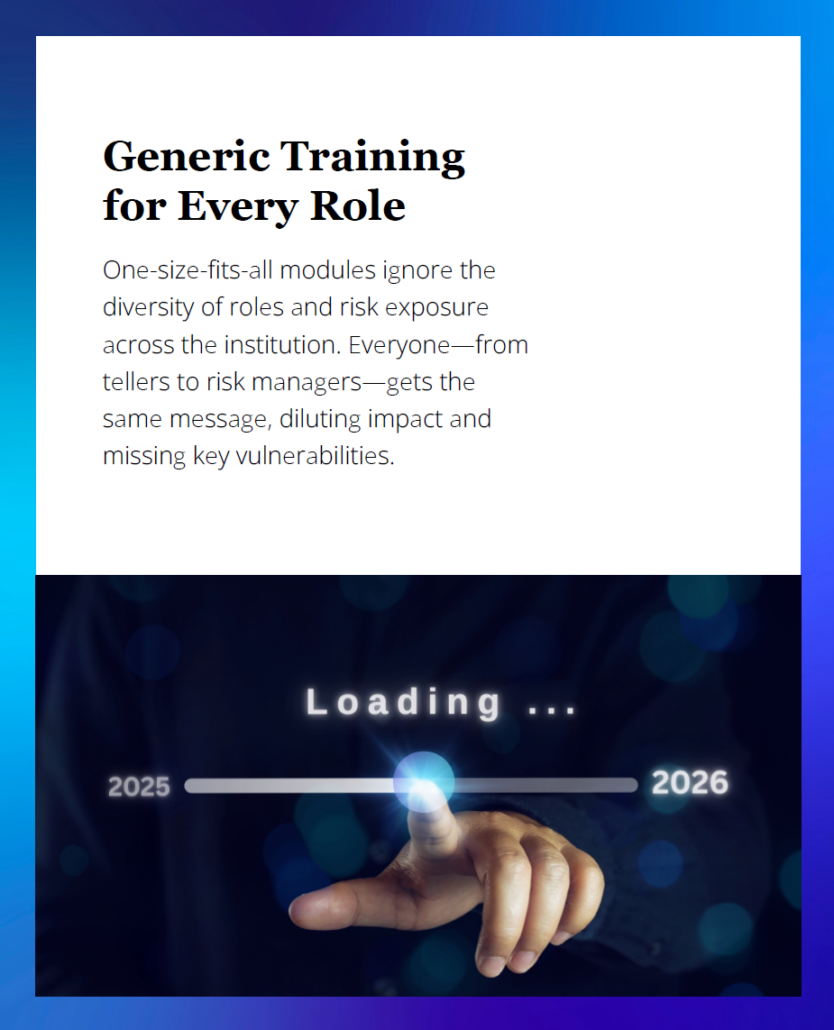
If you’ve ever sat through a training and thought, “This has nothing to do with my job,” you’re not alone. A major issue with many compliance programs is that they treat everyone the same. Whether you’re a customer service rep in a retail branch or managing cross-border payments in a trade finance unit, you might get the exact same content—when in reality, the risks you face and the decisions you make are completely different. Without real-world examples that match the challenges staff encounter, the training just doesn’t stick.
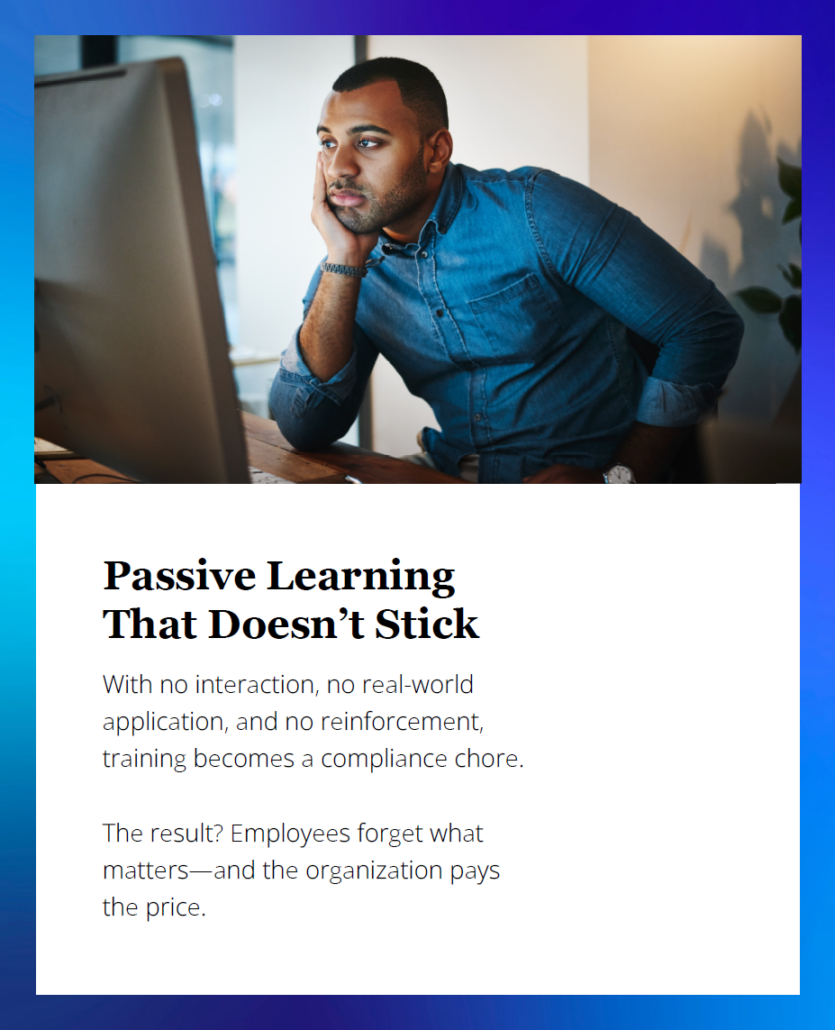
Even when the information is useful, the way it’s delivered often gets in the way. Think long, text-heavy modules, monotone voiceovers, or walls of legal definitions. People zone out. They click through. And a week later, they’ve forgotten most of it. That’s not a learner problem—that’s a design problem. Without repetition, real-life scenarios, or interactive moments to break things up, retention is minimal.
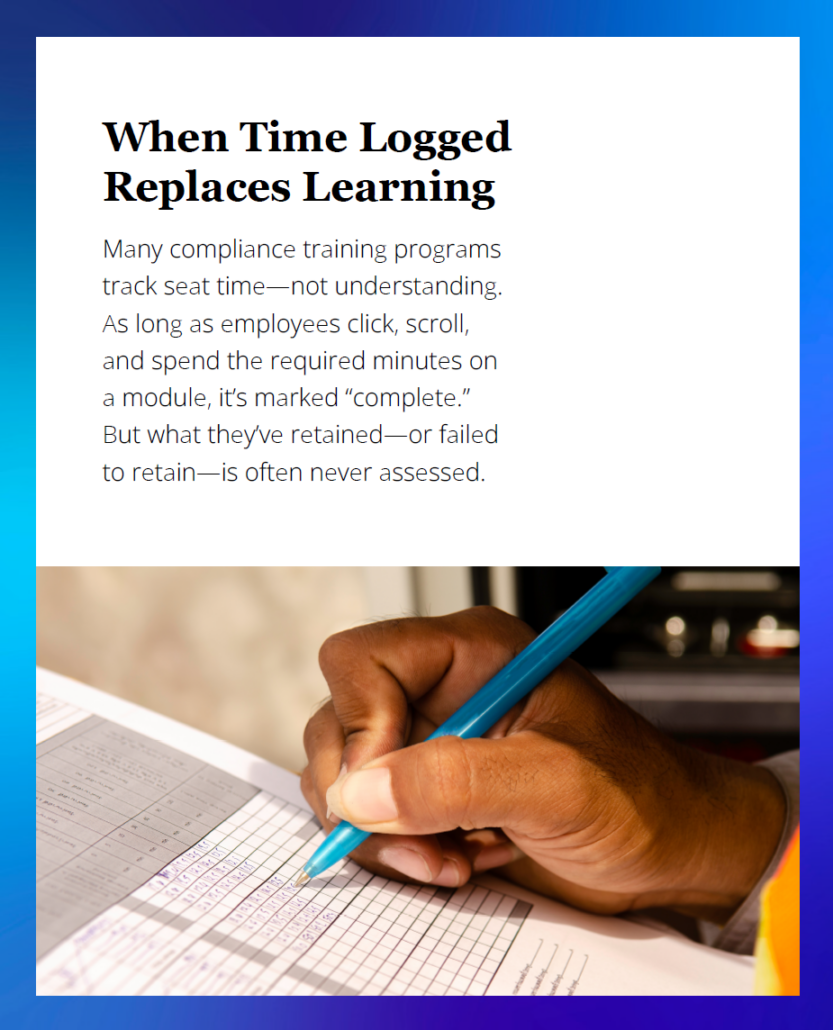
For many institutions, success is measured by how many people completed the training. But checking a box doesn’t mean someone actually learned anything—or that they’ll apply it when it counts. There’s rarely follow-up to see if people can recognize a suspicious transaction six months later, or if that new sanctions update changed how teams operate. Without measuring comprehension or behavior change, it’s impossible to know whether the training is actually reducing risk.
Risk changes fast—especially in the financial sector. But training often lags behind. Institutions roll out annual modules that don’t reflect current threats, emerging technologies, or regulatory focus areas. For example, while regulators are turning their attention to digital asset risks and AI-driven fraud, many programs are still running the same fraud or AML training from years ago. When training doesn’t reflect what’s actually happening in the risk environment, it becomes performative—just another thing to get through before moving on to “real” work.
When compliance training is treated as a formality, the consequences aren’t just theoretical—they’re very real, and very costly.
It’s one thing for an employee to complete a training module. It’s another for them to apply what they’ve learned when it matters. We’ve seen time and again how staff who’ve technically fulfilled all their training obligations still fail to follow basic procedures—allowing high-risk transactions to go unreported, missing red flags in KYC files, or failing to escalate suspicious activity. The problem isn’t that they didn’t take the training—it’s that the training didn’t stick.
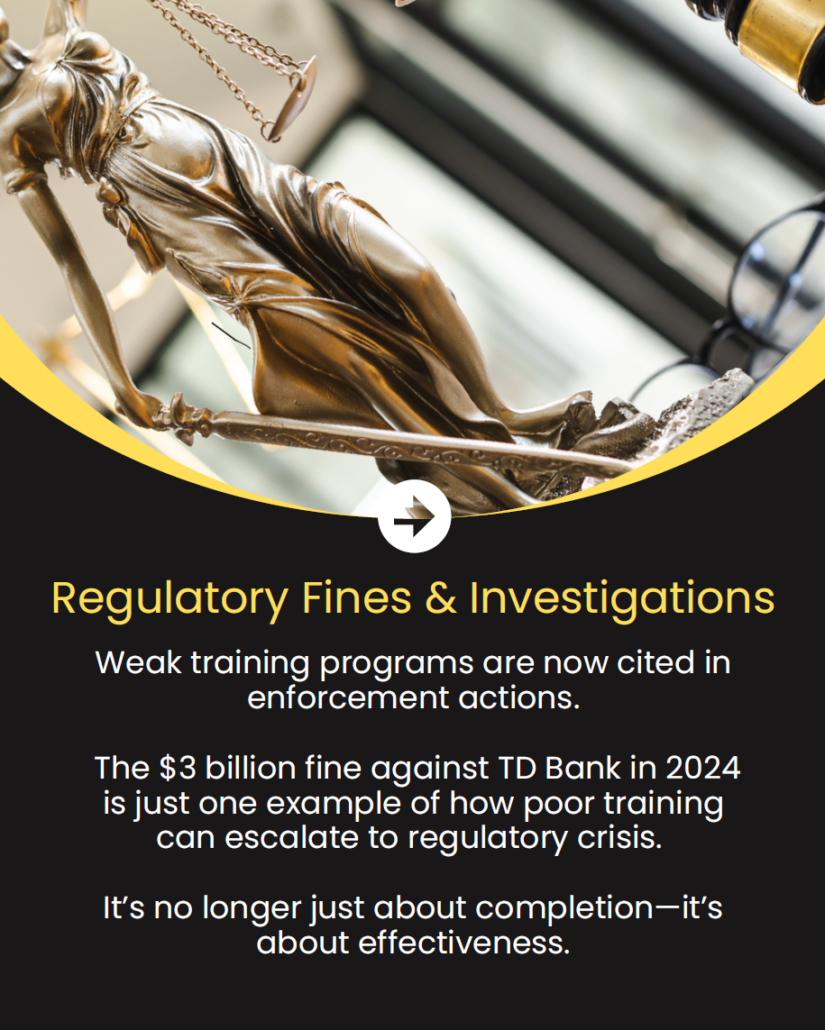
Regulators aren’t just checking whether training happened. Increasingly, they’re asking how effective it was. In several recent enforcement actions—such as the $3 billion penalty against TD Bank in 2024 and earlier actions against institutions like HSBC and Standard Chartered—deficiencies in staff training were explicitly cited. The message is clear: if your program is superficial or out of sync with current risks, it can be used against you in an investigation.
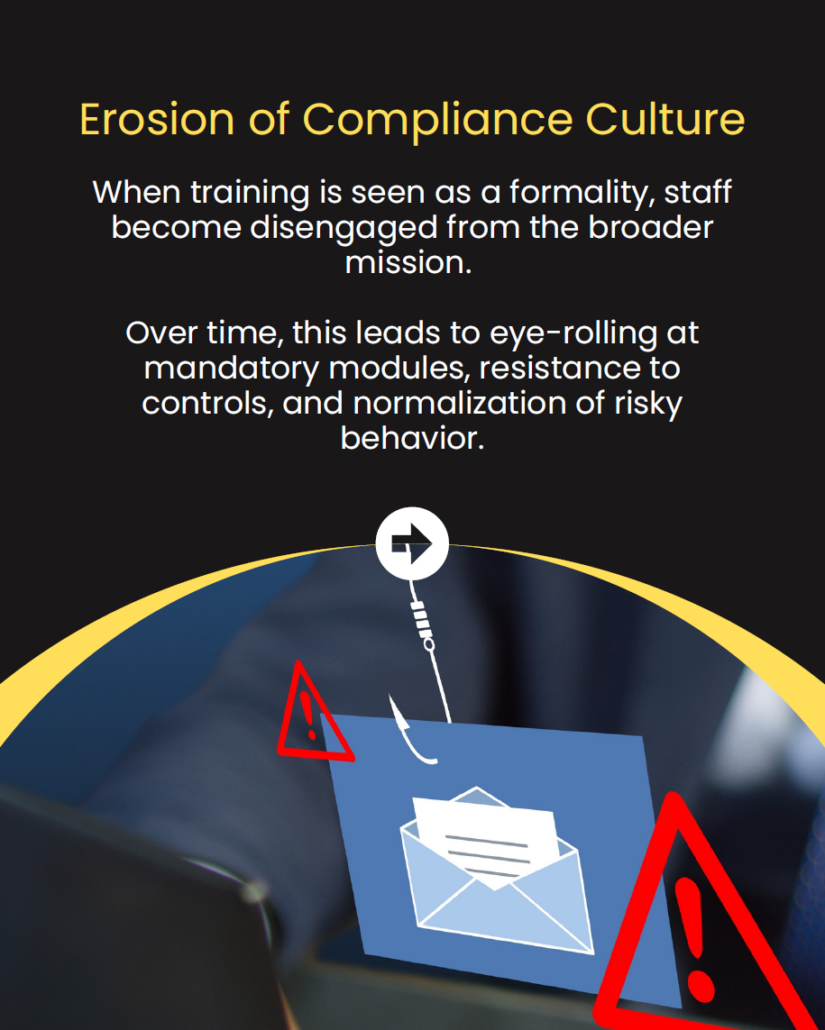
Poorly designed training doesn’t just fail to educate—it erodes trust. Employees come to view compliance as a box-ticking exercise, not a real business risk. This leads to training fatigue, eye-rolling during mandatory modules, and a general sense of disengagement. And when compliance doesn’t feel meaningful internally, it’s far less likely to be taken seriously in practice.
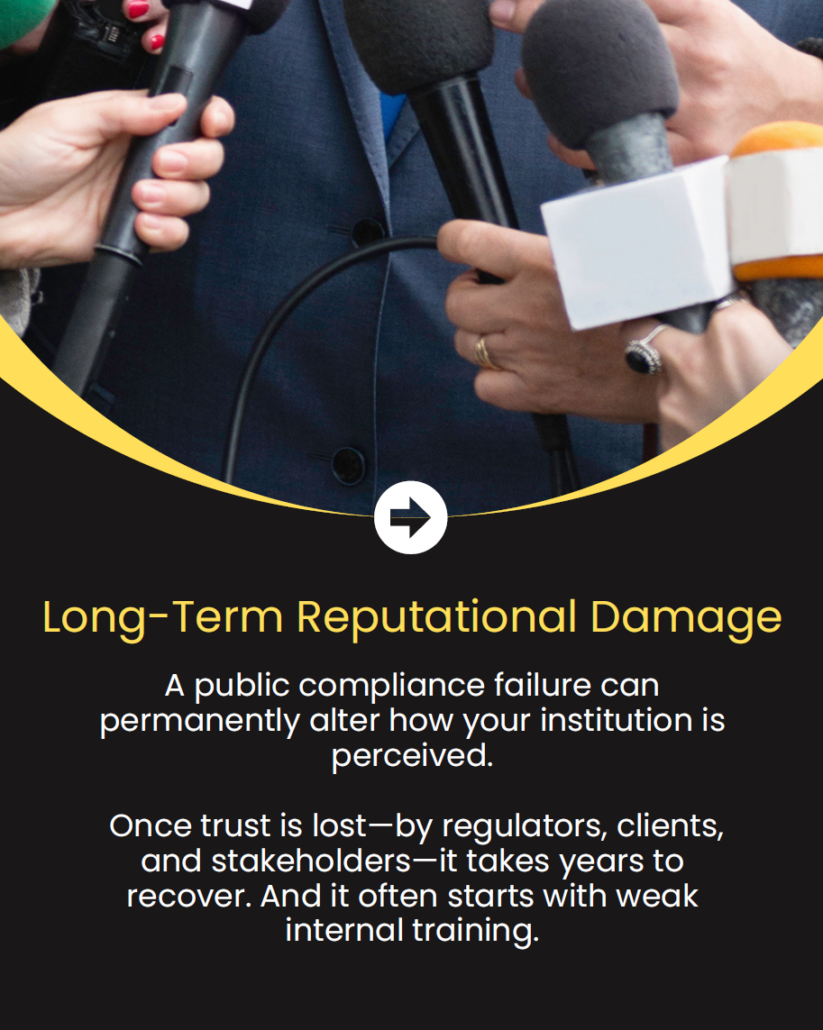
Once your institution’s name is tied to a major compliance failure, everything changes. Regulators look more closely at your entire program. Clients—especially institutional ones—may begin to question your internal controls. Media scrutiny adds fuel to the fire. And even after the fine is paid, that reputational hit lingers, complicating relationships with investors, partners, and stakeholders.
The truth is, compliance training that merely checks the box isn’t just ineffective—it’s risky. It creates blind spots, undermines your culture, and leaves your institution exposed to exactly the types of failures training is meant to prevent.
As the regulatory space evolves and risks become more complex, it’s not enough to say training happened. Financial institutions need programs that actually work—ones that engage, educate, and empower employees to recognize and respond to real-world threats.
In our upcoming article, Rethinking Compliance Training — Smarter Strategies for Real Institutional Impact, we’ll explore what that kind of training looks like. From smarter design principles to risk-based tailoring and meaningful measurement, we’ll show how financial institutions can shift from box-ticking to behavior-changing—and why it’s not just a compliance win, but a business advantage.

Explore our suite of compliance e-learning courses covering an array of financial crime compliance topics. All courses are designed to maximize retention of relevant knowledge and are available for customization.

An on-demand video library designed for today’s risk environment, this expert-led training program make complex topics clear, practical, and engaging—ideal for onboarding, upskilling, or refreshing core compliance knowledge across your teams.
 https://finintegrity.org/wp-content/uploads/2026/09/shutterstock_2645005987-scaled.jpg
1706
2560
IFI
https://live-black-pebble.pantheonsite.io/wp-content/uploads/2023/12/GIFI-Placeholder2.png
IFI2026-09-24 07:00:302026-09-24 11:44:27Dirty Barrels
https://finintegrity.org/wp-content/uploads/2026/09/shutterstock_2645005987-scaled.jpg
1706
2560
IFI
https://live-black-pebble.pantheonsite.io/wp-content/uploads/2023/12/GIFI-Placeholder2.png
IFI2026-09-24 07:00:302026-09-24 11:44:27Dirty Barrels https://finintegrity.org/wp-content/uploads/2026/01/bg-synethic-identities.jpg
500
1200
IFI
https://live-black-pebble.pantheonsite.io/wp-content/uploads/2023/12/GIFI-Placeholder2.png
IFI2026-01-08 07:00:252026-03-27 12:40:46Synthetic Identities
https://finintegrity.org/wp-content/uploads/2026/01/bg-synethic-identities.jpg
500
1200
IFI
https://live-black-pebble.pantheonsite.io/wp-content/uploads/2023/12/GIFI-Placeholder2.png
IFI2026-01-08 07:00:252026-03-27 12:40:46Synthetic Identities https://finintegrity.org/wp-content/uploads/2025/08/shutterstock_2599430089-scaled.jpg
1202
2560
IFI
https://live-black-pebble.pantheonsite.io/wp-content/uploads/2023/12/GIFI-Placeholder2.png
IFI2025-08-27 07:00:452026-05-14 14:14:01Deepfake Deep Dive
https://finintegrity.org/wp-content/uploads/2025/08/shutterstock_2599430089-scaled.jpg
1202
2560
IFI
https://live-black-pebble.pantheonsite.io/wp-content/uploads/2023/12/GIFI-Placeholder2.png
IFI2025-08-27 07:00:452026-05-14 14:14:01Deepfake Deep Dive https://finintegrity.org/wp-content/uploads/2025/06/Screenshot-2025-06-03-194254.png
416
767
IFI
https://live-black-pebble.pantheonsite.io/wp-content/uploads/2023/12/GIFI-Placeholder2.png
IFI2025-06-05 07:00:132026-03-04 18:12:30The Network, Not the Node
https://finintegrity.org/wp-content/uploads/2025/06/Screenshot-2025-06-03-194254.png
416
767
IFI
https://live-black-pebble.pantheonsite.io/wp-content/uploads/2023/12/GIFI-Placeholder2.png
IFI2025-06-05 07:00:132026-03-04 18:12:30The Network, Not the Node https://finintegrity.org/wp-content/uploads/2024/11/bg-ai-vs-human-judgement.jpg
1162
1800
IFI
https://live-black-pebble.pantheonsite.io/wp-content/uploads/2023/12/GIFI-Placeholder2.png
IFI2025-04-09 07:00:202025-09-25 15:17:41AI vs. Human Judgment
https://finintegrity.org/wp-content/uploads/2024/11/bg-ai-vs-human-judgement.jpg
1162
1800
IFI
https://live-black-pebble.pantheonsite.io/wp-content/uploads/2023/12/GIFI-Placeholder2.png
IFI2025-04-09 07:00:202025-09-25 15:17:41AI vs. Human Judgment https://finintegrity.org/wp-content/uploads/2025/02/the-heat-is-on-bg.jpg
1157
1800
IFI
https://live-black-pebble.pantheonsite.io/wp-content/uploads/2023/12/GIFI-Placeholder2.png
IFI2025-02-24 07:00:152025-03-26 19:38:52The Heat is On
https://finintegrity.org/wp-content/uploads/2025/02/the-heat-is-on-bg.jpg
1157
1800
IFI
https://live-black-pebble.pantheonsite.io/wp-content/uploads/2023/12/GIFI-Placeholder2.png
IFI2025-02-24 07:00:152025-03-26 19:38:52The Heat is On https://finintegrity.org/wp-content/uploads/2025/01/article-green-gold-rush.jpg
1261
1800
IFI
https://live-black-pebble.pantheonsite.io/wp-content/uploads/2023/12/GIFI-Placeholder2.png
IFI2025-01-13 07:00:472025-09-25 15:00:34The Green Gold Rush
https://finintegrity.org/wp-content/uploads/2025/01/article-green-gold-rush.jpg
1261
1800
IFI
https://live-black-pebble.pantheonsite.io/wp-content/uploads/2023/12/GIFI-Placeholder2.png
IFI2025-01-13 07:00:472025-09-25 15:00:34The Green Gold Rush https://finintegrity.org/wp-content/uploads/2024/12/bg-toward-financial-integrity-risk-management-program.png
835
1800
IFI
https://live-black-pebble.pantheonsite.io/wp-content/uploads/2023/12/GIFI-Placeholder2.png
IFI2024-12-19 07:00:412025-09-25 14:57:22Toward a Financial Integrity Risk Management Program
https://finintegrity.org/wp-content/uploads/2024/12/bg-toward-financial-integrity-risk-management-program.png
835
1800
IFI
https://live-black-pebble.pantheonsite.io/wp-content/uploads/2023/12/GIFI-Placeholder2.png
IFI2024-12-19 07:00:412025-09-25 14:57:22Toward a Financial Integrity Risk Management Program https://finintegrity.org/wp-content/uploads/2024/12/shutterstock_2472894163-scaled.jpg
1403
2560
Lauren Jack
https://live-black-pebble.pantheonsite.io/wp-content/uploads/2023/12/GIFI-Placeholder2.png
Lauren Jack2024-12-12 07:00:342025-09-25 14:57:44Safeguarding Trust – How to Balance Innovation and Security in Gen AI-Powered Compliance
https://finintegrity.org/wp-content/uploads/2024/12/shutterstock_2472894163-scaled.jpg
1403
2560
Lauren Jack
https://live-black-pebble.pantheonsite.io/wp-content/uploads/2023/12/GIFI-Placeholder2.png
Lauren Jack2024-12-12 07:00:342025-09-25 14:57:44Safeguarding Trust – How to Balance Innovation and Security in Gen AI-Powered Compliance Lessons From Russia & Iran – What EU Sanctions Teach Us About Policy...