Understanding and Addressing Fraud and Corruption Risks
Exploring Bribery & Corruption Drivers, Regulations, Preventative Measures, and Case Studies
📅 July 2, 2024

Note: This blog post is a summary of the webinar “Corruption in Construction: Case Studies & Compliance Strategies.” Click here if you’d like to access the full recording.
In our recent webinar, industry experts delved into the crucial topic of fraud and corruption risks. From seasoned professionals to anti-corruption activists, the webinar featured a panel of distinguished speakers: Steve Burgess, Nikki Kenyon, Chris Williams, and James Wasserstrom. This blog post aims to summarize the key points discussed during the session, equipping readers with the knowledge necessary to navigate these risks effectively.
The session kicked off with Steve Burgess, a seasoned expert in risk management and fraud prevention, discussing three key aspects that drive fraud and corruption risk: money, opacity, and setting. Burgess emphasized the significance of understanding how money flows through a system and the various contracts and payment mechanisms involved. He also highlighted the impact of opacity, which occurs when information is hidden or partially hidden, leading to issues such as unclear bid specifications and contract variations. Additionally, Burgess stressed the importance of considering the local context and established norms when entering a new market.
To effectively address fraud and corruption risks, Burgess recommended seeking information from industry experts, monitoring news and social media for potential risks, and being cautious when entering agreements. It is crucial to keep an eye on the flow and accessibility of money, the clarity or opacity of the situation, and the stakeholders and setting involved in any given contract. By understanding these factors, businesses can proactively mitigate risks and maintain integrity in their operations.
The discussion then shifted gears, with Nicki Kenyon, an associate managing director at the Institute of Financial Integrity, diving into the regulatory landscape surrounding bribery and corruption. Kenyon highlighted that both US law and international anti-bribery conventions firmly deem bribery illegal. She emphasized that offering or promising anything of value to a public official with the intent of influencing their actions or prompting them to engage in fraudulent behavior amounts to bribery.
Kenyon presented a number of real-world cases to underscore the pernicious nature of corruption. The Odebrecht scandal, involving a Latin American construction giant, and the Operation Car Wash scandal, which implicated Petrobras, a Brazilian oil giant, were among the examples cited. Additionally, bid rigging, a collusion tactic employed by construction companies to circumvent fair competition, was discussed. Kenyon pointed out that such practices undermine transparency and integrity within the industry.
The consequences of engaging in corrupt activities were further exemplified through the case of Deutsche Bank. The institution faced severe penalties due to its involvement in a criminal scheme aimed at concealing bribe payments. Kenyon also shed light on the Foreign Corrupt Practices Act (FCPA), which criminalizes the offering of bribes to foreign officials by US companies, underscoring the potential civil and criminal penalties for violations.
Discussing foreign bribe demands, Kenyon introduced the Foreign Extortion Prevention Act (FEPA), passed last year to address the unfairness faced by US companies that pay bribes. FEPA makes it illegal for foreign officials to demand or accept bribes from US persons or companies. Kenyon highlighted the far-reaching consequences of foreign bribe demands, including detrimental impacts on human trafficking and drug distribution.
Chris Williams, the senior director for anti-fraud and corruption at the Millennium Challenge Corporation, addressed the importance of implementing preventive measures to mitigate fraud and corruption risks in construction projects. Williams underlined the significance of implementing controls and actions to mitigate fraud and corruption in construction projects.
Dedicated funds and personnel, clear rules forbidding fraudulent behavior, and disclosure of conflicts of interest were key components of effective prevention strategies outlined by Williams. In addition, he stressed the importance of international standards and qualified oversight, including unannounced site visits, to enhance transparency and minimize risks.
Clear instructions for reporting suspicious activities, coupled with real consequences such as contract termination, debarment, and prosecution, were deemed essential.
James Wasserstrom, a seasoned anti-corruption expert and activist, captivated the audience with his firsthand experiences combating corruption in various countries. Wasserstrom’s accounts spanned Kosovo, Ukraine, and Afghanistan, providing unique insights into the challenges faced in these contexts including facilitation fees and substandard construction projects.
Drawing from specific instances of corruption, Wasserstrom emphasized the necessity of extended due diligence, contractual obligations, supply chain visibility, and ongoing compliance monitoring throughout the project lifecycle. He encouraged attendees to leverage available resources, such as the Global Infrastructure Anti-Corruption Centre, the Open Contracting Partnership, and the Infrastructure Transparency Initiative, to gain support and guidance in combating corruption.
The webinar brought to the fore critical aspects that drive fraud and corruption risks and highlighted real-world cases where these risks were encountered. From understanding the flow of money to navigating the intricacies of transparency and comprehending the nuances of different settings, attendees gained valuable insights from industry experts.
We extend our gratitude to the speakers, Steve Burgess, Chris Williams, James Wasserstrom, and Nicki Kenyon, for sharing their extensive experience and invaluable insights. Access the full webinar recording here.
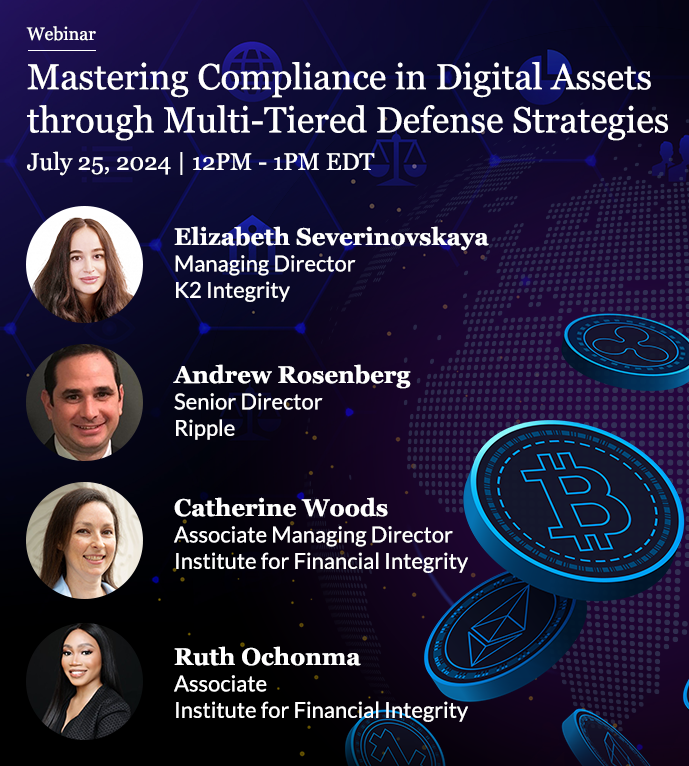
For those who wish to delve deeper into the topics discussed, we encourage you to email your questions to info@finintegrity.org. Additionally, stay tuned for our next webinar, Mastering Compliance in Digital Assets through Multi-Tiered Defense Strategies.
Together, let us fortify our commitment to integrity and transparency, and collectively strive toward a future where fraud and corruption hold no place in our professional endeavors.
The digital assets sector presents unique compliance challenges, including a complex and rapidly evolving regulatory landscape, misuse of digital assets in financial crime, and the need to adapt existing risk and compliance frameworks to include digital assets. As this industry continues to grow, with projections indicating substantial market expansion, staying ahead of compliance requirements and future challenges is crucial for financial institutions to safeguard their operations and reputation, while benefiting from the potential of this asset class.
Effective defense strategies are paramount to mitigating these risks and maintaining the highest standards of compliance. Led by industry experts, panelists will assess the integral roles of the first and second lines of defense in maintaining rigorous compliance frameworks and will dive into the future challenges that could redefine regulatory landscapes. Prepare to gain actionable insights and forward-looking strategies to elevate your compliance practices in the fast-evolving world of digital assets.
 https://finintegrity.org/wp-content/uploads/2026/10/Screenshot-2026-10-20-115053.png
1301
2320
IFI
https://live-black-pebble.pantheonsite.io/wp-content/uploads/2023/12/GIFI-Placeholder2.png
IFI2026-10-21 07:00:052026-10-21 11:26:02Across Borders, Beyond Sight
https://finintegrity.org/wp-content/uploads/2026/10/Screenshot-2026-10-20-115053.png
1301
2320
IFI
https://live-black-pebble.pantheonsite.io/wp-content/uploads/2023/12/GIFI-Placeholder2.png
IFI2026-10-21 07:00:052026-10-21 11:26:02Across Borders, Beyond Sight https://finintegrity.org/wp-content/uploads/2026/09/shutterstock_2645005987-scaled.jpg
1706
2560
IFI
https://live-black-pebble.pantheonsite.io/wp-content/uploads/2023/12/GIFI-Placeholder2.png
IFI2026-09-24 07:00:302026-09-24 11:44:27Dirty Barrels
https://finintegrity.org/wp-content/uploads/2026/09/shutterstock_2645005987-scaled.jpg
1706
2560
IFI
https://live-black-pebble.pantheonsite.io/wp-content/uploads/2023/12/GIFI-Placeholder2.png
IFI2026-09-24 07:00:302026-09-24 11:44:27Dirty Barrels https://finintegrity.org/wp-content/uploads/2026/09/august-2026-se-report-bg.jpg
888
1184
IFI
https://live-black-pebble.pantheonsite.io/wp-content/uploads/2023/12/GIFI-Placeholder2.png
IFI2026-09-02 07:00:562026-09-01 13:19:24August Monthly Sanctions and Export Controls Report
https://finintegrity.org/wp-content/uploads/2026/09/august-2026-se-report-bg.jpg
888
1184
IFI
https://live-black-pebble.pantheonsite.io/wp-content/uploads/2023/12/GIFI-Placeholder2.png
IFI2026-09-02 07:00:562026-09-01 13:19:24August Monthly Sanctions and Export Controls Report https://finintegrity.org/wp-content/uploads/2026/08/judgement-gap-in-market-abuse-compliance-bg.jpg
841
1500
IFI
https://live-black-pebble.pantheonsite.io/wp-content/uploads/2023/12/GIFI-Placeholder2.png
IFI2026-08-25 07:00:462026-08-24 11:34:59The Judgment Gap in Market Abuse Compliance
https://finintegrity.org/wp-content/uploads/2026/08/judgement-gap-in-market-abuse-compliance-bg.jpg
841
1500
IFI
https://live-black-pebble.pantheonsite.io/wp-content/uploads/2023/12/GIFI-Placeholder2.png
IFI2026-08-25 07:00:462026-08-24 11:34:59The Judgment Gap in Market Abuse Compliance https://finintegrity.org/wp-content/uploads/2026/07/guide-to-market-abuse-bg.jpg
1067
1600
IFI
https://live-black-pebble.pantheonsite.io/wp-content/uploads/2023/12/GIFI-Placeholder2.png
IFI2026-07-29 07:00:472026-07-28 12:45:11A Financial Institution’s Guide to Updated EU Market Abuse Regulation
https://finintegrity.org/wp-content/uploads/2026/07/guide-to-market-abuse-bg.jpg
1067
1600
IFI
https://live-black-pebble.pantheonsite.io/wp-content/uploads/2023/12/GIFI-Placeholder2.png
IFI2026-07-29 07:00:472026-07-28 12:45:11A Financial Institution’s Guide to Updated EU Market Abuse Regulation https://finintegrity.org/wp-content/uploads/2026/06/social-engineering-bg-1.jpg
675
1200
IFI
https://live-black-pebble.pantheonsite.io/wp-content/uploads/2023/12/GIFI-Placeholder2.png
IFI2026-07-08 07:00:562026-07-08 07:57:51Social Engineering Is Rewriting the Fraud Playbook
https://finintegrity.org/wp-content/uploads/2026/06/social-engineering-bg-1.jpg
675
1200
IFI
https://live-black-pebble.pantheonsite.io/wp-content/uploads/2023/12/GIFI-Placeholder2.png
IFI2026-07-08 07:00:562026-07-08 07:57:51Social Engineering Is Rewriting the Fraud Playbook https://finintegrity.org/wp-content/uploads/2026/03/understandingfatf-bg.jpg
1000
1500
IFI
https://live-black-pebble.pantheonsite.io/wp-content/uploads/2023/12/GIFI-Placeholder2.png
IFI2026-05-13 07:00:082026-05-22 13:26:47Understanding the FATF: A Guide for Private Sector Stakeholders Part 3
https://finintegrity.org/wp-content/uploads/2026/03/understandingfatf-bg.jpg
1000
1500
IFI
https://live-black-pebble.pantheonsite.io/wp-content/uploads/2023/12/GIFI-Placeholder2.png
IFI2026-04-28 07:00:032026-05-22 13:28:23Understanding the FATF: A Guide for Private Sector Stakeholders Part 2
https://finintegrity.org/wp-content/uploads/2026/03/understandingfatf-bg.jpg
1000
1500
IFI
https://live-black-pebble.pantheonsite.io/wp-content/uploads/2023/12/GIFI-Placeholder2.png
IFI2026-05-13 07:00:082026-05-22 13:26:47Understanding the FATF: A Guide for Private Sector Stakeholders Part 3
https://finintegrity.org/wp-content/uploads/2026/03/understandingfatf-bg.jpg
1000
1500
IFI
https://live-black-pebble.pantheonsite.io/wp-content/uploads/2023/12/GIFI-Placeholder2.png
IFI2026-04-28 07:00:032026-05-22 13:28:23Understanding the FATF: A Guide for Private Sector Stakeholders Part 2 https://finintegrity.org/wp-content/uploads/2026/04/consumerprotection-bg.jpg
1000
1500
IFI
https://live-black-pebble.pantheonsite.io/wp-content/uploads/2023/12/GIFI-Placeholder2.png
IFI2026-04-15 07:00:202026-04-08 09:36:08Data as a Critical Business and Compliance Asset
https://finintegrity.org/wp-content/uploads/2026/04/consumerprotection-bg.jpg
1000
1500
IFI
https://live-black-pebble.pantheonsite.io/wp-content/uploads/2023/12/GIFI-Placeholder2.png
IFI2026-04-15 07:00:202026-04-08 09:36:08Data as a Critical Business and Compliance Asset
 Three Lines of Defense