Tech vs. Corruption
How New Technologies Are Fighting Old Enemies
📅 June 6, 2024

Corruption remains a pervasive challenge in multiple sectors, affecting government agencies, traditional banking institutions, and the broad spectrum of designated non-financial businesses and professionals (DNFBPs), including real estate agents, lawyers, casinos, and accountants. In these environments, corruption can manifest in various forms such as money laundering, bribery, fraud, and evasion of regulatory oversight. The implications are profound, eroding trust, undermining stability, and costing trillions in financial losses annually. Beyond financial losses, corruption diverts funds from essential public services, resulting in lower quality infrastructure such as schools and roads. This misuse of resources directly impacts communities by compromising the quality of services and infrastructure they rely on. Corruption isn’t a victimless crime; it harms society by undermining public trust and reducing the quality of life.
In response to these challenges, there is a growing recognition of technology’s potential in the fight against corruption. Corruption thrives in environments lacking transparency, where monitoring is inefficient, data can be easily tampered with, and corrupt patterns are difficult to detect due to complex data and delayed reporting. New innovations, particularly in blockchain, artificial intelligence (AI), and data analytics, offer unprecedented opportunities to enhance transparency and accountability. These technologies can automate processes to reduce human error, secure data with high levels of encryption to prevent tampering and provide real-time analytics that make it significantly harder for corrupt activities to go unnoticed. By addressing these specific challenges, technology creates a more robust framework for preventing and detecting corruption.
As we explore technological avenues that can help fight corruption, the promise is clear: integrating advanced technologies can not only deter the incidence of corruption, but also reshape the landscape of compliance and oversight within government agencies, private financial institutions, and DNFBPs.
Secure and Transparent Transaction Logging
Blockchain technology allows for the creation of a transparent and immutable record of transactions – not only financial transactions using virtual assets, but other business activities such as contracts. Each transaction recorded on a public blockchain is visible to all participants and is secured through cryptographic techniques, providing protection against alteration. This broad applicability of blockchain in tracking various types of transactions enhances transparency and reduces mismanagement and corruption, making every transaction traceable and accountable. For private financial institutions, the use of the blockchain can strengthen trust from clients and regulators, as well as improve compliance with anti-money laundering (AML) and know your customer (KYC) regulations. The versatile application of blockchain across different sectors—from supply chain management to the recording of documents—demonstrates its potential as a tool for ensuring transaction integrity.
Reduction of Fraud in High-Risk Transactions
Blockchain is particularly valuable in securing high-risk transactions, such as cross-border payments and large-scale corporate transfers, which are prone to fraud. The use of smart contracts—computer protocols that automate and enforce transaction terms based on preset conditions—minimize human error and can help deter manipulation. This automation not only streamlines processes but also fortifies the transaction chain against fraudulent activities.
HSBC’s Use of Blockchain for Trade Finance
HSBC implemented a blockchain-based platform called “Contour” for managing letters of credit, which are vital documents in international trade used to guarantee payment. The platform utilizes blockchain technology to digitize the letters of credit process from issuance to completion. Each participant in the trade transaction, from banks to traders, can view transaction processes in real time on the blockchain ledger, ensuring transparency and building trust among all parties. The immutability of records on a blockchain ensures that documents cannot be altered after issuance, drastically reducing the potential for fraud. By using blockchain, HSBC reduced the time it takes to process documents and issue letters of credit from 5-10 days to under 24 hours.
Estonia’s Use of Blockchain for Government Procurement
Estonia, a leader in digital governance, has implemented blockchain technology to secure its digital public services, including government contracting processes. This initiative ensures that every transaction related to government contracts is logged in a transparent, inalterable ledger, significantly reducing opportunities for corrupt activities and improving public trust in government operations.
Monitoring Government Spending, Procurement Processes and Enhancing Whistleblower Analysis
AI technologies are particularly effective in monitoring government spending and procurement processes—areas often vulnerable to corruption. By integrating AI tools, these processes can be continuously analyzed in real-time, noting patterns and teaching AI to recognize indicators of corruption. AI algorithms assess the legitimacy of transactions and flag activities that deviate from standard procurement patterns or that match known fraudulent behaviors.
Analyzing Financial Transactions for Unusual Patterns
For financial institutions, AI can play a critical role in scrutinizing financial transactions to detect unusual patterns that might suggest corrupt activities. Using machine learning models, AI systems learn from historical data to recognize the signs of potential corruption, such as irregular large payments or atypical transaction frequencies between certain parties. Once a suspicious pattern is detected, alerts can trigger further investigation, enabling rapid response to potential corruption or fraud.
IDB & Peru’s Use of AI in Managing Corruption
The Peruvian government’s Comptroller General’s Office (CGR), with support from the Inter-American Development Bank (IDB), is using AI in its “PE-L1240” loan program to enhance the government’s ability to detect and deter corruption. This initiative includes the implementation of AI-driven public awareness tools and monitoring controls which have been effective in reducing overbilling in public infrastructure projects. The GCR also developed machine learning algorithms to process and analyze more than 5,000 whistleblower allegations annually, filtering out irrelevant claims and assessing the severity and likelihood of corruption in the remaining allegations, thereby ensuring that resources are strategically utilized to prioritize the most critical issues.
JPMorgan Chase’s Use of AI to Detect Fraud
JPMorgan Chase, one of the largest banking institutions in the United States, employs AI to monitor transactions for signs of fraud and corruption. The bank’s systems analyze patterns in vast quantities of transaction data, flagging anomalies that suggest unethical activities. This proactive approach helps the bank prevent significant losses and maintain compliance with regulatory standards.
DNFBPs, such as professionals in the real estate sector, are particularly prone to corruption because the sector is often exploited by illicit actors to launder ill-gotten gains due to the stable nature of real estate assets and the substantial sums involved. Furthermore, although DNFBPs operate under stringent regulatory frameworks intended to prevent financial crimes, these can be circumvented through sophisticated schemes or the exploitation of regulatory loopholes. these can be circumvented through sophisticated schemes or the exploitation of regulatory loopholes.
Data analytics is increasingly vital in the fight against corruption, particularly within designated DNFBPs. This technology enables the examination of vast amounts of financial data to detect patterns and anomalies indicative of corrupt practices. DNFBPs that proactively implement measures to detect and prevent illicit activities can protect themselves and significantly reduce the likelihood of becoming targets of investigations.
Identification of Anomalies in Financial Flows
In sectors like real estate, where large transactions frequently occur, data analytics plays a crucial role in identifying discrepancies in financial flows. For example, data analytics can highlight inconsistencies in property prices that deviate significantly from market norms, which may suggest under-the-table dealings or money-laundering activities. Similarly, in law firms and accountancies, data analytics can detect irregularities in client accounts or financial statements, pinpointing unusual transaction patterns that warrant further investigation.
Risk Assessments of Clients and Transactions Based on Historical Data
Data analytics also facilitates comprehensive risk assessments by utilizing historical data to profile and evaluate clients and transactions. This process includes analyzing past behavior patterns of clients and the typical transactional frameworks within specific industries to assess the risk levels of new transactions. High-risk transactions or clients can be flagged automatically for additional scrutiny or for the implementation of more stringent controls. This proactive approach helps DNFBPs comply with regulatory requirements and maintain a proactive stance against potential corruption.
Anti-Money Laundering in the UK Real Estate Sector
In the UK, several real estate firms use data analytics to comply with AML regulations. By using their computer systems to analyze transaction data and client profiles, these companies can identify high-risk transactions and clients, flagging those that may involve proceeds from corruption. This approach has helped ensure regulatory compliance and maintain the integrity of the real estate market.
The fight against corruption in private financial institutions and DNFBPs can be significantly enhanced by the synergistic use of blockchain, AI, and data analytics. These technologies, when integrated, offer a comprehensive and robust framework that can detect, prevent, and respond to corrupt activities more effectively than any single technology could on its own. Blockchain provides an immutable record of transactions, ensuring transparency and traceability. AI enhances this capability by intelligently analyzing transaction data, spotting patterns that may indicate corruption, and learning over time to predict potential future breaches. Data Analytics complements both by providing deep insights and revealing trends across vast datasets, enabling proactive risk management.
For example, blockchain can record all transactions related to a government procurement process; AI can monitor these transactions in real-time, flagging anomalies or patterns that deviate from the norm; and data analytics tools can help analyze historical data to understand risk profiles, helping predict and mitigate future risks. Together, these technologies create a layered defense, helping detect and deter corruption.
The Philippines’ Anti-Corruption Initiative in Customs
The Philippines’ Bureau of Customs has integrated blockchain, AI, and data analytics to overhaul its customs processes. By employing blockchain, the bureau ensures that all declarations and payments are indelibly recorded indelibly and analyzed by AI alongside historical data to predict and identify potential corrupt practices, such as evasion of tariffs or attempts to fraudulently alter trade documents. This integrative approach has significantly reduced corruption, increased revenue, and improved efficiency in the customs process.
However, integrating these technologies presents several challenges, such as cost and complexity, organizational resistance, and jurisdictional inconsistencies that can hinder integration.
That being said, engaging with stakeholders to ensure buy-in early in the process, gradually phasing in technologies, and working closely with compliance experts in the public and private sectors can mitigate challenges. Early engagement with industry participants can proactively address their concerns. Cost and complexity can be moderated by using these technologies in small and manageable projects to demonstrate value and allow for iterative improvements. Working with regulatory and legal experts to ensure that integrated systems adhere to all applicable laws and regulations and updating policies as necessary, can also mitigate regulatory and compliance challenges.
It is important to note that while Blockchain, AI, and data analytics significantly enhance our ability to combat corruption across various sectors, these technologies should not replace the human element in governance and compliance Technologies provide tools that can detect, predict, and prevent corrupt practices, but they lack the human characteristics such as ethical judgment, compassion, instinct, and the ability to understand complex human motivations that are often critical in fighting corruption effectively. Therefore, while we embrace these advanced technologies for their capabilities to improve transparency and accountability, they must be integrated into frameworks that also value and incorporate human insight and oversight. By maintaining this balance, we can ensure that our approach to combating corruption is as humane as it is efficient, fostering an environment where technology and human expertise work in tandem to protect the integrity of the global financial system.
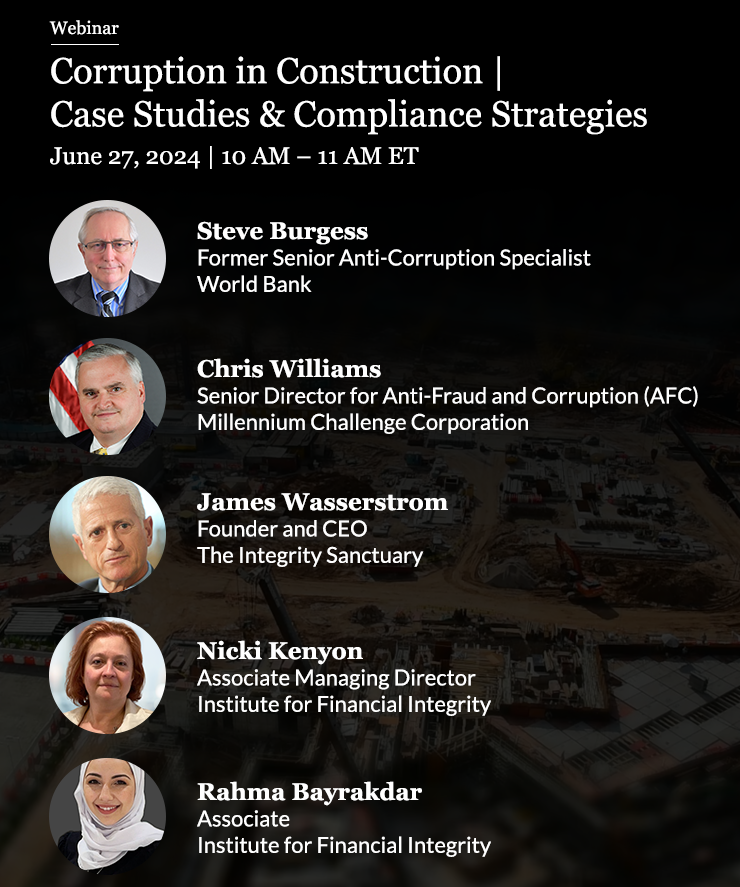
View our webinar focused webinar designed to equip financial institutions with the essential strategies for combating corruption in construction.
The construction and infrastructure sector faces significant corruption challenges, compounded by complex project structures and inadequate anti-corruption measures. Bribery and corruption pose significant risks to financial institutions, including reputational damage, legal and regulatory consequences, and financial losses.
Led by industry experts, this webinar will provide targeted insights into the unique challenges faced by financial institutions and practical solutions for ensuring compliance and reducing risk through an exploration on case studies, the key drivers of fraud and corruption, and U.S. regulatory requirements and compliance measures.
 https://finintegrity.org/wp-content/uploads/2026/09/shutterstock_2645005987-scaled.jpg
1706
2560
IFI
https://live-black-pebble.pantheonsite.io/wp-content/uploads/2023/12/GIFI-Placeholder2.png
IFI2026-09-24 07:00:302026-09-24 11:44:27Dirty Barrels
https://finintegrity.org/wp-content/uploads/2026/09/shutterstock_2645005987-scaled.jpg
1706
2560
IFI
https://live-black-pebble.pantheonsite.io/wp-content/uploads/2023/12/GIFI-Placeholder2.png
IFI2026-09-24 07:00:302026-09-24 11:44:27Dirty Barrels https://finintegrity.org/wp-content/uploads/2026/01/bg-synethic-identities.jpg
500
1200
IFI
https://live-black-pebble.pantheonsite.io/wp-content/uploads/2023/12/GIFI-Placeholder2.png
IFI2026-01-08 07:00:252026-03-27 12:40:46Synthetic Identities
https://finintegrity.org/wp-content/uploads/2026/01/bg-synethic-identities.jpg
500
1200
IFI
https://live-black-pebble.pantheonsite.io/wp-content/uploads/2023/12/GIFI-Placeholder2.png
IFI2026-01-08 07:00:252026-03-27 12:40:46Synthetic Identities https://finintegrity.org/wp-content/uploads/2025/08/shutterstock_2599430089-scaled.jpg
1202
2560
IFI
https://live-black-pebble.pantheonsite.io/wp-content/uploads/2023/12/GIFI-Placeholder2.png
IFI2025-08-27 07:00:452026-05-14 14:14:01Deepfake Deep Dive
https://finintegrity.org/wp-content/uploads/2025/08/shutterstock_2599430089-scaled.jpg
1202
2560
IFI
https://live-black-pebble.pantheonsite.io/wp-content/uploads/2023/12/GIFI-Placeholder2.png
IFI2025-08-27 07:00:452026-05-14 14:14:01Deepfake Deep Dive https://finintegrity.org/wp-content/uploads/2025/06/Screenshot-2025-06-03-194254.png
416
767
IFI
https://live-black-pebble.pantheonsite.io/wp-content/uploads/2023/12/GIFI-Placeholder2.png
IFI2025-06-05 07:00:132026-03-04 18:12:30The Network, Not the Node
https://finintegrity.org/wp-content/uploads/2025/06/Screenshot-2025-06-03-194254.png
416
767
IFI
https://live-black-pebble.pantheonsite.io/wp-content/uploads/2023/12/GIFI-Placeholder2.png
IFI2025-06-05 07:00:132026-03-04 18:12:30The Network, Not the Node https://finintegrity.org/wp-content/uploads/2024/11/bg-ai-vs-human-judgement.jpg
1162
1800
IFI
https://live-black-pebble.pantheonsite.io/wp-content/uploads/2023/12/GIFI-Placeholder2.png
IFI2025-04-09 07:00:202025-09-25 15:17:41AI vs. Human Judgment
https://finintegrity.org/wp-content/uploads/2024/11/bg-ai-vs-human-judgement.jpg
1162
1800
IFI
https://live-black-pebble.pantheonsite.io/wp-content/uploads/2023/12/GIFI-Placeholder2.png
IFI2025-04-09 07:00:202025-09-25 15:17:41AI vs. Human Judgment https://finintegrity.org/wp-content/uploads/2025/02/the-heat-is-on-bg.jpg
1157
1800
IFI
https://live-black-pebble.pantheonsite.io/wp-content/uploads/2023/12/GIFI-Placeholder2.png
IFI2025-02-24 07:00:152025-03-26 19:38:52The Heat is On
https://finintegrity.org/wp-content/uploads/2025/02/the-heat-is-on-bg.jpg
1157
1800
IFI
https://live-black-pebble.pantheonsite.io/wp-content/uploads/2023/12/GIFI-Placeholder2.png
IFI2025-02-24 07:00:152025-03-26 19:38:52The Heat is On https://finintegrity.org/wp-content/uploads/2025/01/article-green-gold-rush.jpg
1261
1800
IFI
https://live-black-pebble.pantheonsite.io/wp-content/uploads/2023/12/GIFI-Placeholder2.png
IFI2025-01-13 07:00:472025-09-25 15:00:34The Green Gold Rush
https://finintegrity.org/wp-content/uploads/2025/01/article-green-gold-rush.jpg
1261
1800
IFI
https://live-black-pebble.pantheonsite.io/wp-content/uploads/2023/12/GIFI-Placeholder2.png
IFI2025-01-13 07:00:472025-09-25 15:00:34The Green Gold Rush https://finintegrity.org/wp-content/uploads/2024/12/bg-toward-financial-integrity-risk-management-program.png
835
1800
IFI
https://live-black-pebble.pantheonsite.io/wp-content/uploads/2023/12/GIFI-Placeholder2.png
IFI2024-12-19 07:00:412025-09-25 14:57:22Toward a Financial Integrity Risk Management Program
https://finintegrity.org/wp-content/uploads/2024/12/bg-toward-financial-integrity-risk-management-program.png
835
1800
IFI
https://live-black-pebble.pantheonsite.io/wp-content/uploads/2023/12/GIFI-Placeholder2.png
IFI2024-12-19 07:00:412025-09-25 14:57:22Toward a Financial Integrity Risk Management Program https://finintegrity.org/wp-content/uploads/2024/12/shutterstock_2472894163-scaled.jpg
1403
2560
Lauren Jack
https://live-black-pebble.pantheonsite.io/wp-content/uploads/2023/12/GIFI-Placeholder2.png
Lauren Jack2024-12-12 07:00:342025-09-25 14:57:44Safeguarding Trust – How to Balance Innovation and Security in Gen AI-Powered Compliance
https://finintegrity.org/wp-content/uploads/2024/12/shutterstock_2472894163-scaled.jpg
1403
2560
Lauren Jack
https://live-black-pebble.pantheonsite.io/wp-content/uploads/2023/12/GIFI-Placeholder2.png
Lauren Jack2024-12-12 07:00:342025-09-25 14:57:44Safeguarding Trust – How to Balance Innovation and Security in Gen AI-Powered Compliance
 FinCEN Issues Warning to Financial Institutions