• Link to LinkedIn
  • Link to Youtube
  • Sign In
  • Register
  • Subscribe
  • Contact
Institute for Financial Integrity
  • Training
    • eLearning Courses

      • Suite of interactive e-learning courses to educate and engage staff on core compliance topics

      • Learn More
    • Video Library

      • An online learning journey through the various domains of financial crime, explore our library of expert-led videos

      • Learn More
    • Training Services

      • Trusted compliance training design, development, and delivery tailored to your unique requirements

      • Learn More
    • Certifications
      • Certified Risk Management Specialist – Global Sanctions
      • Certified Financial Integrity Professional Program
  • Technology
    • DOLFIN

      • A platform that equips financial integrity professionals with the continuing education, expert insights, resources and tools needed to protect the integrity of the global financial system.

      • Learn More
    • AskFIN

      • A revolutionary, AI-powered tool seamlessly integrated with DOLFIN® — the world’s largest and most trusted library of curated resources on financial integrity topics.

      • Learn More
  • Insights
    • Insights
      • Articles
      • Reports & White Papers
      • Webinars
      • Subscribe
  • About Us
    • Who We Are
      • Our Story
      • Leadership
      • Press Releases
    • Who We Serve
      • Financial Institutions
      • Jurisdictions
      • Executives
      • Industry Professionals
  • Get a Demo
  • Menu Menu

Navigating the Convergence of Sanctions & AML Regimes

Insights from the Experts

📅 March 11, 2025

In a recent webinar, leading professionals in sanctions and financial crime risk management convened to discuss the convergence of sanctions and anti-money laundering regimes. The panelists offered insights into how these two sectors have been merging and provided practical advice for professionals to navigate this complex landscape.

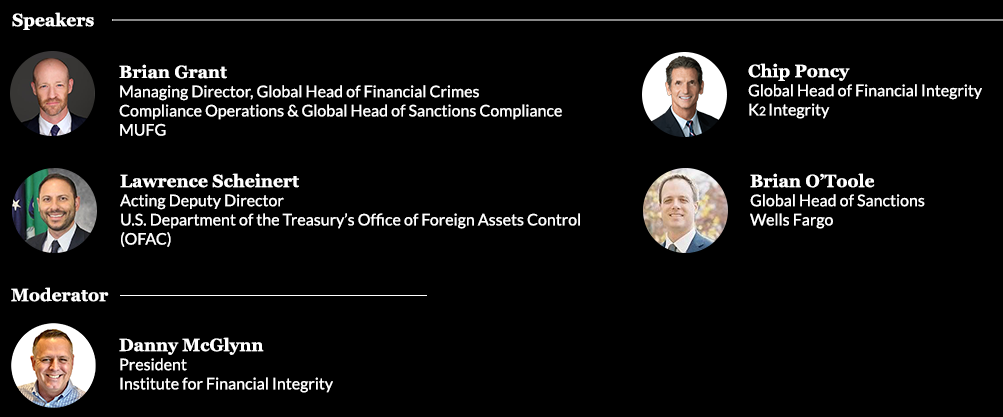
Among the distinguished speakers were:

  • Lawrence Scheinert, the Acting Deputy Director of the U.S. Treasury Department’s Office of Foreign Assets Control (OFAC)
  • Chip Poncy, Global Head of Financial Integrity at K2 Integrity
  • Brian Grant, Managing Director and Global Head of Financial Crimes Compliance Operations & Global Head of Sanctions Compliance at MUFG Bank
  • Brian O’Toole, Global Head of Sanctions at Wells Fargo, also participated in the discussion.

The event was moderated by Danny McGlynn, the President and Chief Integrity Officer of IFI.

The webinar aimed to demonstrate the convergence of sanctions and anti-money laundering regimes and the importance of breaking departmental silos in jurisdictions and financial institutions and the necessity for a comprehensive, holistic approach to compliance and risk management associated with sanctions and financial crimes.

Convergence Overview

Danny McGlynn began with an overview of the evolution of the convergence of sanctions and financial crimes compliance over the years, which underscored the need for institutions to adapt to the changing landscape. He highlighted how the convergence has been multifaceted and can be broken down into four main areas: targeting of common conduct, reliance on common preconditions, evolution of common compliance program pillars, and emergence of common red flags.

With respect to the targeting of common conduct, McGlynn highlighted how over the past 25 years six criminal activities that are considered money laundering predicate offenses targeted by AML/CFT regimes—terrorism, WMD proliferation, corruption, human rights violations, organized crime, and narcotics trafficking—have increasingly also become conduct targeted by sanctions regimes imposed by the U.S., EU, UK, and UN.

Importance of Breaking Down Silos 

The panelists agreed on the deep link between sanctions and AML/CFT regimes and the importance of breaking down the silos between sanctions and AML/CFT departments in both the public and private sector. This was the key takeaway from the lesson of 9/11. From a threat, vulnerability, and control perspective, convergence of sanctions and AML/CFT is necessary if we’re going to be effective in combating financial crime, advancing collective security, and protecting the integrity of the financial system.

The panelists offered the following specific insights and best practices on breaking down silos:

  • ✅ Take a holistic approach: Illicit actors move money in the same ways whether they are the subject of sanctions or part of a money laundering network, and the best way to get at this convergence is through parallel convergence of your own programs in a financial institution. The best practice is to approach financial crimes and sanctions holistically and have your AML and sanctions programs leverage shared services when it comes to investigations.
  • ✅ Ensure linkages between AML teams and sanctions teams: For example, if the AML team is going to file a SAR on a sanctions target they should coordinate with the sanctions team, and if the sanctions team is working on customer risk remediation they should coordinate with the financial crimes intelligence team, which typically lives outside the sanctions space. Second, ensure the proper governance models and routines are in place like getting AML and sanctions teams together monthly to talk about emerging risks.
  • ✅ Use traditional AML tools to investigate sanctions targets: When OFAC sanctions someone, in addition to banks blocking transactions going forward, it is helpful also to look for any past transactional activity involving the target and identify who else they were transacting with and to identify whether they share common addresses with other companies that haven’t been sanctioned. This kind of diligence can be very helpful to OFAC and other government agencies.

Common Preconditions for Effective Measures

Panelists discussed the common preconditions for effective sanctions and AML/CFT measures, pointing out that protecting the international financial system from criminal abuse by identifying and closing systemic vulnerabilities through heightened transparency measures and accountability has long been an overarching objective of the global AML framework.

At the same time, effective implementation of sanctions policy also requires a transparent and accountable international financial system to enable the identification of sanctioned activities and interests of sanctioned individuals and entities. Achieving such financial transparency and accountability requires effective jurisdictional and institutional implementation of preventive measures—backed by sound supervision and enforcement—as called for by AML/CFT regimes.

With respect to institutional implementation, the panelists cited guidance published by OFAC in 2019—A Framework for OFAC Compliance Commitments—and highlighted that the essential elements of a sanctions compliance program are very similar to the AML program requirements: management commitment, risk assessment, customer due diligence / know your customer (CDD/KYC), internal controls, testing and auditing, and training.

Common Red Flags 

Turning to common red flags that banks and others should be on the lookout for regarding money laundering and sanctions evasion activities, the panel discussed several advisories and alerts that OFAC and FinCEN have issued over the past few years. These alerts have provided examples of red flags that can signal when and how third parties and intermediaries may be engaged in efforts to evade sanctions or export controls. Many of these red flags are the same or similar to longstanding AML-related red flags, demonstrating that AML controls and investigations can be helpful in detecting sanctions evasion and uncovering assets and transactions of designated parties.

On Iran, for example, FinCEN last year issued an advisory focused on sanctioned Iran-backed terrorist organizations like Hamas and Hizballah. The advisory includes case studies and typologies on how they raise and move funds, as well as specific red flags like:

  • front companies disguised as general trading companies with unclear business purposes, 
  • payments going to third parties in high-risk jurisdictions, and
  • shared addresses with other suspicious actors.

OFAC has also issued a series of advisories focused on shipping that have included red flags such as:

  • falsifying cargo and vessel documents, 
  • turning off the AIS responders, 
  • ship-to-ship transfers, and 
  • changing vessel names. 

The panel noted that many of the red flags included in these advisories and alerts have been informed by the government’s engagement with the private sector and emphasized the importance of continued cross-sector information-sharing and public-private partnerships.

Detecting Sanctions and Trade Control Evasion 

The panelists emphasized that the biggest problem faced by financial institutions is less about the identification of red flags and the theories behind them and more about having the systems to put them into practice in a repeatable manner. The ability to operationalize red flags in a way to effectively identify and mitigate risk is very difficult, especially at very large financial institutions. The governance and implementation framework is as important or more important than the actual red flags, and regulators reviewing AML and sanctions programs are going to look for consistency of implementation across the enterprise.

The panelists offered the following specific insights and best practices on how to detect potential sanctions and trade control evasion:

  • ✅ Focus on AML program fundamentals and apply them robustly across the enterprise: Focus less on the latest typology around the latest threat, as they change and are prioritized differently by different administrations (for example, the new U.S. administration is prioritizing the elimination of cartels over countering Russian oligarchs), and more on understanding and applying the common approaches to sanctions evasion and money laundering shared by threat actors, including:
  • the use of shell companies,
  • lax or permissive jurisdictions, including those adjacent to high-risk countries, and
  • unusual financial activity that doesn’t fit the profile of the customer
  • ✅ Maintain your curiosity and a proactive investigative mindset: Rather than passively relying on transactions monitoring and sanctions screening to detect suspicious or sanctionable activity, you must go out and look for it. Utilize global and complex investigations units to proactively identify potential illicit activity, including by leveraging open-source information and third-party vendors (e.g. Kharon) and NGOs (e.g. C4ADS) to sharpen the focus of investigative inquiries.
  • ✅ Take advantage of specialized training programs: For example, IFI’s Certified Risk Management Specialist in Russia Sanctions (CRMS-RS) Program has been designed and delivered in partnership with the U.S. State Department to jurisdictional authorities, financial institutions, and other vulnerable industries in over 30 countries. The program includes fact pattern scenarios and transaction alert exercises that allow candidates to practice identifying and mitigating sanctions and trade control risks based on real-world scenarios that participants are likely to encounter in undertaking their professional duties.

Other Key Takeaways and Advice 

  • Ask “why are we doing this?” Often there’s a tendency to overlook why we do this. It’s important to take a step back and constructively question “why are we doing this?” Not just “are we doing this the right way,” but “do we need to do this?” The short answer is because we’ve learned the hard way that if we don’t do this then literally our collective security is at stake. The “why” in this question of convergence of AML and sanctions has moved from producing information that’s useful for law enforcement to catch money launderers to convergence with national and collective security to have information available to intelligence services, to counterterrorism services, to a much more systemic approach of protecting the integrity of the financial system. The importance of this has grown with the complexity of the world that we live in and the challenges our governments and competent authorities have in keeping us safe, and to do that we must implement what is a difficult task of AML/sanctions convergence.
  • Develop a framework for managing risk. Don’t “wing it.” Come up with a written framework you can execute consistently to understand what your risk is and how you’re going to assess and manage risks and issues that arise. Structure your program in a way to allow you to consistently make decisions that mitigate and manage risk for your institution.
  • Mitigate export control risk through a holistic compliance program. Rather than focusing primarily on screening payments in real time across export control lists, which were not designed for screening, the best way from a public and private sector perspective to get after this risk is through a holistic approach that includes incorporating red flags, utilizing open-source information to proactively look for potential channels of risk, and enhancing customer due diligence.
  • Embrace innovative compliance solutions. Experiment with new and novel ways to overcome challenges and more effectively identify and mitigate financial crime and sanctions risks. Share outcomes and lessons learned across industry and sectors.
  • Make financial integrity work for you. If you’re a government, don’t focus solely on how to get great scores on your next FATF assessment. Instead, focus on the things that keep your society in a position of risk, and how you can use the financial integrity regime of AML/CFT convergence with sanctions to address those risks in ways that make us safer. If you’re in the private sector, rather than viewing risk and compliance as a cost of doing business, view it as a financial integrity program designed to allow you to compete in markets you otherwise couldn’t and that can help grow your business.

Recorded Webinar

View a recording of the Institute for Financial Integrity ‘s webinar on the convergence of sanctions and financial crimes compliance featuring a panel of experts.

Key topics to be addressed include:
  • The increasing overlap in the specific conduct targeted by both sanctions and AML/CFT regimes
  • The common preconditions associated with effective sanctions programs and AML/CFT measures
  • How AML controls and investigations can help detect sanctions and trade control evasion and uncover assets and transactions of designated individuals and entities
  • Red flags associated with both sanctions evasion and financial crimes
  • The overlapping elements of effective compliance programs across AML/CFT, sanctions compliance, anti-bribery and corruption (ABC), fraud risk management, and export controls
  • How integrating these programs can lead to more efficient outcomes and overall stronger risk management for institutions
View Recording

Recommended Blogs

The Data Behind the Payment

September 30, 2026
Two changes have raised the bar on what banks can expect to see in a payment. Explore how corporate banks can put ISO 20022 and FATF's revised Recommendation 16 to work in transaction monitoring.
Read more
https://finintegrity.org/wp-content/uploads/2026/09/bg-the-data-behind-the-payment.jpg 1140 1800 IFI https://live-black-pebble.pantheonsite.io/wp-content/uploads/2023/12/GIFI-Placeholder2.png IFI2026-09-30 07:00:312026-09-29 10:35:23The Data Behind the Payment

Real Estate, Real Risks

September 17, 2026
The FATF has identified the global real estate sector as an area requiring heightened attention due to its vulnerabilities to money laundering, terrorism financing, sanctions evasion and other illicit activity. This article explores why property transactions attract financial crime.
Read more
https://finintegrity.org/wp-content/uploads/2026/09/real-estate-risk.jpg 614 1000 IFI https://live-black-pebble.pantheonsite.io/wp-content/uploads/2023/12/GIFI-Placeholder2.png IFI2026-09-17 12:40:222026-09-17 20:35:41Real Estate, Real Risks

Iran and the Sanctions Landscape

September 10, 2026
Iran has spent nearly five decades under some form of U.S. economic sanctions, and the network built to evade those sanctions is correspondingly mature. Since February 2025, that architecture has come under the most intensive and sustained pressure it has faced since the 2015 nuclear deal.
Read more
https://finintegrity.org/wp-content/uploads/2026/09/iran-and-sanctions-landscape-bg.jpg 1013 1800 IFI https://live-black-pebble.pantheonsite.io/wp-content/uploads/2023/12/GIFI-Placeholder2.png IFI2026-09-10 07:00:352026-09-17 20:21:30Iran and the Sanctions Landscape

August Monthly Sanctions and Export Controls Report

September 2, 2026
Explore this month’s Sanctions and Export Controls Update, highlighting IFI’s take on key developments from August 2026.
Read more
https://finintegrity.org/wp-content/uploads/2026/09/august-2026-se-report-bg.jpg 888 1184 IFI https://live-black-pebble.pantheonsite.io/wp-content/uploads/2023/12/GIFI-Placeholder2.png IFI2026-09-02 07:00:562026-09-01 13:19:24August Monthly Sanctions and Export Controls Report

The Judgment Gap in Market Abuse Compliance

August 25, 2026
While banks may know the set of rules outlined in the EU’s Market Abuse Regulation, exposure sits in the judgment calls related to delayed disclosure, information barriers, and market soundings. Dive into where the risk lies in each area.
Read more
https://finintegrity.org/wp-content/uploads/2026/08/judgement-gap-in-market-abuse-compliance-bg.jpg 841 1500 IFI https://live-black-pebble.pantheonsite.io/wp-content/uploads/2023/12/GIFI-Placeholder2.png IFI2026-08-25 07:00:462026-08-24 11:34:59The Judgment Gap in Market Abuse Compliance

The Illicit Oil Pipeline: How Criminal Networks Turn Crude into Clean Cash

August 19, 2026
Money laundering in the oil sector is a highly lucrative global pipeline where illicit networks exploit the massive volume, complex supply chains, and liquid nature of the market. Explore the lifecycle of oil laundering schemes as well as key red flags.
Read more
https://finintegrity.org/wp-content/uploads/2026/08/oil-pipeline-bg.jpg 1000 1500 IFI https://live-black-pebble.pantheonsite.io/wp-content/uploads/2023/12/GIFI-Placeholder2.png IFI2026-08-19 07:00:062026-08-19 00:07:14The Illicit Oil Pipeline: How Criminal Networks Turn Crude into Clean Cash

Beyond the Course Library

August 12, 2026
A comprehensive compliance course library doesn’t guarantee prepared staff. Here's how forward-looking teams are moving beyond static course libraries toward learning that keeps pace with risk.
Read more
https://finintegrity.org/wp-content/uploads/2026/08/beyond-the-course-library-bg.jpg 1060 1800 IFI https://live-black-pebble.pantheonsite.io/wp-content/uploads/2023/12/GIFI-Placeholder2.png IFI2026-08-12 07:00:232026-08-11 12:42:07Beyond the Course Library

July Monthly Sanctions and Export Controls Report

August 4, 2026
Explore this month’s Sanctions and Export Controls Update, highlighting IFI’s take on key developments from July 2026.
Read more
https://finintegrity.org/wp-content/uploads/2026/08/july2026-se-bg.jpg 1177 1800 IFI https://live-black-pebble.pantheonsite.io/wp-content/uploads/2023/12/GIFI-Placeholder2.png IFI2026-08-04 07:00:452026-08-04 09:42:02July Monthly Sanctions and Export Controls Report

A Financial Institution’s Guide to Updated EU Market Abuse Regulation

July 29, 2026
MAR sounds straightforward until a real case tests it. This guide breaks down what the regulation covers, who it applies to, and the disclosure rules, court rulings, and regulatory guidance that shifted the ground under compliance teams in 2026.
Read more
https://finintegrity.org/wp-content/uploads/2026/07/guide-to-market-abuse-bg.jpg 1067 1600 IFI https://live-black-pebble.pantheonsite.io/wp-content/uploads/2023/12/GIFI-Placeholder2.png IFI2026-07-29 07:00:472026-07-28 12:45:11A Financial Institution’s Guide to Updated EU Market Abuse Regulation
Previous Previous Previous Next Next Next
Download IFI Compliance Checklist Report

Follow Us on LinkedIn

Share this article

  • Share on LinkedIn
  • Share by Mail

Recent Articles

  • The Data Behind the Payment
  • Dirty Barrels
  • Real Estate, Real Risks
  • Iran and the Sanctions Landscape
  • August Monthly Sanctions and Export Controls Report

Explore Other Topics

  • Artificial Intelligence
  • Compliance Best Practices
  • Corruption
  • Digital Assets
  • Drug Trafficking
  • European Union
  • Fraud
  • Human Trafficking
  • Money Laundering
  • Oil and Gas
  • Press Releases
  • Proliferation Finance
  • Regulation
  • Russia
  • Sanctions
  • Strategic Trade Controls / Export Controls
  • Terrorism

View Our Expert Insights

  • Compliance Training Readiness Checklist
  • Inside the Cartels and Chinese Money Laundering Networks Driving Criminal Economies
  • High Stakes – Casinos, Crime, and Cartels
  • From Cost Center to Risk Control
  • Leveraging Artificial Intelligence for Enhanced Financial Compliance
  • The Convergence of Sanctions and AML/CFT Regimes
  • Casinos and Cryptocurrency Driving Illicit Finance in East and Southeast Asia
  • Russia 2024: The Two-Year Anniversary of the Invasion
  • Human Trafficking Crisis after Russia’s Invasion of Ukraine
  • 2024 Trends Report
© DOLFIN Academy LLC 2026
  • Link to LinkedIn
  • Link to Youtube
  • Privacy Policy
Link to: Russia: Slew of Sanctions Link to: Russia: Slew of Sanctions Russia: Slew of Sanctions Link to: Untangling the Threads of Global Economic Tools Link to: Untangling the Threads of Global Economic Tools Untangling the Threads of Global Economic Tools
Scroll to top Scroll to top Scroll to top

This site uses cookies. By continuing to browse the site, you are agreeing to our use of cookies.

Accept settingsHide notification onlySettings

Cookie and Privacy Settings


How we use cookies

We may request cookies to be set on your device. We use cookies to let us know when you visit our websites, how you interact with us, to enrich your user experience, and to customize your relationship with our website.

Click on the different category headings to find out more. You can also change some of your preferences. Note that blocking some types of cookies may impact your experience on our websites and the services we are able to offer.

Essential Website Cookies

These cookies are strictly necessary to provide you with services available through our website and to use some of its features.

Because these cookies are strictly necessary to deliver the website, refusing them will have impact how our site functions. You always can block or delete cookies by changing your browser settings and force blocking all cookies on this website. But this will always prompt you to accept/refuse cookies when revisiting our site.

We fully respect if you want to refuse cookies but to avoid asking you again and again kindly allow us to store a cookie for that. You are free to opt out any time or opt in for other cookies to get a better experience. If you refuse cookies we will remove all set cookies in our domain.

We provide you with a list of stored cookies on your computer in our domain so you can check what we stored. Due to security reasons we are not able to show or modify cookies from other domains. You can check these in your browser security settings.

Google Analytics Cookies

These cookies collect information that is used either in aggregate form to help us understand how our website is being used or how effective our marketing campaigns are, or to help us customize our website and application for you in order to enhance your experience.

If you do not want that we track your visit to our site you can disable tracking in your browser here:

Other external services

We also use different external services like Google Webfonts, Google Maps, and external Video providers. Since these providers may collect personal data like your IP address we allow you to block them here. Please be aware that this might heavily reduce the functionality and appearance of our site. Changes will take effect once you reload the page.

Google Webfont Settings:

Google Map Settings:

Google reCaptcha Settings:

Vimeo and Youtube video embeds:

Privacy Policy

You can read about our cookies and privacy settings in detail on our Privacy Policy Page.

Privacy Policy
Accept settingsHide notification only