Export Controls, Ethics & Human Rights in Global Trade
Navigating Strategic Trade Controls and Corporate Responsibilities in an Interconnected World
📅 April 1, 2025

In an increasingly interconnected world, international trade plays a crucial role in driving economic growth and shaping global relations. However, the export of goods and technologies is fraught with ethical and legal complexities, particularly concerning human rights. Strategic trade controls are regulatory measures implemented by governments to safeguard national security, prevent proliferation, and advance foreign policy objectives. These controls typically include restrictions and licensing requirements on sensitive items. Governments and businesses have been faced with ethical dilemmas due to the intricate landscape of strategic trade controls.
Dual-use goods are items that can have both civilian and military applications. These items may include chemicals, industrial equipment, electronics and technology, or even biological materials.
For example, Amnesty International reported on several occasions in which surveillance tools, an example of dual-use goods, were sold to numerous repressive regimes globally and used in violation of international human rights. On one occasion, the Colombian Army used a platform sold by Mollitiam, a Spanish company, to spy on senior judges, politicians, and journalists in Colombia.
Controls on dual-use items are intended to stop the spread of goods or technologies that could be misused for military purposes or have other national security implications. These items create both policy and commercial challenges, as policymakers must craft regulations that prevent misuse without stifling legitimate commercial activities.
There has been heightened scrutiny of strategic trade controls in relation to human rights in recent years. Governments and international organizations are increasingly scrutinizing exports that could facilitate human rights violations. A notable example is the controversy surrounding the export of surveillance technologies to authoritarian regimes. Originally developed for legitimate purposes like crime prevention or counterterrorism, these technologies are now being misused to monitor and suppress political dissidents and minority groups. This presents a significant ethical dilemma, balancing economic interests with the potential for human rights abuses facilitated by advanced technologies.
For example, the use of facial recognition technology in Xinjiang, China, has enabled mass surveillance of the Uyghur population, undermining privacy and civil liberties. Recent revelations indicate that China has implemented an extensive, covert system of facial recognition technology specifically targeting Uyghurs, a predominantly Muslim minority. This marks the first known instance of a government using AI for racial profiling, as the technology tracks Uyghurs through surveillance networks, records their movements, and alerts authorities when their presence exceeds expected norms. Despite imperfections in accuracy, this technology represents a significant advancement in state surveillance and raises concerns about automated discrimination based on ethnicity.
The EU Non-Proliferation and Disarmament Consortium, a network of foreign policy institutions and research centers discussing political and security-related issues, reported on the Syrian regime’s misuse of common biological and chemical substances to produce chemical weapons that targeted civilians during anti-government uprisings in 2013. These common chemicals that are generally used for peaceful purposes, such as for medication or agriculture, were not subject to strategic trade controls, highlighting the complexities related to dual-use goods. Implementing strict trade controls can help prevent these items from being used to suppress dissent and violate privacy rights, thereby promoting ethical standards in global technology trade and safeguarding against their misuse.
However, implementing strategic trade controls on goods and resources that are otherwise used for development and other peaceful activities is challenging and requires a nuanced approach that integrates security considerations with practical trade and technological needs.
The international community plays a crucial role in shaping export control policies that address human rights concerns. The United Nations has established guidelines on business and human rights in order to prevent entities from doing business with countries with human rights violations.
The European Union has established guidelines and embargoes targeting countries or entities that have human rights violations. Regulation (EU) 2019/125 of the European Parliament and of the Council of 16 January 2019 “concerning trade in certain goods which could be used for capital punishment, torture or other cruel, inhuman or degrading treatment or punishment” is an EU-level trade control regulation focusing on goods that may be used for torture or capital punishment.
U.S. initiatives include a code of conduct to take human rights into account when reviewing exports that may be misused or abuse human rights. These measures aim to restrict the export of goods and technologies that could exacerbate repression or conflict. Strategic trade controls are just one measure that can be taken to influence actions. For example, the Uyghur Forced Labor Prevention Act (UFLPA) entity list, managed by the U.S. Department of Homeland Security, provides a database that highlights businesses and groups linked to forced labor, especially those associated with the Xinjiang region in China, to limit their entry into U.S. markets and uphold human rights regulations.
Businesses are increasingly expected to conduct rigorous due diligence to assess the human rights impacts of their exports. Corporate social responsibility frameworks now include provisions for ethical supply chains and responsible export practices. Companies are required to conduct comprehensive risk assessments, engage in dialogue with stakeholders, and implement safeguards to prevent their products from being misused.
While strategic trade controls are crucial for national security and advancing foreign policy objectives, they also now include human rights considerations. Strategic trade controls risks underscore the importance of robust legislation and responsible corporate behavior in ensuring that exports do not contribute to human rights abuses.
Cooperative efforts among governments, businesses, and global entities are essential in addressing the ethical challenges posed by international trade. It is through careful navigation and foresight that stakeholders can strive to ensure that economic interests do not compromise human rights.
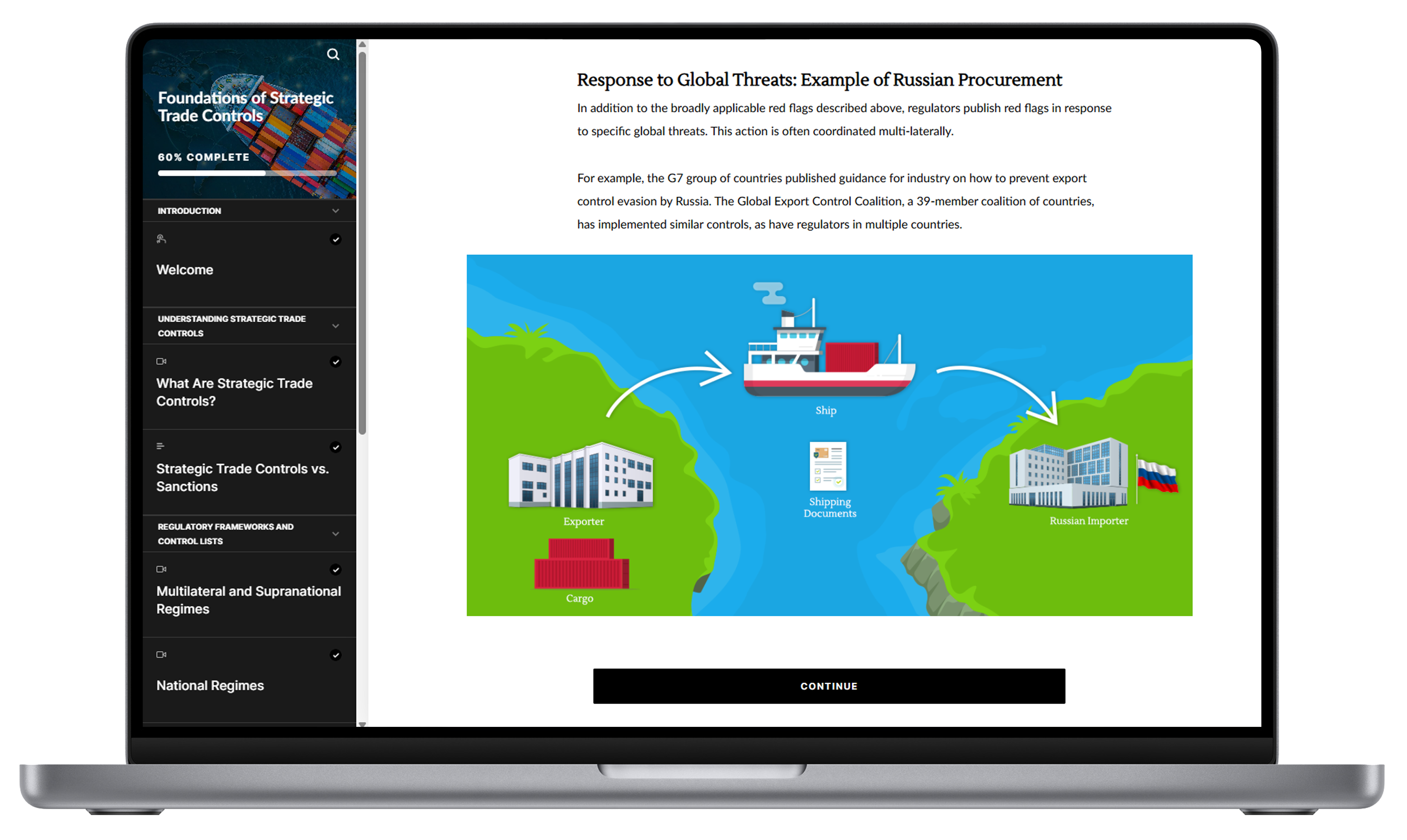
Our course Foundations of Strategic Trade Controls offers a comprehensive overview of how to understand and apply strategic trade control requirements, with a particular focus on those applicable to financial institutions.
Learn more and strengthen your compliance skills today.
 https://finintegrity.org/wp-content/uploads/2026/10/bg-september-2026-se-report.jpg
1199
1600
IFI
https://live-black-pebble.pantheonsite.io/wp-content/uploads/2023/12/GIFI-Placeholder2.png
IFI2026-10-06 07:00:462026-10-05 13:03:02September 2026 Monthly Sanctions and Export Controls Report
 https://finintegrity.org/wp-content/uploads/2026/09/august-2026-se-report-bg.jpg
888
1184
IFI
https://live-black-pebble.pantheonsite.io/wp-content/uploads/2023/12/GIFI-Placeholder2.png
IFI2026-09-02 07:00:562026-09-01 13:19:24August Monthly Sanctions and Export Controls Report
 https://finintegrity.org/wp-content/uploads/2026/08/july2026-se-bg.jpg
1177
1800
IFI
https://live-black-pebble.pantheonsite.io/wp-content/uploads/2023/12/GIFI-Placeholder2.png
IFI2026-08-04 07:00:452026-08-04 09:42:02July Monthly Sanctions and Export Controls Report
 https://finintegrity.org/wp-content/uploads/2026/06/june2026-se-report-bg.jpg
798
1200
IFI
https://live-black-pebble.pantheonsite.io/wp-content/uploads/2023/12/GIFI-Placeholder2.png
IFI2026-07-01 07:00:392026-07-02 10:28:58June 2026 Sanctions and Export Controls Report
 https://finintegrity.org/wp-content/uploads/2026/06/may-bg-2026-se.jpg
1200
1800
IFI
https://live-black-pebble.pantheonsite.io/wp-content/uploads/2023/12/GIFI-Placeholder2.png
IFI2026-06-03 07:00:142026-06-02 14:36:12May 2026 Sanctions and Export Controls Update
 https://finintegrity.org/wp-content/uploads/2026/05/april-bg-2026-se.jpg
1348
1800
IFI
https://live-black-pebble.pantheonsite.io/wp-content/uploads/2023/12/GIFI-Placeholder2.png
IFI2026-05-05 07:00:332026-05-06 13:57:33April 2026 Monthly Sanctions and Export Controls Report
 https://finintegrity.org/wp-content/uploads/2026/04/march2026-header-bg.jpg
944
1500
IFI
https://live-black-pebble.pantheonsite.io/wp-content/uploads/2023/12/GIFI-Placeholder2.png
IFI2026-04-02 07:00:502026-04-08 19:51:19March 2026 Monthly Sanctions and Export Controls Report
 https://finintegrity.org/wp-content/uploads/2026/03/feb2026-bg.jpg
879
1500
IFI
https://live-black-pebble.pantheonsite.io/wp-content/uploads/2023/12/GIFI-Placeholder2.png
IFI2026-03-03 07:00:312026-04-01 11:30:03February 2026 Monthly Sanctions and Export Controls Report
 https://finintegrity.org/wp-content/uploads/2026/02/bg-jan2026.jpg
690
1200
IFI
https://live-black-pebble.pantheonsite.io/wp-content/uploads/2023/12/GIFI-Placeholder2.png
IFI2026-02-03 07:00:332026-03-27 12:34:22January 2026 Monthly Sanctions and Export Controls Report

 Syndicates of Terror