• Link to LinkedIn
  • Link to Youtube
  • Sign In
  • Register
  • Subscribe
  • Contact
Institute for Financial Integrity
  • Training
    • eLearning Courses

      • Suite of interactive e-learning courses to educate and engage staff on core compliance topics

      • Learn More
    • Video Library

      • An online learning journey through the various domains of financial crime, explore our library of expert-led videos

      • Learn More
    • Training Services

      • Trusted compliance training design, development, and delivery tailored to your unique requirements

      • Learn More
    • Certifications
      • Certified Risk Management Specialist – Global Sanctions
      • Certified Financial Integrity Professional Program
  • Technology
    • DOLFIN

      • A platform that equips financial integrity professionals with the continuing education, expert insights, resources and tools needed to protect the integrity of the global financial system.

      • Learn More
    • AskFIN

      • A revolutionary, AI-powered tool seamlessly integrated with DOLFIN® — the world’s largest and most trusted library of curated resources on financial integrity topics.

      • Learn More
  • Insights
    • Insights
      • Articles
      • Reports & White Papers
      • Webinars
      • Subscribe
  • About Us
    • Who We Are
      • Our Story
      • Leadership
      • Press Releases
    • Who We Serve
      • Financial Institutions
      • Jurisdictions
      • Executives
      • Industry Professionals
  • Get a Demo
  • Menu Menu

Crypto Layering

How Digital Assets are Used to Obscure Illicit Funds

📅 June 17, 2026

In fiat currency money laundering, layering is a series of conversions or movements of funds to distance them from their illicit source. Layering methods include moving funds through different bank accounts, financial institutions, or jurisdictions; converting funds to or from other forms of value such as real estate; or use of opaque structures such as shell companies registered in secrecy jurisdictions. In crypto, comparable methods can be used to “layer” funds during the laundering process.

Most crypto layering activity ultimately relies on one or more of three core strategies:

  1. Obscuring Identity
  2. Obscuring Transaction Flow
  3. Obscuring Jurisdiction

Many sophisticated laundering schemes combine several of these techniques. For example, illicit proceeds might be split (smurfing), moved through a peel chain, passed through a mixer, swapped across multiple blockchains, converted into a privacy coin, and eventually cashed out through a low-KYC exchange. From an AML perspective, the cumulative use of multiple layering techniques is often a stronger risk indicator than any single activity on its own.

1) Obscuring Identity

  • Coins with Privacy Features: Some digital assets, such as Monero, have “privacy features” which are designed to conceal the details of the sending wallet, receiving wallet, or transaction amount. The objective is to increase anonymity and reduce traceability.
  • Low/No-KYC Exchanges: Legitimate crypto businesses, such as brokerages and exchanges, in well-regulated jurisdictions complete CDD/KYC on their clients. While the wallet is “pseudonymous,” the exchange or brokerage has verified the identity of their client and knows the individual or business who owns/controls the wallet. This information can be provided to investigators. In contrast, unregulated or non-compliant exchanges apply low or no KYC requirements. Illicit actors may use low/no-KYC exchanges to minimize or remove the link between blockchain activity and their real-world identities. For example, crypto exchange Binance, which received regulatory penalties of more than $4 billion in 2023 for AML/CFT failures, permitted clients to trade using only an email address for identification. The Binance platform was used to process funds from terrorists, criminals, and sanctioned entities.[i]

2) Obscuring Transaction Flow

  • Wallet-to-Wallet Transfers: Illicit actors may move funds through multiple wallets, often creating new wallets for each transfer. This creates complex transactions chains designed to increase investigative effort.
  • Mixers and Tumblers: Mixers and tumblers pool funds from multiple sources and scramble them before redistributing the original amount minus a fee. Even though the blockchain may be public, it is difficult to identify which inbound transactions correspond with the outbound transactions from a mixer/tumbler.
  • Peel-Chaining: Illicit actors may structure/smurf transactions by moving high-value funds through a series of wallets, with a small portion “peeled off” at each step while the remainder continues to the next wallet. This effectively breaks up large amounts of cryptocurrencies into smaller amounts through dozens of automated transactions, depositing them into different crypto wallet addresses.
  • Chain Swapping (Chain-Hopping): Illicit actors may rapidly move illicit funds across different cryptocurrencies or blockchains to make the trail more difficult to follow as blockchain networks are not interconnected and have varying levels of transparency and monitoring capabilities.
  • DeFi Protocols: Whether lending, liquidity pools, yield farming or staking arrangements, illicit actors may use decentralized finance protocols to create complex transaction trails through additional layers and interconnections.
  • NFTs: Non-fungible tokens are used to move value, by purchasing NFTs with illicit funds, trading NFTs among controlled wallets or creating artificial transaction histories.

3) Obscuring Jurisdiction

  • Cross-Border Transfers: Illicit actors may move assets through exchanges and service providers in multiple countries to exploit regulatory differences and move through weakly regulated environments.
  • Offshore Entities: Combining crypto transactions with opaque legal entities including offshore companies, trusts, and complex ownership structures can make establishing beneficial ownership identification more difficult.

Actions for Financial Institutions

Financial institutions and other businesses operating in the crypto economy should ensure that they have crypto-specific controls in place to identify and manage risks, and businesses offering services to crypto clients should undertake detailed due diligence on client compliance programs to ensure their controls are effective, similar to the approach used by a correspondent bank to assess its respondent banks.

In addition to compliance controls applicable to all clients – such as completing KYC/CDD on clients in accordance with regulatory requirements and industry best practices to identify and verify the owner of the wallet – organizations should implement crypto-specific controls.

  • Verify ownership/control of the wallet using a “Satoshi test,” if the wallet is self-hosted. A Satoshi test requires a client to transfer a small, randomly-generated amount of crypto from their wallet within a specific timeframe. A client who owns/controls the wallet will be easily able to complete this task.
  • Consider whether coins with privacy features will be supported. While there may be some legitimate uses or motivations for using privacy coins, they present a high risk of illicit use compared with other types of crypto. A financial institution may decide that privacy coins are outside its risk appetite and that it will not support trading, custody, or other services.
  • Integrate blockchain analytics into their screening and monitoring program. During onboarding and throughout the client lifecycle, client wallets should be screened to ensure they are not sanctioned or linked with illicit activity, such as receiving ransomware payments. Transactions should also be screened to ensure that the FI’s clients are not transacting with wallets that are sanctioned or linked with illicit activity.
  • Establish policies for client activity which is higher risk – even if not provably illicit – such as sending or receiving funds from mixers/tumblers. Although using a mixer/tumbler is not usually illegal (unless the mixer/tumbler is sanctioned), it presents a higher risk that the crypto is the proceeds of criminality. Financial institutions should establish whether this is acceptable, ensure requirements are set out in client terms and conditions, monitor for non-compliance, investigate and report unusual activity, and consider client exit where appropriate.

As crypto becomes increasingly integrated into criminal organizations and laundering networks, financial institutions must be alert to these evolving methodologies and ensure their risk management programs adapt to include crypto-specific measures including policies and processes, technology, and training – as well as ensuring they apply an integrated and cross-functional approach. By doing so, financial institutions will be more effective at identifying illicit crypto activity while gaining the advantages of blockchain for their investigations, and supporting the commercial benefits of meeting the demand for crypto products and services.

[i] https://www.justice.gov/archives/opa/pr/binance-and-ceo-plead-guilty-federal-charges-4b-resolution

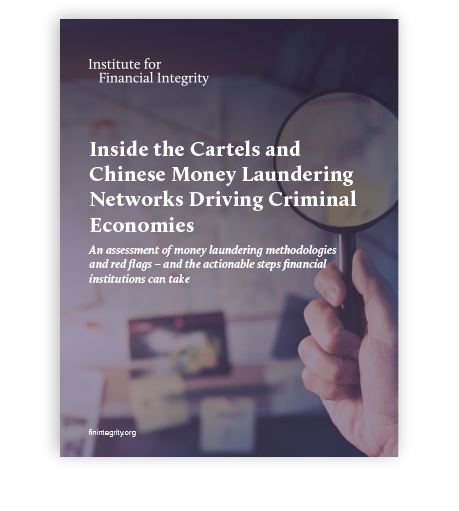
Inside the Cartels and Chinese Money Laundering Networks Driving Criminal Economies 

Cartels and their criminal financing continue to evolve, using professional networks to launder the proceeds from narcotics trafficking, human trafficking, environmental crime, fuel theft and oil smuggling, corruption at ports and “taxation” of local economies.

Download our latest report for an assessment of money laundering methodologies and red flags – and the actionable steps financial institutions can take.

Download the Report

Recommended Blogs

The Expanding Scope of Financial Crime Compliance Training

October 14, 2026
There is a global shift toward integrating proliferation financing as a distinct threat alongside money laundering and terrorist financing. Discover what this means for enterprise-wide training at financial institutions.
Read more
https://finintegrity.org/wp-content/uploads/2026/10/bg-expanding-crime.jpg 1357 1800 IFI https://live-black-pebble.pantheonsite.io/wp-content/uploads/2023/12/GIFI-Placeholder2.png IFI2026-10-14 07:00:092026-10-05 16:11:03The Expanding Scope of Financial Crime Compliance Training

Data as a Critical Business and Compliance Asset

April 15, 2026
Data is an increasingly critical asset. It plays a key role in due diligence, identifying and responding against illicit finance, and identifying fraud, as well as for commercial decisions and business success. Explore global data protection and retention requirements in this article.
Read more
https://finintegrity.org/wp-content/uploads/2026/04/consumerprotection-bg.jpg 1000 1500 IFI https://live-black-pebble.pantheonsite.io/wp-content/uploads/2023/12/GIFI-Placeholder2.png IFI2026-04-15 07:00:202026-04-08 09:36:08Data as a Critical Business and Compliance Asset

The Travel Rule Playbook

March 25, 2026
The Travel Rule was established by the FATF to help prevent bad actors from moving illicit funds undetected. The scope has expanded to include VASPs and digital assets transactions. Explore best practices for compliance and implementation strategies in this article.
Read more
https://finintegrity.org/wp-content/uploads/2025/12/travelrule.jpg 700 1600 IFI https://live-black-pebble.pantheonsite.io/wp-content/uploads/2023/12/GIFI-Placeholder2.png IFI2026-03-25 07:00:132026-03-24 15:51:20The Travel Rule Playbook
Professional Crypto Laundering

March 18, 2026
The indictment of Venezuelan national Jorge Figueira in 2026 reveals a highly advanced professional laundering network using cash, crypto, OTC brokerages registered in the UK and U.S., and shell companies with accounts at regulated financial institutions. This article assesses the methodology used, red flags, and actions for financial institutions.
Read more
https://finintegrity.org/wp-content/uploads/2026/03/jorge.jpg 1003 1500 IFI https://live-black-pebble.pantheonsite.io/wp-content/uploads/2023/12/GIFI-Placeholder2.png IFI2026-03-18 07:00:442026-05-14 13:55:38Professional Crypto Laundering

Electronic Fund Transfer Consumer Protection

February 5, 2026
The Electronic Fund Transfer Act (EFTA) was established to protect consumers using electronic fund transfers. Explore what is considered in scope and the changes proposed to include crypto.
Read more
https://finintegrity.org/wp-content/uploads/2026/01/article-eftfs-bg.jpg 800 1200 IFI https://live-black-pebble.pantheonsite.io/wp-content/uploads/2023/12/GIFI-Placeholder2.png IFI2026-02-05 07:00:282026-03-27 12:32:49Electronic Fund Transfer Consumer Protection

Following the Illicit Funds

January 28, 2026
As crypto grows, so does regulatory oversight. From SARs and CTRs to MSB registration and potential FBAR requirements, crypto businesses are now firmly within the scope of financial regulations.
Read more
https://finintegrity.org/wp-content/uploads/2026/01/following-ilicit-funds-bg.jpg 808 1500 IFI https://live-black-pebble.pantheonsite.io/wp-content/uploads/2023/12/GIFI-Placeholder2.png IFI2026-01-28 07:00:532026-03-27 12:35:12Following the Illicit Funds

Blockchain & Ballistics

July 25, 2025
The Houthis are pioneering a new model of terrorist financing by using digital assets to purchase advanced weapons systems. This article explores the new dimensions of this convergence, and red flags associated with these evolving risks.
Read more
https://finintegrity.org/wp-content/uploads/2025/07/shutterstock_1062008168-scaled.jpg 1792 2560 IFI https://live-black-pebble.pantheonsite.io/wp-content/uploads/2023/12/GIFI-Placeholder2.png IFI2025-07-25 07:00:092025-09-25 15:32:52Blockchain & Ballistics

Cartels & Crypto

July 17, 2025
Cartels and the professional money launderers that service them have integrated digital assets throughout the narcotics trade, from precursors to sales and laundering proceeds.
Read more
https://finintegrity.org/wp-content/uploads/2025/07/shutterstock_1106739479-scaled.jpg 1707 2560 IFI https://live-black-pebble.pantheonsite.io/wp-content/uploads/2023/12/GIFI-Placeholder2.png IFI2025-07-17 07:00:302026-05-14 14:15:46Cartels & Crypto

Advancement in Digital Asset Markets

March 24, 2025
Review policies and regulation on crypto in the U.S., UK, EU, and globally, how this influences adoption, and measures to capitalize on rewards while managing illicit finance risks.
Read more
https://finintegrity.org/wp-content/uploads/2025/03/advancementdigital-bg.jpg 890 1800 IFI https://live-black-pebble.pantheonsite.io/wp-content/uploads/2023/12/GIFI-Placeholder2.png IFI2025-03-24 07:00:542026-05-14 14:22:15Advancement in Digital Asset Markets
Previous Previous Previous Next Next Next
Download IFI Compliance Checklist Report

Follow Us on LinkedIn

Share this article

  • Share on LinkedIn
  • Share by Mail

Recent Articles

  • The Expanding Scope of Financial Crime Compliance Training
  • September 2026 Monthly Sanctions and Export Controls Report
  • The Data Behind the Payment
  • Dirty Barrels
  • Real Estate, Real Risks

Explore Other Topics

  • Artificial Intelligence
  • Compliance Best Practices
  • Corruption
  • Digital Assets
  • Drug Trafficking
  • European Union
  • Fraud
  • Human Trafficking
  • Money Laundering
  • Oil and Gas
  • Press Releases
  • Proliferation Finance
  • Regulation
  • Russia
  • Sanctions
  • Strategic Trade Controls / Export Controls
  • Terrorism

View Our Expert Insights

  • Compliance Training Readiness Checklist
  • Inside the Cartels and Chinese Money Laundering Networks Driving Criminal Economies
  • High Stakes – Casinos, Crime, and Cartels
  • From Cost Center to Risk Control
  • Leveraging Artificial Intelligence for Enhanced Financial Compliance
  • The Convergence of Sanctions and AML/CFT Regimes
  • Casinos and Cryptocurrency Driving Illicit Finance in East and Southeast Asia
  • Russia 2024: The Two-Year Anniversary of the Invasion
  • Human Trafficking Crisis after Russia’s Invasion of Ukraine
  • 2024 Trends Report
© DOLFIN Academy LLC 2026
  • Link to LinkedIn
  • Link to Youtube
  • Privacy Policy
Link to: Who Owns the Risk? Link to: Who Owns the Risk? Who Owns the Risk? Link to: June 2026 Sanctions and Export Controls Report Link to: June 2026 Sanctions and Export Controls Report June 2026 Sanctions and Export Controls Report
Scroll to top Scroll to top Scroll to top

This site uses cookies. By continuing to browse the site, you are agreeing to our use of cookies.

Accept settingsHide notification onlySettings

Cookie and Privacy Settings


How we use cookies

We may request cookies to be set on your device. We use cookies to let us know when you visit our websites, how you interact with us, to enrich your user experience, and to customize your relationship with our website.

Click on the different category headings to find out more. You can also change some of your preferences. Note that blocking some types of cookies may impact your experience on our websites and the services we are able to offer.

Essential Website Cookies

These cookies are strictly necessary to provide you with services available through our website and to use some of its features.

Because these cookies are strictly necessary to deliver the website, refusing them will have impact how our site functions. You always can block or delete cookies by changing your browser settings and force blocking all cookies on this website. But this will always prompt you to accept/refuse cookies when revisiting our site.

We fully respect if you want to refuse cookies but to avoid asking you again and again kindly allow us to store a cookie for that. You are free to opt out any time or opt in for other cookies to get a better experience. If you refuse cookies we will remove all set cookies in our domain.

We provide you with a list of stored cookies on your computer in our domain so you can check what we stored. Due to security reasons we are not able to show or modify cookies from other domains. You can check these in your browser security settings.

Google Analytics Cookies

These cookies collect information that is used either in aggregate form to help us understand how our website is being used or how effective our marketing campaigns are, or to help us customize our website and application for you in order to enhance your experience.

If you do not want that we track your visit to our site you can disable tracking in your browser here:

Other external services

We also use different external services like Google Webfonts, Google Maps, and external Video providers. Since these providers may collect personal data like your IP address we allow you to block them here. Please be aware that this might heavily reduce the functionality and appearance of our site. Changes will take effect once you reload the page.

Google Webfont Settings:

Google Map Settings:

Google reCaptcha Settings:

Vimeo and Youtube video embeds:

Privacy Policy

You can read about our cookies and privacy settings in detail on our Privacy Policy Page.

Privacy Policy
Accept settingsHide notification only