Crypto Layering
How Digital Assets are Used to Obscure Illicit Funds
📅 June 17, 2026

In fiat currency money laundering, layering is a series of conversions or movements of funds to distance them from their illicit source. Layering methods include moving funds through different bank accounts, financial institutions, or jurisdictions; converting funds to or from other forms of value such as real estate; or use of opaque structures such as shell companies registered in secrecy jurisdictions. In crypto, comparable methods can be used to “layer” funds during the laundering process.
Most crypto layering activity ultimately relies on one or more of three core strategies:
Many sophisticated laundering schemes combine several of these techniques. For example, illicit proceeds might be split (smurfing), moved through a peel chain, passed through a mixer, swapped across multiple blockchains, converted into a privacy coin, and eventually cashed out through a low-KYC exchange. From an AML perspective, the cumulative use of multiple layering techniques is often a stronger risk indicator than any single activity on its own.
Financial institutions and other businesses operating in the crypto economy should ensure that they have crypto-specific controls in place to identify and manage risks, and businesses offering services to crypto clients should undertake detailed due diligence on client compliance programs to ensure their controls are effective, similar to the approach used by a correspondent bank to assess its respondent banks.
In addition to compliance controls applicable to all clients – such as completing KYC/CDD on clients in accordance with regulatory requirements and industry best practices to identify and verify the owner of the wallet – organizations should implement crypto-specific controls.
As crypto becomes increasingly integrated into criminal organizations and laundering networks, financial institutions must be alert to these evolving methodologies and ensure their risk management programs adapt to include crypto-specific measures including policies and processes, technology, and training – as well as ensuring they apply an integrated and cross-functional approach. By doing so, financial institutions will be more effective at identifying illicit crypto activity while gaining the advantages of blockchain for their investigations, and supporting the commercial benefits of meeting the demand for crypto products and services.
[i] https://www.justice.gov/archives/opa/pr/binance-and-ceo-plead-guilty-federal-charges-4b-resolution
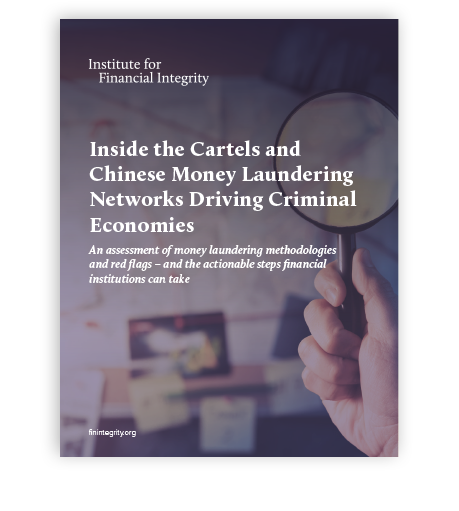
Cartels and their criminal financing continue to evolve, using professional networks to launder the proceeds from narcotics trafficking, human trafficking, environmental crime, fuel theft and oil smuggling, corruption at ports and “taxation” of local economies.
Download our latest report for an assessment of money laundering methodologies and red flags – and the actionable steps financial institutions can take.
 https://finintegrity.org/wp-content/uploads/2026/10/bg-expanding-crime.jpg
1357
1800
IFI
https://live-black-pebble.pantheonsite.io/wp-content/uploads/2023/12/GIFI-Placeholder2.png
IFI2026-10-14 07:00:092026-10-05 16:11:03The Expanding Scope of Financial Crime Compliance Training
https://finintegrity.org/wp-content/uploads/2026/10/bg-expanding-crime.jpg
1357
1800
IFI
https://live-black-pebble.pantheonsite.io/wp-content/uploads/2023/12/GIFI-Placeholder2.png
IFI2026-10-14 07:00:092026-10-05 16:11:03The Expanding Scope of Financial Crime Compliance Training https://finintegrity.org/wp-content/uploads/2026/04/consumerprotection-bg.jpg
1000
1500
IFI
https://live-black-pebble.pantheonsite.io/wp-content/uploads/2023/12/GIFI-Placeholder2.png
IFI2026-04-15 07:00:202026-04-08 09:36:08Data as a Critical Business and Compliance Asset
https://finintegrity.org/wp-content/uploads/2026/04/consumerprotection-bg.jpg
1000
1500
IFI
https://live-black-pebble.pantheonsite.io/wp-content/uploads/2023/12/GIFI-Placeholder2.png
IFI2026-04-15 07:00:202026-04-08 09:36:08Data as a Critical Business and Compliance Asset https://finintegrity.org/wp-content/uploads/2025/12/travelrule.jpg
700
1600
IFI
https://live-black-pebble.pantheonsite.io/wp-content/uploads/2023/12/GIFI-Placeholder2.png
IFI2026-03-25 07:00:132026-03-24 15:51:20The Travel Rule Playbook
https://finintegrity.org/wp-content/uploads/2025/12/travelrule.jpg
700
1600
IFI
https://live-black-pebble.pantheonsite.io/wp-content/uploads/2023/12/GIFI-Placeholder2.png
IFI2026-03-25 07:00:132026-03-24 15:51:20The Travel Rule Playbook https://finintegrity.org/wp-content/uploads/2026/03/jorge.jpg
1003
1500
IFI
https://live-black-pebble.pantheonsite.io/wp-content/uploads/2023/12/GIFI-Placeholder2.png
IFI2026-03-18 07:00:442026-05-14 13:55:38Professional Crypto Laundering
https://finintegrity.org/wp-content/uploads/2026/03/jorge.jpg
1003
1500
IFI
https://live-black-pebble.pantheonsite.io/wp-content/uploads/2023/12/GIFI-Placeholder2.png
IFI2026-03-18 07:00:442026-05-14 13:55:38Professional Crypto Laundering https://finintegrity.org/wp-content/uploads/2026/01/article-eftfs-bg.jpg
800
1200
IFI
https://live-black-pebble.pantheonsite.io/wp-content/uploads/2023/12/GIFI-Placeholder2.png
IFI2026-02-05 07:00:282026-03-27 12:32:49Electronic Fund Transfer Consumer Protection
https://finintegrity.org/wp-content/uploads/2026/01/article-eftfs-bg.jpg
800
1200
IFI
https://live-black-pebble.pantheonsite.io/wp-content/uploads/2023/12/GIFI-Placeholder2.png
IFI2026-02-05 07:00:282026-03-27 12:32:49Electronic Fund Transfer Consumer Protection https://finintegrity.org/wp-content/uploads/2026/01/following-ilicit-funds-bg.jpg
808
1500
IFI
https://live-black-pebble.pantheonsite.io/wp-content/uploads/2023/12/GIFI-Placeholder2.png
IFI2026-01-28 07:00:532026-03-27 12:35:12Following the Illicit Funds
https://finintegrity.org/wp-content/uploads/2026/01/following-ilicit-funds-bg.jpg
808
1500
IFI
https://live-black-pebble.pantheonsite.io/wp-content/uploads/2023/12/GIFI-Placeholder2.png
IFI2026-01-28 07:00:532026-03-27 12:35:12Following the Illicit Funds https://finintegrity.org/wp-content/uploads/2025/07/shutterstock_1062008168-scaled.jpg
1792
2560
IFI
https://live-black-pebble.pantheonsite.io/wp-content/uploads/2023/12/GIFI-Placeholder2.png
IFI2025-07-25 07:00:092025-09-25 15:32:52Blockchain & Ballistics
https://finintegrity.org/wp-content/uploads/2025/07/shutterstock_1062008168-scaled.jpg
1792
2560
IFI
https://live-black-pebble.pantheonsite.io/wp-content/uploads/2023/12/GIFI-Placeholder2.png
IFI2025-07-25 07:00:092025-09-25 15:32:52Blockchain & Ballistics https://finintegrity.org/wp-content/uploads/2025/07/shutterstock_1106739479-scaled.jpg
1707
2560
IFI
https://live-black-pebble.pantheonsite.io/wp-content/uploads/2023/12/GIFI-Placeholder2.png
IFI2025-07-17 07:00:302026-05-14 14:15:46Cartels & Crypto
https://finintegrity.org/wp-content/uploads/2025/07/shutterstock_1106739479-scaled.jpg
1707
2560
IFI
https://live-black-pebble.pantheonsite.io/wp-content/uploads/2023/12/GIFI-Placeholder2.png
IFI2025-07-17 07:00:302026-05-14 14:15:46Cartels & Crypto https://finintegrity.org/wp-content/uploads/2025/03/advancementdigital-bg.jpg
890
1800
IFI
https://live-black-pebble.pantheonsite.io/wp-content/uploads/2023/12/GIFI-Placeholder2.png
IFI2025-03-24 07:00:542026-05-14 14:22:15Advancement in Digital Asset Markets
https://finintegrity.org/wp-content/uploads/2025/03/advancementdigital-bg.jpg
890
1800
IFI
https://live-black-pebble.pantheonsite.io/wp-content/uploads/2023/12/GIFI-Placeholder2.png
IFI2025-03-24 07:00:542026-05-14 14:22:15Advancement in Digital Asset Markets
 June 2026 Sanctions and Export Controls Report