Where Boards and Senior Management Fall Short on Compliance Oversight
Four Common Gaps Leaving Leaders and Their Institutions Exposed
📅 November 18, 2025

When compliance failures make the news, they’re rarely the result of missing policies. More often, the breakdown happens at the top, when boards assume that reviewing reports or approving frameworks is enough. On paper, the oversight looks fine. In practice, the engagement just isn’t there.
The reality is that many boards don’t fail because they ignored compliance altogether. They fail because they took a surface-level approach—listening without leaning in, acknowledging risks without challenging them. Regulators see this for what it is: passive oversight. And when oversight is passive, risks don’t quietly go away; they build until they become scandals.
One of the most common pitfalls for boards is mistaking awareness for oversight. It’s easy to sit through a compliance update, nod at the right moments, and move on to the next agenda item. But regulators are increasingly asking a tougher question: what did the board do with the information they were given?
A passive approach—receiving reports without probing deeper—creates blind spots. Red flags may be raised internally, but if they aren’t challenged, tested, or escalated by the board, they can fester until they erupt into full-blown crises.
Active oversight looks very different. It means directors leaning in, asking uncomfortable questions, pressing for clarity when something doesn’t add up, and making sure risks are addressed rather than just documented. Regulators want to see evidence of this engagement; meeting minutes that capture not just presentations received but real dialogue and challenge from the board.
The difference is simple but profound: passive boards become spectators to risk; active boards shape how it is managed.
Another trap boards often fall into is assuming the compliance function can shoulder accountability on its own. It’s tempting to think, “That’s what the Chief Compliance Officer is for”—but regulators don’t see it that way.
Compliance officers bring expertise, but they are not a shield. Their role is to advise, inform, and guide. The board’s role is to own the decisions. Increasingly, regulators are asking not just whether the compliance team flagged risks, but whether senior leaders acted on those warnings.
When boards lean too heavily on compliance officers, two things happen: first, risks get siloed, and second, leadership loses credibility with regulators and investors. A strong board doesn’t just listen to compliance; it tests assumptions, weighs trade-offs, and takes responsibility for how those risks are managed.
Oversight can’t be outsourced. It has to be owned.
Even the most engaged boards can stumble if they don’t fully understand the risks in front of them. Financial crime risks today are not only broader but also more technical, and that creates blind spots at the leadership level.
Some boards underestimate how sanctions can be evaded through complex corporate structures or affiliates. Others don’t grasp the pace at which fraud is evolving—where AI-generated deepfakes, synthetic identities, and biometric spoofing are already being used to outsmart controls. Cyber threats and data privacy lapses add yet another layer of exposure, with breaches capable of eroding trust in a matter of hours.
The challenge isn’t that boards don’t care, it’s that without the right knowledge, they can’t ask the right questions. And when leaders don’t have visibility into these risks, oversight becomes reactive instead of strategic.
Closing these awareness gaps doesn’t mean turning every director into a compliance technician. It means ensuring the board has the context, training, and confidence to engage meaningfully with management, spot red flags, and connect risk decisions back to the institution’s broader resilience and reputation.
For many boards, “training” means a once-a-year briefing or a generic online module. It ticks the box, but it doesn’t prepare leaders for the kinds of complex, fast-moving risks they’re expected to oversee.
This kind of surface-level approach feeds a check-the-box only culture. Directors may technically complete the requirement, but they don’t walk away with the knowledge or confidence to challenge management or spot weak points.
The most effective boards treat training as more than a compliance exercise. They see it as a leadership tool. Scenario-based sessions, interactive discussions, and regular refreshers keep directors sharp and ensure that oversight is both meaningful and defensible. More importantly, it signals to staff and stakeholders that the commitment to compliance starts at the very top.
When boards invest in their own learning, they set the tone for the entire institution.
The gaps we’ve highlighted: passive oversight, overreliance on compliance officers, blind spots in risk awareness, and a check-the-box only approach to training—are highlighted by regulators again and again. And when they go unaddressed, they don’t just put the institution at risk; they put directors and senior leaders personally in the spotlight.
The good news is that each of these pitfalls can be avoided. Boards that lean in, stay informed, and invest in their own readiness are better positioned to meet rising expectations and build trust with regulators, investors, and customers alike.
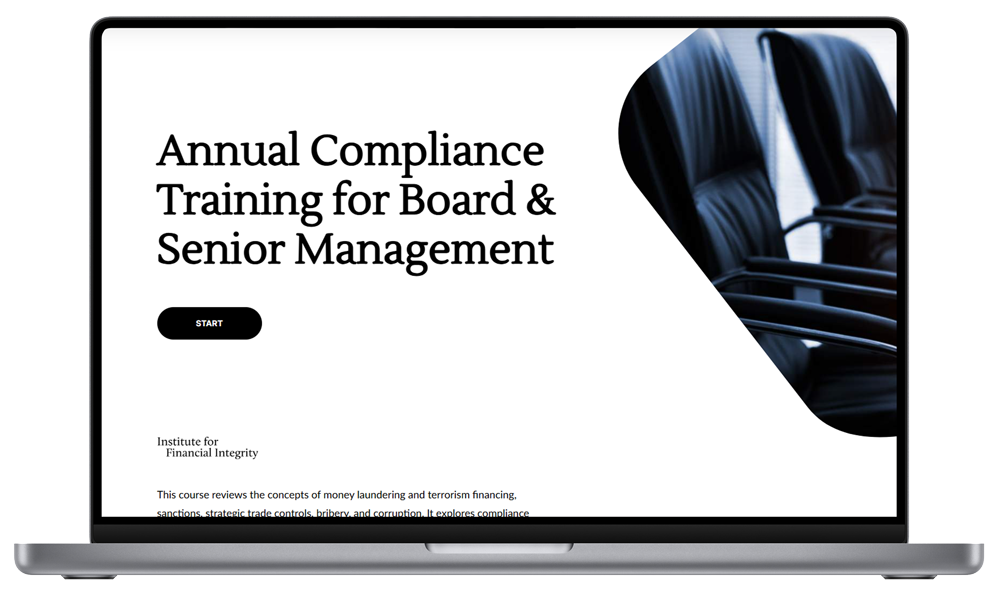
At IFI, our Annual Compliance Training for Board & Senior Management is designed with these exact challenges in mind, equipping directors and executives to move beyond surface-level oversight and demonstrate real accountability in the boardroom.
Because at the end of the day, effective oversight isn’t about delegation—it’s about leadership.
Reach out to us at info@finintegrity.org to schedule a demo.
 https://finintegrity.org/wp-content/uploads/2026/09/shutterstock_2645005987-scaled.jpg
1706
2560
IFI
https://live-black-pebble.pantheonsite.io/wp-content/uploads/2023/12/GIFI-Placeholder2.png
IFI2026-09-24 07:00:302026-09-24 11:44:27Dirty Barrels
https://finintegrity.org/wp-content/uploads/2026/09/shutterstock_2645005987-scaled.jpg
1706
2560
IFI
https://live-black-pebble.pantheonsite.io/wp-content/uploads/2023/12/GIFI-Placeholder2.png
IFI2026-09-24 07:00:302026-09-24 11:44:27Dirty Barrels https://finintegrity.org/wp-content/uploads/2025/02/the-heat-is-on-bg.jpg
1157
1800
IFI
https://live-black-pebble.pantheonsite.io/wp-content/uploads/2023/12/GIFI-Placeholder2.png
IFI2025-02-24 07:00:152025-03-26 19:38:52The Heat is On
https://finintegrity.org/wp-content/uploads/2025/02/the-heat-is-on-bg.jpg
1157
1800
IFI
https://live-black-pebble.pantheonsite.io/wp-content/uploads/2023/12/GIFI-Placeholder2.png
IFI2025-02-24 07:00:152025-03-26 19:38:52The Heat is On https://finintegrity.org/wp-content/uploads/2025/01/article-green-gold-rush.jpg
1261
1800
IFI
https://live-black-pebble.pantheonsite.io/wp-content/uploads/2023/12/GIFI-Placeholder2.png
IFI2025-01-13 07:00:472025-09-25 15:00:34The Green Gold Rush
https://finintegrity.org/wp-content/uploads/2025/01/article-green-gold-rush.jpg
1261
1800
IFI
https://live-black-pebble.pantheonsite.io/wp-content/uploads/2023/12/GIFI-Placeholder2.png
IFI2025-01-13 07:00:472025-09-25 15:00:34The Green Gold Rush https://finintegrity.org/wp-content/uploads/2024/12/bg-toward-financial-integrity-risk-management-program.png
835
1800
IFI
https://live-black-pebble.pantheonsite.io/wp-content/uploads/2023/12/GIFI-Placeholder2.png
IFI2024-12-19 07:00:412025-09-25 14:57:22Toward a Financial Integrity Risk Management Program
https://finintegrity.org/wp-content/uploads/2024/12/bg-toward-financial-integrity-risk-management-program.png
835
1800
IFI
https://live-black-pebble.pantheonsite.io/wp-content/uploads/2023/12/GIFI-Placeholder2.png
IFI2024-12-19 07:00:412025-09-25 14:57:22Toward a Financial Integrity Risk Management Program https://finintegrity.org/wp-content/uploads/2024/10/beneficial-bg.jpg
1200
1800
Lauren Jack
https://live-black-pebble.pantheonsite.io/wp-content/uploads/2023/12/GIFI-Placeholder2.png
Lauren Jack2024-12-10 07:00:012026-05-14 14:51:01Webinar Recap – The Dos, Don’ts & Expert Insights on Beneficial Ownership
https://finintegrity.org/wp-content/uploads/2024/10/beneficial-bg.jpg
1200
1800
Lauren Jack
https://live-black-pebble.pantheonsite.io/wp-content/uploads/2023/12/GIFI-Placeholder2.png
Lauren Jack2024-12-10 07:00:012026-05-14 14:51:01Webinar Recap – The Dos, Don’ts & Expert Insights on Beneficial Ownership https://finintegrity.org/wp-content/uploads/2024/10/blog-pep-talk.jpg
1200
1800
IFI
https://live-black-pebble.pantheonsite.io/wp-content/uploads/2023/12/GIFI-Placeholder2.png
IFI2024-10-24 07:00:412025-09-25 14:49:58A PEP Talk
https://finintegrity.org/wp-content/uploads/2024/10/beneficial-bg.jpg
1200
1800
IFI
https://live-black-pebble.pantheonsite.io/wp-content/uploads/2023/12/GIFI-Placeholder2.png
IFI2024-10-17 07:00:022026-05-14 14:53:52Beneficial Ownership: Who Owns What?
https://finintegrity.org/wp-content/uploads/2024/10/blog-pep-talk.jpg
1200
1800
IFI
https://live-black-pebble.pantheonsite.io/wp-content/uploads/2023/12/GIFI-Placeholder2.png
IFI2024-10-24 07:00:412025-09-25 14:49:58A PEP Talk
https://finintegrity.org/wp-content/uploads/2024/10/beneficial-bg.jpg
1200
1800
IFI
https://live-black-pebble.pantheonsite.io/wp-content/uploads/2023/12/GIFI-Placeholder2.png
IFI2024-10-17 07:00:022026-05-14 14:53:52Beneficial Ownership: Who Owns What? https://finintegrity.org/wp-content/uploads/2024/07/shutterstock_521200432-scaled.jpg
1707
2560
Lauren Jack
https://live-black-pebble.pantheonsite.io/wp-content/uploads/2023/12/GIFI-Placeholder2.png
Lauren Jack2024-07-02 07:00:192026-05-14 15:06:14Understanding and Addressing Fraud and Corruption Risks
https://finintegrity.org/wp-content/uploads/2024/07/shutterstock_521200432-scaled.jpg
1707
2560
Lauren Jack
https://live-black-pebble.pantheonsite.io/wp-content/uploads/2023/12/GIFI-Placeholder2.png
Lauren Jack2024-07-02 07:00:192026-05-14 15:06:14Understanding and Addressing Fraud and Corruption Risks https://finintegrity.org/wp-content/uploads/2024/06/shutterstock_1933884635.jpg
1333
2000
IFI
https://live-black-pebble.pantheonsite.io/wp-content/uploads/2023/12/GIFI-Placeholder2.png
IFI2024-06-21 07:00:332026-05-14 15:09:13Corruption in Construction
https://finintegrity.org/wp-content/uploads/2024/06/shutterstock_1933884635.jpg
1333
2000
IFI
https://live-black-pebble.pantheonsite.io/wp-content/uploads/2023/12/GIFI-Placeholder2.png
IFI2024-06-21 07:00:332026-05-14 15:09:13Corruption in Construction IFI Announces Delivery of Financial Crime Compliance Training Program at the...