• Link to LinkedIn
  • Link to Youtube
  • Sign In
  • Register
  • Subscribe
  • Contact
Institute for Financial Integrity
  • Training
    • eLearning Courses

      • Suite of interactive e-learning courses to educate and engage staff on core compliance topics

      • Learn More
    • Video Library

      • An online learning journey through the various domains of financial crime, explore our library of expert-led videos

      • Learn More
    • Training Services

      • Trusted compliance training design, development, and delivery tailored to your unique requirements

      • Learn More
    • Certifications
      • Certified Risk Management Specialist – Global Sanctions
      • Certified Financial Integrity Professional Program
  • Technology
    • DOLFIN

      • A platform that equips financial integrity professionals with the continuing education, expert insights, resources and tools needed to protect the integrity of the global financial system.

      • Learn More
    • AskFIN

      • A revolutionary, AI-powered tool seamlessly integrated with DOLFIN® — the world’s largest and most trusted library of curated resources on financial integrity topics.

      • Learn More
  • Insights
    • Insights
      • Articles
      • Reports & White Papers
      • Webinars
      • Subscribe
  • About Us
    • Who We Are
      • Our Story
      • Leadership
      • Press Releases
    • Who We Serve
      • Financial Institutions
      • Jurisdictions
      • Executives
      • Industry Professionals
  • Get a Demo
  • Menu Menu

Walking the Sanctions Tightrope

A Compliance Officer’s Guide

📅 February 18, 2025

For compliance officers, navigating the world of sanctions can feel like walking a tightrope. Global sanctions frameworks are often intricate, constantly changing, and riddled with nuances that demand meticulous attention. Here’s a closer look at the key hurdles of sanctions compliance and why these challenges matter.

  1. The Ever-Changing Global Sanctions Landscape

Sanctions are dynamic, especially in today’s volatile world filled with conflicts and evolving criminal activities. Governments and international bodies frequently update their sanctions lists, responding to global events like wars, political shifts, or human rights issues.

Imagine a compliance officer managing updates during an international crisis, where sanctions lists change overnight. Policies and procedures must adjust quickly to avoid violations.

For instance, sanctions targeting a specific country can expand rapidly in response to geopolitical developments. While modern tools help by quickly incorporating updates to sanctions lists, companies must still reassess risks, update internal systems, and retrain staff to ensure compliance. Now, multiply this across multiple jurisdictions, each with its own unique requirements, and the challenge of maintaining smooth operations becomes even more complex.

  1. Different Rules, Different Worlds: Jurisdictional Variances

Operating globally means navigating a patchwork of sanctions rules that can vary across jurisdictions. Nations and global organizations have their unique approaches to sanctions, creating potential for conflict.

  • United States (OFAC): Known for its far-reaching sanctions, the United States often applies penalties via what’s called “secondary sanctions,” even when a transaction doesn’t involve a U.S. person or touch the U.S. financial system. The EU and UK have expanded their extraterritorial reach after Russia’s full-scale invasion of Ukraine in an effort to stem sanctions evasion, but their measures aren’t as severe as U.S. secondary sanctions.
  • European Union: The EU often aligns with UN sanctions but balances them with regional priorities. For example, after the 2014 Crimea annexation, the EU imposed sanctions targeting Russia’s financial and energy sectors through Council Regulation (EU) No 833/2014. These measures included restrictions on exporting specific energy-related technologies critical for deep water, Arctic, or shale oil projects. However, to safeguard its own energy security, the EU allowed certain exemptions . Member states could grant authorizations for transactions related to the maintenance and safety of existing energy infrastructure or for ensuring the continued supply of energy within the EU
  • United Kingdom: Since Brexit, the UK’s independent sanctions framework allows it to target issues like global corruption, proliferation of weapons of mass destruction, and for other purposes. For instance, its Magnitsky-style human rights sanctions go beyond those of neighboring jurisdictions in their scope and application. While the EU also implemented a human rights sanctions regime, the UK’s framework goes further by targeting not just those directly involved in abuses but also individuals and entities that profit from them, allowing for broader action against human rights violations. In contrast, the EU focuses more narrowly on those directly responsible for those associated with abuses, without explicitly expressing financial beneficiaries. This distinction highlights the UK’s more expansive approach, enabling it to impose sanctions independently in line with its foreign policy and national security priorities.

Finally, these variations in rules create challenges like conflicting obligations. A company in both the United States and the EU may find itself caught between U.S. sanctions and EU blocking statutes designed to counter those same measures, Since then, both the EU and the UK have imposed their own sanctions on Iran post-Transition Day 2023 when all remaining sanctions on Iran’s nuclear activities under UN Security Council Resolution 2231 expired, reflecting their autonomous approaches to addressing Iran-related issues.

  1. The Digital Revolution Meets Sanctions: Cryptocurrency Challenges

The rise of cryptocurrencies and digital assets has added a new layer of complexity to sanctions compliance. Digital wallets, blockchain addresses, and crypto exchanges are now increasing targets for sanctions enforcement.

Take Blender.io, for instance – the first virtual currency mixer sanctioned by the U.S. Treasury in 2022 for laundering stolen virtual currencies for North Korea. Compliance teams should use continuously evolving tools to track blockchain transactions and identify sanctioned digital wallets and other potential risks. As digital assets grow in popularity, organizations must stay ahead of evolving regulations and ensure their systems can manage these novel threats.

  1. Evasion Tactics and Enforcement Risks

Sanctions evaders are becoming more innovative, using methods like shell companies, fraudulent documents, and third-party intermediaries to conceal their efforts to circumvent sanctions and other restrictions.

Imagine trying to trace a shipment routed through multiple countries with altered paperwork to obscure its true destination and its restricted cargo. Advanced analytics and enhanced due diligence (EDD) are critical to spotting such tactics.

The stakes are high: failing to catch these schemes can lead to massive fines, reputational damage, and loss of market access. A single misstep can cost financial institutions millions and erode trust with regulators and clients.

Practical Tips for Compliance Officers

Sanctions compliance can feel like a moving target. With the landscape constantly evolving, compliance officers need to be proactive and strategic in their approach. In addition to having a robust sanctions compliance program in place, here are some practical tips to help you stay ahead of the curve, harness the power of technology, and lean on expert support to navigate these challenges effectively.

  1. Keep Up with Regulatory Changes

Geopolitical and economic developments can trigger updates at any moment. Staying on top of these changes is crucial to avoid costly missteps.

  • Subscribe to Alerts and Updates: Regulatory bodies like OFAC, the EU, and the UK’s OFSI frequently release announcements, as do other jurisdictions. Set up alerts or subscribe to newsletters in regions where your organization transacts so you’re always in the loop.
  • Engage with Industry Networks: Join forums or associations where compliance professionals share insights and strategies. A quick chat with peers often provides fresh perspectives on challenges you might be facing.
  • Train Your Team Regularly: Compliance is a team sport. Regular training sessions at least annually ensure everyone is equipped to spot risks and act quickly when regulations shift.
  1. Harness Technology to Lighten the Load

Technology is a compliance officer’s best friend. It can help you work smarter, not harder, by automating time-consuming processes and identifying risks faster.

  • Automate Screening Processes: Advanced screening tools can sift through mountains of data to flag suspicious individuals, entities, or transactions—saving time and reducing human error.
  • Track Digital Assets with Blockchain Analytics: Regulators are increasing enforcement focus to include digital assets. Blockchain tools help trace transactions and spot red flags in this emerging space.
  • Leverage AI and Machine Learning: AI can reveal patterns of evasion, streamline due diligence, and improve risk assessments, allowing your team to focus on high-priority tasks.
  1. Don’t Go It Alone—Work with Experts

You don’t have to navigate this complex world on your own. External advisors can offer valuable insights, especially in tricky or unfamiliar situations.

  • Bring in Regulatory Consultants: Advisors with deep knowledge of sanctions compliance can provide tailored training and support during audits or investigations.
  • Join Workshops and Webinars: Experts often host events with actionable tips and case studies. These sessions can spark ideas and solutions you might not have considered.
  • Consult Legal Counsel: When operating in multiple jurisdictions, legal experts can help you navigate conflicting sanctions rules and avoid costly mistakes. For example, during the EU’s implementation of Blocking Statutes in 2018 that aimed to protect EU citizens and companies from U.S. extraterritorial sanctions by prohibiting them from complying with the restrictions without authorization from the European Commission, many companies sought legal advice to understand how to comply with EU rules while avoiding violations of U.S. sanctions. This collaboration helped them stay operational and compliant.
  1. Develop Specialized Expertise

Sanctions evasion tactics are becoming increasingly sophisticated, often exploiting linguistic nuances, jurisdictional loopholes, and geographic complexities. Developing specialized expertise in these areas equips compliance officers to detect and address such risks more effectively.

  • Linguistic Expertise: Learn to identify name variations and aliases across different languages and alphabets (e.g., Cyrillic, Chinese Pinyin). This is critical when screening entities from non-Latin alphabet jurisdictions.
  • Jurisdictional Expertise: Build a deep understanding of high-risk jurisdictions, especially those near highly sanctioned countries, that may serve as transshipment points for restricted goods and technology.
  • Geographic Expertise: Gain the skills to investigate shell companies, networks, and other entities often used by sanctions evaders to obscure their operations.

By staying informed, embracing technology, investing in targeted training programs, and seeking the right support, you can confidently tackle the challenges of sanctions compliance. These strategies not only shield your organization from penalties but also build a compliance culture that earns trust from regulators and stakeholders alike.

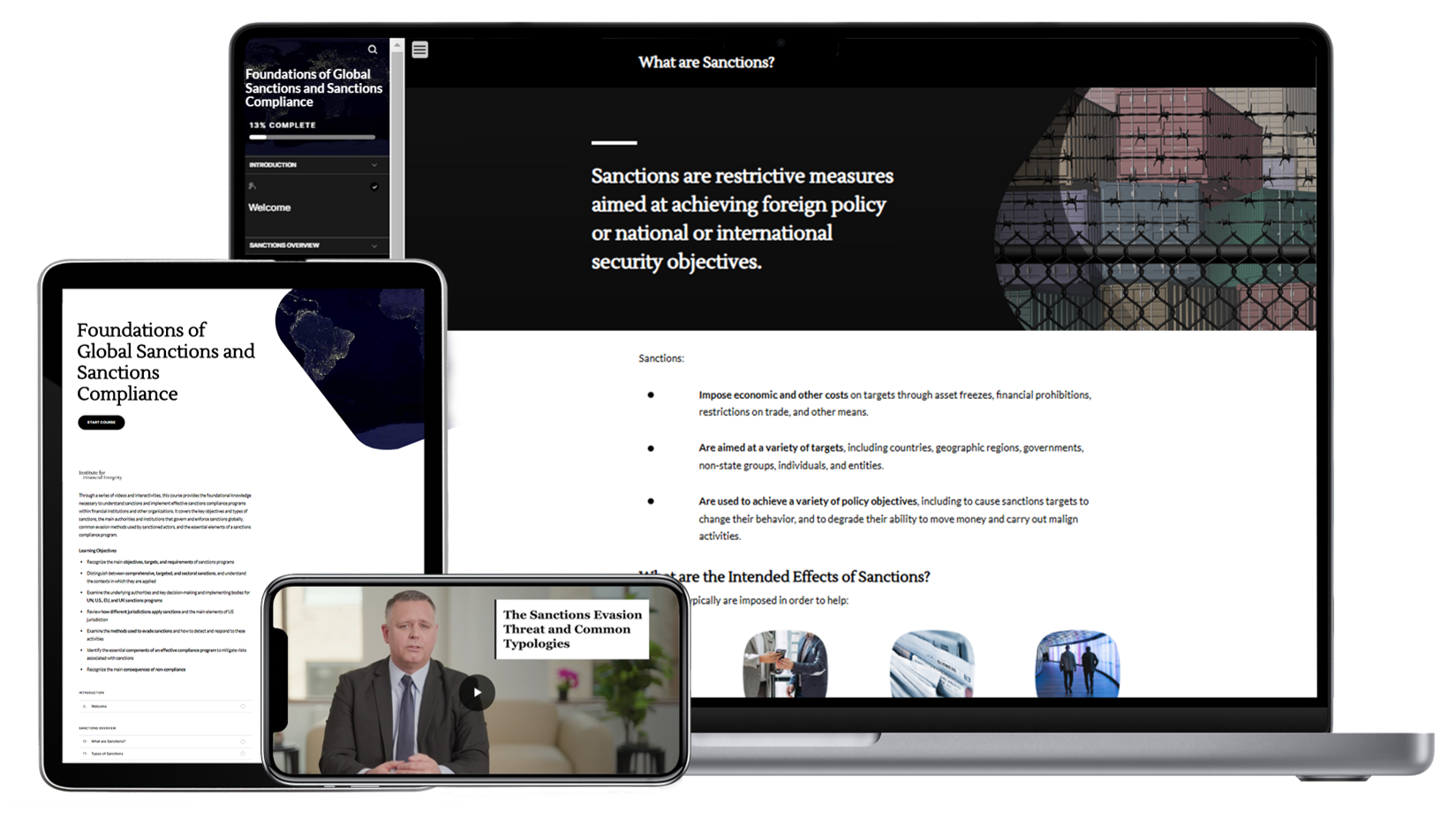
Want to deepen your expertise in sanctions compliance? Our newly released Foundations of Global Sanctions course offers a comprehensive look at navigating the complexities of global sanctions. Plus, stay tuned for upcoming courses on Foundations of UK Sanctions and Foundations of EU Sanctions to broaden your knowledge.

Learn more and strengthen your compliance skills today.
Learn More

Recommended Blogs

The Data Behind the Payment

September 30, 2026
Two changes have raised the bar on what banks can expect to see in a payment. Explore how corporate banks can put ISO 20022 and FATF's revised Recommendation 16 to work in transaction monitoring.
Read more
https://finintegrity.org/wp-content/uploads/2026/09/bg-the-data-behind-the-payment.jpg 1140 1800 IFI https://live-black-pebble.pantheonsite.io/wp-content/uploads/2023/12/GIFI-Placeholder2.png IFI2026-09-30 07:00:312026-09-29 10:35:23The Data Behind the Payment

Real Estate, Real Risks

September 17, 2026
The FATF has identified the global real estate sector as an area requiring heightened attention due to its vulnerabilities to money laundering, terrorism financing, sanctions evasion and other illicit activity. This article explores why property transactions attract financial crime.
Read more
https://finintegrity.org/wp-content/uploads/2026/09/real-estate-risk.jpg 614 1000 IFI https://live-black-pebble.pantheonsite.io/wp-content/uploads/2023/12/GIFI-Placeholder2.png IFI2026-09-17 12:40:222026-09-17 20:35:41Real Estate, Real Risks

Iran and the Sanctions Landscape

September 10, 2026
Iran has spent nearly five decades under some form of U.S. economic sanctions, and the network built to evade those sanctions is correspondingly mature. Since February 2025, that architecture has come under the most intensive and sustained pressure it has faced since the 2015 nuclear deal.
Read more
https://finintegrity.org/wp-content/uploads/2026/09/iran-and-sanctions-landscape-bg.jpg 1013 1800 IFI https://live-black-pebble.pantheonsite.io/wp-content/uploads/2023/12/GIFI-Placeholder2.png IFI2026-09-10 07:00:352026-09-17 20:21:30Iran and the Sanctions Landscape

August Monthly Sanctions and Export Controls Report

September 2, 2026
Explore this month’s Sanctions and Export Controls Update, highlighting IFI’s take on key developments from August 2026.
Read more
https://finintegrity.org/wp-content/uploads/2026/09/august-2026-se-report-bg.jpg 888 1184 IFI https://live-black-pebble.pantheonsite.io/wp-content/uploads/2023/12/GIFI-Placeholder2.png IFI2026-09-02 07:00:562026-09-01 13:19:24August Monthly Sanctions and Export Controls Report
The Judgment Gap in Market Abuse Compliance

August 25, 2026
While banks may know the set of rules outlined in the EU’s Market Abuse Regulation, exposure sits in the judgment calls related to delayed disclosure, information barriers, and market soundings. Dive into where the risk lies in each area.
Read more
https://finintegrity.org/wp-content/uploads/2026/08/judgement-gap-in-market-abuse-compliance-bg.jpg 841 1500 IFI https://live-black-pebble.pantheonsite.io/wp-content/uploads/2023/12/GIFI-Placeholder2.png IFI2026-08-25 07:00:462026-08-24 11:34:59The Judgment Gap in Market Abuse Compliance
The Illicit Oil Pipeline: How Criminal Networks Turn Crude into Clean Cash

August 19, 2026
Money laundering in the oil sector is a highly lucrative global pipeline where illicit networks exploit the massive volume, complex supply chains, and liquid nature of the market. Explore the lifecycle of oil laundering schemes as well as key red flags.
Read more
https://finintegrity.org/wp-content/uploads/2026/08/oil-pipeline-bg.jpg 1000 1500 IFI https://live-black-pebble.pantheonsite.io/wp-content/uploads/2023/12/GIFI-Placeholder2.png IFI2026-08-19 07:00:062026-08-19 00:07:14The Illicit Oil Pipeline: How Criminal Networks Turn Crude into Clean Cash

Beyond the Course Library

August 12, 2026
A comprehensive compliance course library doesn’t guarantee prepared staff. Here's how forward-looking teams are moving beyond static course libraries toward learning that keeps pace with risk.
Read more
https://finintegrity.org/wp-content/uploads/2026/08/beyond-the-course-library-bg.jpg 1060 1800 IFI https://live-black-pebble.pantheonsite.io/wp-content/uploads/2023/12/GIFI-Placeholder2.png IFI2026-08-12 07:00:232026-08-11 12:42:07Beyond the Course Library

July Monthly Sanctions and Export Controls Report

August 4, 2026
Explore this month’s Sanctions and Export Controls Update, highlighting IFI’s take on key developments from July 2026.
Read more
https://finintegrity.org/wp-content/uploads/2026/08/july2026-se-bg.jpg 1177 1800 IFI https://live-black-pebble.pantheonsite.io/wp-content/uploads/2023/12/GIFI-Placeholder2.png IFI2026-08-04 07:00:452026-08-04 09:42:02July Monthly Sanctions and Export Controls Report

A Financial Institution’s Guide to Updated EU Market Abuse Regulation

July 29, 2026
MAR sounds straightforward until a real case tests it. This guide breaks down what the regulation covers, who it applies to, and the disclosure rules, court rulings, and regulatory guidance that shifted the ground under compliance teams in 2026.
Read more
https://finintegrity.org/wp-content/uploads/2026/07/guide-to-market-abuse-bg.jpg 1067 1600 IFI https://live-black-pebble.pantheonsite.io/wp-content/uploads/2023/12/GIFI-Placeholder2.png IFI2026-07-29 07:00:472026-07-28 12:45:11A Financial Institution’s Guide to Updated EU Market Abuse Regulation
Previous Previous Previous Next Next Next
Download IFI Compliance Checklist Report

Follow Us on LinkedIn

Share this article

  • Share on LinkedIn
  • Share by Mail

Recent Articles

  • The Data Behind the Payment
  • Dirty Barrels
  • Real Estate, Real Risks
  • Iran and the Sanctions Landscape
  • August Monthly Sanctions and Export Controls Report

Explore Other Topics

  • Artificial Intelligence
  • Compliance Best Practices
  • Corruption
  • Digital Assets
  • Drug Trafficking
  • European Union
  • Fraud
  • Human Trafficking
  • Investigations
  • Money Laundering
  • Oil and Gas
  • Press Releases
  • Proliferation Finance
  • Regulation
  • Russia
  • Sanctions
  • Strategic Trade Controls / Export Controls
  • Terrorism

View Our Expert Insights

  • Compliance Training Readiness Checklist
  • Inside the Cartels and Chinese Money Laundering Networks Driving Criminal Economies
  • High Stakes – Casinos, Crime, and Cartels
  • From Cost Center to Risk Control
  • Leveraging Artificial Intelligence for Enhanced Financial Compliance
  • The Convergence of Sanctions and AML/CFT Regimes
  • Casinos and Cryptocurrency Driving Illicit Finance in East and Southeast Asia
  • Russia 2024: The Two-Year Anniversary of the Invasion
  • Human Trafficking Crisis after Russia’s Invasion of Ukraine
  • 2024 Trends Report
© DOLFIN Academy LLC 2026
  • Link to LinkedIn
  • Link to Youtube
  • Privacy Policy
Link to: The New Counter-Illicit Finance Regime Link to: The New Counter-Illicit Finance Regime The New Counter-Illicit Finance Regime Link to: Lighting Up the Darknet Link to: Lighting Up the Darknet Lighting Up the Darknet
Scroll to top Scroll to top Scroll to top

This site uses cookies. By continuing to browse the site, you are agreeing to our use of cookies.

Accept settingsHide notification onlySettings

Cookie and Privacy Settings


How we use cookies

We may request cookies to be set on your device. We use cookies to let us know when you visit our websites, how you interact with us, to enrich your user experience, and to customize your relationship with our website.

Click on the different category headings to find out more. You can also change some of your preferences. Note that blocking some types of cookies may impact your experience on our websites and the services we are able to offer.

Essential Website Cookies

These cookies are strictly necessary to provide you with services available through our website and to use some of its features.

Because these cookies are strictly necessary to deliver the website, refusing them will have impact how our site functions. You always can block or delete cookies by changing your browser settings and force blocking all cookies on this website. But this will always prompt you to accept/refuse cookies when revisiting our site.

We fully respect if you want to refuse cookies but to avoid asking you again and again kindly allow us to store a cookie for that. You are free to opt out any time or opt in for other cookies to get a better experience. If you refuse cookies we will remove all set cookies in our domain.

We provide you with a list of stored cookies on your computer in our domain so you can check what we stored. Due to security reasons we are not able to show or modify cookies from other domains. You can check these in your browser security settings.

Google Analytics Cookies

These cookies collect information that is used either in aggregate form to help us understand how our website is being used or how effective our marketing campaigns are, or to help us customize our website and application for you in order to enhance your experience.

If you do not want that we track your visit to our site you can disable tracking in your browser here:

Other external services

We also use different external services like Google Webfonts, Google Maps, and external Video providers. Since these providers may collect personal data like your IP address we allow you to block them here. Please be aware that this might heavily reduce the functionality and appearance of our site. Changes will take effect once you reload the page.

Google Webfont Settings:

Google Map Settings:

Google reCaptcha Settings:

Vimeo and Youtube video embeds:

Privacy Policy

You can read about our cookies and privacy settings in detail on our Privacy Policy Page.

Privacy Policy
Accept settingsHide notification only