Trump’s IEEPA Tariffs
Blurring the Lines Between Trade Sanctions and Traditional Tariffs
📅 May 13, 2025

On February 1, 2025, President Trump issued three executive orders directing the United States to impose new tariffs on imports from Mexico, Canada, and China. While the United States has utilized tariffs since its founding in the 18th century, this marked the first time that “IEEPA”—a statute ordinarily used to impose economic sanctions—was cited as the legal basis for implementing tariffs on foreign countries.
The International Emergency Economic Powers Act—or “IEEPA”—underpins nearly all sanctions programs imposed by the U.S. President through executive order. Enacted by Congress in 1977, IEEPA gives the President the authority to investigate, regulate, and prohibit a range of economic activity—including trade—to address any “unusual or extraordinary threat … to the national security, foreign policy, or economy of the United States, if the President declares a national emergency with respect to such threat.” For example, in the wake of 9/11, President Bush signed Executive Order 13224 declaring a national emergency under IEEPA to impose sanctions on al-Qaida and other terrorists and supporters of terrorism.
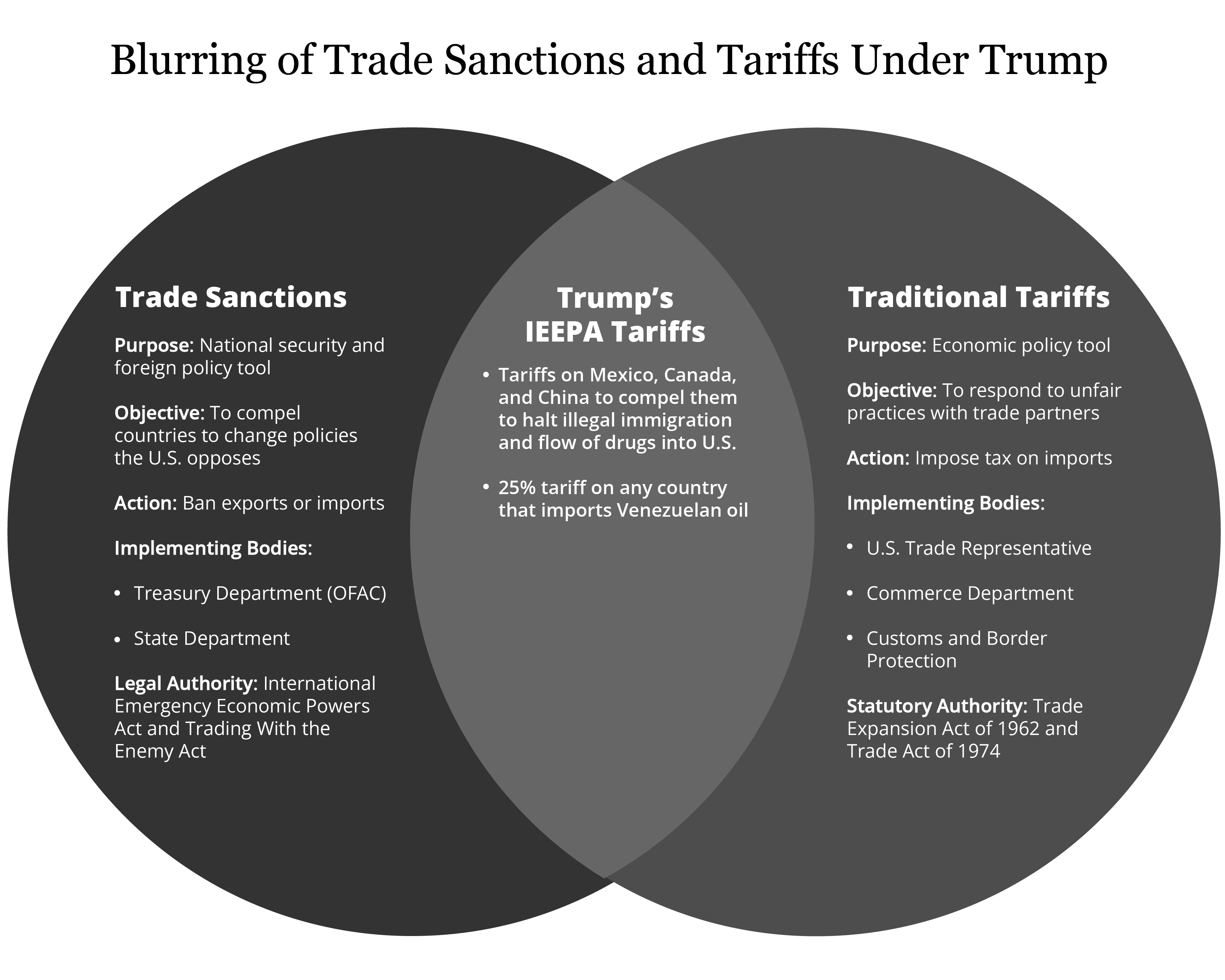
As shown in the graphic below, trade sanctions have traditionally been used by the United States as a tool of national security or foreign policy to compel countries to change their policies that the U.S. opposes. Trade sanctions typically ban all or specified exports or imports and are implemented primarily by the Treasury Department’s Office of Foreign Assets Control (OFAC). For example, in 2011, President Obama issued Executive Order 13570 declaring a national emergency under IEEPA to prohibit imports into the United States of any goods, services, or technology from North Korea.
Tariffs have traditionally been used as a tool of economic policy to respond to unfair practices with trade partners by imposing a tax on their imports. They are usually imposed under Section 301 of the Trade Act of 1974 once the U.S. Trade Representative (USTR) investigates and determines that an “act, policy, or practice of a foreign country” is unjustifiable or unreasonable and “burdens, restricts, or otherwise harms” U.S. commerce. Tariffs may also be implemented under Section 232 of the Trade Expansion Act of 1962 after an investigation by the Department of Commerce assessing whether the importation of a targeted product poses a threat to U.S. national security. For example, during his first term in office President Trump issued a global tariff of 25% on steel imports and 10% on aluminum imports as a result of a Section 232 investigation.
Since taking office for his second term, President Trump has issued a series of executive orders imposing tariffs not as traditionally done pursuant to one of the trade statutes, but under IEEPA authorities. In each case, the President declared a national emergency with respect to an unusual or extraordinary threat to U.S.’s national security, foreign policy, or economy, and rather than imposing trade or other sanctions to deal with the threat, he imposed or threatened to impose tariffs on imports.
| Executive Order | Title | Tariff | Threat | Condition for Removal |
|---|---|---|---|---|
| 14193 February 1, 2025 | Imposing Duties to Address the Flow of Illicit Drugs Across Our Northern Border | 10% energy products and 25% all other products | Canada’s failure to alleviate illegal migration and illicit drug crisis | Sufficient action to alleviate the crisis through cooperative actions |
| 14194 February 1, 2025 | Imposing Duties to Address the Situation at Our Southern Border | 25% on all products | Mexico’s failure to alleviate illegal migration and illicit drug crisis | Sufficient action to alleviate the crisis through cooperative actions |
| 14195 February 1, 2025 | Imposing Duties to Address the Synthetic Opioid Supply Chain in China | 10% on all products | China’s failure to stop chemical precursor suppliers, money launderers, other criminals, and drugs | Sufficient action to alleviate the crisis through cooperative actions |
| 14245 March 24, 2025 | Imposing Tariffs on Countries Importing Venezuelan Oil | 25% on all goods imported into the U.S. from any country that imports Venezuelan oil | Actions and policies of Maduro regime in Venezuela | Expires in 1 year or earlier at the discretion of the Secretary of Commerce |
| 14257 April 2, 2025 | Regulating Imports with a Reciprocal Tariff to Rectify Trade Practices that Contribute to Large and Persistent Annual U.S. Goods Trade Deficits | 10% on all imports from all trading partners, with exceptions, with increases at specified rates by country | Large and persistent annual U.S. goods trade deficits | Take steps to remedy non-reciprocal trade arrangements and align sufficiently with the U.S. on economic and national security matters |
The Trump administration’s use of tariffs beyond their traditional role as an economic policy tool to respond to unfair practices with trade partners, and now as another tool of national security and foreign policy to compel countries to change policies the U.S. opposes, has blurred the lines between trade sanctions and tariffs. The traditional distinctions have been further faded by the unprecedented use of IEEPA to impose tariffs, the threat of tariffs as secondary measures to amplify sanctions policy (as in the case of Venezuela), and the inclusion of national security issues as part of trade tariff negotiations. However, this doesn’t mean that tariffs are the new sanctions, or that the use of tariffs will replace sanctions as the tool of choice for dealing with national security issues.
Trade and other economic sanctions have been and will continue to be a go-to foreign policy tool to support the Trump administration’s “America First” agenda, as demonstrated most notably by the designation of Mexican drug cartels and other violent criminal organizations as Foreign Terrorist Organizations and the aggressive targeting by Treasury OFAC of their leadership and support networks, as well as the multiple tranches of designations targeting Iran’s oil and military procurement networks and terrorist proxies. In the month of April alone, the Treasury and State Departments collectively took eleven actions to impose additional sanctions on Iran and its proxies as part of its maximum pressure campaign
On May 21st, IFI, Crowell & Moring, and K2 Integrity hosted a discussion on the current global framework for sanctions and export controls, including a look ahead to what’s on the horizon.
In recent years, sanctions and export controls have escalated to an unprecedented level of complexity. With the shift in U.S. administration, new policy priorities are emerging bringing changes in enforcements, regulatory expectations, and international standards.
Whether you’re looking to deepen your subject-matter expertise or build strategic initiatives into your compliance program, this webinar offers practical guidance for staying ahead in a shifting regulatory environment.

 https://finintegrity.org/wp-content/uploads/2026/09/shutterstock_2645005987-scaled.jpg
1706
2560
IFI
https://live-black-pebble.pantheonsite.io/wp-content/uploads/2023/12/GIFI-Placeholder2.png
IFI2026-09-24 07:00:302026-09-24 11:44:27Dirty Barrels
https://finintegrity.org/wp-content/uploads/2026/09/shutterstock_2645005987-scaled.jpg
1706
2560
IFI
https://live-black-pebble.pantheonsite.io/wp-content/uploads/2023/12/GIFI-Placeholder2.png
IFI2026-09-24 07:00:302026-09-24 11:44:27Dirty Barrels https://finintegrity.org/wp-content/uploads/2026/01/bg-synethic-identities.jpg
500
1200
IFI
https://live-black-pebble.pantheonsite.io/wp-content/uploads/2023/12/GIFI-Placeholder2.png
IFI2026-01-08 07:00:252026-03-27 12:40:46Synthetic Identities
https://finintegrity.org/wp-content/uploads/2026/01/bg-synethic-identities.jpg
500
1200
IFI
https://live-black-pebble.pantheonsite.io/wp-content/uploads/2023/12/GIFI-Placeholder2.png
IFI2026-01-08 07:00:252026-03-27 12:40:46Synthetic Identities https://finintegrity.org/wp-content/uploads/2025/08/shutterstock_2599430089-scaled.jpg
1202
2560
IFI
https://live-black-pebble.pantheonsite.io/wp-content/uploads/2023/12/GIFI-Placeholder2.png
IFI2025-08-27 07:00:452026-05-14 14:14:01Deepfake Deep Dive
https://finintegrity.org/wp-content/uploads/2025/08/shutterstock_2599430089-scaled.jpg
1202
2560
IFI
https://live-black-pebble.pantheonsite.io/wp-content/uploads/2023/12/GIFI-Placeholder2.png
IFI2025-08-27 07:00:452026-05-14 14:14:01Deepfake Deep Dive https://finintegrity.org/wp-content/uploads/2025/06/Screenshot-2025-06-03-194254.png
416
767
IFI
https://live-black-pebble.pantheonsite.io/wp-content/uploads/2023/12/GIFI-Placeholder2.png
IFI2025-06-05 07:00:132026-03-04 18:12:30The Network, Not the Node
https://finintegrity.org/wp-content/uploads/2025/06/Screenshot-2025-06-03-194254.png
416
767
IFI
https://live-black-pebble.pantheonsite.io/wp-content/uploads/2023/12/GIFI-Placeholder2.png
IFI2025-06-05 07:00:132026-03-04 18:12:30The Network, Not the Node https://finintegrity.org/wp-content/uploads/2024/11/bg-ai-vs-human-judgement.jpg
1162
1800
IFI
https://live-black-pebble.pantheonsite.io/wp-content/uploads/2023/12/GIFI-Placeholder2.png
IFI2025-04-09 07:00:202025-09-25 15:17:41AI vs. Human Judgment
https://finintegrity.org/wp-content/uploads/2024/11/bg-ai-vs-human-judgement.jpg
1162
1800
IFI
https://live-black-pebble.pantheonsite.io/wp-content/uploads/2023/12/GIFI-Placeholder2.png
IFI2025-04-09 07:00:202025-09-25 15:17:41AI vs. Human Judgment https://finintegrity.org/wp-content/uploads/2025/02/the-heat-is-on-bg.jpg
1157
1800
IFI
https://live-black-pebble.pantheonsite.io/wp-content/uploads/2023/12/GIFI-Placeholder2.png
IFI2025-02-24 07:00:152025-03-26 19:38:52The Heat is On
https://finintegrity.org/wp-content/uploads/2025/02/the-heat-is-on-bg.jpg
1157
1800
IFI
https://live-black-pebble.pantheonsite.io/wp-content/uploads/2023/12/GIFI-Placeholder2.png
IFI2025-02-24 07:00:152025-03-26 19:38:52The Heat is On https://finintegrity.org/wp-content/uploads/2025/01/article-green-gold-rush.jpg
1261
1800
IFI
https://live-black-pebble.pantheonsite.io/wp-content/uploads/2023/12/GIFI-Placeholder2.png
IFI2025-01-13 07:00:472025-09-25 15:00:34The Green Gold Rush
https://finintegrity.org/wp-content/uploads/2025/01/article-green-gold-rush.jpg
1261
1800
IFI
https://live-black-pebble.pantheonsite.io/wp-content/uploads/2023/12/GIFI-Placeholder2.png
IFI2025-01-13 07:00:472025-09-25 15:00:34The Green Gold Rush https://finintegrity.org/wp-content/uploads/2024/12/bg-toward-financial-integrity-risk-management-program.png
835
1800
IFI
https://live-black-pebble.pantheonsite.io/wp-content/uploads/2023/12/GIFI-Placeholder2.png
IFI2024-12-19 07:00:412025-09-25 14:57:22Toward a Financial Integrity Risk Management Program
https://finintegrity.org/wp-content/uploads/2024/12/bg-toward-financial-integrity-risk-management-program.png
835
1800
IFI
https://live-black-pebble.pantheonsite.io/wp-content/uploads/2023/12/GIFI-Placeholder2.png
IFI2024-12-19 07:00:412025-09-25 14:57:22Toward a Financial Integrity Risk Management Program https://finintegrity.org/wp-content/uploads/2024/12/shutterstock_2472894163-scaled.jpg
1403
2560
Lauren Jack
https://live-black-pebble.pantheonsite.io/wp-content/uploads/2023/12/GIFI-Placeholder2.png
Lauren Jack2024-12-12 07:00:342025-09-25 14:57:44Safeguarding Trust – How to Balance Innovation and Security in Gen AI-Powered Compliance
https://finintegrity.org/wp-content/uploads/2024/12/shutterstock_2472894163-scaled.jpg
1403
2560
Lauren Jack
https://live-black-pebble.pantheonsite.io/wp-content/uploads/2023/12/GIFI-Placeholder2.png
Lauren Jack2024-12-12 07:00:342025-09-25 14:57:44Safeguarding Trust – How to Balance Innovation and Security in Gen AI-Powered Compliance IFI and Crowell & Moring Expand Global Sanctions and Export Controls Training...