Onerous Ownership
Beneficial Ownership Reporting
📅 November 5, 2024

On January 1, 2024, a new beneficial ownership information reporting requirement went into effect, mandated by the Corporate Transparency Act passed by Congress in 2021. Beneficial ownership reporting is part of the U.S. government’s effort to curb the use of anonymous shell companies or other opaque ownership structures to hide illicit gains.
Reporting requirements for the U.S. new beneficial ownership information database oblige many corporations, limited liability companies (LLCs), and other entities doing business in the United States to report to the Financial Crimes Enforcement Network (FinCEN) identifying information about the individuals who directly or indirectly own or control 25 percent or more of the company.
The requirements are straightforward, and a beneficial ownership report can be filed online or via PDF.
A reporting company must report:
The reporting company must also complete the beneficial ownership information, including:
That’s it.
Depending on the complexity of your company’s ownership structure, the time to ensure compliance with the Corporate Transparency Act can be as little as 10-15 minutes.
This is not an onerous requirement, but company owners are worried about how their information will be used and who will have access to it.
Obscure and complex ownership and control structures are a common methodology used to evade sanctions, integrate laundered illicit funds into the financial system, and hide misappropriated assets, among other financial crimes.
Tracking the proceeds of criminal activity can be complicated. The UN in 2023 assessed the need for better information in asset recovery efforts, citing a survey noting that responses from nearly 70 countries indicate their authorities are facing challenges in identifying and verifying beneficial ownership of suspected corruption proceeds.
The use of anonymous shell companies and complex corporate structures continues to be the number one money laundering typology, according to Global Financial Integrity (GFI)—a think tank that produces research, promotes policy solutions, and advises governments in their efforts to curtail illicit financial flows. GFI noted that 82 percent of U.S. money-laundering cases involved the use of a legal entity to mask ownership.
Legislators and civil society organizations have long advocated for the creation of a beneficial ownership registry in the United States to combat the problem of anonymous illicit actors using shell and front companies in the country to move illicit gains. Global AML/CFT watchdog the Financial Action Task Force during its 2016 review of the U.S. technical compliance with its recommendations found the United States as non-compliant with recommendation 24 (Transparency and Beneficial Ownership of Legal Persons). After the passage of the Corporate Transparency Act, however, the FATF upgraded its rating to “largely compliant.”
In addition, the U.S. real estate market is what GFI has described as a “Kleptocrat’s Dream,” used to launder billions of dollars by sanctioned individuals, corrupt government officials, and other illicit actors. Part of the reason is that billions of dollars’ worth of real estate in the United States is held through opaque corporate structures, according to the Brookings Institution. Brookings noted that offshore investors can easily hide their identity by using anonymous shell companies and other complex and opaque ownership structures to purchase properties in the United States. And because this practice is so common, offshore investment in the real estate sector is significant, allowing illicit actors to hide and integrate assets into the financial system.
FinCEN assessed in a 2020 Financial Trend Analysis that residential or commercial real estate, specifically in Türkiye and the UAE, has increasingly become a safe haven for Russian wealth—both licit and illicit. However, the use of opaque corporate entities to purchase commercial properties in the United States is also a common methodology used by illicit actors.
Beneficial ownership information can help “law enforcement, intelligence, and national security professionals as they work to protect the United States from bad actors who exploit anonymous shell companies to engage in money laundering, corruption, sanctions and tax evasion, drug trafficking, fraud, and a host of other criminal offenses with impunity, while legitimate businesses suffer from their misdeeds,” according to FinCEN Director Andrea Gacki.
Beneficial ownership information can also help financial institutions conduct basic due diligence. FinCEN explains that financial institutions can gain access to its beneficial ownership information in certain circumstances, with the consent of the reporting company. By understanding the ownership and control structures of their potential clients and business partners, firms and financial institutions can determine their illicit finance risk exposure and inform their risk appetite.
Will personal information be disclosed to just anyone? Will disclosing the beneficial owner of a company expose the firm to additional regulatory scrutiny? Will disclosing beneficial owner information to FinCEN increase the risk of identity theft and fraud? And what about the impact on beneficial owners’ personal security, especially if they operate in risky industries or high-profile positions?
These are legitimate questions, and the Corporate Transparency Act, which mandates the creation of the beneficial information registry, included several measures to safeguard the information.
First, access to beneficial owner information is restricted to law enforcement, financial institutions conducting due diligence (with the consent of the reporting company), and certain foreign officials for national security, intelligence, and law enforcement purposes. Money services businesses and other financial institutions with AML program requirements will also have access to the information stored in the registry. According to FinCEN, access to the beneficial ownership database will be implemented in phases, and a pilot program granting access to a handful of key federal agency users started this year.
Second, in its Small Entity Compliance Guide describing safeguards and access, FinCEN notes that when a financial institution receives any foreign government subpoena or foreign legal demand to disclose BOI that the financial institution received from FinCEN, the financial institution must notify FinCEN within three business days of receipt of such request. In other words, regulators should be made aware of requests of access to beneficial ownership information and will likely engage as appropriate.
Many countries exclude information on beneficial ownership registers from public access, allowing individuals to show on a case-by-case basis that public disclosure of their information would put them at risk. FinCEN will only disclose beneficial ownership information to authorized recipients, including federal agencies, law enforcement, and financial institutions for the purposes of conducting customer due diligence, and provided the bank has the consent of the reporting company to access the information.
Since the information will be available only to limited recipients, the risk of identity theft, fraud, and risk to family members of reporting companies likely will be limited.
And since illicit actors may seek to evade regulatory scrutiny by hiding their beneficial ownership of entities, filing beneficial ownership information is unlikely to attract additional regulatory attention, unless the beneficial owner is included on a watchlist or is a known family member or close associate of a designated individual.
Filing information identifying a company’s beneficial owners can help enhance transparency in the financial system and reduce illicit use of opaque corporate entities that exposes the financial system to dirty funds. It can also provide critical information to firms and financial institutions performing due diligence on potential customers and business partners.
Who ultimately owns or controls a potential customer’s firm can provide insights into whether illicit actors are possibly using your financial institution to gain access to the financial system.
Filing beneficial ownership information is not complicated and costs nothing. Filing only needs to be done once, unless the beneficial ownership information needs to be updated. Failing to comply, on the other hand, or providing intentionally false information, can result in significant penalties. Anyone who willfully violates beneficial ownership reporting requirements could be fined up to $591 for each day that the violation continues. Violators can also face criminal penalties of up to two years imprisonment and a fine of up to $10,000.
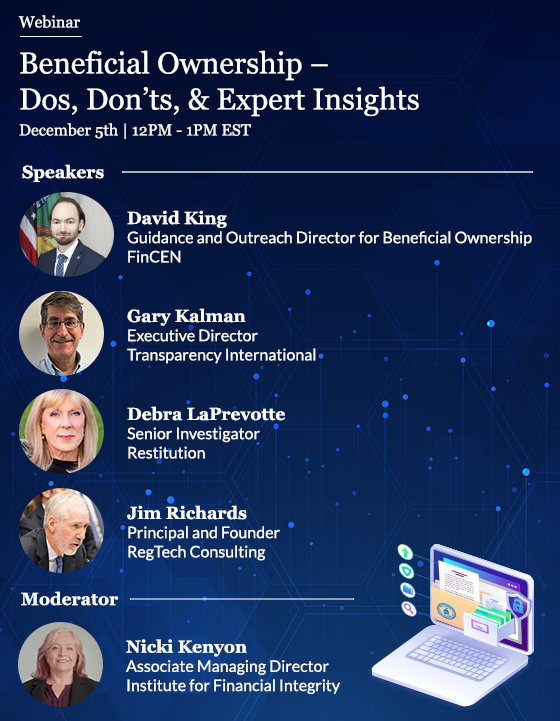
Join the Institute for Financial Integrity for a comprehensive webinar that provides firms and financial institutions with knowledge and strategies they need to ensure they comply with new beneficial ownership rules and regulations.
Led by regulatory, anticorruption, and industry experts, this webinar will equip learners with insights into the nuances of the new beneficial ownership reporting requirements, address concerns about privacy, security, and access, and explore strategies to research beneficial ownership and reduce your exposure to financial crime risk.
 https://finintegrity.org/wp-content/uploads/2026/09/august-2026-se-report-bg.jpg
888
1184
IFI
https://live-black-pebble.pantheonsite.io/wp-content/uploads/2023/12/GIFI-Placeholder2.png
IFI2026-09-02 07:00:562026-09-01 13:19:24August Monthly Sanctions and Export Controls Report
https://finintegrity.org/wp-content/uploads/2026/09/august-2026-se-report-bg.jpg
888
1184
IFI
https://live-black-pebble.pantheonsite.io/wp-content/uploads/2023/12/GIFI-Placeholder2.png
IFI2026-09-02 07:00:562026-09-01 13:19:24August Monthly Sanctions and Export Controls Report https://finintegrity.org/wp-content/uploads/2026/08/judgement-gap-in-market-abuse-compliance-bg.jpg
841
1500
IFI
https://live-black-pebble.pantheonsite.io/wp-content/uploads/2023/12/GIFI-Placeholder2.png
IFI2026-08-25 07:00:462026-08-24 11:34:59The Judgment Gap in Market Abuse Compliance
https://finintegrity.org/wp-content/uploads/2026/08/judgement-gap-in-market-abuse-compliance-bg.jpg
841
1500
IFI
https://live-black-pebble.pantheonsite.io/wp-content/uploads/2023/12/GIFI-Placeholder2.png
IFI2026-08-25 07:00:462026-08-24 11:34:59The Judgment Gap in Market Abuse Compliance https://finintegrity.org/wp-content/uploads/2026/07/guide-to-market-abuse-bg.jpg
1067
1600
IFI
https://live-black-pebble.pantheonsite.io/wp-content/uploads/2023/12/GIFI-Placeholder2.png
IFI2026-07-29 07:00:472026-07-28 12:45:11A Financial Institution’s Guide to Updated EU Market Abuse Regulation
https://finintegrity.org/wp-content/uploads/2026/07/guide-to-market-abuse-bg.jpg
1067
1600
IFI
https://live-black-pebble.pantheonsite.io/wp-content/uploads/2023/12/GIFI-Placeholder2.png
IFI2026-07-29 07:00:472026-07-28 12:45:11A Financial Institution’s Guide to Updated EU Market Abuse Regulation https://finintegrity.org/wp-content/uploads/2026/03/understandingfatf-bg.jpg
1000
1500
IFI
https://live-black-pebble.pantheonsite.io/wp-content/uploads/2023/12/GIFI-Placeholder2.png
IFI2026-05-13 07:00:082026-05-22 13:26:47Understanding the FATF: A Guide for Private Sector Stakeholders Part 3
https://finintegrity.org/wp-content/uploads/2026/03/understandingfatf-bg.jpg
1000
1500
IFI
https://live-black-pebble.pantheonsite.io/wp-content/uploads/2023/12/GIFI-Placeholder2.png
IFI2026-04-28 07:00:032026-05-22 13:28:23Understanding the FATF: A Guide for Private Sector Stakeholders Part 2
https://finintegrity.org/wp-content/uploads/2026/03/understandingfatf-bg.jpg
1000
1500
IFI
https://live-black-pebble.pantheonsite.io/wp-content/uploads/2023/12/GIFI-Placeholder2.png
IFI2026-05-13 07:00:082026-05-22 13:26:47Understanding the FATF: A Guide for Private Sector Stakeholders Part 3
https://finintegrity.org/wp-content/uploads/2026/03/understandingfatf-bg.jpg
1000
1500
IFI
https://live-black-pebble.pantheonsite.io/wp-content/uploads/2023/12/GIFI-Placeholder2.png
IFI2026-04-28 07:00:032026-05-22 13:28:23Understanding the FATF: A Guide for Private Sector Stakeholders Part 2 https://finintegrity.org/wp-content/uploads/2026/04/consumerprotection-bg.jpg
1000
1500
IFI
https://live-black-pebble.pantheonsite.io/wp-content/uploads/2023/12/GIFI-Placeholder2.png
IFI2026-04-15 07:00:202026-04-08 09:36:08Data as a Critical Business and Compliance Asset
https://finintegrity.org/wp-content/uploads/2026/03/understandingfatf-bg.jpg
1000
1500
IFI
https://live-black-pebble.pantheonsite.io/wp-content/uploads/2023/12/GIFI-Placeholder2.png
IFI2026-04-08 07:00:352026-05-22 13:30:04Understanding the FATF: A Guide for Private Sector Stakeholders
https://finintegrity.org/wp-content/uploads/2026/04/consumerprotection-bg.jpg
1000
1500
IFI
https://live-black-pebble.pantheonsite.io/wp-content/uploads/2023/12/GIFI-Placeholder2.png
IFI2026-04-15 07:00:202026-04-08 09:36:08Data as a Critical Business and Compliance Asset
https://finintegrity.org/wp-content/uploads/2026/03/understandingfatf-bg.jpg
1000
1500
IFI
https://live-black-pebble.pantheonsite.io/wp-content/uploads/2023/12/GIFI-Placeholder2.png
IFI2026-04-08 07:00:352026-05-22 13:30:04Understanding the FATF: A Guide for Private Sector Stakeholders https://finintegrity.org/wp-content/uploads/2026/03/feb2026-bg.jpg
879
1500
IFI
https://live-black-pebble.pantheonsite.io/wp-content/uploads/2023/12/GIFI-Placeholder2.png
IFI2026-03-03 07:00:312026-04-01 11:30:03February 2026 Monthly Sanctions and Export Controls Report
https://finintegrity.org/wp-content/uploads/2026/03/feb2026-bg.jpg
879
1500
IFI
https://live-black-pebble.pantheonsite.io/wp-content/uploads/2023/12/GIFI-Placeholder2.png
IFI2026-03-03 07:00:312026-04-01 11:30:03February 2026 Monthly Sanctions and Export Controls Report https://finintegrity.org/wp-content/uploads/2026/01/article-eftfs-bg.jpg
800
1200
IFI
https://live-black-pebble.pantheonsite.io/wp-content/uploads/2023/12/GIFI-Placeholder2.png
IFI2026-02-05 07:00:282026-03-27 12:32:49Electronic Fund Transfer Consumer Protection
https://finintegrity.org/wp-content/uploads/2026/01/article-eftfs-bg.jpg
800
1200
IFI
https://live-black-pebble.pantheonsite.io/wp-content/uploads/2023/12/GIFI-Placeholder2.png
IFI2026-02-05 07:00:282026-03-27 12:32:49Electronic Fund Transfer Consumer Protection
 Unverified and Unsure