2024’s Top 10 Major Developments
The Good, The Bad, and The Future
📅 January 17, 2025

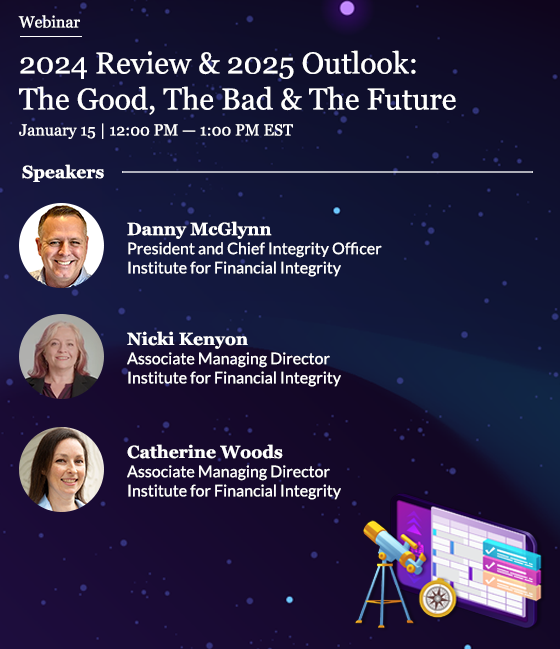
In our latest webinar, IFI’s panel of experts included IFI’s President, Danny McGlynn, and Associate Managing Directors, Nicki Kenyon and Catherine Woods. During their discussion, the panel explored a range of subjects and discussed the “Top 10” developments in the financial integrity space, as well as the good, the bad, and the future of each development.
The panel’s discussion included issues on global compliance, and Danny McGlynn began by appraising the progress made in meeting AML/CFT global standards, noting substantial improvements during the past year. He emphasized that low-performing countries, typically on the Financial Action Task Force (FATF) grey list, have also made strides in improving their AML/CFT regimes and a number of them, including Türkiye and the UAE, were removed from the watchdog’s list of countries under increased monitoring.
Nonetheless, McGlynn stressed that the global effectiveness of AML measures remains inadequate, particularly in investigations, prosecutions, and sanctions. Looking ahead, he remarked on FATF’s move toward assessing effectiveness over mere technical compliance in its impending fifth evaluation round.
Nicki Kenyon noted the impact of OFAC’s designation of all entities and individuals designated under Executive Order (EO) 14024 as secondary sanctions risks, exposing foreign financial institutions that conduct significant transactions with Russia’s military-industrial sector to designations by the United States. Treasury last year assessed that Russia had fully transitioned to a wartime economy, making all persons blocked pursuant to EO 14024 part of Russia’s military-industrial sector. Kenyon assessed that Russia would turn to alternative payment schemes and use digital assets to evade sanctions.
In a discussion on crypto crime, Catherine Woods noted recent trends, then examined three real-life examples and their implications. She highlighted North Korea’s state-sponsored crypto crimes, particularly the infiltration of tech companies by DPRK IT workers, the use of digital assets for terrorism financing including internally within the United States, and how law enforcement actions, such as UK’s “Operation Destabilise,” are outstanding examples of international cooperation against sophisticated money laundering networks.
The webinar further highlighted significant developments in Europe in which McGlynn discussed the major AML initiatives including the new EU AML Authority (AMLA), and Kenyon highlighted how the sanctions regimes in both the EU and the UK have evolved during the past year. With respect to the United States, McGlynn discussed the national risk assessments and strategy, the final rules to address illicit finance vulnerabilities in the residential real estate and investment adviser sectors, and the record $3 billion fine of TD Bank for AML violations.
Woods then turned to export controls and stepped through U.S. BIS’s intensifying focus on financial institutions, as well as increasing attention from global groups and national regulators on dual-use items and the responsibilities of banks not to finance unlawful trade.
McGlynn went on to review key AML developments in the U.S., including the U.S. Department of Treasury’s release of four major documents – the National Money Laundering Risk Assessment, the National Terrorism Financing Risk Assessment, the National Proliferation Financing Risk Assessment, and the National Strategy for Combating Terrorist and Other Illicit Finance. In particular, he noted how the risk assessments called out the lack of comprehensive AML/CFT coverage for investment advisers. He then discussed a number of current legal challenges, such as the constitutionality of the Corporate Transparency Act, as well as potential implementation challenges going forward.
Kenyon noted that a significant development that took place last year was Russia’s veto of the UN Security Council’s Resolution to renew the mandate for the North Korea Panel of Experts. The panel investigated reports about North Korean supplies of conventional arms and munitions, their cyber-attacks, as well as North Korean financial institutions and representatives operating overseas in violation of sanctions, especially in the IT and construction sectors. She went on to discuss why Russia vetoed as well as the implications for counterproliferation efforts since.
The session discussed specific prosecutions, such as the Bitcoin Fog crypto mixer case, and Woods assessed the significance of blockchain analytics data being admissible in court – including the wider implications of this decision for the use of technology in decision-making. In particular, she highlighted the necessity of traceability of data and decisions, and how appropriate use will vary depending on whether tech is being used for “order of magnitude” assessments or more specific decisions.
Interagency and multilateral collaboration were identified as key to combating financial crimes. Joint initiatives and operations were highlighted as crucial to this effort. The speakers outlined the urgency and value of such collaborations against the increasing cross-border financial crime and cybercrime.
Ultimately, the speakers emphasized the need for addressing multiple types of financial crime, finding common methodologies, and working cooperatively within various compliance teams to share information and assessments.
The FATF’s 5th round of evaluations will focus on effectiveness over technical compliance, and the global AML/CFT watchdog this year will conduct mutual evaluations of countries including Malaysia, Belgium, Singapore, Austria, Italy, Canada, and Türkiye. Regulators and the private sector should monitor evaluators’ assessments and recommendations to help countries and organizations adhere to the best and most effective compliance principles.
Regulators, financial institutions, and other organizations should think outside the box when it comes to deterring sanctions evasion and stopping money laundering, as well as deterring the use of digital assets for financial crimes. Reporting on alternative payment methods and techniques to move assets can help prevent regulatory penalties and reputational damage, as well as protect the financial system.
In sum, the IFI webinar presented an opportunity for professionals to hear from seasoned industry experts, gain insights into their vast experiences, and chart the future of financial integrity work.
If you missed the webinar, access the recording here, and be sure to watch out for the next webinar, which will focus on compliance best practices to help your organization remain on the right side of the law.
2024 was a busy year, with developments in sanctions, export controls, anti-money laundering, countering terrorism financing and other financial crimes.
Led by IFI’s senior experts, this webinar will review these developments, including the rollout of key assessments, strategies, regulations, guidance, and enforcement actions by global financial integrity stakeholders.
 https://finintegrity.org/wp-content/uploads/2026/10/Screenshot-2026-10-20-115053.png
1301
2320
IFI
https://live-black-pebble.pantheonsite.io/wp-content/uploads/2023/12/GIFI-Placeholder2.png
IFI2026-10-21 07:00:052026-10-21 11:26:02Across Borders, Beyond Sight
https://finintegrity.org/wp-content/uploads/2026/10/Screenshot-2026-10-20-115053.png
1301
2320
IFI
https://live-black-pebble.pantheonsite.io/wp-content/uploads/2023/12/GIFI-Placeholder2.png
IFI2026-10-21 07:00:052026-10-21 11:26:02Across Borders, Beyond Sight https://finintegrity.org/wp-content/uploads/2026/10/bg-expanding-crime.jpg
1357
1800
IFI
https://live-black-pebble.pantheonsite.io/wp-content/uploads/2023/12/GIFI-Placeholder2.png
IFI2026-10-14 07:00:092026-10-05 16:11:03The Expanding Scope of Financial Crime Compliance Training
https://finintegrity.org/wp-content/uploads/2026/10/bg-expanding-crime.jpg
1357
1800
IFI
https://live-black-pebble.pantheonsite.io/wp-content/uploads/2023/12/GIFI-Placeholder2.png
IFI2026-10-14 07:00:092026-10-05 16:11:03The Expanding Scope of Financial Crime Compliance Training https://finintegrity.org/wp-content/uploads/2026/10/bg-september-2026-se-report.jpg
1199
1600
IFI
https://live-black-pebble.pantheonsite.io/wp-content/uploads/2023/12/GIFI-Placeholder2.png
IFI2026-10-06 07:00:462026-10-05 13:03:02September 2026 Monthly Sanctions and Export Controls Report
https://finintegrity.org/wp-content/uploads/2026/10/bg-september-2026-se-report.jpg
1199
1600
IFI
https://live-black-pebble.pantheonsite.io/wp-content/uploads/2023/12/GIFI-Placeholder2.png
IFI2026-10-06 07:00:462026-10-05 13:03:02September 2026 Monthly Sanctions and Export Controls Report https://finintegrity.org/wp-content/uploads/2026/09/bg-the-data-behind-the-payment.jpg
1140
1800
IFI
https://live-black-pebble.pantheonsite.io/wp-content/uploads/2023/12/GIFI-Placeholder2.png
IFI2026-09-30 07:00:312026-09-29 10:35:23The Data Behind the Payment
https://finintegrity.org/wp-content/uploads/2026/09/bg-the-data-behind-the-payment.jpg
1140
1800
IFI
https://live-black-pebble.pantheonsite.io/wp-content/uploads/2023/12/GIFI-Placeholder2.png
IFI2026-09-30 07:00:312026-09-29 10:35:23The Data Behind the Payment https://finintegrity.org/wp-content/uploads/2026/09/real-estate-risk.jpg
614
1000
IFI
https://live-black-pebble.pantheonsite.io/wp-content/uploads/2023/12/GIFI-Placeholder2.png
IFI2026-09-17 12:40:222026-09-17 20:35:41Real Estate, Real Risks
https://finintegrity.org/wp-content/uploads/2026/09/real-estate-risk.jpg
614
1000
IFI
https://live-black-pebble.pantheonsite.io/wp-content/uploads/2023/12/GIFI-Placeholder2.png
IFI2026-09-17 12:40:222026-09-17 20:35:41Real Estate, Real Risks https://finintegrity.org/wp-content/uploads/2026/09/iran-and-sanctions-landscape-bg.jpg
1013
1800
IFI
https://live-black-pebble.pantheonsite.io/wp-content/uploads/2023/12/GIFI-Placeholder2.png
IFI2026-09-10 07:00:352026-09-17 20:21:30Iran and the Sanctions Landscape
https://finintegrity.org/wp-content/uploads/2026/09/iran-and-sanctions-landscape-bg.jpg
1013
1800
IFI
https://live-black-pebble.pantheonsite.io/wp-content/uploads/2023/12/GIFI-Placeholder2.png
IFI2026-09-10 07:00:352026-09-17 20:21:30Iran and the Sanctions Landscape https://finintegrity.org/wp-content/uploads/2026/09/august-2026-se-report-bg.jpg
888
1184
IFI
https://live-black-pebble.pantheonsite.io/wp-content/uploads/2023/12/GIFI-Placeholder2.png
IFI2026-09-02 07:00:562026-09-01 13:19:24August Monthly Sanctions and Export Controls Report
https://finintegrity.org/wp-content/uploads/2026/09/august-2026-se-report-bg.jpg
888
1184
IFI
https://live-black-pebble.pantheonsite.io/wp-content/uploads/2023/12/GIFI-Placeholder2.png
IFI2026-09-02 07:00:562026-09-01 13:19:24August Monthly Sanctions and Export Controls Report https://finintegrity.org/wp-content/uploads/2026/08/judgement-gap-in-market-abuse-compliance-bg.jpg
841
1500
IFI
https://live-black-pebble.pantheonsite.io/wp-content/uploads/2023/12/GIFI-Placeholder2.png
IFI2026-08-25 07:00:462026-08-24 11:34:59The Judgment Gap in Market Abuse Compliance
https://finintegrity.org/wp-content/uploads/2026/08/judgement-gap-in-market-abuse-compliance-bg.jpg
841
1500
IFI
https://live-black-pebble.pantheonsite.io/wp-content/uploads/2023/12/GIFI-Placeholder2.png
IFI2026-08-25 07:00:462026-08-24 11:34:59The Judgment Gap in Market Abuse Compliance https://finintegrity.org/wp-content/uploads/2026/08/oil-pipeline-bg.jpg
1000
1500
IFI
https://live-black-pebble.pantheonsite.io/wp-content/uploads/2023/12/GIFI-Placeholder2.png
IFI2026-08-19 07:00:062026-08-19 00:07:14The Illicit Oil Pipeline: How Criminal Networks Turn Crude into Clean Cash
https://finintegrity.org/wp-content/uploads/2026/08/oil-pipeline-bg.jpg
1000
1500
IFI
https://live-black-pebble.pantheonsite.io/wp-content/uploads/2023/12/GIFI-Placeholder2.png
IFI2026-08-19 07:00:062026-08-19 00:07:14The Illicit Oil Pipeline: How Criminal Networks Turn Crude into Clean Cash
 IFI Releases New Training Video Library to Fight Financial Crime