Exploring the Balance of Innovation & Responsibility
Industry Leaders Weigh In On Challenges and Opportunities of AI Implementation
📅 September 24, 2024

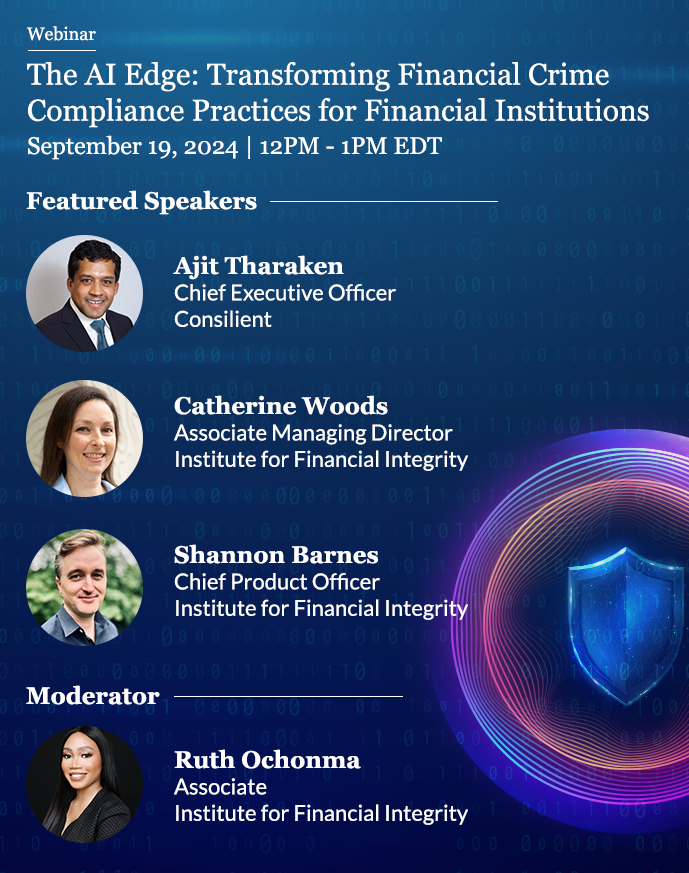
Note: This blog post is a summary of the webinar, “The AI Edge: Transforming Financial Crime Compliance Practices for Financial Institutions.” Click here if you’d like to access the full recording.
In today’s rapidly evolving financial landscape, the sophistication of financial crimes has reached unprecedented levels. As illicit activities become more complex, the need for innovative solutions in financial compliance intensifies. Our recent webinar brought together industry experts to explore this critical intersection of technology and compliance. This blog post aims to summarize the key insights shared by panelists Shannon Barnes, Ajit Tharaken, and Catherine Woods,
Shannon Barnes, Chief Product Officer at the Institute for Financial Integrity, set the foundation for our discussion by tracing AI’s journey and its impact on financial compliance.
“AI is not a monolith; it’s an umbrella term that encompasses a range of technologies,” Shannon explained. This includes Machine Learning (ML), Deep Learning, Neural Networks, and Large Language Models (LLMs). While these technologies are interconnected, they serve different functions within the AI ecosystem. Importantly, Shannon highlighted the distinction between AI and Generative AI (GenAI). “Generative AI is a subset of AI that’s gained significant attention recently, but it’s crucial to understand that AI doesn’t equal GenAI,” he emphasized.
A Brief History: From ELIZA to ChatGPT
AI isn’t new. Its roots trace back to the 1960s with the creation of ELIZA, the world’s first chatbot and financial institutions have been leveraging machine learning for decades. The game-changer came with the advent of GenAI. In 2014, Generative Adversarial Networks (GANs) emerged, allowing AI to create new content rather than just analyze existing data. The release of ChatGPT in 2018 marked a significant milestone, but it was the launch of ChatGPT 3.5 in 2022 that propelled GenAI into the mainstream, amassing one billion monthly users within just three months—a record-breaking adoption rate.
The Double-Edged Sword of Generative AI
“GenAI’s explosive growth is both exciting and challenging,” Shannon noted. Its ability to generate content and make connections autonomously is its greatest strength but also its Achilles’ heel. “To create and connect the dots, AI has to make assumptions, which can lead to errors,” he cautioned. He also warned that AI is not a magical wand; it’s a tool that requires careful handling.
As financial institutions explore AI implementation, safeguarding sensitive customer data becomes paramount. Ajit Tharaken, CEO of Consilient, addressed this concern head-on. “Data breaches and cyber threats are real and escalating,” Ajit stated. To combat this, he introduced Federated Learning, an innovative machine learning approach that trains AI models across decentralized devices or servers without transferring the actual data.
“Federated learning allows us to harness AI’s power without compromising customer data security,” he explained. “By keeping data on local servers and only sharing model updates, we maintain privacy while benefiting from collective intelligence.”
Ensuring Fairness and Eliminating Bias
Catherine Woods, Associate Managing Director at the Institute for Financial Integrity, emphasized the importance of addressing bias and fairness in AI models. Catherine highlighted some strategies for ethical AI implementation such as:
“Fairness isn’t just a regulatory requirement; it’s an ethical imperative,” Catherine highlighted. “We have a responsibility to build AI systems that serve everyone equitably.”
Transparency and Accountability: Building Trust
Understanding AI’s decision-making process is crucial for trust and compliance. Explainability bridges the gap between complex algorithms and human understanding. It’s essential for maintaining stakeholder trust and meeting regulatory standards. Additionally, robust oversight mechanisms further ensure accountability.
Catherine delved into the importance of transparency and accountability in AI. Complex algorithms can be black boxes, which isn’t acceptable in compliance. She advocated for:
Regulators worldwide are increasingly focusing on AI’s use in financial services, they’re emphasizing responsible implementation and accountability. Catherine cited instances where financial institutions faced scrutiny due to AI-related deficiencies.
“Regulators are sending a clear message: Organizations are accountable for their AI systems,” she emphasized, so we must ensure our practices align with evolving standards.
Proactive compliance strategies include:
“By staying engaged, institutions can navigate AI regulations effectively,” Woods concluded.
The Synergy of Humans and Machines
While AI offers significant advancements, human expertise remains irreplaceable. Shannon Barnes emphasized the importance of this synergy. AI enhances our capabilities but doesn’t replace the nuanced understanding humans brings – “it’s about augmentation, not substitution.” Shannon added.
Fostering collaboration involves:
Efficiency Without Compromising Quality
Ajit Tharaken highlighted AI’s potential to reduce manual workloads while maintaining high standards. “Efficiency shouldn’t come at the expense of quality or integrity,” he pointed out, with thoughtful implementation, AI allows us to achieve both.
Preparing for a Digitized Compliance Landscape: Empowering Professionals
As AI reshapes the industry, professionals need to adapt. Shannon Barnes discussed the importance of education and training. Professionals don’t need to be AI engineers, but they should understand how AI impacts their work. This knowledge empowers them to leverage AI effectively.
Some key areas for development that was highlighted include:
By fostering AI literacy, institutions ensure their teams are equipped to navigate complexities and drive innovation responsibly. This proactive approach positions organizations to stay ahead in a rapidly digitizing landscape.
The webinar underscored AI’s transformative potential in financial crime compliance, highlighting that benefits are maximized when implemented thoughtfully and ethically. “The future of compliance lies in integrating AI thoughtfully,” Catherine Woods concluded, by doing so, we enhance our capabilities while upholding our industry’s core principles.
We extend our gratitude to our expert panelists – Shannon Barnes, Ajit Tharaken and Catherine Woods, for sharing their expertise and valuable perspectives. For a deeper exploration of the topics discussed, access the full webinar recording below.
The integration of AI into financial compliance is becoming more crucial for managing the escalating complexity and sophistication of financial crimes. As the financial industry continues to evolve, AI presents opportunities to enhance financial crime compliance, reduce operational costs, and improve the accuracy and effectiveness of compliance programs.
Led by industry experts, this webinar explores how AI technologies can be integrated into traditional compliance frameworks, address the unique challenges presented by the digital transformation of financial services, and prepare financial institutions for the future of compliance.
 https://finintegrity.org/wp-content/uploads/2026/09/shutterstock_2645005987-scaled.jpg
1706
2560
IFI
https://live-black-pebble.pantheonsite.io/wp-content/uploads/2023/12/GIFI-Placeholder2.png
IFI2026-09-24 07:00:302026-09-24 11:44:27Dirty Barrels
https://finintegrity.org/wp-content/uploads/2026/09/shutterstock_2645005987-scaled.jpg
1706
2560
IFI
https://live-black-pebble.pantheonsite.io/wp-content/uploads/2023/12/GIFI-Placeholder2.png
IFI2026-09-24 07:00:302026-09-24 11:44:27Dirty Barrels https://finintegrity.org/wp-content/uploads/2026/01/bg-synethic-identities.jpg
500
1200
IFI
https://live-black-pebble.pantheonsite.io/wp-content/uploads/2023/12/GIFI-Placeholder2.png
IFI2026-01-08 07:00:252026-03-27 12:40:46Synthetic Identities
https://finintegrity.org/wp-content/uploads/2026/01/bg-synethic-identities.jpg
500
1200
IFI
https://live-black-pebble.pantheonsite.io/wp-content/uploads/2023/12/GIFI-Placeholder2.png
IFI2026-01-08 07:00:252026-03-27 12:40:46Synthetic Identities https://finintegrity.org/wp-content/uploads/2025/08/shutterstock_2599430089-scaled.jpg
1202
2560
IFI
https://live-black-pebble.pantheonsite.io/wp-content/uploads/2023/12/GIFI-Placeholder2.png
IFI2025-08-27 07:00:452026-05-14 14:14:01Deepfake Deep Dive
https://finintegrity.org/wp-content/uploads/2025/08/shutterstock_2599430089-scaled.jpg
1202
2560
IFI
https://live-black-pebble.pantheonsite.io/wp-content/uploads/2023/12/GIFI-Placeholder2.png
IFI2025-08-27 07:00:452026-05-14 14:14:01Deepfake Deep Dive https://finintegrity.org/wp-content/uploads/2025/06/Screenshot-2025-06-03-194254.png
416
767
IFI
https://live-black-pebble.pantheonsite.io/wp-content/uploads/2023/12/GIFI-Placeholder2.png
IFI2025-06-05 07:00:132026-03-04 18:12:30The Network, Not the Node
https://finintegrity.org/wp-content/uploads/2025/06/Screenshot-2025-06-03-194254.png
416
767
IFI
https://live-black-pebble.pantheonsite.io/wp-content/uploads/2023/12/GIFI-Placeholder2.png
IFI2025-06-05 07:00:132026-03-04 18:12:30The Network, Not the Node https://finintegrity.org/wp-content/uploads/2024/11/bg-ai-vs-human-judgement.jpg
1162
1800
IFI
https://live-black-pebble.pantheonsite.io/wp-content/uploads/2023/12/GIFI-Placeholder2.png
IFI2025-04-09 07:00:202025-09-25 15:17:41AI vs. Human Judgment
https://finintegrity.org/wp-content/uploads/2024/11/bg-ai-vs-human-judgement.jpg
1162
1800
IFI
https://live-black-pebble.pantheonsite.io/wp-content/uploads/2023/12/GIFI-Placeholder2.png
IFI2025-04-09 07:00:202025-09-25 15:17:41AI vs. Human Judgment https://finintegrity.org/wp-content/uploads/2025/02/the-heat-is-on-bg.jpg
1157
1800
IFI
https://live-black-pebble.pantheonsite.io/wp-content/uploads/2023/12/GIFI-Placeholder2.png
IFI2025-02-24 07:00:152025-03-26 19:38:52The Heat is On
https://finintegrity.org/wp-content/uploads/2025/02/the-heat-is-on-bg.jpg
1157
1800
IFI
https://live-black-pebble.pantheonsite.io/wp-content/uploads/2023/12/GIFI-Placeholder2.png
IFI2025-02-24 07:00:152025-03-26 19:38:52The Heat is On https://finintegrity.org/wp-content/uploads/2025/01/article-green-gold-rush.jpg
1261
1800
IFI
https://live-black-pebble.pantheonsite.io/wp-content/uploads/2023/12/GIFI-Placeholder2.png
IFI2025-01-13 07:00:472025-09-25 15:00:34The Green Gold Rush
https://finintegrity.org/wp-content/uploads/2025/01/article-green-gold-rush.jpg
1261
1800
IFI
https://live-black-pebble.pantheonsite.io/wp-content/uploads/2023/12/GIFI-Placeholder2.png
IFI2025-01-13 07:00:472025-09-25 15:00:34The Green Gold Rush https://finintegrity.org/wp-content/uploads/2024/12/bg-toward-financial-integrity-risk-management-program.png
835
1800
IFI
https://live-black-pebble.pantheonsite.io/wp-content/uploads/2023/12/GIFI-Placeholder2.png
IFI2024-12-19 07:00:412025-09-25 14:57:22Toward a Financial Integrity Risk Management Program
https://finintegrity.org/wp-content/uploads/2024/12/bg-toward-financial-integrity-risk-management-program.png
835
1800
IFI
https://live-black-pebble.pantheonsite.io/wp-content/uploads/2023/12/GIFI-Placeholder2.png
IFI2024-12-19 07:00:412025-09-25 14:57:22Toward a Financial Integrity Risk Management Program https://finintegrity.org/wp-content/uploads/2024/12/shutterstock_2472894163-scaled.jpg
1403
2560
Lauren Jack
https://live-black-pebble.pantheonsite.io/wp-content/uploads/2023/12/GIFI-Placeholder2.png
Lauren Jack2024-12-12 07:00:342025-09-25 14:57:44Safeguarding Trust – How to Balance Innovation and Security in Gen AI-Powered Compliance
https://finintegrity.org/wp-content/uploads/2024/12/shutterstock_2472894163-scaled.jpg
1403
2560
Lauren Jack
https://live-black-pebble.pantheonsite.io/wp-content/uploads/2023/12/GIFI-Placeholder2.png
Lauren Jack2024-12-12 07:00:342025-09-25 14:57:44Safeguarding Trust – How to Balance Innovation and Security in Gen AI-Powered Compliance
 From Cash to Clicks – AML Challenges & Typologies for Digital Pa...