Top 10: Cartel Finance & Chinese Money Laundering Networks
Actionable Resources for Financial Institutions
📅 January 15, 2026

Chinese Money Laundering Networks (CMLNs) fulfill a critical role in laundering proceeds of cartels and other organized criminal groups. Driven by capital flight from China, CMLNs service demand from wealthy Chinese nationals seeking funds overseas by supplying them with criminal cash. The volumes are immense: financial institutions in the United States reported $312 billion in suspicious transactions associated with CMLNs over the period 2020-2024.
“CMLNs are considered professional money launderers (PMLs) and play a vital role in laundering the Cartels’ drug proceeds in the United States… CMLNs operate around the world and may coordinate with other international PMLs, such as shadow banking networks and Colombian peso brokers.” – FinCEN Advisory FIN-2025-A003
CMLNs provide fast, efficient, competitively priced, and rapidly adaptive services to cartels. Financial institutions must be adaptive in response: tracking evolutions in the money laundering methods used by these illicit actors and re-calibrating their counter illicit finance programs to ensure they remain effective.
To assist financial institutions with this objective, the Institute for Financial Integrity has identified our “Top 10” list of actionable resources for financial institutions. These can inform policies, processes, systems, controls, and training programs to detect and respond to cartel finance and CMLNs.
Selection Criteria
Our Top 10 took three criteria into consideration:
As you read the list, you may ask: why are U.S. resources so prominently represented? This is because cartels – and the CMLNs that are a key enabler – are a proximate and priority threat for the United States and are the focus of many publications by U.S. government and private sector organizations.
1. FinCEN Advisory and Financial Trend Analysis on Chinese Money Laundering Networks (August 2025)
Starting with a “double-header” comprising an Advisory and a Financial Trend Analysis, issued jointly, these resources from FinCEN are a recent and comprehensive foundation on CMLN laundering of cartel proceeds.
The Advisory sets out the links between CMLNs and cartels, the drivers and operations of CMLNs, financial typologies, and red flags. The Financial Trend Analysis provides real-life examples of how CMLNs launder cartel proceeds, transactional patterns, and methodologies including Trade-Based Money Laundering, “daigou,” real estate, and use of students as money mules. Both the Advisory and Analysis focus on financial sector touchpoints, making them readily applicable within financial institutions.
The second resource on our list also reveals links between cartels and China – this time to companies providing precursor chemicals for fentanyl production – as well as other countries associated with fentanyl supply chains. The Advisory provides context on fentanyl trafficking, the involvement of cartels, and the methodologies used, including specific detail on use of shell companies and chemical reference numbers in payment instructions. These can be directly implemented by financial institutions in their due diligence, monitoring, and investigative processes.
The Advisory adds to earlier advisories in June 2024 and August 2019, both containing red flags specific to different types of financial institutions (e.g. MSBs and banks), which continue to be useful references too.
This Alert adds to a complete view of cartel money laundering by focusing on a specific methodology: bulk cash smuggling by Transnational Criminal Organizations based in Mexico. The Alert details how criminal proceeds are smuggled from the United States to Mexico, then repatriated back into the United States by air and land, along with red flags specific to financial institutions.
Issued concurrently with Resource 3, this Alert also adds to a comprehensive “map” of cartel money laundering, this time focusing on oil smuggling. It describes the financial typologies associated with multiple types of oil smuggling including obtaining oil, smuggling it, selling it, and repatriating the proceeds to the United States. Like the other FinCEN advisories, it includes red flags specific to financial institutions.
5. Drug Enforcement Administration National Drug Threat Assessment (2025)
The Drug Enforcement Administration (DEA) National Drug Threat Assessment provides detailed analysis on the threats of illicit drugs and the criminal organizations responsible for producing them. The report includes a high-level section on illicit finance with an overview of laundering methodologies and data on seizures. There is also contextual information on criminal organizations, geographical activity, and drugs themselves. It’s a useful document, but we’ve put it further down our list because the FinCEN resources have more detail that can be directly applied by financial institutions.
6. National Risk Assessments
Our next selections are the National Risk Assessments (NRAs) for each country. NRAs establish how cartels, CMLNs, and similar criminal networks operate in each specific jurisdiction, which should inform each institution’s risk assessment. Our recommendation is to start with your own country NRA – but review others as well. Transnational criminal networks such as cartels and CMLNs operate globally, and by reviewing additional countries you’ll get a more complete view of supply chains, illicit financial networks, and criminal operations. Additionally, one country may uncover red flags or a laundering methodology which has yet to be established or identified in others, providing an early-warning indicator that can be used to strengthen financial institution defenses.
NRAs that include cartel and/or CMLN activity (referred to in some countries as “Chinese underground banking” or “Chinese professional money launderers”) include:
7. United Kingdom National Crime Agency Report on Daigou (October 2019)
This alert from the United Kingdom remains an authoritative source on “daigou,” or laundering through luxury and high-value goods. It provides detailed analysis on the operation and scale of CMLNs (referred to in the alert as Chinese Underground Banking), in addition to a description of daigou operations. The alert complements the FinCEN advisory (Resource 1 on our list) which provides recent financial sector red flags.
While financial institution reports to FinCEN referring to “daigou” represent only $9.6 million out of $312 billion in CMLN-related reports, a further $19 billion refer to unusual credit card activity. This suggests that daigou may be an under-identified risk requiring further action from financial institutions. For an integrated analysis of daigou operations across multiple jurisdictions and the actions financial institutions can take, refer to the Institute for Financial Integrity’s analysis on Laundering Luxury.
8. Canada’s Cullen Commission Final Report into Money Laundering in British Columbia (June 2022)
Looking for a read for those long winter nights? The Cullen Commission’s 1,808 page report on laundering through casinos in British Columbia, Canada, may be just what you need!
The report describes in detail how millions in illicit cash was laundered – including $20 million in suspicious cash activity in one single month in July 2015 – and the involvement of CLMNs, “mirror transfer” methodologies, and junket operators. For a distilled version of the Cullen Commission report highlighting the red flags relevant to financial institutions, refer to the Institute for Financial Integrity’s report High Stakes – Casinos, Crime, and Cartels.
While use of the “Vancouver method” of money laundering described in the Cullen Commission report declined when more stringent regulations were introduced, similar methods have been identified in casinos in Australia, Macau SAR, Cambodia, Lao, Myanmar, and the Philippines – and financial institutions and commercial gaming operators must ensure the red flags are integrated into their counter illicit finance programs.
9. United Nations Office of Drugs and Crime World Drugs Report (2025)
This report from the United Nations Office of Drugs and Crime (UNODC) provides a comprehensive global view of drugs and criminality including analysis of organized crime groups and geographical factors. While the detail on laundering and financial sector touchpoints is more limited, it’s a valuable resource to provide a global view on criminal networks and supply chains, especially in jurisdictions where national reporting is more limited.
Complementing the UNDOC report, the Global Initiative against Organized Transnational Crime, an independent civil-society organization, also publishes a Global Organized Crime Index. The index provides an analysis of criminality including drug trafficking, presents global aggregate data, regional and country breakdowns, and thematic analysis. While the index does not include immediately-actionable red flags for financial institutions, it complements the UNODC report by providing context.
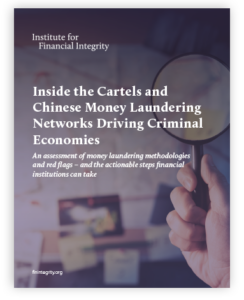
10. Inside the Cartels and Chinese Money Laundering Networks Driving Criminal Economies (2026)
And last on our list, a hometown favorite! In our view, our recent report Inside the Cartels and Chinese Money Laundering Networks Driving Criminal Economies earns a place in the Top 10. This expert report draws together analysis on the sources of cartel proceeds, CMLNs and their drivers, and money laundering methodologies, into an actionable and financial institution-focused report. In addition, we provide deep-dives on mirror transfers, crypto, casinos, daigou, and student money mules – including comprehensive red flags and organizational-level actions financial institutions must take to address cartel and CMLN risks. With comprehensive references throughout, it maps the cartel and CMLN terrain, as well as signposting to other sources.
Any Top 10 list involves competitive selection! We find the following resources useful too, though we weren’t able to identify a single one that best represented each category to reach the Top 10.
Cartels and their criminal financing continue to evolve, using professional networks to launder the proceeds from narcotics trafficking, human trafficking, environmental crime, fuel theft and oil smuggling, corruption at ports and “taxation” of local economies.
Join the Institute for Financial Integrity on February 25th for an assessment of key recent actions taken by the U.S. and Mexican Governments and the implications of heightened sanctions and money laundering risks for financial institutions and businesses.
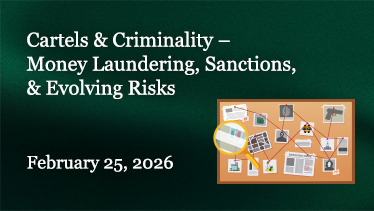
Cartels and their criminal financing continue to evolve, using professional networks to launder the proceeds from narcotics trafficking, human trafficking, environmental crime, fuel theft and oil smuggling, corruption at ports and “taxation” of local economies.
Download our latest report for an assessment of money laundering methodologies and red flags – and the actionable steps financial institutions can take.
 https://finintegrity.org/wp-content/uploads/2026/01/bg-synethic-identities.jpg
500
1200
IFI
https://live-black-pebble.pantheonsite.io/wp-content/uploads/2023/12/GIFI-Placeholder2.png
IFI2026-01-08 07:00:252026-03-27 12:40:46Synthetic Identities
https://finintegrity.org/wp-content/uploads/2026/01/bg-synethic-identities.jpg
500
1200
IFI
https://live-black-pebble.pantheonsite.io/wp-content/uploads/2023/12/GIFI-Placeholder2.png
IFI2026-01-08 07:00:252026-03-27 12:40:46Synthetic Identities https://finintegrity.org/wp-content/uploads/2025/08/shutterstock_2599430089-scaled.jpg
1202
2560
IFI
https://live-black-pebble.pantheonsite.io/wp-content/uploads/2023/12/GIFI-Placeholder2.png
IFI2025-08-27 07:00:452026-05-14 14:14:01Deepfake Deep Dive
https://finintegrity.org/wp-content/uploads/2025/08/shutterstock_2599430089-scaled.jpg
1202
2560
IFI
https://live-black-pebble.pantheonsite.io/wp-content/uploads/2023/12/GIFI-Placeholder2.png
IFI2025-08-27 07:00:452026-05-14 14:14:01Deepfake Deep Dive https://finintegrity.org/wp-content/uploads/2025/06/Screenshot-2025-06-03-194254.png
416
767
IFI
https://live-black-pebble.pantheonsite.io/wp-content/uploads/2023/12/GIFI-Placeholder2.png
IFI2025-06-05 07:00:132026-03-04 18:12:30The Network, Not the Node
https://finintegrity.org/wp-content/uploads/2025/06/Screenshot-2025-06-03-194254.png
416
767
IFI
https://live-black-pebble.pantheonsite.io/wp-content/uploads/2023/12/GIFI-Placeholder2.png
IFI2025-06-05 07:00:132026-03-04 18:12:30The Network, Not the Node https://finintegrity.org/wp-content/uploads/2024/11/bg-ai-vs-human-judgement.jpg
1162
1800
IFI
https://live-black-pebble.pantheonsite.io/wp-content/uploads/2023/12/GIFI-Placeholder2.png
IFI2025-04-09 07:00:202025-09-25 15:17:41AI vs. Human Judgment
https://finintegrity.org/wp-content/uploads/2024/11/bg-ai-vs-human-judgement.jpg
1162
1800
IFI
https://live-black-pebble.pantheonsite.io/wp-content/uploads/2023/12/GIFI-Placeholder2.png
IFI2025-04-09 07:00:202025-09-25 15:17:41AI vs. Human Judgment https://finintegrity.org/wp-content/uploads/2025/02/the-heat-is-on-bg.jpg
1157
1800
IFI
https://live-black-pebble.pantheonsite.io/wp-content/uploads/2023/12/GIFI-Placeholder2.png
IFI2025-02-24 07:00:152025-03-26 19:38:52The Heat is On
https://finintegrity.org/wp-content/uploads/2025/02/the-heat-is-on-bg.jpg
1157
1800
IFI
https://live-black-pebble.pantheonsite.io/wp-content/uploads/2023/12/GIFI-Placeholder2.png
IFI2025-02-24 07:00:152025-03-26 19:38:52The Heat is On https://finintegrity.org/wp-content/uploads/2025/01/article-green-gold-rush.jpg
1261
1800
IFI
https://live-black-pebble.pantheonsite.io/wp-content/uploads/2023/12/GIFI-Placeholder2.png
IFI2025-01-13 07:00:472025-09-25 15:00:34The Green Gold Rush
https://finintegrity.org/wp-content/uploads/2025/01/article-green-gold-rush.jpg
1261
1800
IFI
https://live-black-pebble.pantheonsite.io/wp-content/uploads/2023/12/GIFI-Placeholder2.png
IFI2025-01-13 07:00:472025-09-25 15:00:34The Green Gold Rush https://finintegrity.org/wp-content/uploads/2024/12/bg-toward-financial-integrity-risk-management-program.png
835
1800
IFI
https://live-black-pebble.pantheonsite.io/wp-content/uploads/2023/12/GIFI-Placeholder2.png
IFI2024-12-19 07:00:412025-09-25 14:57:22Toward a Financial Integrity Risk Management Program
https://finintegrity.org/wp-content/uploads/2024/12/bg-toward-financial-integrity-risk-management-program.png
835
1800
IFI
https://live-black-pebble.pantheonsite.io/wp-content/uploads/2023/12/GIFI-Placeholder2.png
IFI2024-12-19 07:00:412025-09-25 14:57:22Toward a Financial Integrity Risk Management Program https://finintegrity.org/wp-content/uploads/2024/12/shutterstock_2472894163-scaled.jpg
1403
2560
Lauren Jack
https://live-black-pebble.pantheonsite.io/wp-content/uploads/2023/12/GIFI-Placeholder2.png
Lauren Jack2024-12-12 07:00:342025-09-25 14:57:44Safeguarding Trust – How to Balance Innovation and Security in Gen AI-Powered Compliance
https://finintegrity.org/wp-content/uploads/2024/12/shutterstock_2472894163-scaled.jpg
1403
2560
Lauren Jack
https://live-black-pebble.pantheonsite.io/wp-content/uploads/2023/12/GIFI-Placeholder2.png
Lauren Jack2024-12-12 07:00:342025-09-25 14:57:44Safeguarding Trust – How to Balance Innovation and Security in Gen AI-Powered Compliance https://finintegrity.org/wp-content/uploads/2024/10/beneficial-bg.jpg
1200
1800
Lauren Jack
https://live-black-pebble.pantheonsite.io/wp-content/uploads/2023/12/GIFI-Placeholder2.png
Lauren Jack2024-12-10 07:00:012026-05-14 14:51:01Webinar Recap – The Dos, Don’ts & Expert Insights on Beneficial Ownership
https://finintegrity.org/wp-content/uploads/2024/10/beneficial-bg.jpg
1200
1800
Lauren Jack
https://live-black-pebble.pantheonsite.io/wp-content/uploads/2023/12/GIFI-Placeholder2.png
Lauren Jack2024-12-10 07:00:012026-05-14 14:51:01Webinar Recap – The Dos, Don’ts & Expert Insights on Beneficial Ownership
 Blind Spots in the System