From Alerts to Accountability
What Regulators Expect From Sanctions Screening Teams
📅 April 21, 2026

Financial institutions build sanctions screening programs so that they can generate alerts. Daily, employees review many entries to resolve potential matches and advance cases. To an observer this activity appears to indicate that a program is successful, but regulators do not prioritize the total number of alerts that a team processes. They examine if a program identifies actual threats.
As a result, a high volume of alerts can provide a false sense of security. If a queue is busy, it doesn’t prove that a program functions well. For instance, high activity might mask instances where matches were overlooked, reviews were completed too quickly or decisions were made inconsistently. In this context the primary concern is whether a team detects real risks or merely completes tasks to maintain a schedule.
By looking at those trends, it’s clear that compliance requirements have changed. It’s no longer sufficient to measure success by the amount of work performed. The effectiveness of a program is defined by its results. Regulators require evidence of specific outcomes, sound reasoning and decisions that remain valid during an audit. Since the emphasis is transitioning from high levels of activity to personal and institutional responsibility, sanctions screening teams must change how they function.
Regulators are not just looking at your screening system, they’re trying to understand whether it actually works. Expectations from agencies like the Office of Foreign Assets Control (OFAC), Financial Conduct Authority (FCA), all point in the same direction: effectiveness matters more than how sophisticated your setup looks on paper.
Is your program truly risk-based, or are you treating everything the same? Are real matches being caught and escalated, or getting lost in the noise? And when decisions are made, can your team explain them clearly and stand behind them?
Regulators are less interested in the technology itself and more interested in what it produces. A simple program that consistently identifies risk and supports sound decisions will always carry more weight than a complex system that cannot demonstrate results.
Where Sanctions Screening Programs Fail
Most sanctions screening programs don’t break because something is missing. They break in the day-to-day, in how the system is used.
None of these issues stand out in the moment. But they are exactly the kinds of weaknesses regulators tend to uncover when they take a closer look.
Most teams already have training programs in place, but the issue is that it doesn’t always show up where it matters, in the decisions people make every day.
A lot of training feels like something to get through, but when a messy or a high-risk alert comes in, it doesn’t always help someone think it through or explain their call with confidence.
What really works is more practical and more specific:
It also has to feel grounded as going through real scenarios, missed matches, or common evasion tactics is what builds judgment. That is the kind of learning people remember when they are under pressure.
And it cannot stay static because sanctions risks move fast. New programs, new typologies, new ways around controls and if training doesn’t evolve with that, teams end up relying on outdated thinking.
At the end of the day, it comes down to mindset. If training is treated like a requirement, it will not change much. But if it is treated like a control, something that sharpens judgment and improves decisions, it becomes one of the most important parts of making a screening program effective.
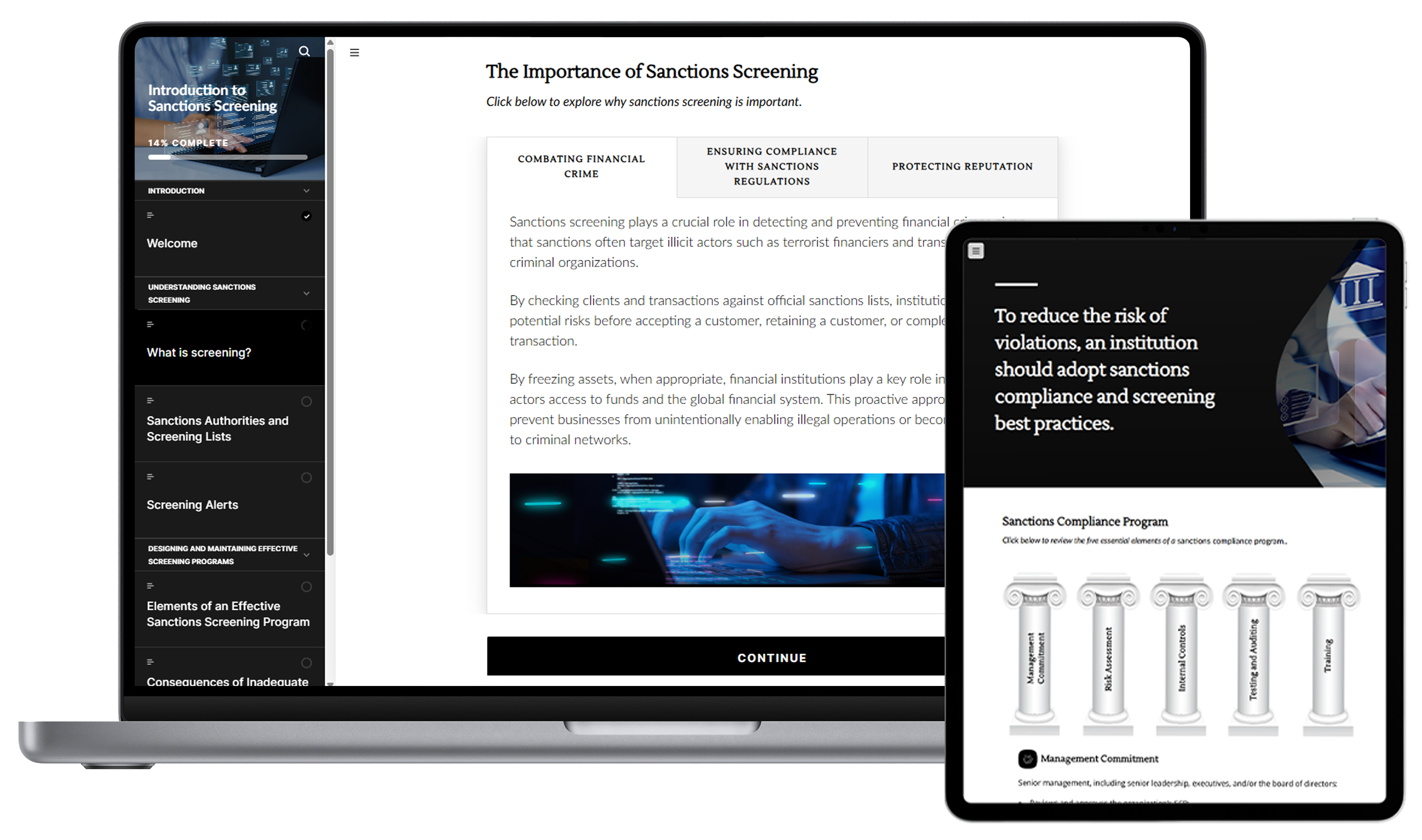
If your screening program depends on people making the right calls, then training needs to do more than check a box.
IFI’s Introduction to Sanctions Screening course is built with that in mind. It goes beyond basic concepts and walks through how screening works in practice, how alerts are generated, how they should be reviewed, and where programs typically fall short. Through practical examples and real-world scenarios, it helps teams build the judgment needed to identify true matches, escalate appropriately, and document decisions with confidence. For institutions looking to strengthen screening effectiveness, not just activity, it is a practical starting point.
 https://finintegrity.org/wp-content/uploads/2026/10/Screenshot-2026-10-20-115053.png
1301
2320
IFI
https://live-black-pebble.pantheonsite.io/wp-content/uploads/2023/12/GIFI-Placeholder2.png
IFI2026-10-21 07:00:052026-10-21 11:26:02Across Borders, Beyond Sight
https://finintegrity.org/wp-content/uploads/2026/10/Screenshot-2026-10-20-115053.png
1301
2320
IFI
https://live-black-pebble.pantheonsite.io/wp-content/uploads/2023/12/GIFI-Placeholder2.png
IFI2026-10-21 07:00:052026-10-21 11:26:02Across Borders, Beyond Sight https://finintegrity.org/wp-content/uploads/2026/10/bg-expanding-crime.jpg
1357
1800
IFI
https://live-black-pebble.pantheonsite.io/wp-content/uploads/2023/12/GIFI-Placeholder2.png
IFI2026-10-14 07:00:092026-10-05 16:11:03The Expanding Scope of Financial Crime Compliance Training
https://finintegrity.org/wp-content/uploads/2026/10/bg-expanding-crime.jpg
1357
1800
IFI
https://live-black-pebble.pantheonsite.io/wp-content/uploads/2023/12/GIFI-Placeholder2.png
IFI2026-10-14 07:00:092026-10-05 16:11:03The Expanding Scope of Financial Crime Compliance Training https://finintegrity.org/wp-content/uploads/2026/10/bg-september-2026-se-report.jpg
1199
1600
IFI
https://live-black-pebble.pantheonsite.io/wp-content/uploads/2023/12/GIFI-Placeholder2.png
IFI2026-10-06 07:00:462026-10-05 13:03:02September 2026 Monthly Sanctions and Export Controls Report
https://finintegrity.org/wp-content/uploads/2026/10/bg-september-2026-se-report.jpg
1199
1600
IFI
https://live-black-pebble.pantheonsite.io/wp-content/uploads/2023/12/GIFI-Placeholder2.png
IFI2026-10-06 07:00:462026-10-05 13:03:02September 2026 Monthly Sanctions and Export Controls Report https://finintegrity.org/wp-content/uploads/2026/09/bg-the-data-behind-the-payment.jpg
1140
1800
IFI
https://live-black-pebble.pantheonsite.io/wp-content/uploads/2023/12/GIFI-Placeholder2.png
IFI2026-09-30 07:00:312026-09-29 10:35:23The Data Behind the Payment
https://finintegrity.org/wp-content/uploads/2026/09/bg-the-data-behind-the-payment.jpg
1140
1800
IFI
https://live-black-pebble.pantheonsite.io/wp-content/uploads/2023/12/GIFI-Placeholder2.png
IFI2026-09-30 07:00:312026-09-29 10:35:23The Data Behind the Payment https://finintegrity.org/wp-content/uploads/2026/09/real-estate-risk.jpg
614
1000
IFI
https://live-black-pebble.pantheonsite.io/wp-content/uploads/2023/12/GIFI-Placeholder2.png
IFI2026-09-17 12:40:222026-09-17 20:35:41Real Estate, Real Risks
https://finintegrity.org/wp-content/uploads/2026/09/real-estate-risk.jpg
614
1000
IFI
https://live-black-pebble.pantheonsite.io/wp-content/uploads/2023/12/GIFI-Placeholder2.png
IFI2026-09-17 12:40:222026-09-17 20:35:41Real Estate, Real Risks https://finintegrity.org/wp-content/uploads/2026/09/iran-and-sanctions-landscape-bg.jpg
1013
1800
IFI
https://live-black-pebble.pantheonsite.io/wp-content/uploads/2023/12/GIFI-Placeholder2.png
IFI2026-09-10 07:00:352026-09-17 20:21:30Iran and the Sanctions Landscape
https://finintegrity.org/wp-content/uploads/2026/09/iran-and-sanctions-landscape-bg.jpg
1013
1800
IFI
https://live-black-pebble.pantheonsite.io/wp-content/uploads/2023/12/GIFI-Placeholder2.png
IFI2026-09-10 07:00:352026-09-17 20:21:30Iran and the Sanctions Landscape https://finintegrity.org/wp-content/uploads/2026/09/august-2026-se-report-bg.jpg
888
1184
IFI
https://live-black-pebble.pantheonsite.io/wp-content/uploads/2023/12/GIFI-Placeholder2.png
IFI2026-09-02 07:00:562026-09-01 13:19:24August Monthly Sanctions and Export Controls Report
https://finintegrity.org/wp-content/uploads/2026/09/august-2026-se-report-bg.jpg
888
1184
IFI
https://live-black-pebble.pantheonsite.io/wp-content/uploads/2023/12/GIFI-Placeholder2.png
IFI2026-09-02 07:00:562026-09-01 13:19:24August Monthly Sanctions and Export Controls Report https://finintegrity.org/wp-content/uploads/2026/08/judgement-gap-in-market-abuse-compliance-bg.jpg
841
1500
IFI
https://live-black-pebble.pantheonsite.io/wp-content/uploads/2023/12/GIFI-Placeholder2.png
IFI2026-08-25 07:00:462026-08-24 11:34:59The Judgment Gap in Market Abuse Compliance
https://finintegrity.org/wp-content/uploads/2026/08/judgement-gap-in-market-abuse-compliance-bg.jpg
841
1500
IFI
https://live-black-pebble.pantheonsite.io/wp-content/uploads/2023/12/GIFI-Placeholder2.png
IFI2026-08-25 07:00:462026-08-24 11:34:59The Judgment Gap in Market Abuse Compliance https://finintegrity.org/wp-content/uploads/2026/08/oil-pipeline-bg.jpg
1000
1500
IFI
https://live-black-pebble.pantheonsite.io/wp-content/uploads/2023/12/GIFI-Placeholder2.png
IFI2026-08-19 07:00:062026-08-19 00:07:14The Illicit Oil Pipeline: How Criminal Networks Turn Crude into Clean Cash
https://finintegrity.org/wp-content/uploads/2026/08/oil-pipeline-bg.jpg
1000
1500
IFI
https://live-black-pebble.pantheonsite.io/wp-content/uploads/2023/12/GIFI-Placeholder2.png
IFI2026-08-19 07:00:062026-08-19 00:07:14The Illicit Oil Pipeline: How Criminal Networks Turn Crude into Clean Cash
 Understanding the FATF: A Guide for Private Sector Stakeholders Part 2