The Use of Secondary Sanctions
Advanced Tools for International Power and Pressure
📅 December 16, 2025

Sanctions have long been a preferred tool of foreign policy, offering governments a way to exert pressure without resorting to armed conflict. Though primary sanctions usually take center stage, a more complex type of sanction is also equally relevant: secondary sanctions.
Unlike primary sanctions, which restrict a country’s own citizens and businesses from engaging with certain targets, secondary sanctions extend the reach of a country’s regulatory authority to foreign individuals and entities, even those with no direct connection to the sanctioning country.
Secondary sanctions have proven to be powerful tools, but they also raise critical questions about jurisdiction, diplomacy, and global business risk. Understanding how they work and why they matter is essential for policymakers, multinational businesses, and compliance professionals alike.
At their core, secondary sanctions target third parties including individuals, financial institutions, or other firms that do business with a designated target of sanctions, even if those third parties themselves aren’t based in the sanctioning country. For example, if the United States imposes sanctions on an Iranian oil company, it may then threaten to penalize foreign banks or shipping companies that continue to do business with that company even if those foreign actors have no U.S. nexus.
Secondary sanctions operate not by outright prohibiting activity, but by creating a stark choice: continue your business dealings with the sanctioned individual or entity and risk losing access to the sanctioning country’s market, most often, the U.S. economy and financial system.
This “choice” is often no choice at all. The risk of losing access to U.S. dollars, banking services, and market access is a powerful deterrent for most global firms.
The main rationale behind secondary sanctions is to amplify pressure on the primary target, which is usually a government, regime, or major entity that would otherwise continue to find partners in jurisdictions not aligned with the sanctions policy. They’re used when global cooperation is lacking, or when a sanctioning country wants to unilaterally raise the cost of certain conduct for both the primary and any supporting parties.
Key use cases have included:
One of the most contentious aspects of secondary sanctions is their extraterritorial reach. Some argue that they impose a country’s laws on foreign actors operating in sovereign jurisdictions, often without due process or alignment with international law.
The European Union, in particular, has pushed back, even introducing “blocking statutes” to prohibit EU firms from complying with certain U.S. secondary sanctions. These statutes aim to shield EU companies from penalties but often leave them caught in a dangerous balancing act between conflicting legal obligations.
For multinational corporations and financial institutions, secondary sanctions introduce significant compliance challenges. Even if a company has no U.S. operations, it may still use U.S. dollars, rely on U.S. banks, or need access to the U.S. market, which are all potential vulnerabilities.
This creates a chilling effect. De-risking becomes the norm, as companies preemptively exit markets or relationships that could be seen as risky, even if not explicitly prohibited.
Risks include:
For compliance teams, this means robust due diligence, supply chain transparency, and real-time monitoring are critical for direct partners and also for indirect connections that could expose them to secondary sanctions risk.
Secondary sanctions are becoming more common in a fractured geopolitical environment. As multilateral consensus becomes harder to achieve, individual countries are turning to secondary sanctions to enforce their foreign policy agendas.
But overuse comes with risks:
The long-term effectiveness of secondary sanctions depends on their strategic deployment. Used judiciously, they can enhance pressure and deter sanctions evasion. But if seen as arbitrary or politically motivated, they may erode trust in the international economic system.
Secondary sanctions sit at the crossroads of law, diplomacy, and global commerce. They have undeniably become a critical tool in the sanctions playbook, especially for countries with powerful economies and financial systems. But with that power comes responsibility, controversy, and complexity.
For businesses and compliance professionals, understanding secondary sanctions is central to managing global risk. For policymakers, the challenge is to balance effectiveness with legitimacy, ensuring that these powerful tools support rather than undermine the broader goals of international stability and cooperation.
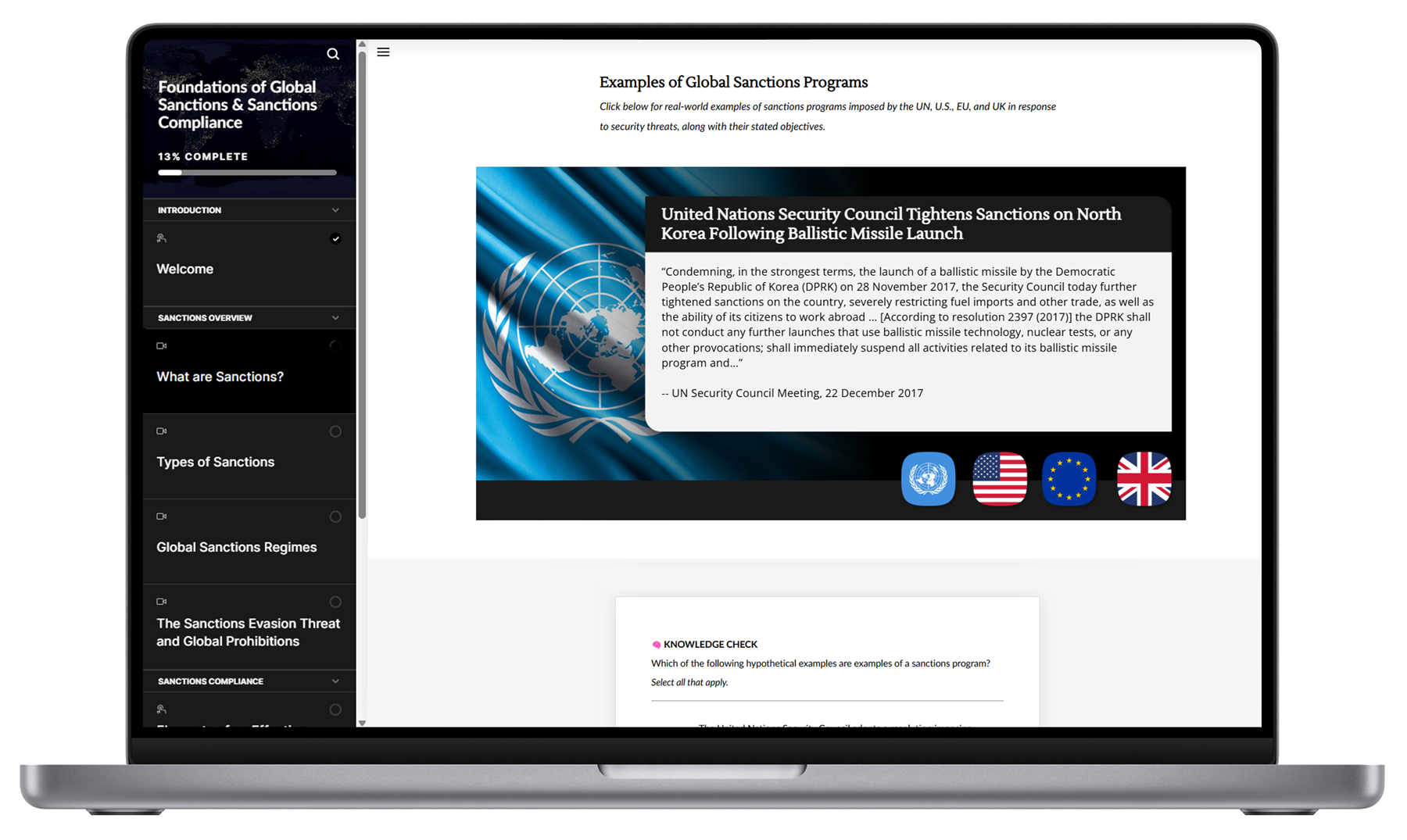
Need to update your staff on the latest in global sanctions? Our Foundations of Global Sanctions course offers a comprehensive look at navigating the complexities of current global sanctions regimes. Other foundational courses offered cover U.S. Sanctions, EU Sanctions, and UK Sanctions.
 https://finintegrity.org/wp-content/uploads/2025/12/bg-enforcement.jpg
993
1500
IFI
https://live-black-pebble.pantheonsite.io/wp-content/uploads/2023/12/GIFI-Placeholder2.png
IFI2025-12-09 07:00:472025-12-15 09:33:55AML/CFT and Sanctions Enforcement Actions in 2025
https://finintegrity.org/wp-content/uploads/2025/12/bg-enforcement.jpg
993
1500
IFI
https://live-black-pebble.pantheonsite.io/wp-content/uploads/2023/12/GIFI-Placeholder2.png
IFI2025-12-09 07:00:472025-12-15 09:33:55AML/CFT and Sanctions Enforcement Actions in 2025 https://finintegrity.org/wp-content/uploads/2025/04/article-intensifying-focus.png
217
379
IFI
https://live-black-pebble.pantheonsite.io/wp-content/uploads/2023/12/GIFI-Placeholder2.png
IFI2025-12-02 07:00:102025-12-04 14:52:07November 2025 Sanctions and Export Controls Update
https://finintegrity.org/wp-content/uploads/2025/04/article-intensifying-focus.png
217
379
IFI
https://live-black-pebble.pantheonsite.io/wp-content/uploads/2023/12/GIFI-Placeholder2.png
IFI2025-12-02 07:00:102025-12-04 14:52:07November 2025 Sanctions and Export Controls Update https://finintegrity.org/wp-content/uploads/2025/10/ofc-bg.jpg
1000
2000
IFI
https://live-black-pebble.pantheonsite.io/wp-content/uploads/2023/12/GIFI-Placeholder2.png
IFI2025-11-12 07:00:472025-11-11 20:46:41OFAC’s 50 Percent Rule
https://finintegrity.org/wp-content/uploads/2025/04/article-intensifying-focus.png
217
379
IFI
https://live-black-pebble.pantheonsite.io/wp-content/uploads/2023/12/GIFI-Placeholder2.png
IFI2025-11-05 07:00:122025-11-06 13:22:10October 2025 Sanctions and Export Controls Update
https://finintegrity.org/wp-content/uploads/2025/10/ofc-bg.jpg
1000
2000
IFI
https://live-black-pebble.pantheonsite.io/wp-content/uploads/2023/12/GIFI-Placeholder2.png
IFI2025-11-12 07:00:472025-11-11 20:46:41OFAC’s 50 Percent Rule
https://finintegrity.org/wp-content/uploads/2025/04/article-intensifying-focus.png
217
379
IFI
https://live-black-pebble.pantheonsite.io/wp-content/uploads/2023/12/GIFI-Placeholder2.png
IFI2025-11-05 07:00:122025-11-06 13:22:10October 2025 Sanctions and Export Controls Update https://finintegrity.org/wp-content/uploads/2025/10/aba-bg-sanctions.jpg
936
1800
IFI
https://live-black-pebble.pantheonsite.io/wp-content/uploads/2023/12/GIFI-Placeholder2.png
IFI2025-10-22 07:00:502025-10-21 14:26:29Navigating the Convergence of Sanctions Evasion, Export Control Evasion, and Money Laundering
https://finintegrity.org/wp-content/uploads/2025/04/article-intensifying-focus.png
217
379
IFI
https://live-black-pebble.pantheonsite.io/wp-content/uploads/2023/12/GIFI-Placeholder2.png
IFI2025-10-01 07:00:082025-10-01 08:45:49September 2025 Sanctions and Export Controls Update
https://finintegrity.org/wp-content/uploads/2025/04/article-intensifying-focus.png
217
379
IFI
https://live-black-pebble.pantheonsite.io/wp-content/uploads/2023/12/GIFI-Placeholder2.png
IFI2025-09-03 07:00:262025-09-25 15:34:36August 2025 Sanctions and Export Controls Update
https://finintegrity.org/wp-content/uploads/2025/10/aba-bg-sanctions.jpg
936
1800
IFI
https://live-black-pebble.pantheonsite.io/wp-content/uploads/2023/12/GIFI-Placeholder2.png
IFI2025-10-22 07:00:502025-10-21 14:26:29Navigating the Convergence of Sanctions Evasion, Export Control Evasion, and Money Laundering
https://finintegrity.org/wp-content/uploads/2025/04/article-intensifying-focus.png
217
379
IFI
https://live-black-pebble.pantheonsite.io/wp-content/uploads/2023/12/GIFI-Placeholder2.png
IFI2025-10-01 07:00:082025-10-01 08:45:49September 2025 Sanctions and Export Controls Update
https://finintegrity.org/wp-content/uploads/2025/04/article-intensifying-focus.png
217
379
IFI
https://live-black-pebble.pantheonsite.io/wp-content/uploads/2023/12/GIFI-Placeholder2.png
IFI2025-09-03 07:00:262025-09-25 15:34:36August 2025 Sanctions and Export Controls Update https://finintegrity.org/wp-content/uploads/2025/04/exportcontrols.jpg
937
2000
Lauren Jack
https://live-black-pebble.pantheonsite.io/wp-content/uploads/2023/12/GIFI-Placeholder2.png
Lauren Jack2025-08-04 08:50:552025-09-25 15:32:21July 2025 Sanctions and Export Controls Update
https://finintegrity.org/wp-content/uploads/2025/04/exportcontrols.jpg
937
2000
Lauren Jack
https://live-black-pebble.pantheonsite.io/wp-content/uploads/2023/12/GIFI-Placeholder2.png
Lauren Jack2025-08-04 08:50:552025-09-25 15:32:21July 2025 Sanctions and Export Controls Update https://finintegrity.org/wp-content/uploads/2025/07/shutterstock_2360980105-scaled.jpg
1440
2560
IFI
https://live-black-pebble.pantheonsite.io/wp-content/uploads/2023/12/GIFI-Placeholder2.png
IFI2025-07-23 07:00:362025-09-25 15:33:22Out of the Shadows
https://finintegrity.org/wp-content/uploads/2025/07/shutterstock_2360980105-scaled.jpg
1440
2560
IFI
https://live-black-pebble.pantheonsite.io/wp-content/uploads/2023/12/GIFI-Placeholder2.png
IFI2025-07-23 07:00:362025-09-25 15:33:22Out of the Shadows