Sanctions and Export Controls Update
Monthly Roundup – November 2025
📅 December 2, 2025

Welcome to this month’s Sanctions and Export Controls Update, highlighting IFI’s take on key developments from November 2025.
The West’s intensified pressure on Moscow beginning in late October, most prominently from the sanctioning of Russia’s two largest oil companies, appear to be having their intended effect. Meanwhile, the U.S. worked with Mexico against a major Sinaloa Cartel-linked money laundering network, with China to tighten controls on fentanyl precursor chemicals, and with Australia and the United Kingdom to target cybercriminals.

A U.S. Treasury Department analysis indicates that new sanctions on Russian oil producers have sent prices there tumbling, choking off a key revenue source that Russia has used to fund its war in Ukraine, according to CBS News. Since the announcement, nearly a dozen major Indian and Chinese purchasers of Russian oil have reportedly stated intentions to pause their purchases of Russian oil deliveries for December. Several grades of Russian oil are trading at multi-year lows, and one key benchmark for Russian oil prices—Urals crude—has fallen by at least 21% since a set of new sanctions were announced last month.
Meanwhile, the UK, EU, and Canada rolled out new designations targeting individuals and entitles involved in supporting Russia’s war effort in Ukraine, sanctions evasion, and human rights violations, and UK released an alert on how Russian shadow fleets enable circumvention. On the enforcement front, a Dutch court initiated the first ever prosecution of a major European defense firm for Russia sanctions evasion, British prosecutors filed the first charges over luxury goods exports to Russia, and the U.S. imposed a statutory-maximum fine on a real estate investor for willfully violating Russia sanctions.
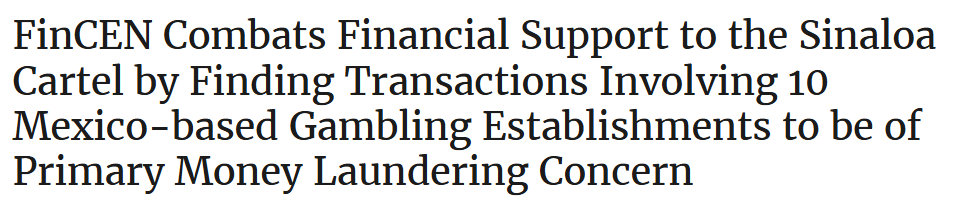
OFAC and FinCEN, working with the Mexican government, took action against the Hysa Organized Crime Group (HOCG) and a network of Mexico-based gambling establishments used for cartel-linked money laundering. OFAC designated 27 individuals and entities linked to the HOCG, a family-run organization operating with the Sinaloa cartel’s approval. Pursuant to section 311 of the USA PATRIOT Act, FinCEN simultaneously proposed cutting off 10 HOCG-operated casinos in Mexico from the U.S. financial system due to their longstanding role in laundering drug proceeds for the Sinaloa cartel, the U.S. Treasury Department said.
China has begun requiring export licenses for 13 precursor chemicals shipped to the United States, Mexico, and Canada. The decision follows recent diplomatic friction over the flow of fentanyl and reports of a visit to Beijing by FBI Director Kash Patel. China also announced a one-year suspension of countermeasures against five U.S.-linked companies after Washington took similar steps.
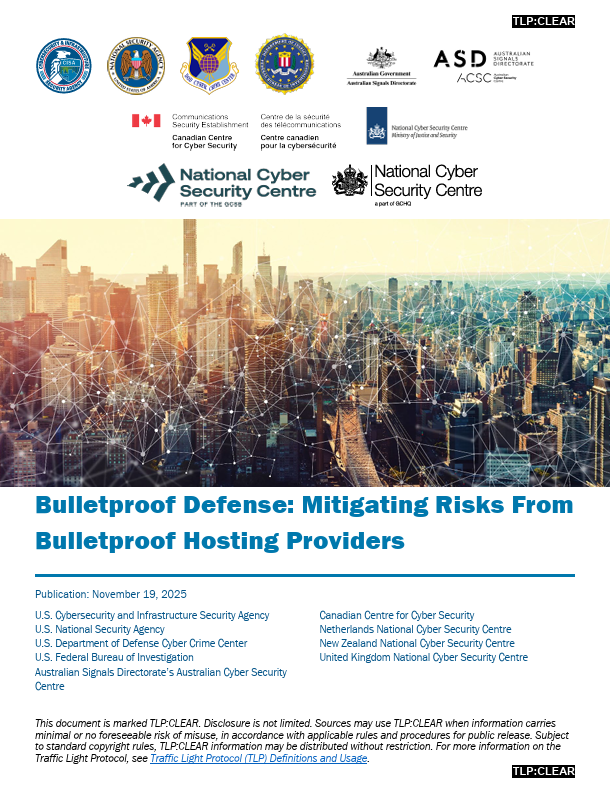
The United States, Australia, and the United Kingdom jointly imposed sanctions on Media Land, a Russia-based bulletproof hosting (BPH) service provider, for supporting ransomware groups and other cybercriminal activity. The coordinated sanctions included Media Land’s leaders, affiliated companies, and infrastructure used in ransomware and distributed denial-of-service (DDoS) attacks. The U.S. and the UK also designated Hypercore Ltd., a front for the Aeza Group, a BPH service provider previously sanctioned, along with individuals and entities accused of helping the group evade sanctions.
OFAC designated the Democratic Karen Benevolent Army (DKBA) and several associated persons for developing and supporting cyber scam centers in Burma that target Americans using fraudulent investment schemes. This follows last month’s sweeping actions against hundreds of targets associated with the Prince Group, a Cambodia-based transnational criminal organization responsible for industrial scale cyberfraud operations globally.
Other highlights from November included U.S. designations of networks supporting Iranian petroleum sales and missile programs, the UN’s removal of Syria’s president and interior minister from the ISIL/al-Qaida sanctions list, and China suspending its export ban to the United States on several dual-use metals vital for technology and defense industries.
The U.S. Department of State sanctioned 17 targets, including individuals, shipping firms, and vessels facilitating the transport and trade of Iranian petroleum. Concurrently, the U.S. Department of the Treasury imposed parallel sanctions targeting a network of front companies, six shadow-fleet vessels, and Iran-linked firms.
Global Networks Supporting Iran’s Missile, UAV Programs Added to U.S. Treasury’s Sanctions List
OFAC sanctioned 32 individuals and entities in Iran, the UAE, Turkey, China, Hong Kong, India, Germany, and Ukraine that aid Iran’s ballistic missile and unmanned aerial vehicle (UAV) production. The targets include the “MVM partnership,” which helped procure missile propellant ingredients for Parchin Chemical Industries through firms including UAE-based Marco Klinge and Iran- and Turkey-based Majid Dolatkhah and Vahid Qayumi.
OFSI Updates Iran Sanctions Guidance
The UK’s Office of Financial Sanctions Implementation (OFSI) updated its Iran nuclear sanctions guidance to reflect changes following the snap-back of UN sanctions.
OFAC imposed sanctions on eight Democratic People’s Republic of Korea (DPRK) individuals and two institutions for laundering funds linked to cybercrime and illicit information technology work that finance North Korea’s weapons programs. Those targeted include DPRK bankers managing millions in cryptocurrency through sanctioned banks and entities facilitating ransomware and IT schemes abroad. Several overseas representatives operating in China and Russia were also blacklisted for helping evade sanctions and channel funds to the regime’s missile and nuclear programs.
U.S. Sanctions Four Militant Groups Designated as Global Terrorists
The U.S. Department of State designated Antifa Ost, Informal Anarchist Federation/International Revolutionary Front (FAI/FRI), Armed Proletarian Justice, and Revolutionary Class Self-Defense as Specially Designated Global Terrorists (SDGTs) and Foreign Terrorist Organizations. Antifa Ost, operating in Germany and linked to the 2023 Budapest attacks, was previously designated a terrorist group by Hungary. The Italy-based FAI/FRI network has claimed responsibility for bomb and letter-bomb attacks since 2003. In Greece, Armed Proletarian Justice and Revolutionary Class Self-Defense carried out improvised explosive device attacks against government and infrastructure targets.
U.S. Sanctions Hizballah Operatives Exploiting Lebanon’s Cash Economy to Channel Iranian Funds
OFAC sanctioned several Hizballah operatives and associates for exploiting Lebanon’s cash-based financial system to move tens of millions of dollars from Iran to the group in 2025. The sanctions target key figures responsible for managing the Hizballah’s financial network and coordinating oil, metals, and chemical trades from Iran.
U.S. Designates Cartel de los Soles as Foreign Terrorist Organization
The U.S. Department of State designated Cartel de los Soles (Cartel of the Suns) as a foreign terrorist organization under Section 219 of the Immigration and Nationality Act. Based in Venezuela, the group is reportedly headed by Nicolas Maduro and other high-ranking regime officials.
U.S. to Consider Designating Certain Muslim Brotherhood Chapters as Terrorist Organizations
President Trump issued an executive order directing the U.S. Departments of State and the Treasury to consider designating chapters of the Muslim Brotherhood—including those in Lebanon, Jordan, and Egypt—as Foreign Terrorist Organizations and Specially Designated Global Terrorists. The activities cited in the order include rocket attacks by the Lebanese chapter’s military wing, jointly with Hamas and Hezbollah, calls by an Egyptian chapter leader for violence against U.S. partners, and Jordanian leaders’ longstanding support for Hamas. The State and Treasury secretaries must submit a joint report to the President within 30 days regarding the potential designations, and the entities must be designated, if applicable, within 45 days after submitting the report.
UN and U.S. Lift Sanctions on Syrian Leaders
The UN Security Council has voted 14–0, with one abstention from China, to adopt Resolution 2799 (2025), removing Syria’s transitional President Ahmed al-Sharaa and Interior Minister Anas Hasan Khattab from the ISIL/al-Qaida sanctions list. The vote reflects international recognition of political transition in Syria following the December 2024 uprising in the country and the renewed Syrian commitments to counterterrorism and stability. OFAC also removed Syrian President Ahmad al-Sharaa and other Syrian officials, including Interior Minister Anas Hasan Khattab, from its SDN List, and the Treasury, State, and Commerce Departments jointly published an advisory regarding sanctions and export controls relief for Syria that outlines what business with Syria is permissible and what restrictions remain.
UN Extends Yemen Sanctions, Citing Need to Curb Houthi Destabilization
The United Nations Security Council voted 13-0, with China and Russia abstaining, to renew for one year the asset freeze and travel bans imposed on designated individuals and entities in Yemen. It also extended the UN Panel of Experts’ mandate for 13 months. The sanctions’ renewal aims to restrain the destabilization efforts of the country’s Houthi movement, address increasingly complex smuggling networks, and improve monitoring of dual-use components and chemicals fueling the Houthi weapons program.
EU Sanctions RSF Deputy Chief Over Sudan Atrocities
The European Union (EU) condemned Sudan’s Rapid Support Forces (RSF) for committing severe atrocities, including attacks on civilians, ethnic killings, sexual violence, starvation tactics, and aid obstruction. Citing grave breaches of international law, the EU Foreign Affairs Council imposed restrictive measures against Abdelrahim Hamdan Dagalo, the RSF’s second-in-command, for his responsibility in the violence. The EU indicated readiness to impose further sanctions on any actors destabilizing Sudan or obstructing its political transition.
U.S. OKs Advanced Semiconductor Exports to UAE, Saudi Arabia
The U.S. Department of Commerce authorized advanced semiconductor exports to G42 in the UAE and Humain in Saudi Arabia, allowing purchases of up to 35,000 NVIDIA Blackwell chips. The approvals aim to bolster American artificial intelligence leadership and support global technological competitiveness and align with recent U.S. partnership agreements with both countries.
UK Updates Export Controls on Dual-Use Items
The UK Department for Business & Trade’s Export Control Joint Unit (ECJU) amended the government’s Export Control Order 2008, the Dual-Use Regulation, and the Torture Regulation, to align the UK’s export control framework with international commitments. The changes update control lists for dual-use items and goods usable for capital punishment or torture, replacing national controls on sensitive emerging technologies with new “500 series” entries.
DOJ Indicts Four in Scheme to Ship Restricted NVIDIA GPUs Overseas
Two U.S. citizens and two Chinese nationals were indicted for allegedly conspiring to illegally export advanced NVIDIA artificial intelligence graphics processing units (GPUs) to China. According to the U.S. Department of Justice Office of Public Affairs, the individuals routed the chips through Malaysia and Thailand, using a Florida-based shell company to disguise purchases. The group allegedly falsified documents, created fake contracts, and misled authorities to evade U.S. export controls.
Proposed Legislation to Boost Export Licensing Transparency
Senators Rick Scott (R, FL) and Elizabeth Warren (D, MA) introduced the License Monopoly Prevention Act, a bipartisan proposal aimed at increasing transparency and fairness in the U.S. export licensing process. The bill would require BIS to conduct competitive market analyses before approving licenses to export, reexport, or transfer sensitive technologies to entities on the U.S. Department of Commerce’s Entity List.
Taiwan to Expand Export Controls on High-Tech Items
Taiwan’s Ministry of Economic Affairs (MOEA) has proposed adding 18 high-tech items, including advanced semiconductor equipment, high-end 3D printers, electron microscopes, and quantum computers, to its strategic export control list. The proposal initiates a 60-day public notice period for the updates on both the Dual-Use Items list and the Common Military List.
China Suspends U.S. Export Ban on Key Tech Metals After Xi-Trump Talks
China suspended its export ban to the United States on several dual-use metals vital for technology and defense industries, the Chinese Commerce Ministry announced. The restrictions on gallium, germanium, and antimony, which are essential for semiconductors and electronics, were imposed in December 2024 but are now lifted until November 27, 2026. The move follows an Oct. 30 meeting between Chinese President Xi Jinping and U.S. President Donald Trump in South Korea, where both agreed to ease trade tensions.
 https://finintegrity.org/wp-content/uploads/2026/03/feb2026-bg.jpg
879
1500
IFI
https://live-black-pebble.pantheonsite.io/wp-content/uploads/2023/12/GIFI-Placeholder2.png
IFI2026-03-03 07:00:312026-03-07 23:21:57February 2026 Monthly Sanctions and Export Controls Report
https://finintegrity.org/wp-content/uploads/2026/03/feb2026-bg.jpg
879
1500
IFI
https://live-black-pebble.pantheonsite.io/wp-content/uploads/2023/12/GIFI-Placeholder2.png
IFI2026-03-03 07:00:312026-03-07 23:21:57February 2026 Monthly Sanctions and Export Controls Report https://finintegrity.org/wp-content/uploads/2026/01/article-eftfs-bg.jpg
800
1200
IFI
https://live-black-pebble.pantheonsite.io/wp-content/uploads/2023/12/GIFI-Placeholder2.png
IFI2026-02-05 07:00:282026-02-03 16:27:02Electronic Fund Transfer Consumer Protection
https://finintegrity.org/wp-content/uploads/2026/01/article-eftfs-bg.jpg
800
1200
IFI
https://live-black-pebble.pantheonsite.io/wp-content/uploads/2023/12/GIFI-Placeholder2.png
IFI2026-02-05 07:00:282026-02-03 16:27:02Electronic Fund Transfer Consumer Protection https://finintegrity.org/wp-content/uploads/2026/02/bg-jan2026.jpg
690
1200
IFI
https://live-black-pebble.pantheonsite.io/wp-content/uploads/2023/12/GIFI-Placeholder2.png
IFI2026-02-03 07:00:332026-02-05 15:29:40January 2026 Monthly Sanctions and Export Controls Report
https://finintegrity.org/wp-content/uploads/2026/02/bg-jan2026.jpg
690
1200
IFI
https://live-black-pebble.pantheonsite.io/wp-content/uploads/2023/12/GIFI-Placeholder2.png
IFI2026-02-03 07:00:332026-02-05 15:29:40January 2026 Monthly Sanctions and Export Controls Report https://finintegrity.org/wp-content/uploads/2026/01/following-ilicit-funds-bg.jpg
808
1500
IFI
https://live-black-pebble.pantheonsite.io/wp-content/uploads/2023/12/GIFI-Placeholder2.png
IFI2026-01-28 07:00:532026-01-27 18:01:41Following the Illicit Funds
https://finintegrity.org/wp-content/uploads/2026/01/following-ilicit-funds-bg.jpg
808
1500
IFI
https://live-black-pebble.pantheonsite.io/wp-content/uploads/2023/12/GIFI-Placeholder2.png
IFI2026-01-28 07:00:532026-01-27 18:01:41Following the Illicit Funds https://finintegrity.org/wp-content/uploads/2025/12/blind-spots-in-the-system-bg.jpg
1066
1600
IFI
https://live-black-pebble.pantheonsite.io/wp-content/uploads/2023/12/GIFI-Placeholder2.png
IFI2026-01-21 07:00:252026-01-19 22:03:22Blind Spots in the System
https://finintegrity.org/wp-content/uploads/2025/12/blind-spots-in-the-system-bg.jpg
1066
1600
IFI
https://live-black-pebble.pantheonsite.io/wp-content/uploads/2023/12/GIFI-Placeholder2.png
IFI2026-01-21 07:00:252026-01-19 22:03:22Blind Spots in the System https://finintegrity.org/wp-content/uploads/2025/04/article-intensifying-focus.png
217
379
IFI
https://live-black-pebble.pantheonsite.io/wp-content/uploads/2023/12/GIFI-Placeholder2.png
IFI2026-01-06 07:00:382026-01-06 08:15:24December 2025 Monthly Sanctions and Export Controls Report
https://finintegrity.org/wp-content/uploads/2025/04/article-intensifying-focus.png
217
379
IFI
https://live-black-pebble.pantheonsite.io/wp-content/uploads/2023/12/GIFI-Placeholder2.png
IFI2026-01-06 07:00:382026-01-06 08:15:24December 2025 Monthly Sanctions and Export Controls Report https://finintegrity.org/wp-content/uploads/2025/10/bg-secondary-sanctions.jpg
1200
1800
IFI
https://live-black-pebble.pantheonsite.io/wp-content/uploads/2023/12/GIFI-Placeholder2.png
IFI2025-12-16 07:00:392025-12-16 07:20:47The Use of Secondary Sanctions
https://finintegrity.org/wp-content/uploads/2025/10/bg-secondary-sanctions.jpg
1200
1800
IFI
https://live-black-pebble.pantheonsite.io/wp-content/uploads/2023/12/GIFI-Placeholder2.png
IFI2025-12-16 07:00:392025-12-16 07:20:47The Use of Secondary Sanctions https://finintegrity.org/wp-content/uploads/2025/12/bg-enforcement.jpg
993
1500
IFI
https://live-black-pebble.pantheonsite.io/wp-content/uploads/2023/12/GIFI-Placeholder2.png
IFI2025-12-09 07:00:472025-12-15 09:33:55AML/CFT and Sanctions Enforcement Actions in 2025
https://finintegrity.org/wp-content/uploads/2025/12/bg-enforcement.jpg
993
1500
IFI
https://live-black-pebble.pantheonsite.io/wp-content/uploads/2023/12/GIFI-Placeholder2.png
IFI2025-12-09 07:00:472025-12-15 09:33:55AML/CFT and Sanctions Enforcement Actions in 2025 https://finintegrity.org/wp-content/uploads/2025/10/ofc-bg.jpg
1000
2000
IFI
https://live-black-pebble.pantheonsite.io/wp-content/uploads/2023/12/GIFI-Placeholder2.png
IFI2025-11-12 07:00:472025-11-11 20:46:41OFAC’s 50 Percent Rule
https://finintegrity.org/wp-content/uploads/2025/10/ofc-bg.jpg
1000
2000
IFI
https://live-black-pebble.pantheonsite.io/wp-content/uploads/2023/12/GIFI-Placeholder2.png
IFI2025-11-12 07:00:472025-11-11 20:46:41OFAC’s 50 Percent Rule
 Debt & Duty