Blind Spots in the System
Why Transaction Monitoring Failures Keep Costing Banks Billions
📅 January 21, 2026

When the U.S. Department of Justice announced TD Bank’s $3 billion settlement in October 2024, it wasn’t just another enforcement headline—it was a wake-up call. The case, which cited years of ignored red flags and weak monitoring controls, revealed that even the largest institutions are still struggling to detect suspicious activity. And TD Bank isn’t alone. Danske Bank’s $2 billion fine for facilitating billions in suspicious Estonian transactions, and Deutsche Bank’s repeated penalties for AML control failures, tell the same story: technology and resources mean little if systems aren’t tuned to identify real risk.
What’s striking is that most of these violations didn’t stem from a lack of monitoring tools, they came from how those tools were used. Inconsistent data feeds, alert backlogs, poorly calibrated rules, and weak escalation protocols created blind spots large enough for illicit flows to pass through unnoticed.
Transaction monitoring remains one of the most scrutinized elements of AML compliance, and recent enforcement actions show why. The European Banking Authority (EBA) in July 2025 warned that financial institutions continue to exhibit “weak AML/CFT controls and poor governance,” noting that many authorities have described transaction monitoring as inadequate. These deficiencies have been echoed in major European cases, where failures in detecting or escalating suspicious activity have cost institutions billions.
At Danske Bank, investigators found that between 2007 and 2015, its Estonian branch processed more than €200 billion in suspicious transactions—undetected due to poor data integration and ineffective risk segmentation. Deutsche Bank, too, has faced repeated penalties for AML control failures, including a $186 million fine by the U.S. Federal Reserve for insufficient progress in strengthening its monitoring systems.
The financial cost is steep, but reputational damage is harder to repair. Once cited for AML weaknesses, banks face ongoing remediation requirements, tighter regulatory supervision, and strained correspondent relationships. The lesson is clear: transaction monitoring systems must be dynamic, risk-based, and continuously refined. Static or poorly calibrated frameworks don’t just generate inefficiencies—they invite enforcement.
Transaction monitoring systems fail when they are treated as static rather than adaptive. Regulators and investigative findings show that the biggest weaknesses stem not from the absence of systems, but from how those systems are designed, maintained, and used.
The takeaway is simple: transaction monitoring is not a compliance checkbox, but a living system that requires investment, oversight, and accountability. When done right, it not only detects suspicious activity but strengthens institutional resilience and trust.
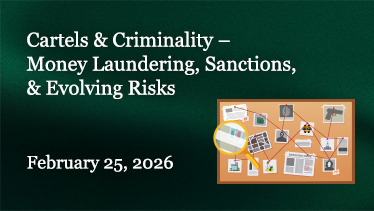
Cartels and their criminal financing continue to evolve, using professional networks to launder the proceeds from narcotics trafficking, human trafficking, environmental crime, fuel theft and oil smuggling, corruption at ports and “taxation” of local economies.
Join the Institute for Financial Integrity on February 25th for an assessment of key recent actions taken by the U.S. and Mexican Governments and the implications of heightened sanctions and money laundering risks for financial institutions and businesses.

Every enforcement case tells the same story in a different way: transaction monitoring is only as effective as the people and processes behind it. Strong systems require more than software—they demand teams who understand risk indicators, can interpret alerts intelligently, and know how to refine monitoring frameworks over time.
IFI’s Introduction to Transaction Monitoring course equips compliance professionals with the knowledge to do just that. The program breaks down the full monitoring lifecycle—from data inputs and scenario design to alert investigation and escalation. Participants learn how to identify high-risk activity, tune systems to reduce false positives, and align their programs with regulatory expectations.
Whether your team is updating existing controls or building new ones, this course provides the foundation to transform monitoring from a reactive function into a proactive shield against financial crime.
 https://finintegrity.org/wp-content/uploads/2026/10/bg-expanding-crime.jpg
1357
1800
IFI
https://live-black-pebble.pantheonsite.io/wp-content/uploads/2023/12/GIFI-Placeholder2.png
IFI2026-10-14 07:00:092026-10-05 16:11:03The Expanding Scope of Financial Crime Compliance Training
https://finintegrity.org/wp-content/uploads/2026/10/bg-expanding-crime.jpg
1357
1800
IFI
https://live-black-pebble.pantheonsite.io/wp-content/uploads/2023/12/GIFI-Placeholder2.png
IFI2026-10-14 07:00:092026-10-05 16:11:03The Expanding Scope of Financial Crime Compliance Training https://finintegrity.org/wp-content/uploads/2026/10/bg-september-2026-se-report.jpg
1199
1600
IFI
https://live-black-pebble.pantheonsite.io/wp-content/uploads/2023/12/GIFI-Placeholder2.png
IFI2026-10-06 07:00:462026-10-05 13:03:02September 2026 Monthly Sanctions and Export Controls Report
https://finintegrity.org/wp-content/uploads/2026/10/bg-september-2026-se-report.jpg
1199
1600
IFI
https://live-black-pebble.pantheonsite.io/wp-content/uploads/2023/12/GIFI-Placeholder2.png
IFI2026-10-06 07:00:462026-10-05 13:03:02September 2026 Monthly Sanctions and Export Controls Report https://finintegrity.org/wp-content/uploads/2026/09/bg-the-data-behind-the-payment.jpg
1140
1800
IFI
https://live-black-pebble.pantheonsite.io/wp-content/uploads/2023/12/GIFI-Placeholder2.png
IFI2026-09-30 07:00:312026-09-29 10:35:23The Data Behind the Payment
https://finintegrity.org/wp-content/uploads/2026/09/bg-the-data-behind-the-payment.jpg
1140
1800
IFI
https://live-black-pebble.pantheonsite.io/wp-content/uploads/2023/12/GIFI-Placeholder2.png
IFI2026-09-30 07:00:312026-09-29 10:35:23The Data Behind the Payment https://finintegrity.org/wp-content/uploads/2026/09/real-estate-risk.jpg
614
1000
IFI
https://live-black-pebble.pantheonsite.io/wp-content/uploads/2023/12/GIFI-Placeholder2.png
IFI2026-09-17 12:40:222026-09-17 20:35:41Real Estate, Real Risks
https://finintegrity.org/wp-content/uploads/2026/09/real-estate-risk.jpg
614
1000
IFI
https://live-black-pebble.pantheonsite.io/wp-content/uploads/2023/12/GIFI-Placeholder2.png
IFI2026-09-17 12:40:222026-09-17 20:35:41Real Estate, Real Risks https://finintegrity.org/wp-content/uploads/2026/09/august-2026-se-report-bg.jpg
888
1184
IFI
https://live-black-pebble.pantheonsite.io/wp-content/uploads/2023/12/GIFI-Placeholder2.png
IFI2026-09-02 07:00:562026-09-01 13:19:24August Monthly Sanctions and Export Controls Report
https://finintegrity.org/wp-content/uploads/2026/09/august-2026-se-report-bg.jpg
888
1184
IFI
https://live-black-pebble.pantheonsite.io/wp-content/uploads/2023/12/GIFI-Placeholder2.png
IFI2026-09-02 07:00:562026-09-01 13:19:24August Monthly Sanctions and Export Controls Report https://finintegrity.org/wp-content/uploads/2026/08/judgement-gap-in-market-abuse-compliance-bg.jpg
841
1500
IFI
https://live-black-pebble.pantheonsite.io/wp-content/uploads/2023/12/GIFI-Placeholder2.png
IFI2026-08-25 07:00:462026-08-24 11:34:59The Judgment Gap in Market Abuse Compliance
https://finintegrity.org/wp-content/uploads/2026/08/judgement-gap-in-market-abuse-compliance-bg.jpg
841
1500
IFI
https://live-black-pebble.pantheonsite.io/wp-content/uploads/2023/12/GIFI-Placeholder2.png
IFI2026-08-25 07:00:462026-08-24 11:34:59The Judgment Gap in Market Abuse Compliance https://finintegrity.org/wp-content/uploads/2026/08/oil-pipeline-bg.jpg
1000
1500
IFI
https://live-black-pebble.pantheonsite.io/wp-content/uploads/2023/12/GIFI-Placeholder2.png
IFI2026-08-19 07:00:062026-08-19 00:07:14The Illicit Oil Pipeline: How Criminal Networks Turn Crude into Clean Cash
https://finintegrity.org/wp-content/uploads/2026/08/oil-pipeline-bg.jpg
1000
1500
IFI
https://live-black-pebble.pantheonsite.io/wp-content/uploads/2023/12/GIFI-Placeholder2.png
IFI2026-08-19 07:00:062026-08-19 00:07:14The Illicit Oil Pipeline: How Criminal Networks Turn Crude into Clean Cash https://finintegrity.org/wp-content/uploads/2026/08/beyond-the-course-library-bg.jpg
1060
1800
IFI
https://live-black-pebble.pantheonsite.io/wp-content/uploads/2023/12/GIFI-Placeholder2.png
IFI2026-08-12 07:00:232026-08-11 12:42:07Beyond the Course Library
https://finintegrity.org/wp-content/uploads/2026/08/beyond-the-course-library-bg.jpg
1060
1800
IFI
https://live-black-pebble.pantheonsite.io/wp-content/uploads/2023/12/GIFI-Placeholder2.png
IFI2026-08-12 07:00:232026-08-11 12:42:07Beyond the Course Library https://finintegrity.org/wp-content/uploads/2026/08/july2026-se-bg.jpg
1177
1800
IFI
https://live-black-pebble.pantheonsite.io/wp-content/uploads/2023/12/GIFI-Placeholder2.png
IFI2026-08-04 07:00:452026-08-04 09:42:02July Monthly Sanctions and Export Controls Report
https://finintegrity.org/wp-content/uploads/2026/08/july2026-se-bg.jpg
1177
1800
IFI
https://live-black-pebble.pantheonsite.io/wp-content/uploads/2023/12/GIFI-Placeholder2.png
IFI2026-08-04 07:00:452026-08-04 09:42:02July Monthly Sanctions and Export Controls Report
 Following the Illicit Funds