Report

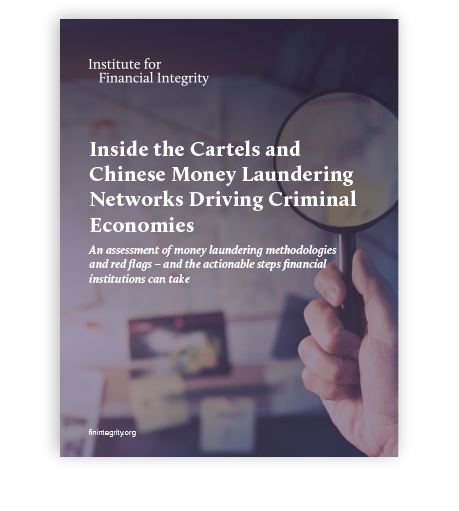
Inside the Cartels and Chinese Money Laundering Networks Driving Criminal Economies

Thank you for your interest in our report!

Cartels and their criminal financing continue to evolve, using professional networks to launder the proceeds from narcotics trafficking, human trafficking, environmental crime, fuel theft and oil smuggling, corruption at ports and “taxation” of local economies.

Download our latest report for an assessment of money laundering methodologies and red flags – and the actionable steps financial institutions can take.

Key Topic Covered

  • The Cartels
  • Cartel Revenue Sources
  • Money Laundering Methodologies
  • Focus Areas: Mirror Transfers, Crypto, Casinos, Daigou, Students as Money Mules
  • Use of Illicit Funds
  • Actions for Financial Institutions

Recommended Articles

October 2026 Monthly Sanctions and Export Controls Report
Explore this month’s Sanctions and Export Controls Update, highlighting IFI’s take on key developments from October 2026.

The $1.2 Billion AML Wake-Up Call

FinCEN’s $1.2 billion penalty against Bank of America highlights significant gaps in transaction monitoring, suspicious activity reporting, and customer due diligence. Explore key findings from the enforcement action and what they mean for strengthening compliance controls.

Across Borders, Beyond Sight

Cross-border payments power the global economy, but they also create opportunities for financial crime. Explore key areas of exposure and how leading institutions are gaining greater visibility into the payment chain.

The Expanding Scope of Financial Crime Compliance Training

There is a global shift toward integrating proliferation financing as a distinct threat alongside money laundering and terrorist financing. Discover what this means for enterprise-wide training at financial institutions.

September 2026 Monthly Sanctions and Export Controls Report

Explore this month’s Sanctions and Export Controls Update, highlighting IFI’s take on key developments from September 2026.

The Data Behind the Payment

Two changes have raised the bar on what banks can expect to see in a payment. Explore how corporate banks can put ISO 20022 and FATF's revised Recommendation 16 to work in transaction monitoring.

Real Estate, Real Risks

The FATF has identified the global real estate sector as an area requiring heightened attention due to its vulnerabilities to money laundering, terrorism financing, sanctions evasion and other illicit activity. This article explores why property transactions attract financial crime.

The Judgment Gap in Market Abuse Compliance

While banks may know the set of rules outlined in the EU’s Market Abuse Regulation, exposure sits in the judgment calls related to delayed disclosure, information barriers, and market soundings. Dive into where the risk lies in each area.

The Illicit Oil Pipeline: How Criminal Networks Turn Crude into Clean Cash

Money laundering in the oil sector is a highly lucrative global pipeline where illicit networks exploit the massive volume, complex supply chains, and liquid nature of the market. Explore the lifecycle of oil laundering schemes as well as key red flags.