
 https://finintegrity.org/wp-content/uploads/2024/10/cash-to-clicks-bg.jpg
798
1800
IFI
https://live-black-pebble.pantheonsite.io/wp-content/uploads/2023/12/GIFI-Placeholder2.png
IFI2024-10-02 07:00:422025-09-25 14:47:21From Cash to Clicks – AML Challenges & Typologies for Digital Payments
https://finintegrity.org/wp-content/uploads/2024/10/cash-to-clicks-bg.jpg
798
1800
IFI
https://live-black-pebble.pantheonsite.io/wp-content/uploads/2023/12/GIFI-Placeholder2.png
IFI2024-10-02 07:00:422025-09-25 14:47:21From Cash to Clicks – AML Challenges & Typologies for Digital PaymentsComprehensive Training Program
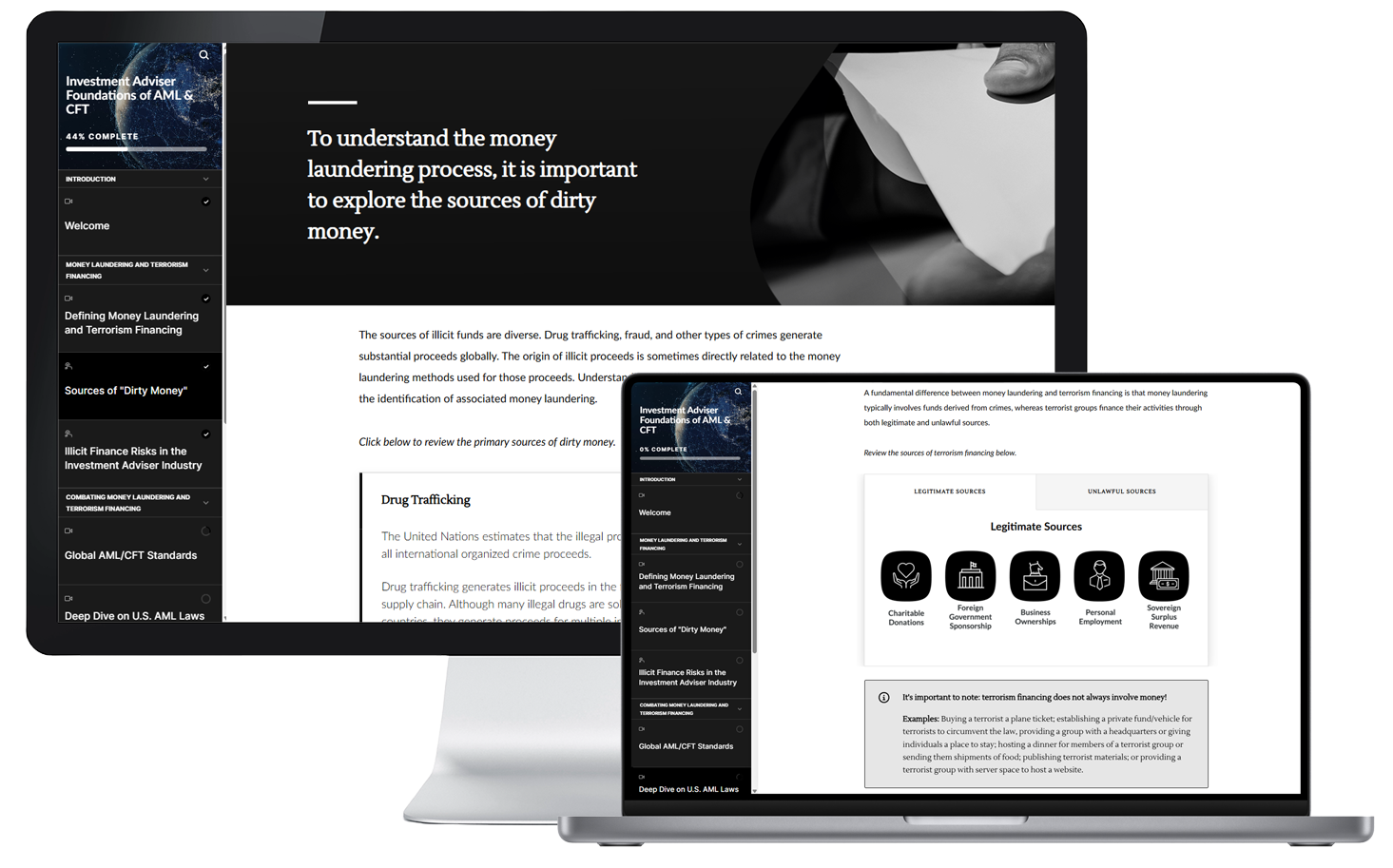
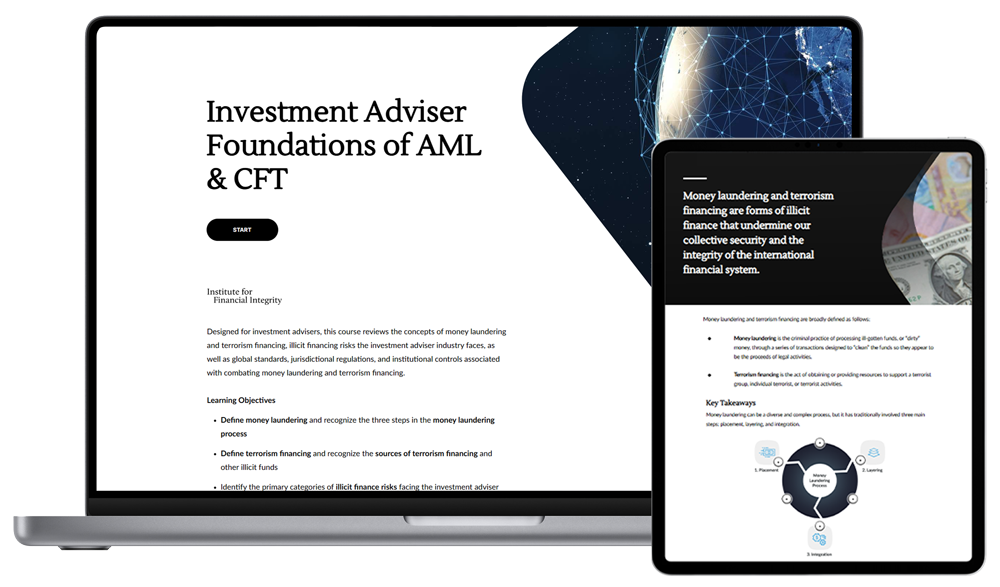
Designed for investment advisers, this course reviews the concepts of money laundering and terrorism financing, illicit financing risks the investment adviser industry faces, as well as global standards, jurisdictional regulations, and institutional controls associated with combating money laundering and terrorism financing.
Learning Objectives
- Define money laundering and recognize the three steps in the money laundering process
- Define terrorism financing and recognize the sources of terrorism financing and other illicit funds
- Identify the primary categories of illicit finance risks facing the investment adviser industry
- Review global regulatory standards for anti-money laundering and countering the financing of terrorism (AML/CFT)
- Deep-dive into the U.S. AML/CFT requirements for investment advisers
- Explore institutional controls and implementation of U.S. regulatory requirements
- Examine the consequences of non-compliance including key enforcement actions
Course Features
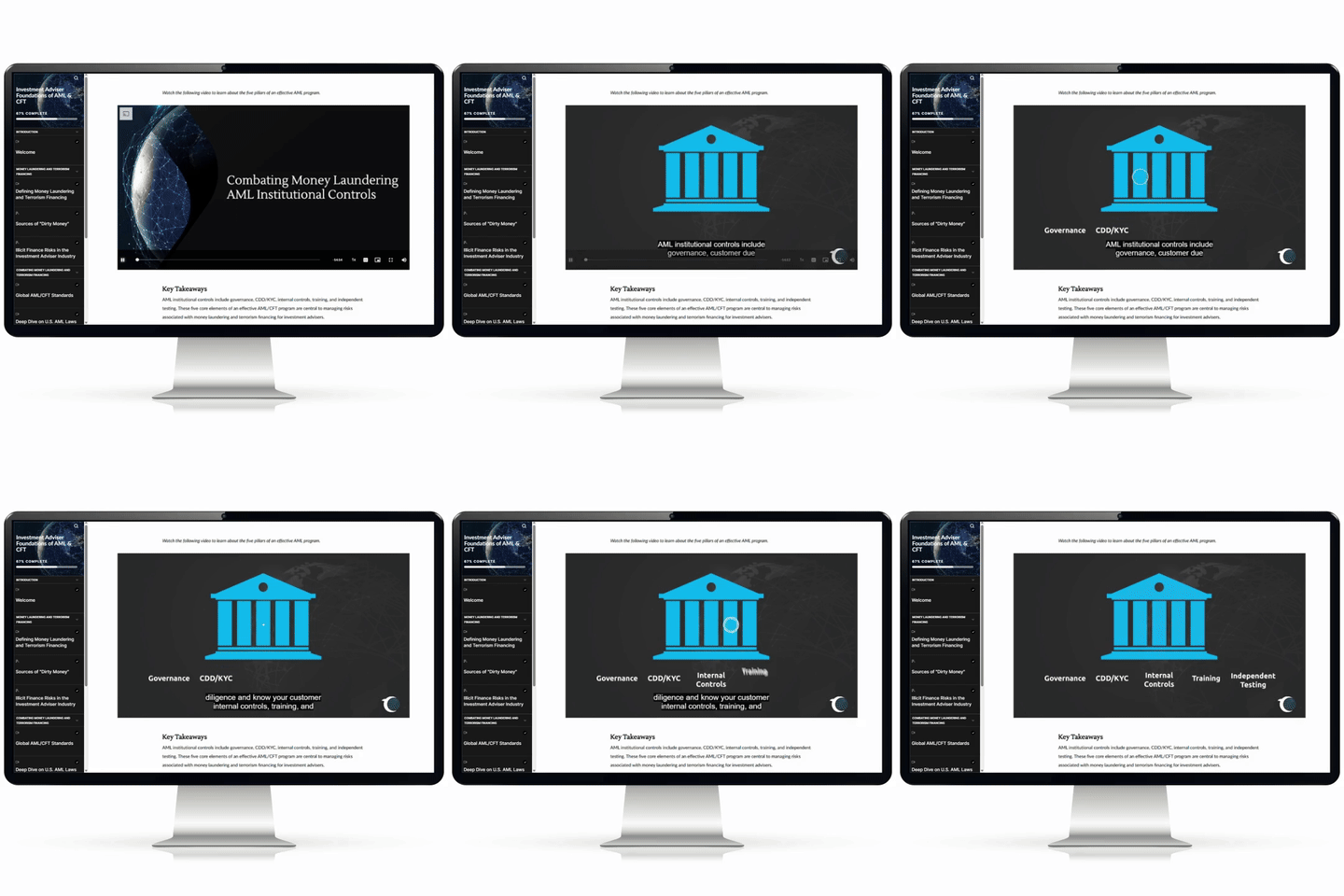
- Engaging Content: Every lesson within the course features interactivities, which employees are required to engage with in order to progress. Enhanced engagement means better retention.
- Video: Content is kept fresh including animated videos throughout to illustrate key concepts.
- Knowledge Checks: Each lesson includes with 1-3 knowledge check questions to confirm understanding of the content before proceeding. After submitting an answer, staff receive real-time feedback, which offers an opportunity to continue learning.
- Final Test: The course concludes with a final test consisting of 10 questions pulled randomly from a larger question bank. Passing the final test is a requirement for course completion.
Seamless Administration
Designed to ease the burden of administrators, this course is developed to industry SCORM standards and offers real-time reporting and seamless integration with industry learning management systems.
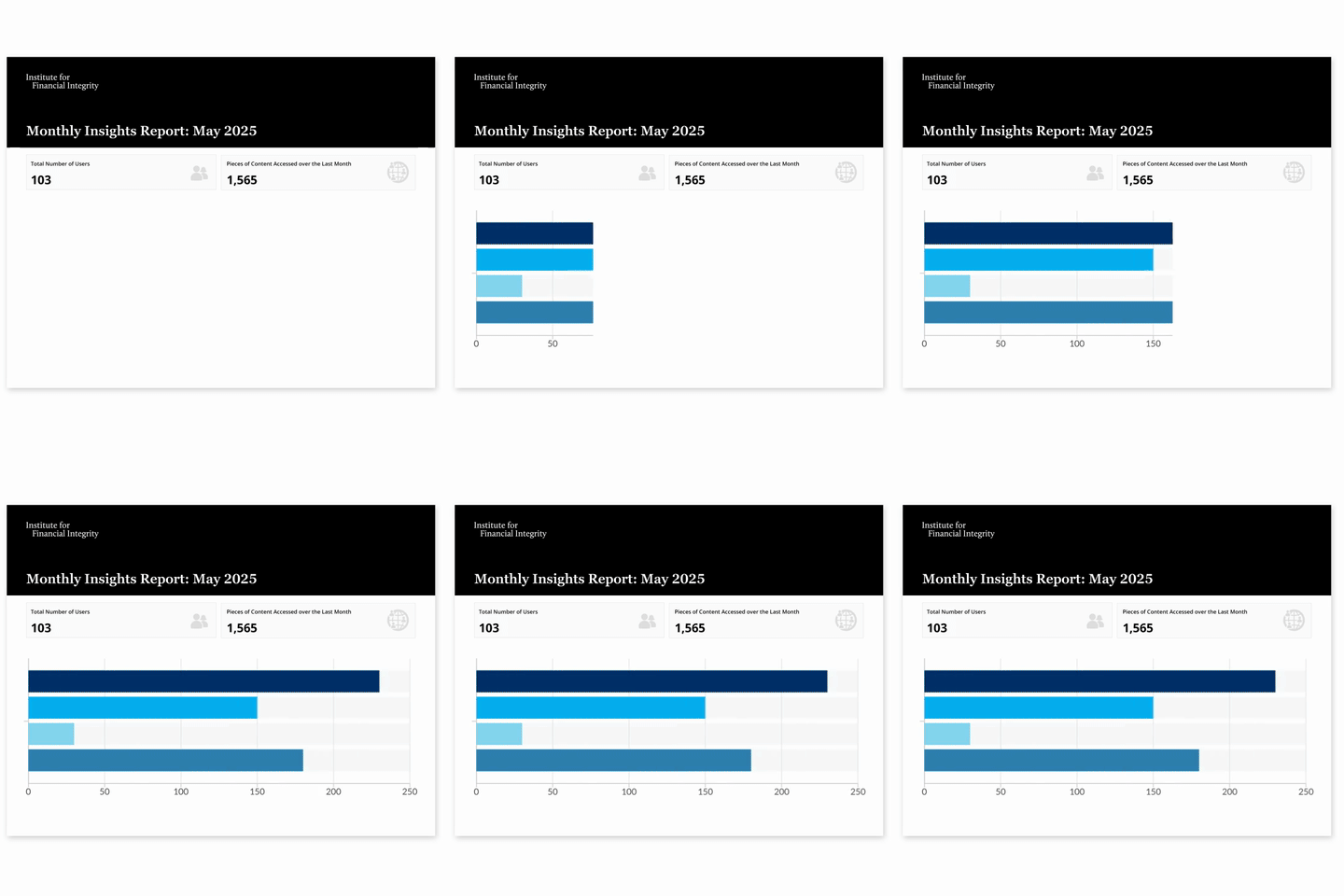
In addition to on-demand reporting, administrators receive monthly insight reports customized for your organization. This can include key usage data such as time spent, completion status, and scores, all of which can be analyzed by department, region, or other metrics.
Our courses provide efficient solutions for you to deliver training, track completion, and take action where required, all key elements of every compliance program.
Request a Demo and Learn More
Recommended Articles
https://finintegrity.org/wp-content/uploads/2024/10/cash-to-clicks-bg.jpg
798
1800
IFI
https://live-black-pebble.pantheonsite.io/wp-content/uploads/2023/12/GIFI-Placeholder2.png
IFI2024-10-02 07:00:422025-09-25 14:47:21From Cash to Clicks – AML Challenges & Typologies for Digital Payments https://finintegrity.org/wp-content/uploads/2024/09/bg-terrorism-change.png
1200
1800
IFI
https://live-black-pebble.pantheonsite.io/wp-content/uploads/2023/12/GIFI-Placeholder2.png
IFI2024-09-12 07:00:542025-09-25 14:45:09How has Terrorism Financing Changed Since 9/11?
https://finintegrity.org/wp-content/uploads/2024/09/bg-terrorism-change.png
1200
1800
IFI
https://live-black-pebble.pantheonsite.io/wp-content/uploads/2023/12/GIFI-Placeholder2.png
IFI2024-09-12 07:00:542025-09-25 14:45:09How has Terrorism Financing Changed Since 9/11? https://finintegrity.org/wp-content/uploads/2024/09/bg-banks.jpg
1200
1800
IFI
https://live-black-pebble.pantheonsite.io/wp-content/uploads/2023/12/GIFI-Placeholder2.png
IFI2024-09-11 07:00:572025-09-25 14:45:30A Review of the Financial System Post 9/11
https://finintegrity.org/wp-content/uploads/2024/09/bg-banks.jpg
1200
1800
IFI
https://live-black-pebble.pantheonsite.io/wp-content/uploads/2023/12/GIFI-Placeholder2.png
IFI2024-09-11 07:00:572025-09-25 14:45:30A Review of the Financial System Post 9/11 https://finintegrity.org/wp-content/uploads/2024/09/aml-smallbusiness-bg.jpg
1333
2000
IFI
https://live-black-pebble.pantheonsite.io/wp-content/uploads/2023/12/GIFI-Placeholder2.png
IFI2024-09-04 07:00:082025-09-25 14:44:22AML Compliance for Small Businesses
https://finintegrity.org/wp-content/uploads/2024/09/aml-smallbusiness-bg.jpg
1333
2000
IFI
https://live-black-pebble.pantheonsite.io/wp-content/uploads/2023/12/GIFI-Placeholder2.png
IFI2024-09-04 07:00:082025-09-25 14:44:22AML Compliance for Small Businesses https://finintegrity.org/wp-content/uploads/2024/08/china-ml-bg.jpg
1200
1800
IFI
https://live-black-pebble.pantheonsite.io/wp-content/uploads/2023/12/GIFI-Placeholder2.png
IFI2024-08-28 07:00:052026-05-14 15:00:21Collaboration Between Chinese Money Laundering Organizations & Drug Cartels
https://finintegrity.org/wp-content/uploads/2024/08/china-ml-bg.jpg
1200
1800
IFI
https://live-black-pebble.pantheonsite.io/wp-content/uploads/2023/12/GIFI-Placeholder2.png
IFI2024-08-28 07:00:052026-05-14 15:00:21Collaboration Between Chinese Money Laundering Organizations & Drug Cartels